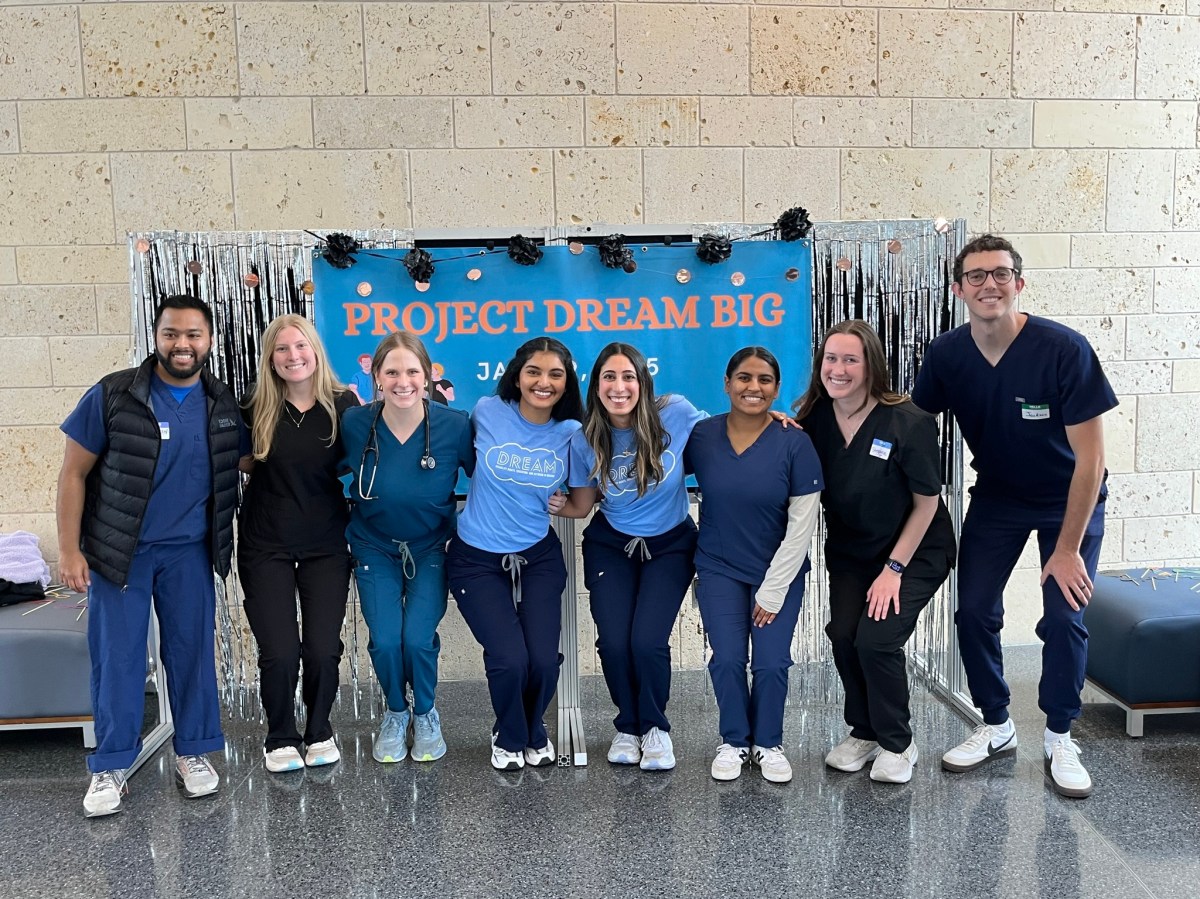
by Jackson Tobler, OMS-I
When I first met Alex in high school, I never anticipated that we’d become life-long friends. Alex has an intellectual and developmental disability (IDD), and we met through Best Buddies—an organization that promotes inclusion and friendship for individuals with disabilities. Alex and I developed a good friendship in high school, and we still maintain it today. We talk on the phone each week, and he participates in my family’s March Madness bracket pool each year. He lives in a different state now, but I was recently able to fly out to visit him and his family. His face lit up when I surprised him at his door, and we enjoyed spending a few days together. I am grateful for my long-lasting friendship with Alex and that I have gotten to know him beyond his intellectual disability. Meeting Alex in high school is what first sparked my desire to serve the IDD community—a desire that grew during college and has continued into medical school.
As an undergraduate student, I expanded my involvement with the IDD community by becoming president of my university’s Best Buddies chapter. I got to connect students to community members with IDD and plan fun events celebrating inclusion. Some of our biggest events were a talent show, a bowling night, and a Halloween party. I was moved when one of the parents told me how much our program meant to her adult son with Down syndrome. She shared that her son sometimes felt lonely or excluded, but our events provided him a welcoming environment where he felt he could belong. This experience showed me the power of inclusion.
When I began medical school at TCOM, I was excited to discover the DREAM student organization. DREAM, which stands for Disability Rights, Education, and Advocacy in Medicine, has allowed me to merge my interest in the IDD community with my career in medicine. DREAM’s mission is to advocate for individuals with disabilities and to prepare future health professionals to care for their unique needs. I attended the first meeting and was inspired by the story of DREAM’s faculty advisor, Brandie Wiley. Brandie is the mother of three adopted children with disabilities. She shared some of the challenges that her children have faced when receiving healthcare, such as barriers in accessibility and communication. She also detailed the qualities she saw in the physicians who were best able to interact with her daughter. Hearing Brandie’s experiences strengthened my desire to advocate for patients with disabilities.
I became a first-year representative on DREAM’s leadership team, which we aptly call “the DREAM team.” We began planning DREAM’s main event of the year, Project Dream Big. In collaboration with Special Olympics Texas and the Fort Worth ISD Boulevard Heights School and Transition Center, we arranged to host over 50 individuals with intellectual disabilities on campus. We planned to pair them with medical student volunteers for an afternoon of games, crafts, physical exams, and a multi-specialty provider panel. The goal of the event was to help medical students learn inclusive healthcare principles and to help the individuals with IDD become more comfortable around medical professionals.
After months of planning, the event successfully came together. As the Special Olympics athletes arrived, it was rewarding to watch them mingle with the medical students and bond at the cornhole and coloring stations. When the physical exam portion began, the medical students were instructed by physician faculty on how to properly obtain consent from individuals with IDD. It was a valuable experience to practice our bedside manner and physical exam knowledge on a different demographic, one that we get little exposure to in the normal curriculum. Connecting with the individuals in both a casual and a clinical setting that day was impactful for everyone. This exposure is helping us become compassionate future physicians and equipping us with the tools to provide quality care for our friends with IDD.
From high school to medical school, advocating for individuals with intellectual disabilities has been a meaningful part of my journey. Each experience—from developing a friendship with Alex, to leading my college’s Best Buddies chapter, and now being involved with DREAM—has reinforced the importance of inclusion, empathy, and advocacy for individuals with IDD. Each step has influenced the kind of physician that I aspire to be. As I continue my medical training and involvement with DREAM, I look forward to more opportunities to help create a healthcare environment that is compassionate, inclusive, and equitable for people with intellectual and developmental disabilities.
 Tarrant County Physician Online