And Then There Were Two

By Shanna Combs, MD

This piece was originally published in the September/October issue of the Tarrant County Physician. You can read find the full magazine here.

As is tradition, despite what may be going on in the world (global pandemic, public demonstrations, etc.) every year, sometime in late June or early July, the wheel of medical education continues to turn.  The TCU and UNTHSC School of Medicine continued this cycle on July 6, 2020. And just like that, our school went from one class to two, officially welcoming its second class of 60 medical students. The students in the Class of 2024 are from 18 states within the U.S., with 38 percent of them from Texas. Fifty-five percent are male and 45 percent are female. The new students come from 45 different undergraduate higher education institutions.

And just like that, there were two, and we continue our journey of developing a new medical school.

Similarly to our now second-year medical students, our first-year medical students are having to discover the brave new world of virtual medical education due to COVID-19.  Despite this distance, our new students show the same enthusiasm for diving in that is always present in a brand-new class.  This enthusiasm helps to invigorate those of us involved in medical education, and it helps us to continue to appreciate the honor it is to be a physician as well as an educator.  

I was fortunate to participate in an interprofessional education event with our new first years as well as senior nursing students from TCU, held virtually of course.  Our students were able to work through the concepts of communication in the clinical environment with the nursing students.  They were also able to gain insight from the nursing students who have already been working in the clinical environment.  It reminds me how important it is that our learners start working together while training.  We highlight the concept that medicine is a team sport, and we must work together to obtain optimal outcomes for our patients.

The medical education wheel continues to turn.  

By the time you read this, our second-year students will have completed the first of three phases of our curriculum, which is traditionally considered the basic science content.  After years of planning and a global pandemic occurring more than halfway through our first year, it is hard to believe that this milestone has already occurred.  Our students will now begin the transition to the clinical learning environment (barring any changes that may occur due to COVID-19). They will have the opportunity to step away from the computer screen and step back onto the campus for their Transition to the LIC course.  

They will first get acquainted with the new normal of wearing a mask while trying to interact and gain rapport with simulated patients.  They will also practice and hone clinical skills that were not able to be taught virtually.  They will learn new procedures and have opportunities to practice.  They will discover different medical environments, such as the operating room, labor and delivery, the inpatient setting, the emergency room, and outpatient clinic, and how they will play a role in those settings.  They will also learn about the appropriate donning and doffing of personal protection equipment as well as telehealth that is now more commonplace due to the COVID-19 pandemic. 

Once they complete their transitions course, the students will move into the hospital setting to continue their education.  We are grateful to our physician and hospital partners in the community who have worked with us to bring our students into their clinical practice and hospital settings.  To quote Sir William Osler, “To study the phenomena of disease without books is to sail an uncharted sea, while to study books without patients is not to go to sea at all.”1

And just like that, the medical education wheel continues to turn.

References
1. Boston Medical and Surgical Journal, January 17, 1901, page 60.

A Masking Primer for COVID-19: Public Health Notes

By Catherine Colquitt, MD, Tarrant County Public Health Medical Director

This piece was originally published in the September/October issue of the Tarrant County Physician. You can read find the full magazine here.

There is still much controversy regarding efficacy of masking during the COVID-19 pandemic, so I reviewed some of the thousands of peer-reviewed scientific articles addressing this topic since SARS exploded onto the world stage in 2003.  Epidemiologists, infection perfectionists, and most if not all practicing physicians field questions from patients, friends, health care workers, and first responders about masking, and, while a comprehensive literature survey is beyond my scope, I came away from my reading heartened by evidence which clearly supports masks as a source control measure (a means of preventing transmission of infection from a source to others) AND endorses the use of masks, especially respirator and surgical masks, to PROTECT the wearer as well.

Masks, along with social (or physical) distancing, and hygiene (hand and surface disinfection, and cough and sneeze control) are the mainstays of control of droplet-spread pathogens and are critically important when COVID-19 hospital resources are strained, when treatments are reserved only for the sickest of those hospitalized, and in the absence of a vaccine or treatment for outpatients with COVID-19.

The science of evaluating masks is very complicated and typically involves at least three parameters: filtration efficacy (percentage of particles prevented from escaping the wearer’s mask), the pressure gradient across the mask (affects filtration efficacy and the comfort of the wearer), and fit, or face seal, of the mask on the wearer (droplets can escape more easily around looser edges of the mask on the wearer’s face).

The National Institute of Occupational Safety and Health (NIOSH) is responsible for conducting research and making recommendations for the prevention of work-related injury and illness and is a resource for information regarding healthcare and occupational PPE in setting on COVID-19.  NIOSH also assesses important PPE to confirm efficacy and develops crisis strategies for coping with PPE shortages. NIOSH is responsible for the “N95” label on the mask you have likely been fit-tested to wear.  The “95” generally indicates filtration efficacy of 95 percent of particles in the challenge aerosol (usually 0.1 micron diameter latex sphere aerosol) from the nose and mouth of the wearer. The “N” indicates that the respirator is NOT resistant to oil, “R” is somewhat resistant to oil, and “P” is oil-proof.  (The oil resistance matters in some industrial settings in which the oils to which the respirator filters are exposed can remove the electrostatic charges from the filter media and thereby compromise filter efficacy.)

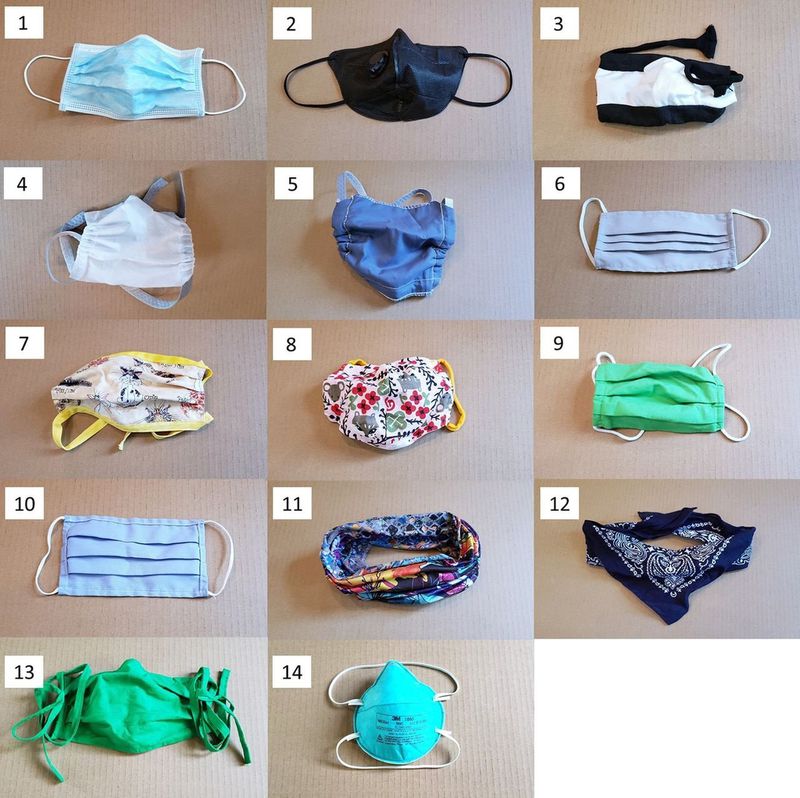
Fig. 1. Pictures of face masks under investigation.  
We tested 14 different face masks or alternatives and one mask (not shown).  
Photo Credit: Emma Fischer, Duke University.


In 2008, VanderSande et al. evaluated professional and homemade masks (made from tea cloth) for their efficacy in reducing respiratory infections in the general population and found that cloth masks provided a “modest degree” of protection to the wearer, while surgical masks were 25 times more effective and respirator masks were 50 times more effective at protecting the wearer than homemade cloth masks.1

S. Rengasamy et al., writing in Annals of Occupational Hygiene in 2010, analyzed filtration performance of cloth masks for particles 20-1000 nanometers in diameter and found instantaneous penetration level of 40 percent to 90 percent across the range of fabrics they tested.1

Fischer et al presented a low-cost technique for assessing filtration efficacy through various mask fabrics during speech and confirmed excellent filtration efficacy of respirator and surgical masks (figure 1), fair efficacy of some  multilayered cotton, polyester, and mixed fabric masks, poor filtration efficacy with some cotton weaves as well as knitted masks and bandanas, and, somewhat remarkably, very poor filtration efficacy for fleece face coverings (often used in gaiters or “neck tubes”).  (See figure 2) Fleece performed worse than no face covering at all, presumably by dispersing larger droplets into several smaller ones, thereby increasing the droplet count.


Davies et al., in Disaster Medicine and Public Health, tested the efficacy of homemade masks as protection in an influenza pandemic and offered that homemade masks should be used only “as a last resort” to prevent droplet transmission from infected individuals, but a homemade mask would be “better than no protection.”4

Scientists continue to study how and when and whom to mask since SARS and H1N1, and aerosol science will continue to evolve and to refine our use of PPE during and after the COVID-19 pandemic, but the overwhelming published scientific opinion supports the use of masks and, the better the mask, the better the protection for the wearer and those he or she faces.

Ready! Set! Mask!

References
1. VanderSande et al. 2008. PLOS ONE 3 (7) e2118.

2. S. Rengasamy et al. Annals of Occupational Hygiene, 2010. Vol 54, No 7, pp 789-798.

3. Fischer et al. Science Advances. SciAdv.10.1126/sciadv.abh3083, 2020.

4. Davies et al. Disaster Medicine and Public Health Preparedness. 2013 August: 7 (4) 413-418.

Free Drive-Thru Flu Shots at Dickies Arena

Kroger Health will offer drive-thru vaccinations noon to 6 p.m. Friday, Oct. 9 and 9 a.m.-3 p.m. Saturday, Oct. 10 in the Chevrolet parking lot at Dickies Arena, 3464 Trail Drive.

Kroger Health, the health care division of The Kroger Co., announced a partnership with the City of Fort Worth and Tarrant County as part of a comprehensive flu shot program designed to provide recommended vaccines amid the COVID-19 pandemic.

The Centers for Disease Control and Prevention estimates that during an average flu season, 8% of the U.S. population gets sick from the flu, with an average of 500,000 flu-related hospitalizations.

To make an appointment

  1. If you do not speak English well, call the Tarrant County Public Health Information Line at 817-248-6299.
    • Si no habla inglés, por favor llame al Tarrant County Public Health línea de información a 817 248-6299.
    • Nếu quý vị không rành Tiếng Anh, xin vui lòng gọi đường dây thông tin Tarrant County Public Health (Y Tế Cộng Đồng Quan Tarrant) theo số 817 248-6299.
  2. Walk-ups are welcome on Friday and Saturday.

Event details:

  1. Flu shots will be provided at no cost, with or without insurance. Children must be six months or older.
  2. Flu shots are available at no out-of-pocket cost to those with Medicare B and are also fully covered by many insurance plans. Bring identification and an insurance card.
  3. For the safety of patients and the health care team, vaccinations are limited to one arm per vehicle door. Wear short sleeves.

Learn more here.

Physicians Needed for DSHS’ HIV Drug Resistance Testing Project

The Texas Department of State Health Services (DSHS) is looking for physicians located in Dallas-Fort Worth, San Antonio, and the Rio Grande Valley who specialize in Infectious Disease, Internal Medicine, Family Medicine, and Obstetrics and Gynecology for a new project on HIV resistance testing in Texas. Project Conectate utilizes molecular HIV surveillance in collecting, reporting and analysis of HIV genetic sequences generated through HIV drug resistance testing to monitor clusters of HIV infections, improve access to testing and engagement in HIV medical care or Pre-Exposure prophylaxis (PrEP) services.

DSHS is looking to speak with physicians about tools and solutions that can support HIV drug resistance testing for their practice. If interested or for answers to any questions, please reach out to DSHS Public Health Director Uche Odunze at Uche.Odunze@dshs.texas.gov before October 31st to schedule a short phone call.

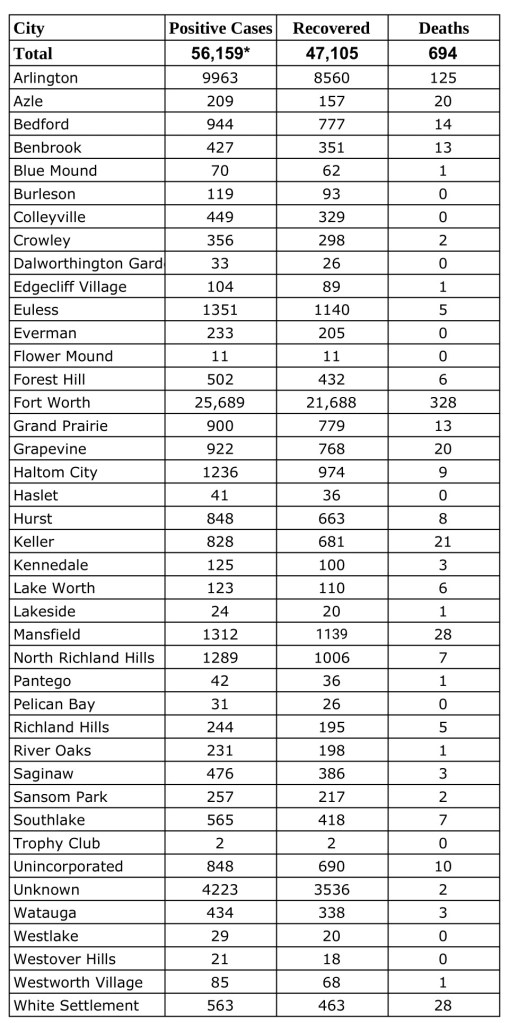
Tarrant County COVID-19 Activity – 10/8/20

COVID-19 Positive cases: 53,838*

COVID-19 related deaths: 685

Recovered COVID-19 cases: 45,715

Data from Tarrant County Public Heath’s (TCPH) report of COVID-19 activity in Tarrant County, updated Thursday, October 8, 2020. Find more COVID-19 information from TCPH here.

These data are provisional and are subject to change at any time.

Deaths and recovered cases are included in total COVID-19 positive cases.

Tarrant County COVID-19 Activity – 10/6/20


COVID-19 Positive cases: 52,720*

COVID-19 related deaths: 676

Recovered COVID-19 cases: 45,231

Data from Tarrant County Public Heath’s (TCPH) report of COVID-19 activity in Tarrant County, updated Tuesday, October 6, 2020. Find more COVID-19 information from TCPH here.

These data are provisional and are subject to change at any time.

Deaths and recovered cases are included in total COVID-19 positive cases.

Tarrant County COVID-19 Activity – 10/5/20

COVID-19 Positive cases: 52,366*

COVID-19 related deaths: 672

Recovered COVID-19 cases: 45,046

Data from Tarrant County Public Heath’s (TCPH) report of COVID-19 activity in Tarrant County, updated Monday, October 5, 2020. Find more COVID-19 information from TCPH here.

These data are provisional and are subject to change at any time.

Deaths and recovered cases are included in total COVID-19 positive cases.

More Emergency COVID-19 Funds Becoming Available

By David Doolittle

Originally published on the Texas Medical Association website.

The federal Health and Human Services (HHS) Department will begin accepting applications Monday for a new round of emergency funding for physicians and practices affected by the COVID-19 pandemic.

The new funds – $20 billion – are the third phase of distribution from the Provider Relief Fund, which is part of the Coronavirus Aid, Relief, and Economic Security (CARES) Act

Physicians and practices that already received, rejected, or accepted Provider Relief Fund payments will be eligible to apply for additional money, HHS said.

In addition, physicians who began practicing in between Jan. 1 and March 31, 2020, will be eligible, as well as an expanded group of behavioral health specialists, the agency said.

The window to apply for funds is Monday, Oct. 5, through Friday, Nov. 6. HHS encourages physicians to apply as quickly as possible to “expedite [its] review process and payment calculations.”

Click here to read the full article.

Tarrant County COVID-19 Activity – 10/1/20


COVID-19 Positive cases: 50,729*

COVID-19 related deaths: 666

Recovered COVID-19 cases: 44,149

Data from Tarrant County Public Heath’s (TCPH) report of COVID-19 activity in Tarrant County, updated Thursday, October 1, 2020. Find more COVID-19 information from TCPH here.

These data are provisional and are subject to change at any time.

Deaths and recovered cases are included in total COVID-19 positive cases.

Alliance Update – Immunize 2020

By Terri Andrews and Linda Kennedy

BeeWise-Immunize Test Site – Ridgmar Mall

It has long been our fear to have community spread of an illness that potentially overwhelms our healthcare system capacity and results in the illness and/or death of tens or even hundreds of thousands of people.  Many years ago, the TCMS Alliance and Foundation joined other concerned organizations, both public and private, to form the Immunization Collaboration of Tarrant County (ICTC) to help promote and provide immunizations in our community.  In this year of COVID-19, we know that our fears were well founded and what the world looks like with a virus and no vaccine.  Our community is opening from the quarantine that was needed to control the initial spread of COVID-19.  Schools are opening and thousands of children need required vaccines to move from virtual to in person classes. Many of our local children missed scheduled vaccines when the pandemic hit North Texas.

Every August, the ICTC has hosted immunization clinics which Tarrant County Public Health provides the vaccines for at five different community health fairs and back to school events over four weeks. This model in five locations over a shorter time is not possible in this time of COVID-19. Fortunately, ICTC was able to react to the new circumstances hosting the Be Wise—ImmunizeTM Low Cost Back to School Vaccine Event July 20 through September 11, 2020 at Ridgmar Mall in Fort Worth. The site provides plenty of social distancing space for families and students receiving the needed vaccines.  Immunizations are low cost for families who are uninsured or are covered by CHIP or Medicaid.  

In 2005, TCMS Alliance brought Be Wise—ImmunizeTM to Immunization Collaboration of Tarrant County. ICTC is a volunteer driven, nonprofit organization dedicated to the systematic eradication of vaccine preventable diseases in Tarrant County. ICTC projects directly improve the health and well-being of children, teens and adults through low cost vaccine events, community education on the importance of childhood and adult immunizations, and advocacy for better vaccine systems and policy since 1991. Over 40 agencies are members of ICTC.

TMA Foundation and TCMS Alliance support for ICTC programs is ongoing.  The Be Wise—Immunize logo, leadership, funding, and volunteers from across Tarrant County keep ICTC going strong. ICTC Vaccine events 2019 provided 9412 clients with 24,057 doses of vaccine. To learn more or to be an ICTC volunteer visit http://www.icthome.org or http://www.tcmsalliance.org.

Design a site like this with WordPress.com
Get started