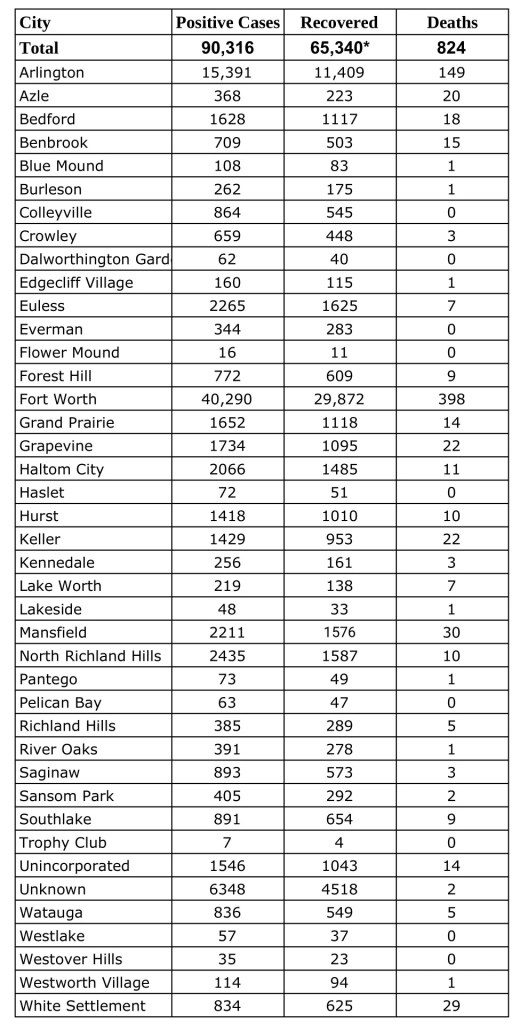
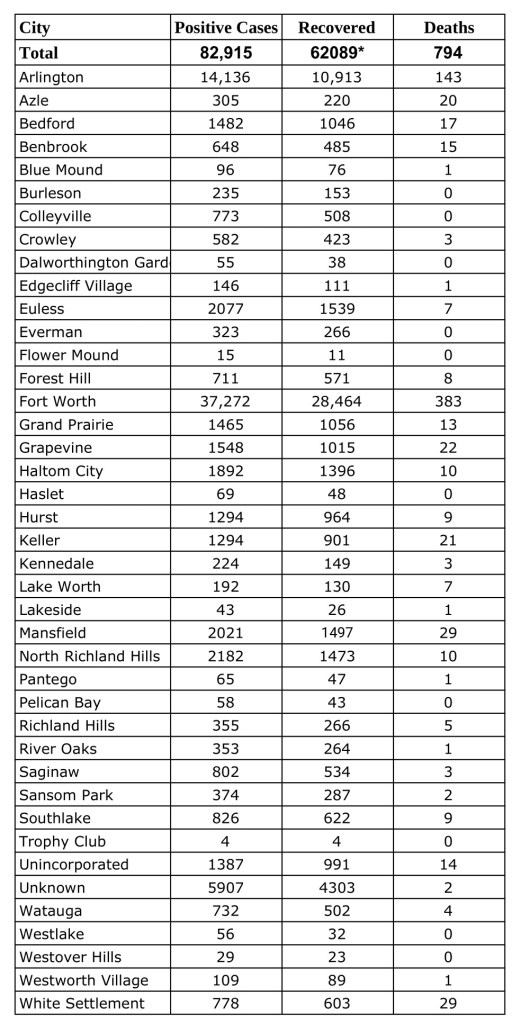
Data from Tarrant County Public Heath’s (TCPH) report of COVID-19 activity in Tarrant County, updated Wednesday, November 25, 2020.Find more COVID-19 information from TCPH here.
*These data are provisional and are subject to change at any time.
Deaths and recovered cases are included in total COVID-19 positive cases.
AMA President Susan R. Bailey, MD, will host the webinar, and she will be joined by guest Peter Marks, MD, PhD, Director of the Center for Biologics Evaluation and Research at the Food and Drug Administration (FDA). Dr. Marks will discuss the latest developments on the road to effective COVID-19 vaccines. Dr. Marks will do a deep dive into the Emergency Use Authorization (EUA) process, specifically explaining how the timeline has been shortened from a matter of years to a matter of months. Physicians will learn the similarities and differences between routine vaccine development and the EUA process and understand how accelerated approval is being arrived at safely.
Registration is limited to physicians, residents, medical students and Federation staff.
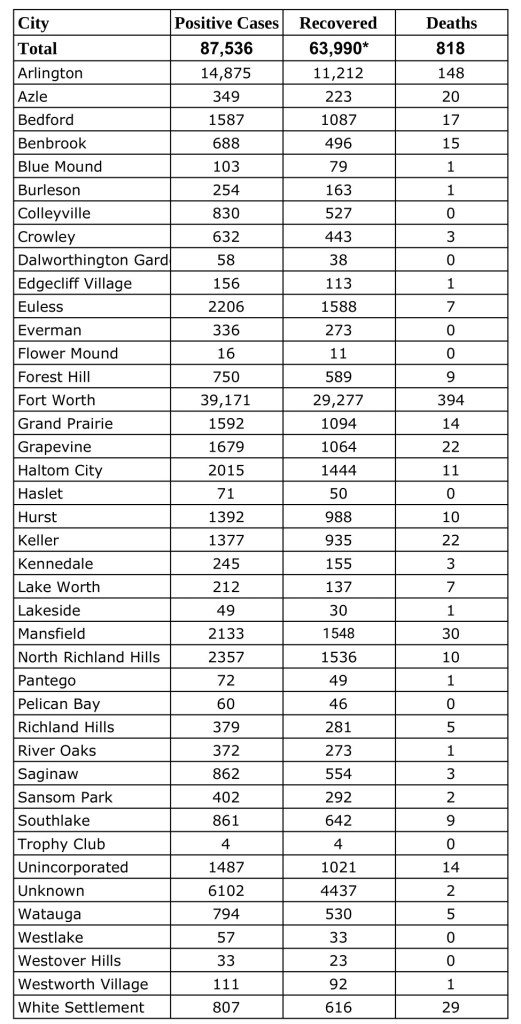
Data from Tarrant County Public Heath’s (TCPH) report of COVID-19 activity in Tarrant County, updated Tuesday, November 24, 2020.Find more COVID-19 information from TCPH here.
*These data are provisional and are subject to change at any time.
Deaths and recovered cases are included in total COVID-19 positive cases.
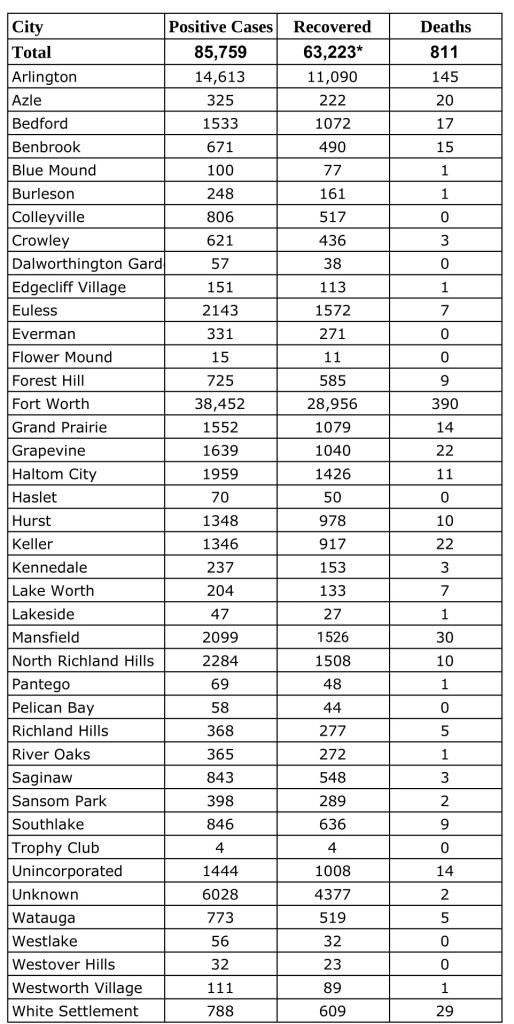
Data from Tarrant County Public Heath’s (TCPH) report of COVID-19 activity in Tarrant County, updated Saturday, November 21, 2020.Find more COVID-19 information from TCPH here.
*These data are provisional and are subject to change at any time.
Deaths and recovered cases are included in total COVID-19 positive cases.
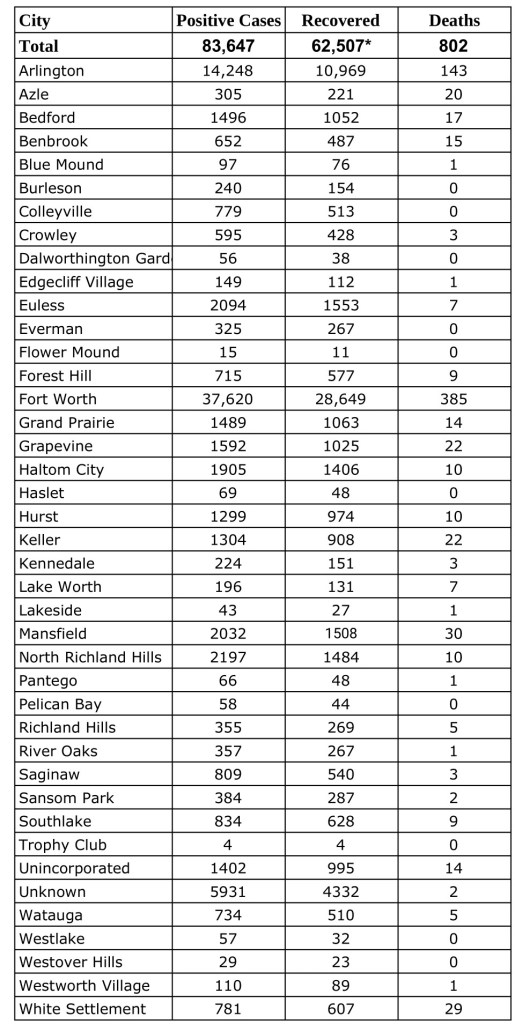
Data from Tarrant County Public Heath’s (TCPH) report of COVID-19 activity in Tarrant County, updated Thursday, November 19, 2020.Find more COVID-19 information from TCPH here.
*These data are provisional and are subject to change at any time.
Deaths and recovered cases are included in total COVID-19 positive cases.
Data from Tarrant County Public Heath’s (TCPH) report of COVID-19 activity in Tarrant County, updated Wednesday, November 18, 2020.Find more COVID-19 information from TCPH here.
*These data are provisional and are subject to change at any time.
Deaths and recovered cases are included in total COVID-19 positive cases.
This piece was originally published in the November/December issue of the Tarrant County Physician. You can read find the full magazine here.
This article was sponsored TCMS Publication Committee member Monte Troutman, DO.
In a recent Wednesday afternoon, first year Texas College of Osteopathic Medicine (TCOM) medical students met for the first time with interprofessional student colleagues encompassing eleven health professions. Sequestered at home due to the COVID-19 pandemic, students meet in a ZOOM virtual meeting room. Together they participate in a modified version of the reality show “What Would You Do,” identifying and correcting disrespectful communication and behavior to foster value and respect among interprofessional teammates. Students from Medicine, Pharmacy, Physician Assistant, Physical Therapy, Public Health and Health Administration, Nursing, Social Work, Speech Language Pathology, Athletic Training, and Dietetics from the University of North Texas Health Science Center (UNTHSC), TCU, Texas Woman’s University, Texas Wesleyan, and The University of Texas Arlington, practiced competency development in interprofessional teaming to improve patient and population health outcomes.
Had it not been for social distancing in response to COVID-19, these students would be meeting in person, in small interprofessional teams on the UNTHSC campus in Fort Worth. These interprofessional student workshops are part of a national initiative to integrate interprofessional education (IPE) into each health profession’s curriculum. IPE is the collaboration among students from two or more healthcare professions to promote teamwork and improve outcomes.1
The purpose of IPE is to prepare health profession students for interprofessional practice by teaching collaborative practice competencies within the context of interprofessional teams. What are those competencies? In 2009, six national education associations of schools of health professions: The American Association of Colleges of Osteopathic Medicine, The American Association of Medical Colleges (AAMC), The American Association of Colleges of Nurses, The American Association of Colleges of Pharmacy, The American Dental Education Association, and The Schools and Programs of Public Health, formed the Interprofessional Education Collaborative (IPEC) to promote IPE. The IPEC released a report of an expert panel in 2011 recommending four core interprofessional collaborative practice competency domains be integrated into health profession education: Values and Ethics for Interprofessional Practice; Interprofessional Practice Roles and Responsibilities; Interprofessional Communication and Teams; and Teamwork for Interprofessional Collaboration.2 IPEC now includes twenty-one national associations.
At TCOM, the knowledge, skills, and attitudes necessary for effective collaborative practice are being integrated into both the preclinical and clinical years of training in a variety of contexts.
Integration of these core IPE competencies has been woven into the accreditation standards of the health professions. For Osteopathic Medicine, the American Osteopathic Association’s Commission on Osteopathic College Accreditation introduced Standard 6.8: Interprofessional Education for Collaborative Practice, which states that the curriculum of a College of Osteopathic Medicine must prepare osteopathic medical students to function collaboratively on interprofessional health care teams, calling out adherence to the IPEC core IPE competencies.3 For Allopathic Medicine, the AAMC Liaison Committee on Medical Education (LCME) introduced Standard 7.9: Interprofessional Collaborative Skills, which states that the core curriculum must prepare allopathic medical students to function collaboratively on interprofessional health care teams.4
It is important that IPE occurs across the continuum of undergraduate and graduate pre-clinical and clinical training. A focus on interprofessional teaming is now included in residency training. The Accreditation Council for Graduate Medical Education’s Clinical Learning Environment Review (CLER) Program provides formative feedback to institutions sponsoring graduate medical education on the effectiveness of resident and fellow engagement in six focused areas for continuous institutional improvement. CLER was established to learn how best to optimize patient safety and clinical quality in clinical environments of teaching institutions and to learn how to best prepare physicians-in-training to meet the needs of a changing health care system.5 In 2019, the CLER Version 2.0 introduced a new focus area—teaming. The new Teaming Pathway requires that the clinical learning environment provides continual interprofessional educational programming on teaming that engages residents, fellows, and faculty members across the continuum of patient care and at all care delivery sites.6
So why is effective teaming so important? Some health care needs are adequately and efficiently handled by individual practitioners. Not all patients need an interprofessional healthcare team; however, the needs of many patients and populations can be better met by the use of teams.7 Effective collaboration among health profession teams has been found to be a factor in improved quality and safety in patient care.8 An added bonus is that participation in an effective team can be a protective factor for health care providers in reducing burnout.9 The purpose of the team approach is to optimize the special and shared contributions in skills and knowledge of team members, leading to patient needs being met more efficiently.
At TCOM, the knowledge, skills, and attitudes necessary for effective collaborative practice are being integrated into both the preclinical and clinical years of training in a variety of contexts. UNTHSC adopted IPE as an institutional initiative in 2012 with the development of the Department of Interprofessional Education and Practice to lead IPE initiatives. An IPE Curriculum Committee was formed with representation from each of UNTHSC’s colleges and schools along with representation from partnering institutions participating in IPE with UNTHSC. Through this committee, faculty across health professions model effective interprofessional collaboration, working together to create meaningful opportunities for students to learn and practice the competencies necessary for collaborative practice.
Though COVID has presented new challenges in medical education, innovative learning strategies are being utilized to keep TCOM students engaged in the development of their collaborative practice competencies. Third year TCOM students preparing to enter clinical rotations recently trained in a team development system utilizing Zoom and the virtual game Minecraft to demonstrate process improvement in teamwork, across three virtual simulations. Medical students commented, “This was an engaging and fun way to practice teamwork! Can we have more opportunities to utilize Minecraft?”
IPE has gained momentum across the nation; however, concern has been raised at the absence of authentic models of interprofessional collaboration within the clinical learning environment. The National Collaborative for Improving the Clinical Learning Environment (NCICLE) sponsored a symposium in 2017 to better understand issues related to enhancing the interprofessional clinical learning environment. Symposium attendees were invited by NCICLE and represented education, practice, and leadership across the spectrum of health care. An outcome of the symposium was the expressed concern that interprofessional values taught through IPE at the undergraduate and preprofessional levels are at risk of being lost as new clinicians enter clinical learning environments that reflect traditional approaches to health care delivery that remain siloed and hierarchical in nature.10
Emphasis is being placed nationally on enhancing the clinical learning environment through interprofessional learning to support the continuum of learning between academic and patient care settings.
How can you help? A clear understanding of IPE initiatives within undergraduate and graduate medical education can help clinicians reinforce collaborative practice competencies with students and trainees in the clinical learning environment. We know that the competencies necessary for effective collaborative interprofessional practice must be explicitly taught and modeled. The UNTHSC Department of Interprofessional Education and Practice has created faculty IPE development programs and is piloting an interprofessional collaborative development program for preceptors. Let us know how we can help you and your teams enhance the clinical learning environment.
References 1 World Health Organization. (2010). Framework for Action on Interprofessional Education and Collaborative Practice. Geneva: WHO Press.
2 Interprofessional Education Collaborative Expert Panel. (2011). Core competencies for interprofessional collaborative practice: Report of an expert panel. Washington, D.C.: Interprofessional Education Collaborative.
3 Commission on Osteopathic College Accreditation. (2019). Accreditation of Colleges of Osteopathic Medicine: COM Continuing Accreditation Standards. Chicago: American Osteopathic Association.
4 Liaison Committee on Medical Education. (2019). Functions and Structure of a Medical School: Standards for Accreditation of Medical Education Programs Leading to the MD Degree. Chicago: Association of American Medical Colleges and American Medical Association.
5 Weiss, K. B., Wagner, R., Bagian, J. P., Newton, R. C., Patow, C. A., & Nasca, T. J. (2013). Advances in the ACGME Clinical Learning Environment Review (CLER) Program. Journal of Graduate Medical Education, 5(4), 718–721. https://doi.org/10.4300/jgme-05-04-44
6 CLER Evaluation Committee. CLER Pathways to Excellence: Expectations for an Optimal Clinical Learning Environment to Achieve Safe and High-Quality Patient Care, Version 2.0. Chicago, IL: Accreditation Council for Graduate Medical Education; 2019. doi:10.35425/ACGME.0003
9 Willard-Grace, R., Hessler, D., Rogers, E., Dube, K., Bodenheimer, T., & Grumbach, K. (2014). Team Structure and Culture Are Associated With Lower Burnout in Primary Care. The Journal of the American Board of Family Medicine, 27(2), 229–238. https://doi.org/10.3122/jabfm.2014.02.130215
10 Weiss KB, Passiment M, Riordan L, Wagner R for the National Collaborative for Improving the Clinical Learning Environment IP-CLE Report Work Group. Achieving the Optimal Interprofessional Clinical Learning Environment: Proceedings From an NCICLE Symposium. http://ncicle.org. Published January 18, 2019. doi:10.33385/NCICLE.0002
Data from Tarrant County Public Heath’s (TCPH) report of COVID-19 activity in Tarrant County, updated Tuesday, November 17, 2020.Find more COVID-19 information from TCPH here.
*These data are provisional and are subject to change at any time.
Deaths and recovered cases are included in total COVID-19 positive cases.
Data from Tarrant County Public Heath’s (TCPH) report of COVID-19 activity in Tarrant County, updated Monday, November 16, 2020.Find more COVID-19 information from TCPH here.
*These data are provisional and are subject to change at any time.
Deaths and recovered cases are included in total COVID-19 positive cases.
Data from Tarrant County Public Heath’s (TCPH) report of COVID-19 activity in Tarrant County, updated Friday, November 13, 2020.Find more COVID-19 information from TCPH here.
*These data are provisional and are subject to change at any time.
Deaths and recovered cases are included in total COVID-19 positive cases.