Blog Feed

The Last Word: The Troll

“The mass of men lead lives of quiet desperation.”
-Henry David Thoreau – Walden

by Tom Black, MD – Publications Committee

As I reflect upon the thousands of patients with whom I had contact during my general surgery residency training, one stands out as perhaps the most important, at least in the sense that she is the one from whom I learned the most profound lesson.

I can see Sara Hardin in my mind’s eye. She occupied bed space 15, the middle bed of the three just to the left of the 2nd floor nurses’ desk, facing south. Sara was 49 years old, but she appeared to be at least 70. She was thin and bent. Her wrinkled and leathery skin spoke of a life none of us could hope to understand, undoubtedly spent out of doors and working hard. Her teeth were gone and she either didn’t bother putting in her dentures or didn’t own any. Her unkempt short gray hair and the dirt under her nails contributed to her derelict appearance. Sara was admitted to the county hospital for evaluation of intestinal bleeding. 

No one came to visit Sara, at least, no one that I was ever aware of. Whenever I saw her, she was generally napping or staring out the window. I don’t recall that she ever said a word to us as we rounded each morning and evening, but then again, I don’t recall ever saying much to her either.   

Once, when I was a senior resident, a new second year resident was assigned to our surgical service. We had never worked with each other and I knew nothing of him aside from the expensive watch he wore. I always thought it was in poor taste, if not ill advised, to flaunt something of such value in front of so many people who themselves had so little. One day during rounds at Sara’s beside, this new resident concluded his introductory remarks with the words, “She’s your typical troll.” All present nodded knowingly.

   “Troll” was Ben Taub Hospital parlance for a homeless individual, and the term carried with it, as one might imagine, a terribly negative connotation. It comes, I’m sure, from the Norwegian folktale of the ugly ogre who lived under the bridge that the Three Billy Goats Gruff had to cross. In Houston, as in many other cities, many homeless people live under the shelter of bridges and overpasses.

I am quite embarrassed now to admit that I neither said nor did anything at the time to set the young man straight regarding his opinion of someone of whose situation he was ignorant. But the label stuck in my mind, and it troubled me. In retrospect I can only hope that Sara either did not overhear that young man’s comment or did not understand his insinuation.

I suppose I had fallen, as do most students and residents, into the depersonalizing mindset of those who say, “the appendix in room five,” or “I admitted a head injury last night.” Most physicians-in-training are much more focused on the task of developing clinical acumen and less on humanity, but that’s a poor excuse. Nurses are often guilty, as they tend to report, “Four fifty-seven needs some pain medication.” HIPAA has greatly exacerbated the problem by disallowing the use of names in favor of initials or anonymous room numbers. But it’s a leap beyond depersonalization into cruelty to demean and denigrate another individual, particularly when he or she is in a debilitated condition and worse yet, when he or she is dependent upon you for assistance. 

What right did I have to do anything other than to exhibit the utmost respect for everyone as unique individuals of worth, while administering to them
the best possible care?

A day or two after the episode, I stopped by Sara’s bed. She was sleeping, which allowed me the opportunity to observe and to learn a bit about her. A book lay on the bedside table. It was a well-worn copy of the Bible. The bookmark and the pair of scratched and repaired eyeglasses nearby indicated that the book was read often and was of significance to her. A cross hanging next to her bed showed her personal devotion. Although she wore no jewelry, the proximal phalanx of her left ring finger was noticeably narrower than the same area of her other fingers, indicating that a ring had once held a longstanding position of importance there. Perhaps she had been recently widowed; who knew? And who even asked? I studied the lines on her face. They indicated that she had spent much more of her life smiling than frowning and spoke of happier and perhaps more secure days now past. Taped to the side of the bedside table, in such a manner as to be easily visible by her, but nearly invisible to casual visitors, was a simple crayon drawing with a crudely scrawled caption that read, “I love you Gramma.” Next to that was a small photograph of the type taken annually in public schools, of a little girl aged five or six years. I was even more ashamed of the callous attitude my colleague had displayed toward one of our fellow human beings and of myself for having remained silent. 

I may have been as guilty as others of depersonalization, but never of cruelty, and having witnessed that appalling lack of compassion was a wakeup call for me to reassess my own values. I began to appreciate the people who passed through the hospital in a new light and as being more than “clinical material” who existed for my benefit. Each became an individual. Each old man was someone’s father, and if not father or grandfather, then at least someone’s son. Each elderly woman was someone’s daughter and, as in Sara’s case, likely to be loved by someone. There were experiences etched into the wrinkles of each of Sara’s hand that I could not even begin to understand. What right did I have to do anything other than to exhibit the utmost respect for everyone as unique individuals of worth, while administering to them the best possible care?

Several days later, in a different location but similar circumstance, I heard the term “troll” again used in a similarly insensitive manner. This time I was determined not to allow the opportunity to pass.

“Stop right there. Everyone remember from this moment on that the word you just used is not acceptable on this service, at least as long as I’m here.” I paused to collect my thoughts, although I had mentally rehearsed my comments many times. 

I addressed the speaker. “When you applied to medical school, you were probably asked why you wanted to become a doctor, and you probably said ‘Because I want to help people.’ Well, either you meant it or you didn’t, but if you were honest and you do want to help others, start by treating everyone as a fellow human being. You wouldn’t appreciate someone speaking that way about your mother or grandmother.” There was some resentment after that over the reprimand, but I heard no more “troll” comments.

On the evening of the day Sara was discharged, the team assembled at the nurses’ station for rounds. “Dr. Black,” the charge nurse said. “This was left for you.” It was an orange mailing envelope with Sara’s name on it. Opening it, I pulled out a nice greeting card addressed to our team. I read the card aloud to the members present. “Dear Blue Surgery team. Thank you all so much for the kindness and care you gave to our mother and grandmother while she was recovering in the hospital.” I was gratified to see that the irony of the message had wounded a few egos. 

A few months ago, an essay by medical student Sneha Sudanagunta appeared in this journal. In it, Ms. Sudanagunta concluded that medical schools must do a better job teaching what she called “humanism,” (an ambiguous word for which I suggest “compassion” may be a more apt term). While I applaud her passion for this important topic, it is disconcerting that Ms. Sudanagunta felt compelled at all to implore physicians to teach more compassion. My experience leads me to believe that her observations represent an exception rather than the rule among practicing physicians. 

I suppose medical students and residents are much the same as they were forty years ago. Sometime between acceptance to medical school and the completion of medical training, one must resolve one’s personal standards regarding the treatment of others and the sanctity of human life. Of course, cruelty must be categorically opposed and compassion fostered just as strongly. While I am doubtful that compassion can be taught, per se, I am quite certain that it can be effectively modeled, and a receptive individual can be influenced to change his or her own behavior. 

I am convinced that we are surrounded by compassionate physicians; their names are in the TCMS directory. It is who we are, or at least, who we want to be. Nevertheless, it is wise for us to recall from time to time the wisdom of the Dalai Lama: “Be kind whenever possible. It is always possible.” We need to show Ms. Sudanagunta that whatever she experienced was the exception, not the rule.
Tarrant County students will not be returning for in-person classes until Sept. 28

Tarrant County students will not return to school until Sept. 28 under a Joint Control Order issued today by Local Health Authorities from Tarrant County, City of Arlington and the City of Burleson.

Under the order, all public and non-religious private schools are not to re-open for on-campus, face-to-face instruction or activities until Sept.28. Some activities are allowed, though social distancing, facial coverings and other safety protocols must still be observed:

  1. Administrators, teachers and staff may conduct remote learning while on-campus
  2. All events and activities, including clubs, sports, band, choir, fairs, exhibitions, academic and/or athletic competitions and similar student activities may take place remotely or outdoors in accordance with current social distancing and masking guidelines.
  3. Special education instruction may occur when necessary and in accordance with TEA guidelines when feasible
  4. Students whose individual education plans cannot be implemented with remote learning or who have limited household connectivity to the internet may be provided in-person instruction
  5. All school systems shall re-open schools through remote learning only as per each school system’s own plan and may provide curbside meals from school campuses

The new order requires each school district to provide the Local Health Authority a written plan for resuming on-campus instruction and extra-curricular activities no later than two weeks before re-opening school. Tarrant County Public Health Director Vinny Taneja said the order is needed to continue to slow the spread of COVID-19.

“The safety of our children is our greatest concern along with the health of their parents, teachers and friends,” said Tarrant County Public Health Director Vinny Taneja. “With community spread actively in place, our children going to school would undo everything that our stay at home and mask-wearing efforts have tried to accomplish.”

 The order, effective today, was signed jointly by all three Local Health Authorities, Dr. Catherine Colquitt for Tarrant County Public Health,  Dr. Cynthia Simmons for the City of Arlington and Dr. Steve Martin for the City of Burleson.

To read the Joint Control Order go here. Or for questions, call the Tarrant County Public Health information line at (817) 248-6299.

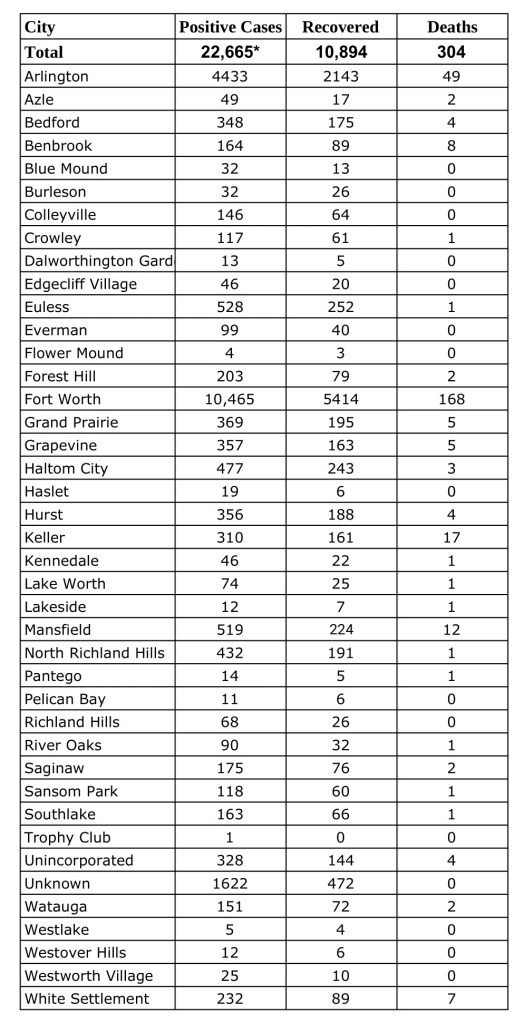
Tarrant County COVID-19 Activity – 7/21/20


COVID-19 Positive cases: 22,665*

COVID-19 related deaths: 304

Recovered COVID-19 cases: 10,894

Data from Tarrant County Public Heath’s (TCPH) report of COVID-19 activity in Tarrant County, updated Tuesday, July 21, 2020. Find more COVID-19 information from TCPH here.

* These data are provisional and are subject to change at any time.

Deaths and recovered cases are included in total COVID-19 positive cases.

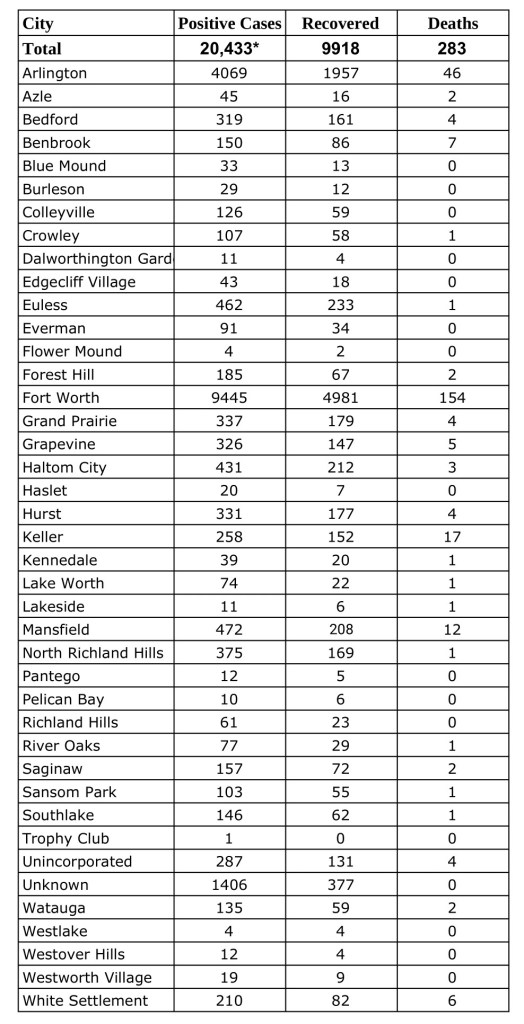
Tarrant County COVID-19 Activity – 7/16/20

COVID-19 Positive cases: 20,433*

COVID-19 related deaths: 283

Recovered COVID-19 cases: 9918

Data from Tarrant County Public Heath’s (TCPH) report of COVID-19 activity in Tarrant County, updated Thursday, July 16, 2020. Find more COVID-19 information from TCPH here.

* These data are provisional and are subject to change at any time.

Deaths and recovered cases are included in total COVID-19 positive cases.

COVID-19 Testing, Isolation, and Quarantine Answers

As COVID-19 numbers continue to rise, misconceptions and confusion surrounding the virus have also increased. As more individuals come in contact with COVID-19, questions regarding best practices for isolation, quarantine, and how to obtain testing have circulated. In response, the North Texas Medical Society Coalitions (NTMSC) has provided answers for the most commonly asked questions.

Q. Does an individual need to get tested if he or she has COVID-19 symptoms?

A. Persons with symptoms of potential COVID-19 infection, including the following, should consider getting tested to confirm COVID-19. Always talk with your physician about the necessity and best method for obtaining a test:

  1. fever, cough, shortness of breath, chills, muscle pain, new loss of taste or smell, vomiting or diarrhea, and/or sore throat;
  2. anyone 65-years-old or older;
  3. anyone with chronic health issues (diabetes, asthma, heart issues, etc.);
  4. first responders or essential workers; and
  5. persons without symptoms who have been actively engaged in large group settings, such as public gatherings or congregations of people, within the past 15 days.

Q.  Does an individual need to get tested if they were exposed to someone who is COVID-19 positive but are not showing any symptoms themselves?

A.  Probably not. Persons who have been exposed to someone with confirmed COVID-19 but who are not symptomatic do not need to obtain a test unless it is required by an employer, school, or other third party. In all cases the person who was exposed should quarantine themselves for 14 days to ensure they do not develop symptoms. Even if the person obtains a test and it comes back as negative, it is important to complete the 14 days of quarantine since tests may give false negatives if the virus has not fully developed in infected individuals.

Q. What is the difference between isolation and quarantine?

A.  Individuals who are confirmed positive for COVID-19 but who are not sick enough to require admission to a hospital should isolate themselves to one room in their home and avoid all interaction with family members and pets. Individuals who have been exposed to someone who has COVID-19 but do not know if they contracted the virus should quarantine themselves inside their house for 14 days to ensure they do not develop symptoms.

Q. If someone has COVID-19 and has symptoms, at what point can the individual stop isolating themselves?

A. The individual should remain in isolation until three days after a fever has subsided, respiratory symptoms have improved, and it has been at least 10 days after the first on-set of symptoms. Some employers may require two negative COVID-19 nasal swab tests done at least 24 hours apart before allowing isolated individuals to return to the workplace.

Q. If an individual tests positive for COVID-19, but does not have any symptoms, how long should he or she isolate themselves?

A. Anyone who is confirmed COVID-19 positive without symptoms should isolate for 10 days. 

Q. If someone has contact with an individual who tests positive for COVID-19, do they need to quarantine themselves? If so, for how long?

A. Anyone who has been exposed to, or in close contact with, an individual who tests positive for COVID-19 needs to quarantine for 14 days, as it may take that long for symptoms to develop.

Q. What does being in “close contact” mean?

A.  Close contact means:

  1. Being within six feet of someone who has COVID-19 for 15 minutes or longer;
  2. Taking care of someone who has COVID-19;
  3. Having physical contact with someone who has the virus;
  4. Sharing eating or drinking utensils with someone who has COVID-19; and
  5. Being sneezed on or coughed on by someone who has the virus.

Q. Where can I get tested?

A. Individuals who need COVID-19 testing should contact their physicians for recommendations; if further resources are needed, they should check Txcovidtest.org to see what options are available.

Individuals are always encouraged to talk to their doctor first about the appropriate steps to take to keep themselves and their family safe in regard to COVID-19. Physicians can also provide the best advice about managing COVID-19, such as if a test is necessary or where to obtain a test.

Knowing how to respond when encountering COVID-19 is an important part of reducing the number of cases in North Texas. Combining this information with the proactive measures of masking, hand washing, maintaining physical distance, and staying home when possible empowers individuals in the community to protect themselves and others. 

About North Texas Medical Society Coalition: 

The NTMSC represents more than 11,500 physicians in the communities of Collin-Fannin, Dallas, Denton, Grayson, and Tarrant County. Founded in 2020, NTMSC works with community healthcare partners, including public health departments, hospitals, and business leaders, to advise on medical recommendations to serve the health care needs of the residents of North Texas. 

Tarrant County COVID-19 Activity – 7/15/20

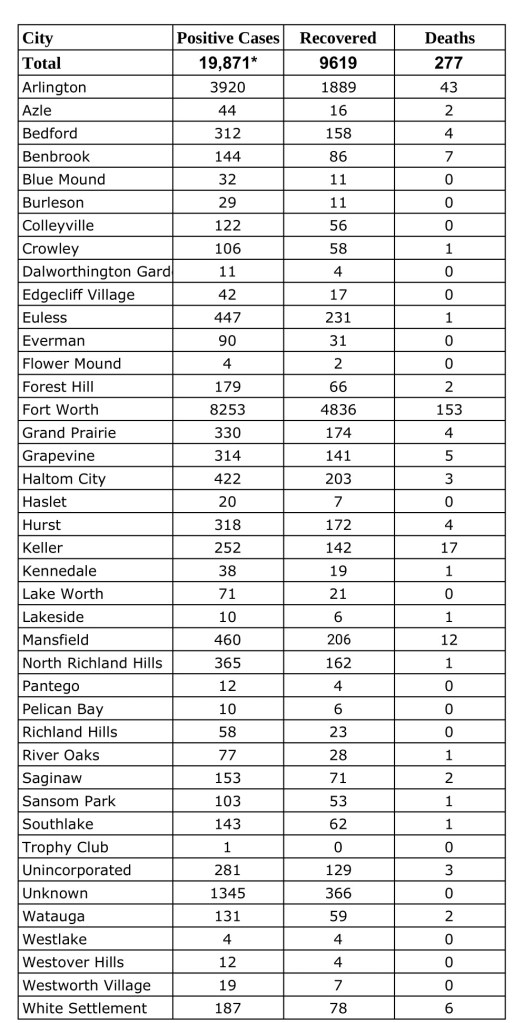
COVID-19 Positive cases: 19,871*

COVID-19 related deaths: 277

Recovered COVID-19 cases: 9619

Data from Tarrant County Public Heath’s (TCPH) report of COVID-19 activity in Tarrant County, updated Wednesday, July 15, 2020. Find more COVID-19 information from TCPH here.

* These data are provisional and are subject to change at any time.

Deaths and recovered cases are included in total COVID-19 positive cases.

West Nile cases on the rise; Tarrant County residents urged to take precautions

West Nile Virus (WNV) has reemerged as a current health threat in North Texas. Tarrant County Public Health is advising residents to take extra care as WNV cases increase across the county. Public Health Director Vinny Taneja said precautions against WNV are particularly important during the current pandemic.

“It’s prudent to stay focused on protecting against COVID-19, and although mosquitoes do not carry the COVID-19 virus, we don’t want to minimize the dangers of West Nile right now,” Taneja said. The symptoms are similar and since it can be hard to tell the difference, he encouraged residents to see a doctor if they experience fever, cough or sore throat.  “We want to remind everyone to protect themselves against mosquitoes by wearing long sleeves and pants and using repellents when outside.”

Tarrant County Vector Control Supervisor Nina Dacko said most of the positive mosquito results have been in northeast Tarrant County. “In 2018 and 2019, the number of positive mosquito pool samples were very low, which is cause for concern this summer,” Dacko said. “Environmental factors are ripe for the virus to make a big comeback and recent rains also allow more mosquitoes to thrive in hot weather like Texas is experiencing right now.”


Here is a list of mosquito repellents endorsed by the FDA and CDC. Tarrant County Public Health also has more information about West Nile Virus and other preventive measures residents can take at Be Mosquito Free.

Tarrant County COVID-19 Activity – 7/14/20

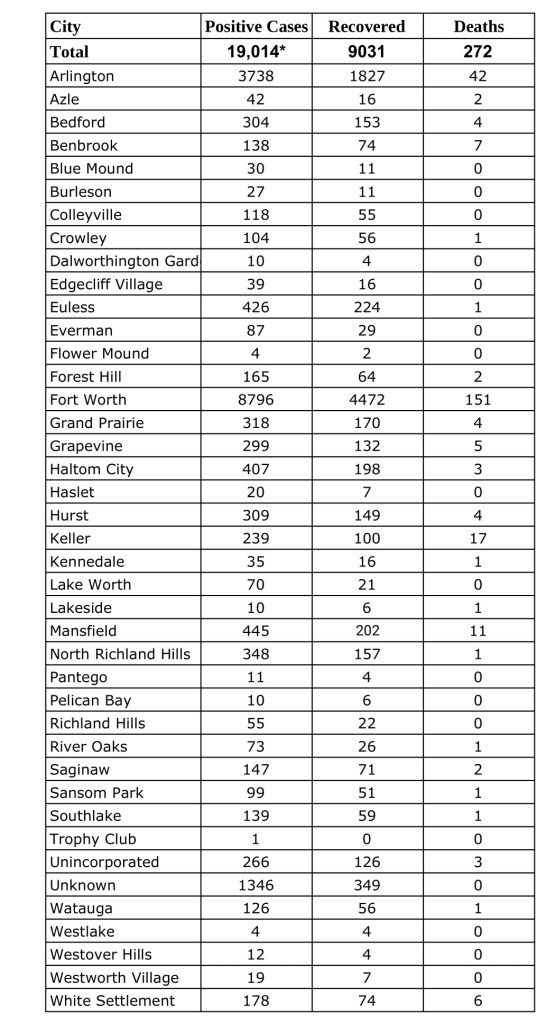
COVID-19 Positive cases: 19,014*

COVID-19 related deaths: 272

Recovered COVID-19 cases: 9031

Data from Tarrant County Public Heath’s (TCPH) report of COVID-19 activity in Tarrant County, updated Tuesday, July 14, 2020. Find more COVID-19 information from TCPH here.

* These data are provisional and are subject to change at any time.

Deaths and recovered cases are included in total COVID-19 positive cases.

Preceptors Needed for TCOM Students

Students from the Texas College of Osteopathic Medicine (TCOM) need assistance finding available rotations for their fourth year of medical school. These students are responsible for scheduling their own rotations, but COVID-19 has made it difficult for them to do so. Due to the virus, many hospitals and clinics that typically participate are unable to provide preceptors. To combat this, TCOM’s class officers have produced a TCOM Preceptor Sign-Up Form, making it easy for physicians in our community to participate as preceptors.

If you have any questions, you can contact Conner Reynolds, M.S., OMS-IV, at ConnerReynolds@my.unthsc.edu.

Tarrant County COVID-19 Activity – 7/10/20

COVID-19 Positive cases: 17,334*

COVID-19 related deaths: 262

Recovered COVID-19 cases: 7730

Data from Tarrant County Public Heath’s (TCPH) report of COVID-19 activity in Tarrant County, updated Friday, July 10, 2020. Find more COVID-19 information from TCPH here.

* These data are provisional and are subject to change at any time.

Deaths and recovered cases are included in total COVID-19 positive cases.

Create your own website, free on WordPress.com.Create your own website.
Start free