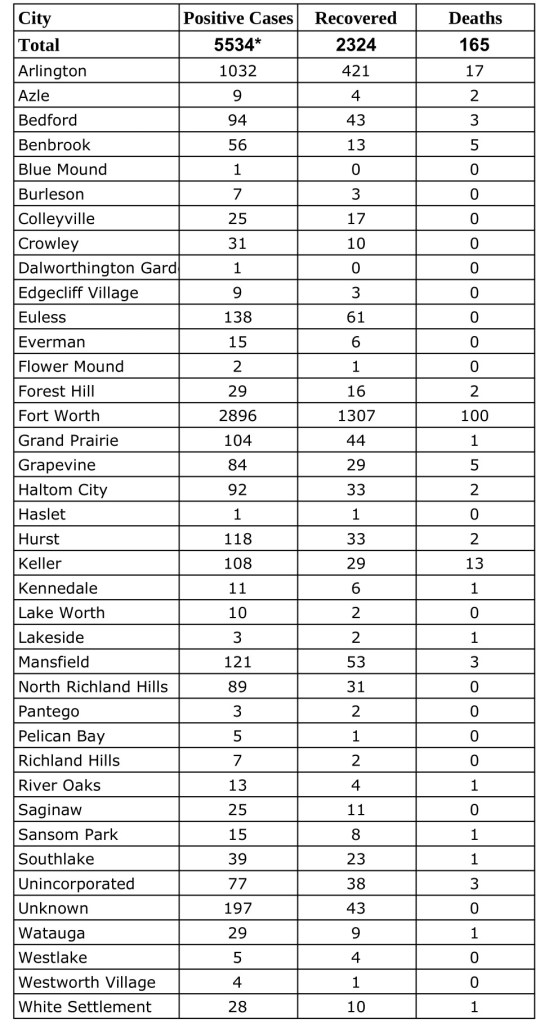
Data from Tarrant County Public Heath’s (TCPH) report of COVID-19 activity in Tarrant County, updated Wednesday, June 3, 2020.Find more COVID-19 information from TCPH here.
* These data are provisional and are subject to change at any time.
Deaths and recovered cases are included in total COVID-19 positive cases.
Aetna is moving its provider portal to Availity (from NaviNet) effective May 31. After that date, you’ll lose access to Aetna on NaviNet, including electronic transactions. Aetna also:
Has extended coverage for commercial telemedicine service, including audio-only visits, through Aug. 4; and
Will no longer waive cost sharing for any in-network telemedicine visits for commercial plans starting June 4.
Blue Cross Blue Shield of Texas has extended access to telemedicine/telehealth services with no cost sharing for all medically necessary, covered services and treatments through June 30. That access was set to expire May 31.
Cigna will extend certain cost-share waivers, including customer cost-sharing for telemedicine screenings for COVID-19, and other benefits through at least July 31.
Several Medicaid and Children’s Health Insurance Program(CHIP) flexibilities, including paying for Texas Health Steps (THSteps) medical checkups via telemedicine and CHIP copay waivers, will be extended through June 30. Payments had been set to expire May 31.
Medicare’s 2020 Quality Payment Program (QPP) registration window is open for the Merit-Based Incentive Payment System (MIPS) web interface reporting method and Consumer Assessment of Healthcare Providers and Systems survey through June 30.
Medicare’s 2019 QPP final performance feedback, which includes your overall MIPS score (0-100 point scale) and 2021 Medicare payment adjustment (bonus or cut) worth up to 7%, is expected July 1 via the QPP portal. Physicians who did not submit any 2019 MIPS data or who filed an application for an exception due to COVID-19 should not receive a 2021 payment cut.
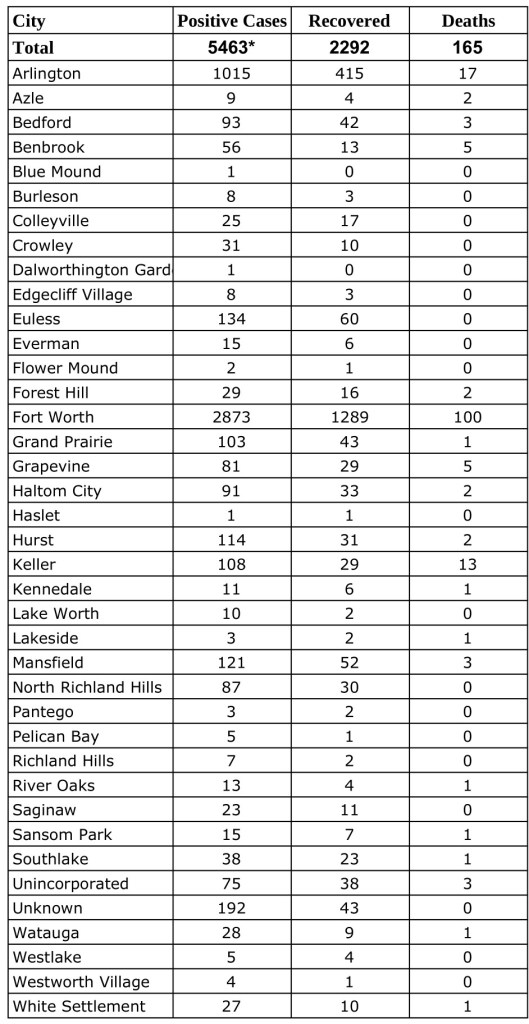
Data from Tarrant County Public Heath’s (TCPH) report of COVID-19 activity in Tarrant County, updated Monday, June 1, 2020.Find more COVID-19 information from TCPH here.
* These data are provisional and are subject to change at any time.
Deaths and recovered cases are included in total COVID-19 positive cases.
The North Texas Medical Society Coalition (NTMSC) is encouraging those who are sick or exposed to COVID-19 to complete a full 14 days in quarantine to avoid a resurgence of the virus in North Texas.
“The respiratory symptoms from COVID-19 usually appear about five to six days after exposure, but may occur as soon as two days or as late as 14 days after exposure. People may be most likely to spread the virus to others during the 48 hours before they start to experience symptoms,” says Beth Kassanoff, MD, NTMSC Vice Chair. “If you get a nasal swab COVID test done too early after exposure, it will be negative, even though you may go on to develop the disease, because there are so few viral particles in your nose so soon after infection that the test cannot detect them. This possibility of a false negative test result is why anyone who has been exposed to someone known or who is suspected to be infected should stay home for 14 days even if they test negative for coronavirus.”
NTMSC makes the following recommendations for those who may have COVID-19:
Self-quarantining is key – sick individuals should stay home and avoid contact with others. They should not go to work or school and should avoid public transportation, taxis, or ride-shares. Local health departments can assist with basic needs (for example, food and medication).
If there has been close contact with a person who has lab-confirmed COVID-19, or who was diagnosed with COVID-19 without lab testing, individuals should self-quarantine and monitor for symptoms of COVID-19 for 14 days after the last contact. If a member of a household has lab-confirmed COVID-19 or is diagnosed with COVID-19, all members of that household should self-quarantine for 14 days after any sick person in the household’s self-isolation period ends.
If anyone is feeling sick they should self-isolate at home. Those who do have COVID-19 need to continue isolating until their symptoms are gone, they have not had a fever for three days, and at least 10 days after their symptoms began. The most common symptoms are fever, cough, and shortness of breath. Other common symptoms include chills, muscle pain, sore throat, or loss of taste or smell. Not everyone with COVID-19 will have all symptoms and fever might not be present. Anyone who has symptoms and wants to get tested for COVID-19 should reach out to their healthcare provider. Providers may collect samples to test or help individuals find testing sites in their area.
Outside of self-quarantine, NTMSC continues to encourage thorough hand washing, wearing a mask, and maintaining six feet of distance from others.
About North Texas Medical Society Coalition:
The NTMSC represents more than 11,500 physicians in the communities of Collin-Fannin, Dallas, Denton, Grayson, and Tarrant County. Founded in 2020, the NTMSC works with community healthcare partners, including public health departments, hospitals, and business leaders, to advise on medical recommendations to serve the health care needs of the residents of North Texas.
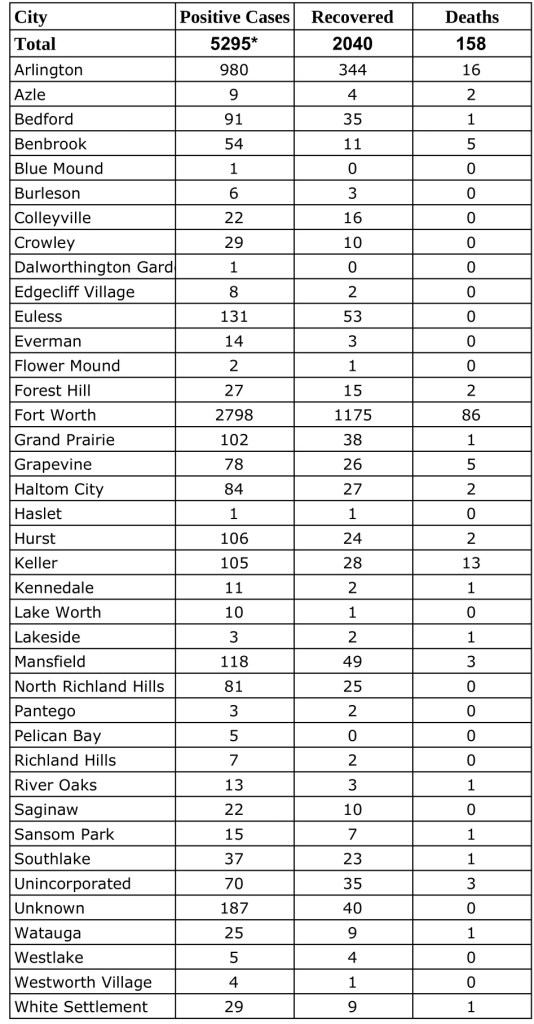
Data from Tarrant County Public Heath’s (TCPH) report of COVID-19 activity in Tarrant County, updated Friday, May 29, 2020.Find more COVID-19 information from TCPH here.
* These data are provisional and are subject to change at any time.
Deaths and recovered cases are included in total COVID-19 positive cases.
Data from Tarrant County Public Heath’s (TCPH) report of COVID-19 activity in Tarrant County, updated Friday, May 29, 2020.Find more COVID-19 information from TCPH here.
* These data are provisional and are subject to change at any time.
Deaths and recovered cases are included in total COVID-19 positive cases.
A few months ago, I was on airplane heading to a meeting. As we started taxiing toward the runway, safely fastened into my window seat on a full flight, I overheard a conversation in the row in front of me. The woman in the center seat was conversing with a gentleman in the aisle seat. It became apparent that he was a physician, and she asked him if he were a member of the AMA.
“The AMA?” he replied. “What’s the point?”
Since I was immobilized in my seat, I did not get the chance to answer his question (that he really didn’t want an answer to, anyway).
So, what is the point of being a member of the AMA?
The American Medical Association is the nation’s largest and most influential medical society in the U.S. and is a powerful ally of physicians and medical students. Our mission is “to promote the art and science of medicine and the betterment of public health.” AMA’s work across healthcare is organized in three ways:
Removing obstacles that interfere with patient care;
Driving the future of medicine by reimagining medical education, training, and lifelong learning, and by promoting innovation to tackle the biggest challenges in healthcare; and
Improving the health of the nation by leading the charge to prevent chronic disease and confront health crises.
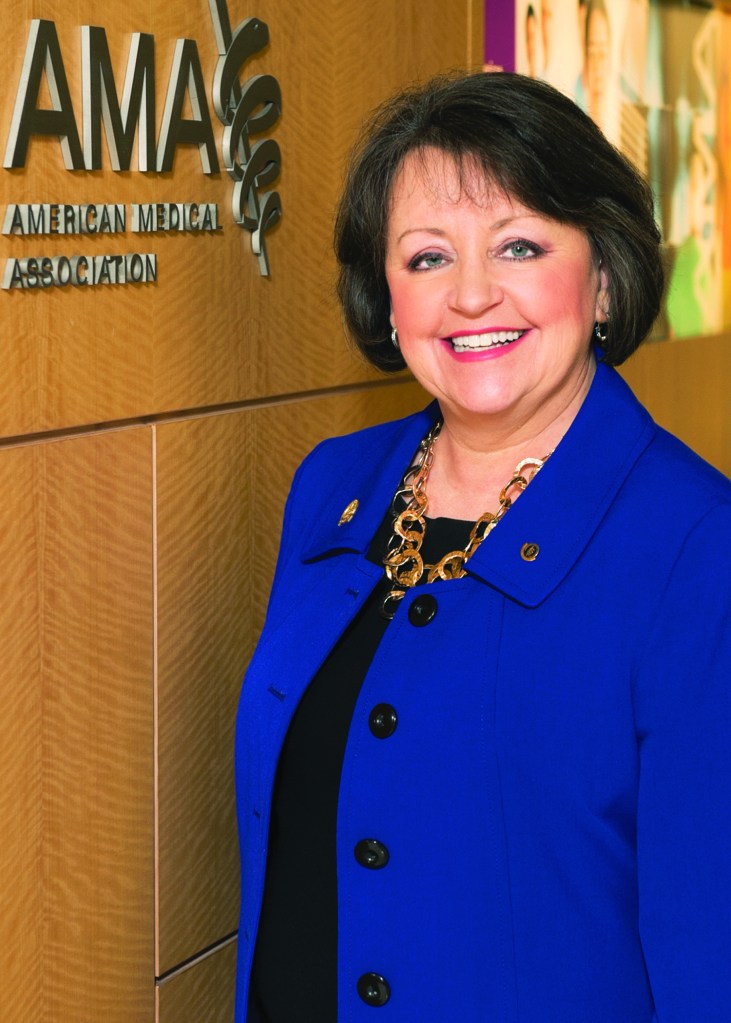
The AMA has changed a great deal in the last decade – it is definitely no longer your granddaddy’s AMA! When I was elected AMA President-elect in June 2019, I joined President Patrice Harris, MD, and Past President Barbara McAneny, MD, as the first trio of women leaders the organization has ever had. The Board of Trustees of the AMA (BOT), who provides governance of the organization and carries out the will of the House of Delegates, is comprised of actively practicing physicians, a resident physician, and a medical student as well as a public member. Most of us are in private practice; some are in academia and some in large medical systems. We come from primary care and specialties. I have no idea what political party each belongs to. Texas has always been strongly represented on the BOT, and I am currently joined there by Russ Kridel, MD, a facial plastic surgeon from Houston.
AMA policy is set by the representative process of the House of Delegates (HOD), which meets twice a year to debate health policy ranging from medical ethics to economics to advocacy to education to science and public health. Half of the HOD, which now has more than 600 delegates, are from state medical societies and half are from specialty societies. Resolutions on health policy are brought from states or specialty societies, debated, and eventually voted on by the HOD.
Tarrant County has long had an active cadre of physicians and students who were active in the AMA. Currently, Gary Floyd, MD, serves on the AMA Council on Legislation, and Sealy Massingill, MD, is on the AMA Council on Long Range Planning and Development. I served on the AMA Council on Medical Education before I became Vice-Speaker. Steve Brotherton, MD, has recently served as Chair of the AMA Council on Ethical and Judicial Affairs. Other Tarrant County physicians serving on the TMA delegation to the AMA are Greg Fuller, MD, and Larry Reaves, MD. Ty Childs, MD, serves in the HOD as a delegate from the American College of Radiology, and Melissa Garretson, MD, serves in the American Academy of Pediatrics delegation. Our TCOM chapter has produced many student leaders, and I know our TCU and UNTHSC students will, as well.
I have believed since medical school at Texas A&M College of Medicine that being involved in organized medicine was a professional obligation and that taking the best care of my patients at the micro level also meant taking care of them at the macro level in Austin and Washington, DC. It’s hard to get health policy adopted on your own. Big changes require big groups of people working together, and the more diverse the groups, the better the policy.
The AMA has a robust Washington, DC, office with talented staffers who are constantly in touch with the three branches of government, HHS, CMS, and the CDC. When a legislator wants to know what doctors think, they call the AMA. When CMS needs help with emergency telemedicine rules, they call the AMA. The heroes of the White House COVID-19 Task Force, Dr. Deborah Birx, Surgeon General Jerome Adams (who was an AMA Delegate before he became Surgeon General), and Dr. Anthony Fauci are all AMA members, and all reach out to the AMA when they want physician involvement.
The AMA is deeply involved in medical education; they make up half of the LCME which accredits medical schools. They are active in the accreditation of residency training, CME, physician office laboratories, and the Joint Commission. They help appoint members of ABMS boards. They have worked on getting rid of Maintenance of Certification as we knew it, especially the high stakes exams and changing to a system more reflective of a physician’s practice needs (and more respectful of our time and money).
This year I will be sharing my travels around the U.S. and the world as AMA President with Tarrant County Physician and discussing the issues that are so vital to all of us. It will take the whole year to explain all the points of how important our AMA is, and I am eternally thankful for TCMS and TMA for supporting me throughout my career and helping me achieve this incredible honor.
As you’re no doubt aware, telemedicine has made it possible for many physicians to continue seeing patients while reducing the risk of spread during the COVID-19 pandemic.
Temporary changes to state and federal rules, particularly regarding payment for services, have helped push up the new demand for and use of telemedicine.
Prior to the pandemic, health plans did not have to pay physicians the same rate for telemedicine visits as for in-person visits.
But what does each type of plan pay for visits?
The Texas Medical Association has compiled information for various types of plans. Remember that some plans’ policies are different for audio-only visits.
Commercial
State-regulated plans. The Texas Department of Insurance’s (TDI) emergency rules requiring state-regulated health insurers and HMOs to pay an in-network health professional at least the same rate for a telemedicine or telehealth service as they would for the same service or procedure in-person took effect March 17. Those rules remain in effect for up to 120 days (mid-July). They can be extended for an additional 60 days if needed. (For more details, see TDIs FAQs.)
ERISA (self-funded) employer-sponsored plans. There is no requirement for these federally regulated plans to pay the in-person rate for telemedicine care. However, many ERISA employee health plans are administered by Texas insurers – as a Third-Party Administrator (TPA). Many of the plans’ administrators have encouraged these plans to pay for telemedicine services at the same level as TDI-regulated plans, and many have.
Medicare:
The Centers for Medicare & Medicaid Services (CMS) has opened up a number of telemedicine payment policies for Medicare telemedicine services. The telehealth waiver remains effective until the Health and Human Services Department secretary declares the public health emergency has ended.
Texas Medicaid recently authorized telemedicine payment for well-child checks for children older than 24 months. The state also approved other telemedicine flexibilities, such as payment for audio-only telemedicine and telehealth visits. These waivers all expire May 31, but TMA anticipates the Texas Health and Human Services Commission (HHSC) will extend them at least for one more month. TMA and state societies representing primary care and obstetrical physicians have asked for a six-month extension, through November.
You can find more information on the Telemedicine section of TMA’s COVID-19 Resource Center, which is updated with the latest news, resources, and government guidance regularly.
Data from Tarrant County Public Heath’s (TCPH) report of COVID-19 activity in Tarrant County, updated Thursday, May 28, 2020.Find more COVID-19 information from TCPH here.
* These data are provisional and are subject to change at any time.
Deaths and recovered cases are included in total COVID-19 positive cases.
By Tammy Camp, MD President, Texas Pediatric Society
Usually at this time of year, children seen in a clinic setting respond with a resounding “yes” when asked if they are ready for school to be out. For many this year, the answer is different. Instead, several have said “No, I can’t wait to go back to school – I miss being there.”
These very thoughts are echoed by the pediatricians who see children and adolescents in their offices. We cannot wait to have children and their caregivers back in our offices so that we can address and treat their physical and emotional needs.
During a disaster such as this pandemic, behavioral health issues in children are likely to be exacerbated. We see this being played out in front of us now. Social isolation has led to increased depression; anxiety is intensified by the relentless news cycle and social media coverage.
The safety net for many children is the education system, but it is no longer functioning in this way for them. While reports of child abuse may be down due to children’s decreased contact with systems that normally watch over them, those children presenting with abuse to emergency rooms unfortunately have injuries far more serious and life-threatening.
Of great concern is data released from Texas Health and Human Services demonstrating a 10% decrease in doses administered every public health region of the state in March of 2020 compared to March of 2019. These decreases suggest that following the current crisis, our children could be faced with another: exposure to vaccine preventable diseases.
While all of this may seem discouraging, there is hope. Pediatricians are prepared to walk alongside their patients, helping them traverse these unprecedented challenges. We are not only prepared, but we long to assist children and caregivers in navigating these rough waters.
As Governor Abbott and his Strike Force team begin to reopen our state, Texas pediatricians stand ready to have the children and adolescents for whom they provide care back in their offices. The Texas Medical Board has instituted minimum standards to assist them in doing this safely. Those standards include that both the patient and the physician wear masks when within 6 feet of one another. Additionally, before encounters, patients must be screened for potential symptoms of COVID-19. Further, prior to procedures that are higher risk for aerosolization for COVID-19, the healthcare provider must use N-95 masks and face shields. These standards are included in addition to what most offices had already implemented to protect their patients. Many offices are concentrating all well child care visits and behavioral health visits to designated morning times, while seeing patients who are ill in the afternoons. Most have implemented telemedicine appointments for visits that can safely be handled in this manner. The offices use increased cleaning measures between patients and at the end of the day.
Still, some offices may choose not to fully reopen, or may only provide limited access. Pediatricians will use their professional judgment to decide if and when they can resume full provision of services as they value the staff of nurses, receptionists and others in their team who assist in providing care and must place a priority on their health.
So now we ask you, the caregivers of our children, to partner with us as we prepare for the return of a “new normal.” We want to meet the emotional needs of your children. We want to provide you with tips for juggling your parenting responsibilities with your new educating duties. We want to ensure that preparticipation histories and physicals are completed so that your child is ready to safely enter extracurricular activities when they are allowed to resume. We also want to protect your child from another health crisis by keeping their immunizations up to date.
While many of our children eagerly anticipate the return of school, complete with the extracurricular activities and in-person reunions with their friends, we also look forward to welcoming you into our offices.




 Tarrant County Physician Online