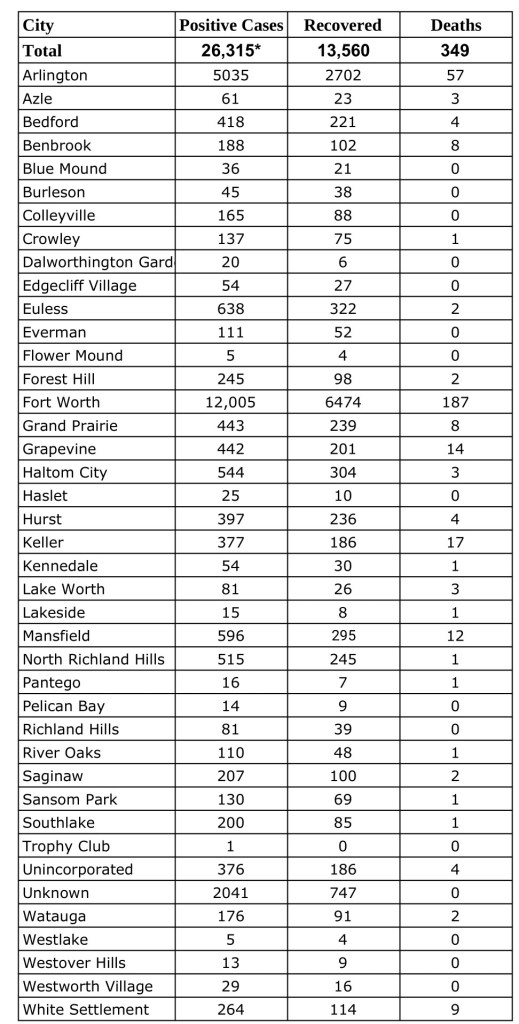
Tarrant County COVID-19 Activity – 7/28/20


COVID-19 Positive cases: 26,315*

COVID-19 related deaths: 349

Recovered COVID-19 cases: 13,560

Data from Tarrant County Public Heath’s (TCPH) report of COVID-19 activity in Tarrant County, updated Tuesday, July 28, 2020. Find more COVID-19 information from TCPH here.

* These data are provisional and are subject to change at any time.

Deaths and recovered cases are included in total COVID-19 positive cases.

Tarrant County COVID-19 Activity – 7/23/20

COVID-19 Positive cases: 23,967*

COVID-19 related deaths: 319

Recovered COVID-19 cases: 11, 680

Data from Tarrant County Public Heath’s (TCPH) report of COVID-19 activity in Tarrant County, updated Thursday, July 23, 2020. Find more COVID-19 information from TCPH here.

* These data are provisional and are subject to change at any time.

Deaths and recovered cases are included in total COVID-19 positive cases.

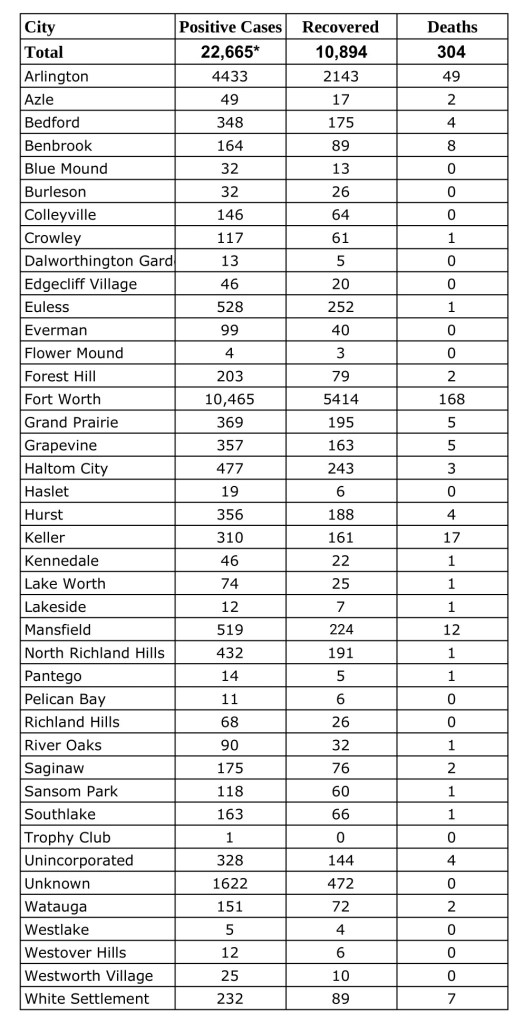
Tarrant County COVID-19 Activity – 7/21/20


COVID-19 Positive cases: 22,665*

COVID-19 related deaths: 304

Recovered COVID-19 cases: 10,894

Data from Tarrant County Public Heath’s (TCPH) report of COVID-19 activity in Tarrant County, updated Tuesday, July 21, 2020. Find more COVID-19 information from TCPH here.

* These data are provisional and are subject to change at any time.

Deaths and recovered cases are included in total COVID-19 positive cases.

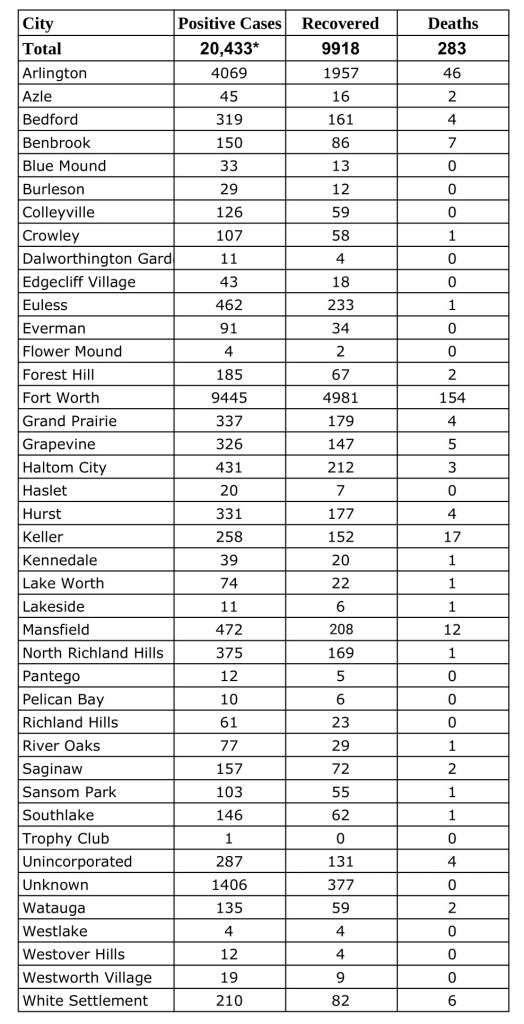
Tarrant County COVID-19 Activity – 7/16/20

COVID-19 Positive cases: 20,433*

COVID-19 related deaths: 283

Recovered COVID-19 cases: 9918

Data from Tarrant County Public Heath’s (TCPH) report of COVID-19 activity in Tarrant County, updated Thursday, July 16, 2020. Find more COVID-19 information from TCPH here.

* These data are provisional and are subject to change at any time.

Deaths and recovered cases are included in total COVID-19 positive cases.

COVID-19 Testing, Isolation, and Quarantine Answers

As COVID-19 numbers continue to rise, misconceptions and confusion surrounding the virus have also increased. As more individuals come in contact with COVID-19, questions regarding best practices for isolation, quarantine, and how to obtain testing have circulated. In response, the North Texas Medical Society Coalitions (NTMSC) has provided answers for the most commonly asked questions.

Q. Does an individual need to get tested if he or she has COVID-19 symptoms?

A. Persons with symptoms of potential COVID-19 infection, including the following, should consider getting tested to confirm COVID-19. Always talk with your physician about the necessity and best method for obtaining a test:

  1. fever, cough, shortness of breath, chills, muscle pain, new loss of taste or smell, vomiting or diarrhea, and/or sore throat;
  2. anyone 65-years-old or older;
  3. anyone with chronic health issues (diabetes, asthma, heart issues, etc.);
  4. first responders or essential workers; and
  5. persons without symptoms who have been actively engaged in large group settings, such as public gatherings or congregations of people, within the past 15 days.

Q.  Does an individual need to get tested if they were exposed to someone who is COVID-19 positive but are not showing any symptoms themselves?

A.  Probably not. Persons who have been exposed to someone with confirmed COVID-19 but who are not symptomatic do not need to obtain a test unless it is required by an employer, school, or other third party. In all cases the person who was exposed should quarantine themselves for 14 days to ensure they do not develop symptoms. Even if the person obtains a test and it comes back as negative, it is important to complete the 14 days of quarantine since tests may give false negatives if the virus has not fully developed in infected individuals.

Q. What is the difference between isolation and quarantine?

A.  Individuals who are confirmed positive for COVID-19 but who are not sick enough to require admission to a hospital should isolate themselves to one room in their home and avoid all interaction with family members and pets. Individuals who have been exposed to someone who has COVID-19 but do not know if they contracted the virus should quarantine themselves inside their house for 14 days to ensure they do not develop symptoms.

Q. If someone has COVID-19 and has symptoms, at what point can the individual stop isolating themselves?

A. The individual should remain in isolation until three days after a fever has subsided, respiratory symptoms have improved, and it has been at least 10 days after the first on-set of symptoms. Some employers may require two negative COVID-19 nasal swab tests done at least 24 hours apart before allowing isolated individuals to return to the workplace.

Q. If an individual tests positive for COVID-19, but does not have any symptoms, how long should he or she isolate themselves?

A. Anyone who is confirmed COVID-19 positive without symptoms should isolate for 10 days. 

Q. If someone has contact with an individual who tests positive for COVID-19, do they need to quarantine themselves? If so, for how long?

A. Anyone who has been exposed to, or in close contact with, an individual who tests positive for COVID-19 needs to quarantine for 14 days, as it may take that long for symptoms to develop.

Q. What does being in “close contact” mean?

A.  Close contact means:

  1. Being within six feet of someone who has COVID-19 for 15 minutes or longer;
  2. Taking care of someone who has COVID-19;
  3. Having physical contact with someone who has the virus;
  4. Sharing eating or drinking utensils with someone who has COVID-19; and
  5. Being sneezed on or coughed on by someone who has the virus.

Q. Where can I get tested?

A. Individuals who need COVID-19 testing should contact their physicians for recommendations; if further resources are needed, they should check Txcovidtest.org to see what options are available.

Individuals are always encouraged to talk to their doctor first about the appropriate steps to take to keep themselves and their family safe in regard to COVID-19. Physicians can also provide the best advice about managing COVID-19, such as if a test is necessary or where to obtain a test.

Knowing how to respond when encountering COVID-19 is an important part of reducing the number of cases in North Texas. Combining this information with the proactive measures of masking, hand washing, maintaining physical distance, and staying home when possible empowers individuals in the community to protect themselves and others. 

About North Texas Medical Society Coalition: 

The NTMSC represents more than 11,500 physicians in the communities of Collin-Fannin, Dallas, Denton, Grayson, and Tarrant County. Founded in 2020, NTMSC works with community healthcare partners, including public health departments, hospitals, and business leaders, to advise on medical recommendations to serve the health care needs of the residents of North Texas. 
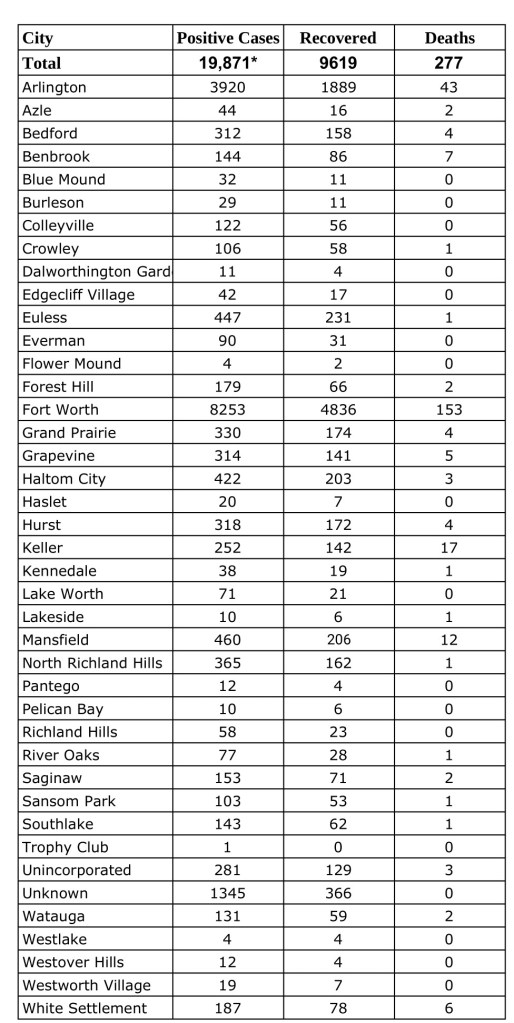
Tarrant County COVID-19 Activity – 7/15/20

COVID-19 Positive cases: 19,871*

COVID-19 related deaths: 277

Recovered COVID-19 cases: 9619

Data from Tarrant County Public Heath’s (TCPH) report of COVID-19 activity in Tarrant County, updated Wednesday, July 15, 2020. Find more COVID-19 information from TCPH here.

* These data are provisional and are subject to change at any time.

Deaths and recovered cases are included in total COVID-19 positive cases.

West Nile cases on the rise; Tarrant County residents urged to take precautions

West Nile Virus (WNV) has reemerged as a current health threat in North Texas. Tarrant County Public Health is advising residents to take extra care as WNV cases increase across the county. Public Health Director Vinny Taneja said precautions against WNV are particularly important during the current pandemic.

“It’s prudent to stay focused on protecting against COVID-19, and although mosquitoes do not carry the COVID-19 virus, we don’t want to minimize the dangers of West Nile right now,” Taneja said. The symptoms are similar and since it can be hard to tell the difference, he encouraged residents to see a doctor if they experience fever, cough or sore throat.  “We want to remind everyone to protect themselves against mosquitoes by wearing long sleeves and pants and using repellents when outside.”

Tarrant County Vector Control Supervisor Nina Dacko said most of the positive mosquito results have been in northeast Tarrant County. “In 2018 and 2019, the number of positive mosquito pool samples were very low, which is cause for concern this summer,” Dacko said. “Environmental factors are ripe for the virus to make a big comeback and recent rains also allow more mosquitoes to thrive in hot weather like Texas is experiencing right now.”


Here is a list of mosquito repellents endorsed by the FDA and CDC. Tarrant County Public Health also has more information about West Nile Virus and other preventive measures residents can take at Be Mosquito Free.

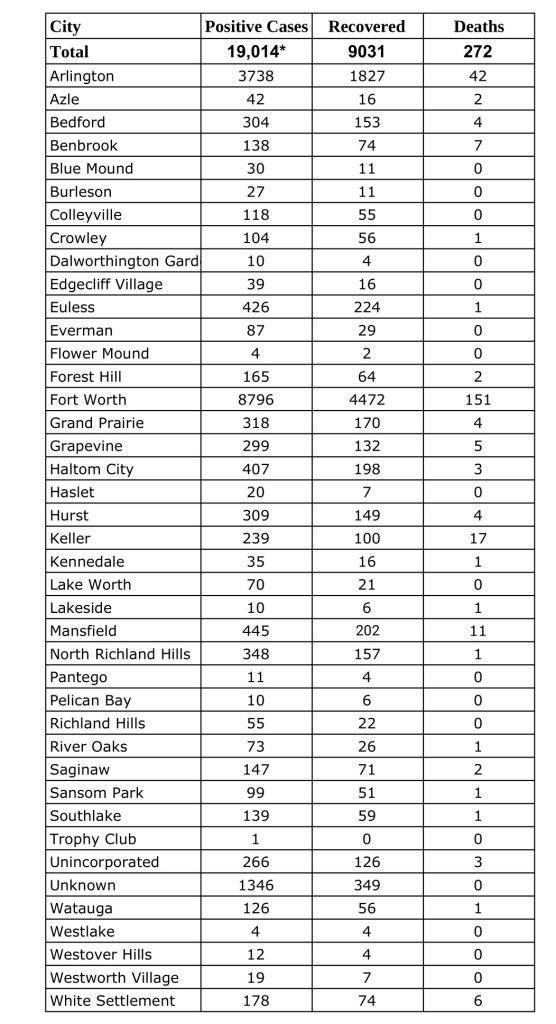
Tarrant County COVID-19 Activity – 7/14/20

COVID-19 Positive cases: 19,014*

COVID-19 related deaths: 272

Recovered COVID-19 cases: 9031

Data from Tarrant County Public Heath’s (TCPH) report of COVID-19 activity in Tarrant County, updated Tuesday, July 14, 2020. Find more COVID-19 information from TCPH here.

* These data are provisional and are subject to change at any time.

Deaths and recovered cases are included in total COVID-19 positive cases.

Preceptors Needed for TCOM Students

Students from the Texas College of Osteopathic Medicine (TCOM) need assistance finding available rotations for their fourth year of medical school. These students are responsible for scheduling their own rotations, but COVID-19 has made it difficult for them to do so. Due to the virus, many hospitals and clinics that typically participate are unable to provide preceptors. To combat this, TCOM’s class officers have produced a TCOM Preceptor Sign-Up Form, making it easy for physicians in our community to participate as preceptors.

If you have any questions, you can contact Conner Reynolds, M.S., OMS-IV, at ConnerReynolds@my.unthsc.edu.

Tarrant County COVID-19 Activity – 7/10/20

COVID-19 Positive cases: 17,334*

COVID-19 related deaths: 262

Recovered COVID-19 cases: 7730

Data from Tarrant County Public Heath’s (TCPH) report of COVID-19 activity in Tarrant County, updated Friday, July 10, 2020. Find more COVID-19 information from TCPH here.

* These data are provisional and are subject to change at any time.

Deaths and recovered cases are included in total COVID-19 positive cases.

Design a site like this with WordPress.com
Get started