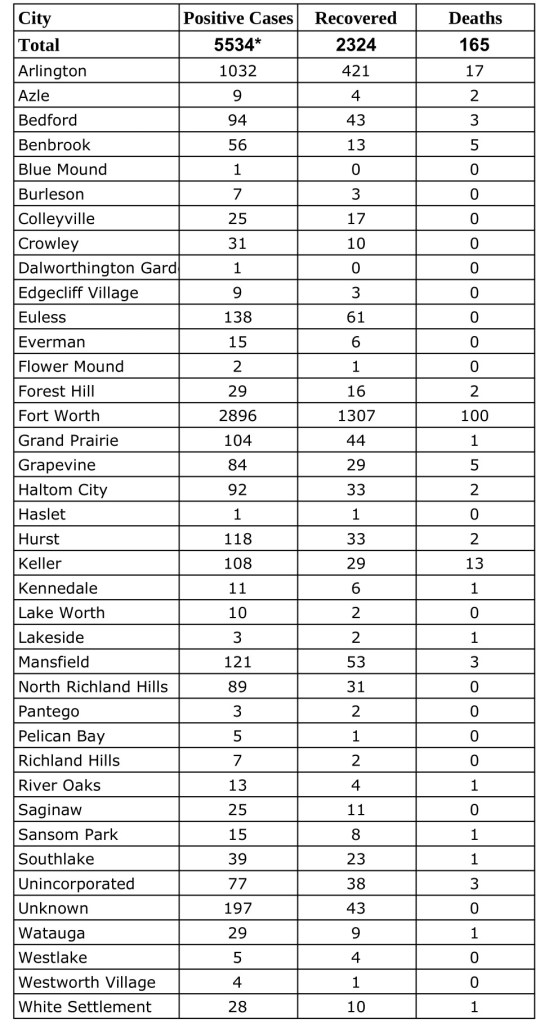
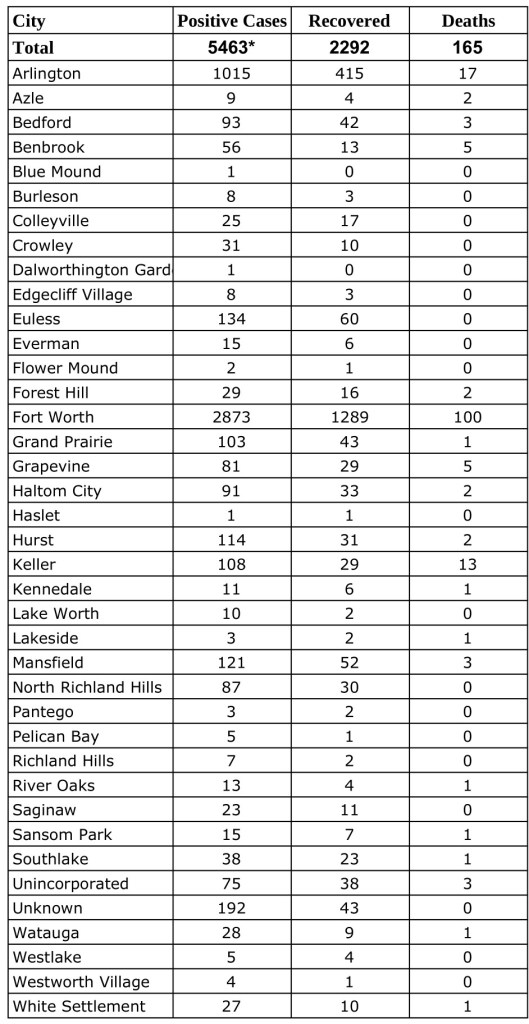
Tarrant County COVID-19 Activity – 5/30/20

COVID-19 Positive cases: 5463*

COVID-19 related deaths: 165

Recovered COVID-19 cases: 2292

Data from Tarrant County Public Heath’s (TCPH) report of COVID-19 activity in Tarrant County, updated Friday, May 29, 2020. Find more COVID-19 information from TCPH here.

* These data are provisional and are subject to change at any time.

Deaths and recovered cases are included in total COVID-19 positive cases.

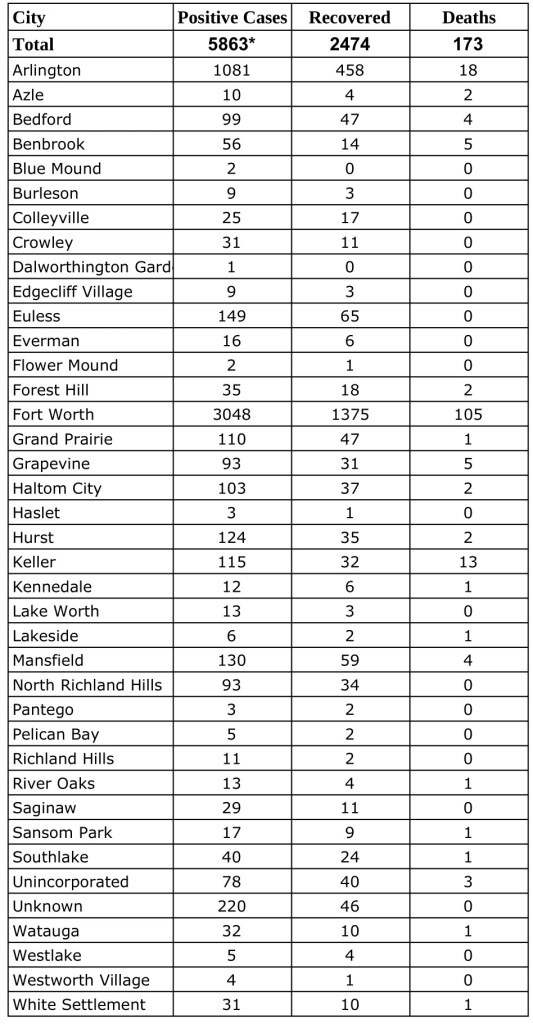
Tarrant County COVID-19 Activity – 5/29/20

COVID-19 Positive cases: 5379*

COVID-19 related deaths: 160

Recovered COVID-19 cases: 2220

Data from Tarrant County Public Heath’s (TCPH) report of COVID-19 activity in Tarrant County, updated Friday, May 29, 2020. Find more COVID-19 information from TCPH here.

* These data are provisional and are subject to change at any time.

Deaths and recovered cases are included in total COVID-19 positive cases.

Which Plans Pay for Telemedicine Services – and for How Long?

Originally published on the Texas Medical Association website.

As you’re no doubt aware, telemedicine has made it possible for many physicians to continue seeing patients while reducing the risk of spread during the COVID-19 pandemic. 

Temporary changes to state and federal rules, particularly regarding payment for services, have helped push up the new demand for and use of telemedicine. 

Prior to the pandemic, health plans did not have to pay physicians the same rate for telemedicine visits as for in-person visits. 

But what does each type of plan pay for visits? 

The Texas Medical Association has compiled information for various types of plans. Remember that some plans’ policies are different for audio-only visits

Commercial

  1. State-regulated plans. The Texas Department of Insurance’s (TDI) emergency rules requiring state-regulated health insurers and HMOs to pay an in-network health professional at least the same rate for a telemedicine or telehealth service as they would for the same service or procedure in-person took effect March 17. Those rules remain in effect for up to 120 days (mid-July). They can be extended for an additional 60 days if needed. (For more details, see TDIs FAQs.)
  2. ERISA (self-funded) employer-sponsored plans. There is no requirement for these federally regulated plans to pay the in-person rate for telemedicine care. However, many ERISA employee health plans are administered by Texas insurers – as a Third-Party Administrator (TPA). Many of the plans’ administrators have encouraged these plans to pay for telemedicine services at the same level as TDI-regulated plans, and many have. 

Medicare:

  1. The Centers for Medicare & Medicaid Services (CMS) has opened up a number of telemedicine payment policies for Medicare telemedicine services. The telehealth waiver remains effective until the Health and Human Services Department secretary declares the public health emergency has ended.
  2. In addition to audio and video services, CMS also allows for telephone-only encounters to be billed and paid at the in-person rate, retroactive to March 1. Refer to the Telemedicine Payer Policies matrix on the  TMA Telemedicine Resource Center for payer policy updates. 

Medicaid:

  1. Texas Medicaid recently authorized telemedicine payment for well-child checks for children older than 24 months. The state also approved other telemedicine flexibilities, such as payment for audio-only telemedicine and telehealth visits. These waivers all expire May 31, but TMA anticipates the Texas Health and Human Services Commission (HHSC) will extend them at least for one more month. TMA and state societies representing primary care and obstetrical physicians          have asked for a six-month extension, through November. 

You can find more information on the Telemedicine section of TMA’s COVID-19 Resource Center, which is updated with the latest news, resources, and government guidance regularly.

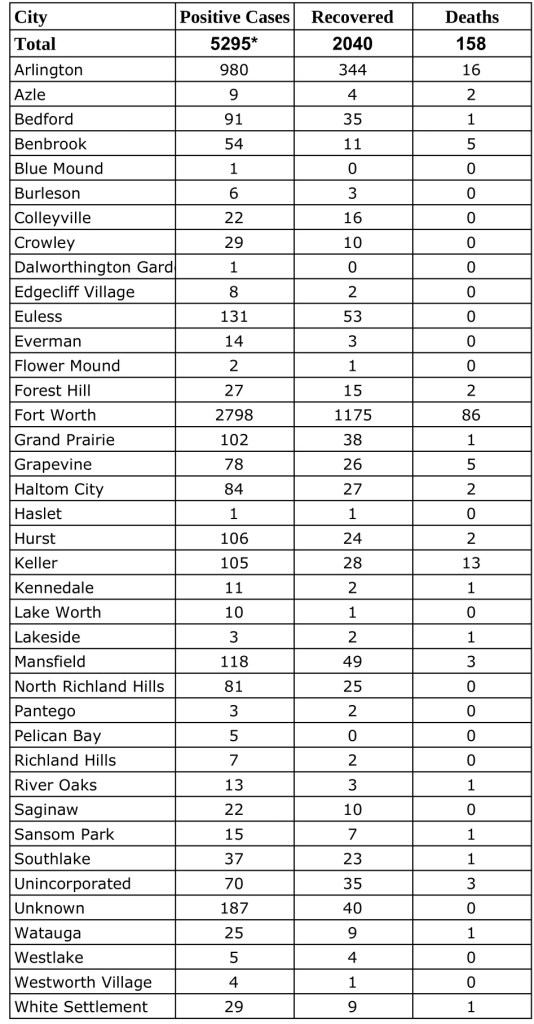
Tarrant County COVID-19 Activity – 5/28/20

COVID-19 Positive cases: 5295*

COVID-19 related deaths: 158

Recovered COVID-19 cases: 2040

Data from Tarrant County Public Heath’s (TCPH) report of COVID-19 activity in Tarrant County, updated Thursday, May 28, 2020. Find more COVID-19 information from TCPH here.

* These data are provisional and are subject to change at any time.

Deaths and recovered cases are included in total COVID-19 positive cases.

Pediatricians Care for and Protect Children Amidst the Pandemic

By Tammy Camp, MD President, Texas Pediatric Society

Usually at this time of year, children seen in a clinic setting respond with a resounding “yes” when asked if they are ready for school to be out. For many this year, the answer is different. Instead, several have said “No, I can’t wait to go back to school – I miss being there.”

These very thoughts are echoed by the pediatricians who see children and adolescents in their offices. We cannot wait to have children and their caregivers back in our offices so that we can address and treat their physical and emotional needs.

During a disaster such as this pandemic, behavioral health issues in children are likely to be exacerbated. We see this being played out in front of us now. Social isolation has led to increased depression; anxiety is intensified by the relentless news cycle and social media coverage.

The safety net for many children is the education system, but it is no longer functioning in this way for them. While reports of child abuse may be down due to children’s decreased contact with systems that normally watch over them, those children presenting with abuse to emergency rooms unfortunately have injuries far more serious and life-threatening.

Of great concern is data released from Texas Health and Human Services demonstrating a 10% decrease in doses administered every public health region of the state in March of 2020 compared to March of 2019. These decreases suggest that following the current crisis, our children could be faced with another: exposure to vaccine preventable diseases.

While all of this may seem discouraging, there is hope. Pediatricians are prepared to walk alongside their patients, helping them traverse these unprecedented challenges. We are not only prepared, but we long to assist children and caregivers in navigating these rough waters.

As Governor Abbott and his Strike Force team begin to reopen our state, Texas pediatricians stand ready to have the children and adolescents for whom they provide care back in their offices. The Texas Medical Board has instituted minimum standards to assist them in doing this safely. Those standards include that both the patient and the physician wear masks when within 6 feet of one another. Additionally, before encounters, patients must be screened for potential symptoms of COVID-19. Further, prior to procedures that are higher risk for aerosolization for COVID-19, the healthcare provider must use N-95 masks and face shields.
These standards are included in addition to what most offices had already implemented to protect their patients. Many offices are concentrating all well child care visits and behavioral health visits to designated morning times, while seeing patients who are ill in the afternoons. Most have implemented telemedicine appointments for visits that can safely be handled in this manner. The offices use increased cleaning measures between patients and at the end of the day.

Still, some offices may choose not to fully reopen, or may only provide limited access. Pediatricians will use their professional judgment to decide if and when they can resume full provision of services as they value the staff of nurses, receptionists and others in their team who assist in providing care and must place a priority on their health.

So now we ask you, the caregivers of our children, to partner with us as we prepare for the return of a “new normal.” We want to meet the emotional needs of your children. We want to provide you with tips for juggling your parenting responsibilities with your new educating duties. We want to ensure that preparticipation histories and physicals are completed so that your child is ready to safely enter extracurricular activities when they are allowed to resume. We also want to protect your child from another health crisis by keeping their immunizations up to date.

While many of our children eagerly anticipate the return of school, complete with the extracurricular activities and in-person reunions with their friends, we also look forward to welcoming you into our offices.

Four children treated for multisystem inflammatory syndrome at Cook Children’s Medical Center

From the Fort Worth City News Letter. Published on May 20, 2020.

A rare but serious health condition related to COVID-19 is now affecting children in North Texas. Since May 9, four patients have been treated at Cook Children’s Medical Center for multisystem inflammatory syndrome, or MIS-C. The children range in age from 6 to 14.

“All of these children presented to the hospital with symptoms that resembled a severe case of Kawasaki disease,” said Nicholas Rister, an infectious diseases physician at Cook Children’s.

Kawasaki disease is an illness that creates inflammation in blood vessels with no proven cause, but is generally thought to follow various infections after they have otherwise resolved. Rister said the patients with MIS-C arrived at Cook Children’s following exposure to COVID-19 and had symptoms including fever, abdominal pain and outward evidence of inflammation including diffuse rashes, conjunctivitis and swelling. In the more severe cases, evidence of multi-organ dysfunction including respiratory distress, low blood pressures, liver and kidney damage and altered mental status were also seen.

“Of particular concern to us is inflammation of the heart and surrounding major blood vessels which is also seen in Kawasaki’s disease. We have seen this same thing in several of these COVID-19 inflammatory disease patients,” Rister said. “Minimizing the degree of inflammation in these children, while providing supportive care for any organ damage, has been a key component of treatment.”

All four patients were tested for COVID-19. Three tests came back negative and one was positive.

“We believe all of these cases are related to COVID-19,” Rister said. “The three negative results are evidence of how far the infection had progressed, resulting in the inflammatory syndrome.”

Three of the patients have been released from the hospital. One remains in the pediatric intensive care unit.

In addition to the recent appearance of MIS-C cases, the infectious diseases team at Cook Children’s is also looking closely at increased reports of unexplained fevers in the area.

“We want parents to be aware of these cases as COVID-19 continues to spread in our community,” Rister said. “Unexplained fevers for several days and evidence of generalized inflammation may be signs of this illness.”

Symptoms of more severe MIS-C cases include severe abdominal pain, shock from low blood pressure, respiratory distress and lethargy. If a child exhibits any of these symptoms, seek emergency medical care immediately.

Less severe symptoms include fever, abdominal pain and rash. Caregivers should call a pediatrician if these symptoms appear, as they overlap with many other common infections and medical conditions. It is important for these children to be fully evaluated.

Tarrant County COVID-19 Activity – 5/26/20


COVID-19 Positive cases: 5039*

COVID-19 related deaths: 144

Recovered COVID-19 cases: 1912

Data from Tarrant County Public Heath’s (TCPH) report of COVID-19 activity in Tarrant County, updated Tuesday, May 26, 2020. Find more COVID-19 information from TCPH here.

* These data are provisional and are subject to change at any time.

Deaths and recovered cases are included in total COVID-19 positive cases.

Tarrant County COVID-19 Activity – 5/24/20

COVID-19 Positive cases: 4977*

COVID-19 related deaths: 144

Recovered COVID-19 cases: 1834

Data from Tarrant County Public Heath’s (TCPH) report of COVID-19 activity in Tarrant County, updated Sunday, May 24, 2020. Find more COVID-19 information from TCPH here.

* These data are provisional and are subject to change at any time.

Deaths and recovered cases are included in total COVID-19 positive cases.

Medical School in a Pandemic

By Shanna Combs, MD

These are interesting times here in North Texas.  I just spent the day completing an eight-hour curricular meeting for our Phase 2 Longitudinal Integrated Clerkship, all through online video conferencing.  These are the current social distancing times of COVID-19.  

Our students have also adjusted to this new reality, by having all their learning converted to online video conferencing.  This includes their small groups, where they work through clinical cases, develop learning objectives, then come back together to teach their fellow students what they have learned.  Their clinical skills sessions are also online where our students can work with their physician educator as well as standardized patients to hone their craft.  While not an ideal platform for teaching hands-on clinical skills, the students are getting introduced to the ever-increasing telehealth that has become more common during this pandemic and will likely be more common after the pandemic comes to an end.  Our students have also been able to engage with patient panels online, where the patients engage with the class in a conversation on their disease processes that are connected to the curricular content the students are learning.  

Unfortunately, during this time our students have also had to step away from their clinical duties, which currently includes working with a family medicine or internal medicine physicians for a half day every other week.  While the students are not able to participate in direct patient care at this time, they have not been deterred.  They now want to find other ways they can contribute to the local community during this pandemic.  They are working on a project to do readings of children’s books for children to access online during this time of sheltering in place and distance learning for all students.   Our students are also working to support and participate in blood drives as well as working on setting up a PPE drive to obtain the necessary PPE for our local clinics and hospitals who are in need.  They truly understand the meaning of being Empathetic Scholars™.

The students are also taking this time to work with their mentors (virtually, of course) for their Scholarly Pursuit and Theses project.  This is a four-year long research program where students work one-on-one with a local mentor to develop, perform, and ultimately present their own scholarly work.  Lastly, our Prep for Practice course is taking the current situation of the COVID-19 pandemic to highlight the many themes in their course including Ethics, Health Care Delivery, Health Care Policy and Advocacy, Informatics, Patient safety and CQI, Population Health, Physician as Educator, Psychological and Behavior Science, as well as Team-Based Care.  So many of these important topics can be highlighted through the lens of the COVID-19 pandemic.

While the pandemic carries on, we at the TCU and UNTHSC School of Medicine continue our work for our students, but ultimately for their future patients.  The COVID-19 pandemic will hopefully pass sooner than later, yet our students will continue in their education and be even more prepared for the next crisis in healthcare.  

Tarrant County COVID-19 Activity – 5/23/20

COVID-19 Positive cases: 4951*

COVID-19 related deaths: 143

Recovered COVID-19 cases: 1832

Data from Tarrant County Public Heath’s (TCPH) report of COVID-19 activity in Tarrant County, updated Saturday, May 23, 2020. Find more COVID-19 information from TCPH here.

* These data are provisional and are subject to change at any time.

Deaths and recovered cases are included in total COVID-19 positive cases.

Design a site like this with WordPress.com
Get started