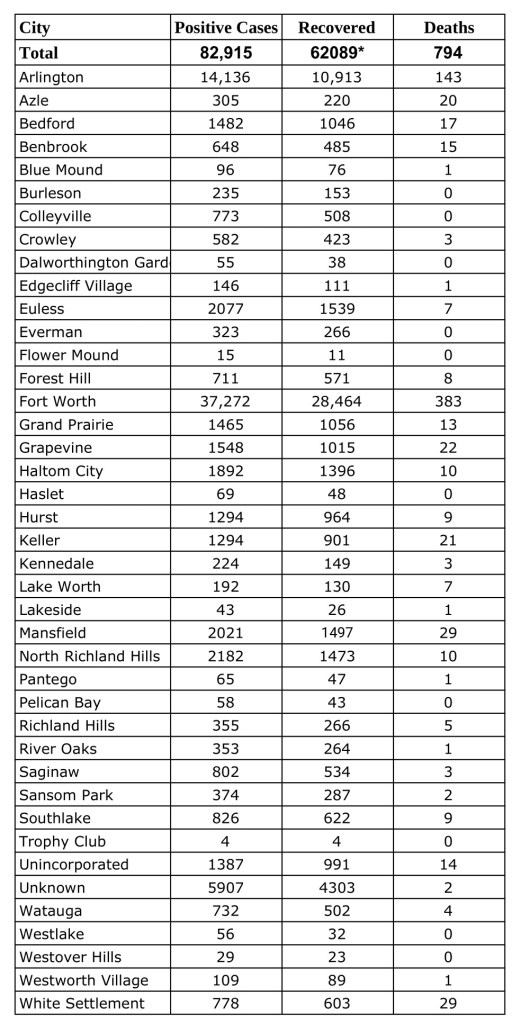
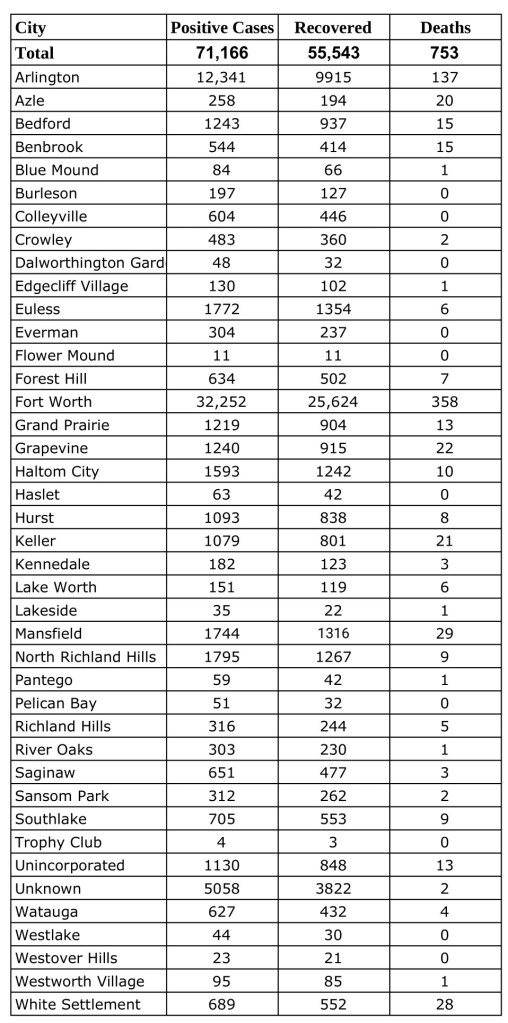
Data from Tarrant County Public Heath’s (TCPH) report of COVID-19 activity in Tarrant County, updated Monday, November 16, 2020.Find more COVID-19 information from TCPH here.
*These data are provisional and are subject to change at any time.
Deaths and recovered cases are included in total COVID-19 positive cases.
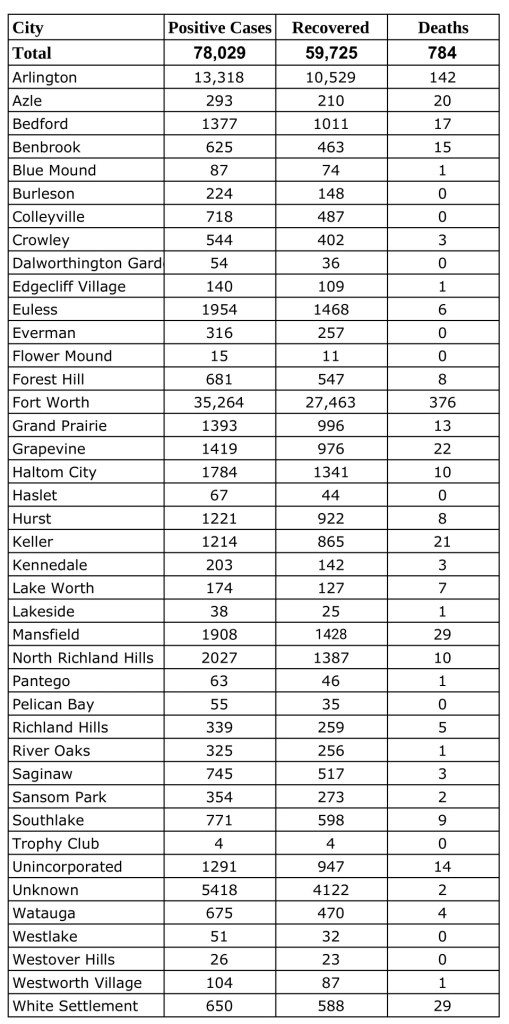
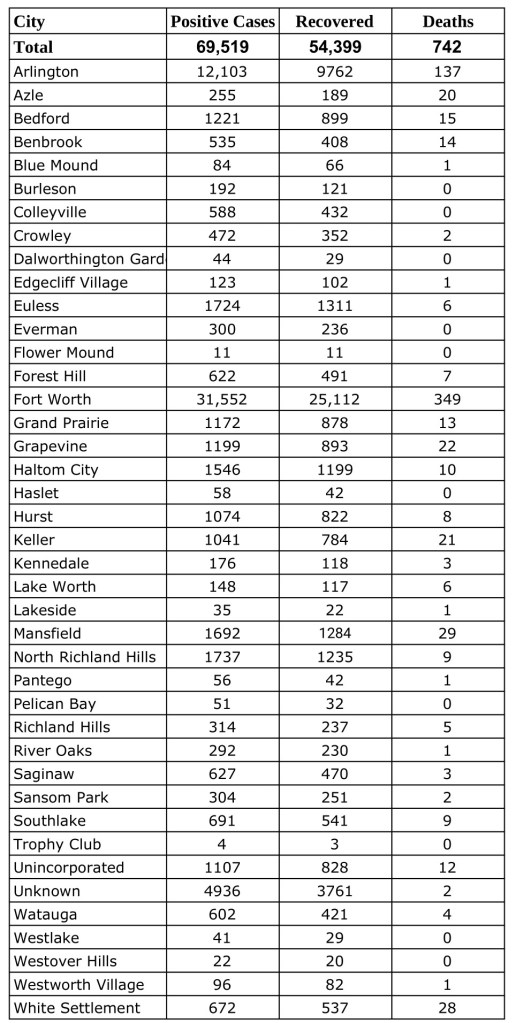
Data from Tarrant County Public Heath’s (TCPH) report of COVID-19 activity in Tarrant County, updated Friday, November 13, 2020.Find more COVID-19 information from TCPH here.
*These data are provisional and are subject to change at any time.
Deaths and recovered cases are included in total COVID-19 positive cases.
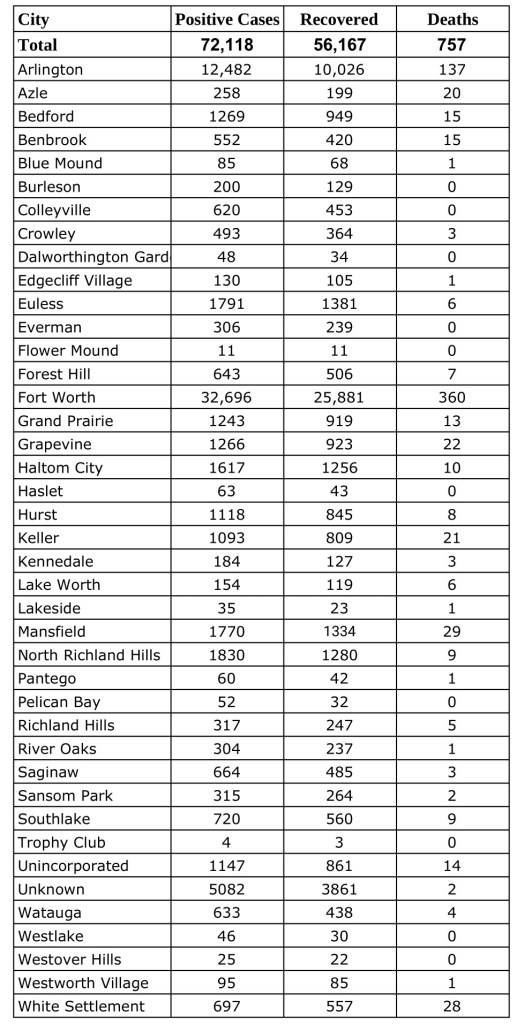
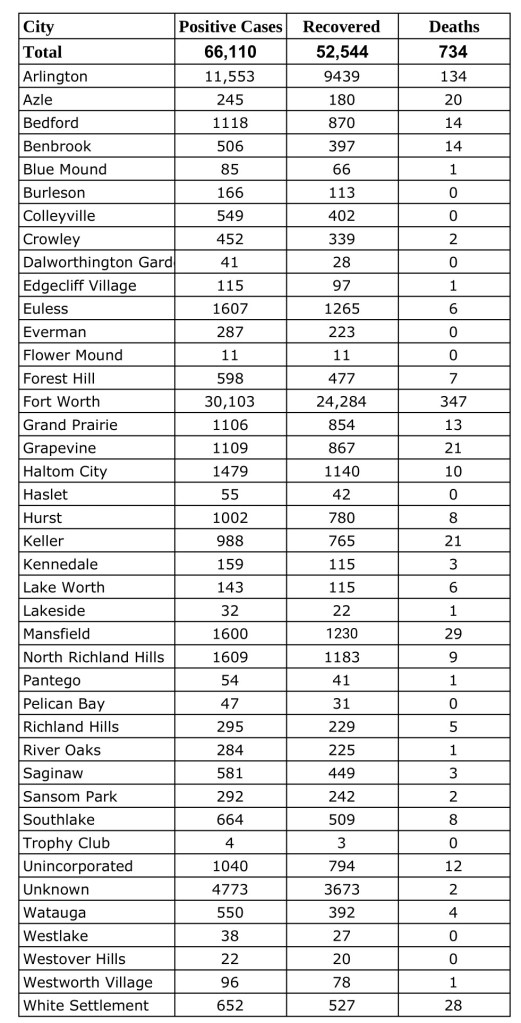
Data from Tarrant County Public Heath’s (TCPH) report of COVID-19 activity in Tarrant County, updated Thursday, November 12, 2020.Find more COVID-19 information from TCPH here.
*These data are provisional and are subject to change at any time.
Deaths and recovered cases are included in total COVID-19 positive cases.
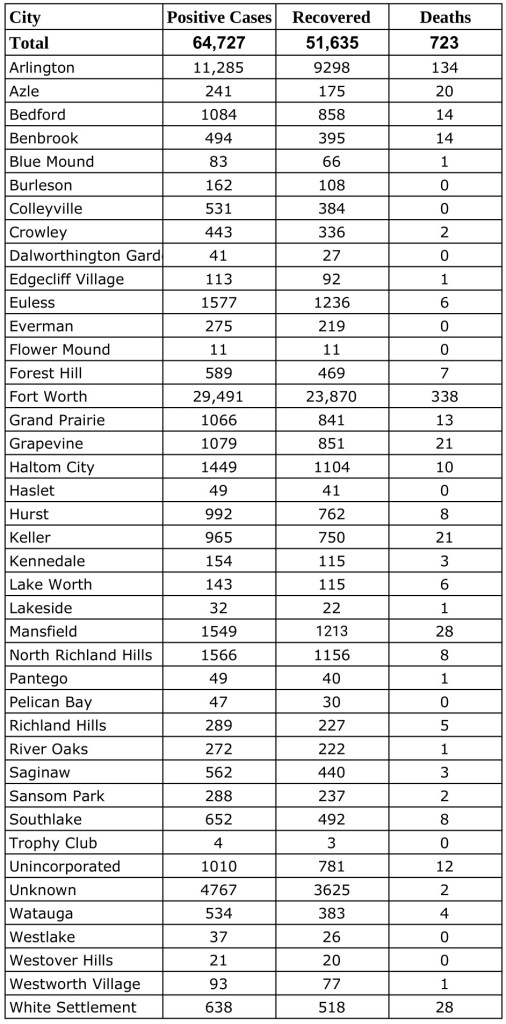
Data from Tarrant County Public Heath’s (TCPH) report of COVID-19 activity in Tarrant County, updated Friday, November 6, 2020.Find more COVID-19 information from TCPH here.
*These data are provisional and are subject to change at any time.
Deaths and recovered cases are included in total COVID-19 positive cases.
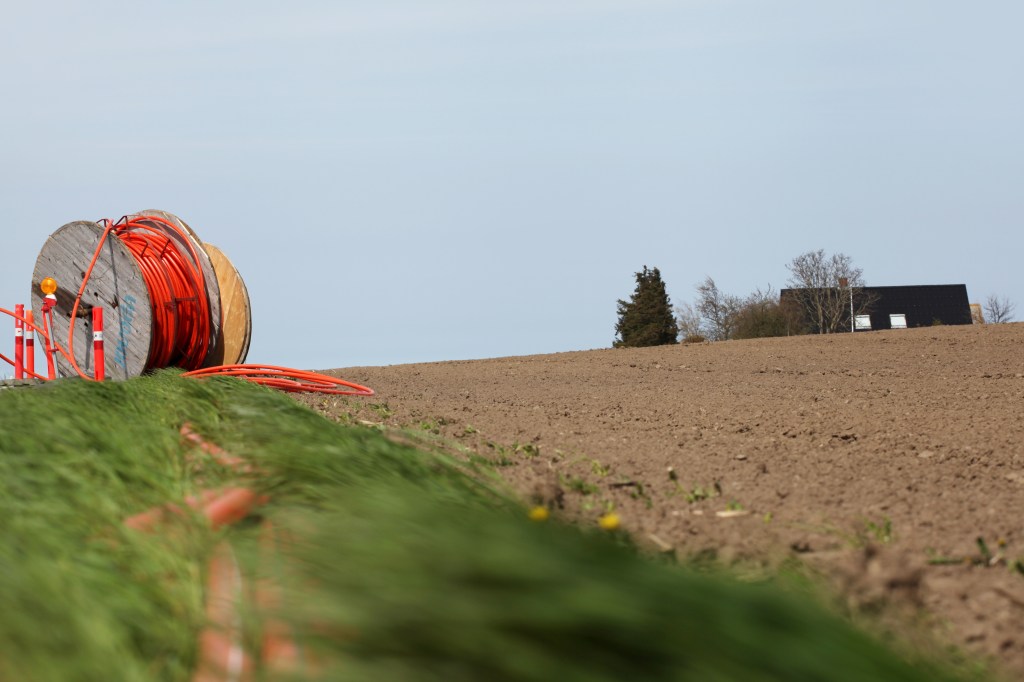
Texas Medical Association (TMA) President Diana L. Fite, MD, addressed the Texas Governor’s Broadband Development Council’s recommendations to create a state broadband plan and develop a funding program to support broadband expansion to unserved areas in Texas.
“TMA supports the Texas Governor’s Broadband Development Council’s call for funding and focused planning, prioritizing this initiative that ultimately could help improve the health of all Texans.
“Our vast state needs sufficient broadband infrastructure to serve the millions of Texans living in the thousands of square miles of rural area currently without sufficient internet access. Texas physicians know this means not only are those patients likely miles away from a physician and health care but also they’re likely disconnected from telemedicine, a particularly important tool during a pandemic.”
TMA is the largest state medical society in the nation, representing more than 53,000 physician and medical student members. It is located in Austin and has 110 component county medical societies around the state. TMA’s key objective since 1853 is to improve the health of all Texans.
Data from Tarrant County Public Heath’s (TCPH) report of COVID-19 activity in Tarrant County, updated Thursday, November 5, 2020.Find more COVID-19 information from TCPH here.
*These data are provisional and are subject to change at any time.
Deaths and recovered cases are included in total COVID-19 positive cases.
Data from Tarrant County Public Heath’s (TCPH) report of COVID-19 activity in Tarrant County, updated Tuesday, November 3, 2020.Find more COVID-19 information from TCPH here.
*These data are provisional and are subject to change at any time.
Deaths and recovered cases are included in total COVID-19 positive cases.
Data from Tarrant County Public Heath’s (TCPH) report of COVID-19 activity in Tarrant County, updated Thursday, October 29, 2020.Find more COVID-19 information from TCPH here.
*These data are provisional and are subject to change at any time.
Deaths and recovered cases are included in total COVID-19 positive cases.
Data from Tarrant County Public Heath’s (TCPH) report of COVID-19 activity in Tarrant County, updated Tuesday, October 27, 2020.Find more COVID-19 information from TCPH here.
*These data are provisional and are subject to change at any time.
Deaths and recovered cases are included in total COVID-19 positive cases.
This piece was originally published in the September/October issue of the Tarrant County Physician. You can read find the full magazine here.
by Tilden Childs, MD – TCMS President
When I was perusing the Wall Street Journal the other day, I ran across an article by one of my favorite writers, Daniel Henninger. He started his article with the following observation, “On Tuesday the New York City sky was clear, blue and filled with sunshine. That’s it for this week’s good news.” His article was not about COVID-19, but it prompted me to think that yes, there is some good news on COVID-19.
As I suspected early on, the COVID-19 pandemic is not going to be a short-term phenomenon with a “V” shaped medical recovery for the country, unlike the stock market (well at least some stocks). However, some recent developments do appear to be positive and hope for some return to normalcy has not been extinguished. The re-opening of the U.S. economy has been progressing, which is good, but unfortunately the infection rates have also increased. Parts of Texas, particularly in the Valley, are suffering. However, the mantra of “wear a mask or face covering, wash your hands frequently, and maintain physical distancing” seems to be working when rigorously applied. Even President Trump is taking the situation more seriously and now supports the wearing of a mask or facial covering.
The mortality rate from COVID-19 may be lower than was initially thought, but this is a complicated issue. As explained in an article in Nature: “Researchers use a metric called infection fatality rate (IFR) to calculate how deadly a new disease is. It is the proportion of infected people who will die as a result, including those who don’t get tested or show symptoms.” “The IFR is one of the important numbers alongside the herd immunity threshold and has implications for the scale of an epidemic and how seriously we should take a new disease,” says Robert Verity, an epidemiologist at Imperial College London. “Calculating an accurate IFR is challenging in the midst of any outbreak because it relies on knowing the total number of people infected—not just those who are confirmed through testing. But the fatality rate is especially difficult to pin down for COVID-19, the disease caused by the SARS-CoV-2 virus,” says Timothy Russell, a mathematical epidemiologist at the London School of Hygiene and Tropical Medicine. “That’s partly because there are many people with mild or no symptoms, whose infection has gone undetected, and also because the time between infection and death can be as long as two months.”1
Some potential reasons for the apparent recent decrease in the mortality rate were discussed in an article in The Atlantic: “COVID-19 Cases Are Rising, So Why Are Deaths Flatlining?”2
Deaths lag cases—and that might explain almost everything.
Expanded testing finds more cases, milder cases, and earlier cases.
The typical COVID-19 patient is getting younger.
Hospitalized patients are dying less frequently, even without a home-run treatment.
Summer might be helping—but only a little bit.
Let’s hope that #1 above is not correct! I would like to believe that the evolution of our understanding of the virus and the disease it causes, including a better appreciation for its variable severity and multi-organ involvement, has and will continue to result in more and better treatment options which are at least in part improving mortality and morbidity outcomes.
“This is really good news as it now appears that herd immunity may be the key to successfully mitigating the current crisis and controlling the SARS CoV-2 virus.”
Progress on developing a vaccine(s) is moving forward at an accelerated pace. This is the result of the National Institutes of Health and the Foundation for the NIH (FNIH) forming the Accelerating COVID-19 Therapeutic Interventions and Vaccines (ACTIV) partnership with the goal of developing “a collaborative framework for prioritizing vaccine and drug candidates, streamlining clinical trials, coordinating regulatory processes and/or leveraging assets among all partners to rapidly respond to the COVID-19 and future pandemics.”3 This represents an unprecedented cooperative alliance between government agencies and private industry to expedite the development of vaccine(s) as well as begin production of potentially successful vaccines in advance of final approval of the vaccine(s). At the time of writing this article, Phase III trials are about to begin for at least one of the vaccines under development. Availability of a vaccine(s) may be as early as late 2020 or early 2021.
This is really good news as it now appears that herd immunity may be the key to successfully mitigating the current crisis and controlling the SARS CoV-2 virus. Recent evidence suggests that immunity following infection is time limited and that significant long-term morbidity is believed to occur after recovery from the acute COVID-19 infection phase. This means that herd immunity generated by vaccinations rather than by community infections looks to be the key to getting the crisis under control and reducing the mortality rate and the long-term sequelae of community acquired infections.
I hope this Good News gives you reason to Keep up the fight and Keep the faith.


 Tarrant County Physician Online