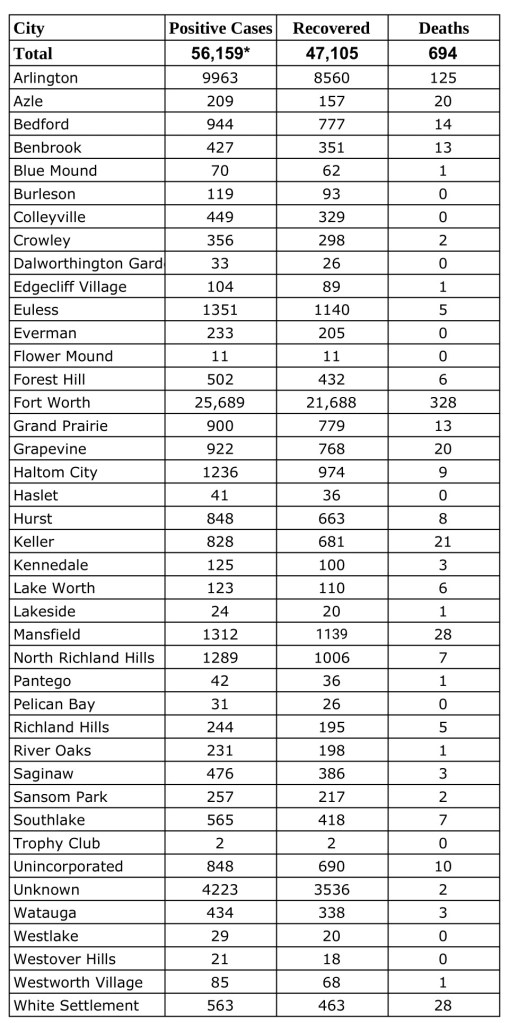
Data from Tarrant County Public Heath’s (TCPH) report of COVID-19 activity in Tarrant County, updated Wednesday, October 14, 2020.Find more COVID-19 information from TCPH here.
These data are provisional and are subject to change at any time.
Deaths and recovered cases are included in total COVID-19 positive cases.
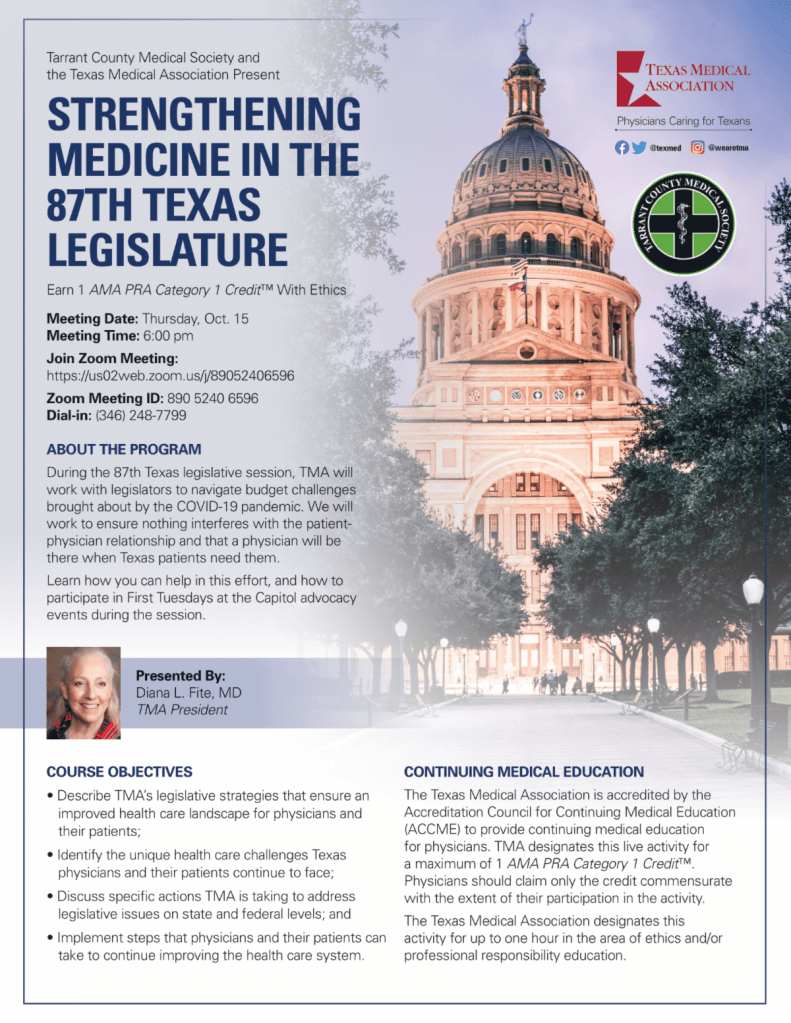
On Thursday, October 15, at 6pm, Tarrant County Medical Society and Texas Medical Association are presenting “Strengthening Medicine in the 87th Texas Legislature,” a virtual CME that will cover advocacy efforts that protect the practice of medicine and the patient-physician relationship.
The CME will be presented by TMA President Diana Fite, MD, and moderated by former TCMS President Robert Rogers, MD.
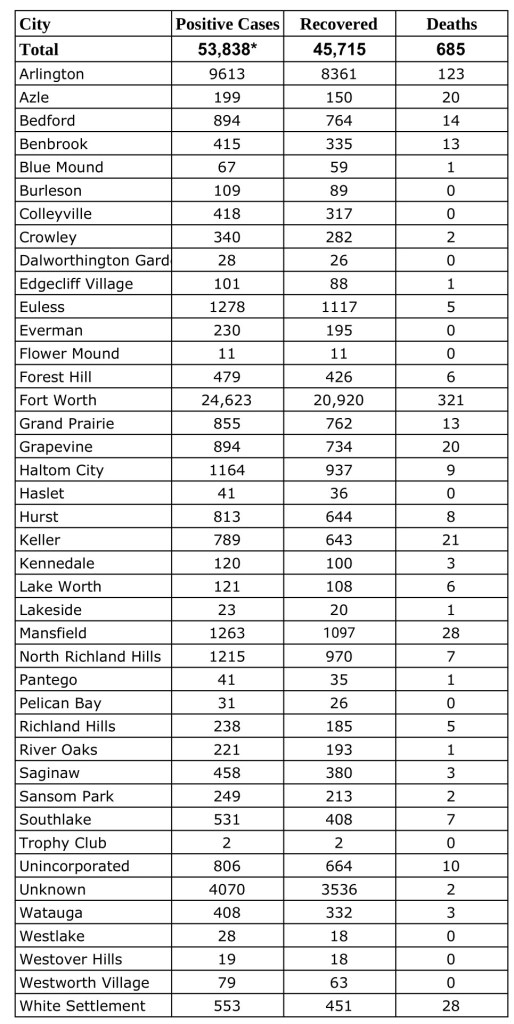
Data from Tarrant County Public Heath’s (TCPH) report of COVID-19 activity in Tarrant County, updated Tuesday, October 13, 2020.Find more COVID-19 information from TCPH here.
These data are provisional and are subject to change at any time.
Deaths and recovered cases are included in total COVID-19 positive cases.
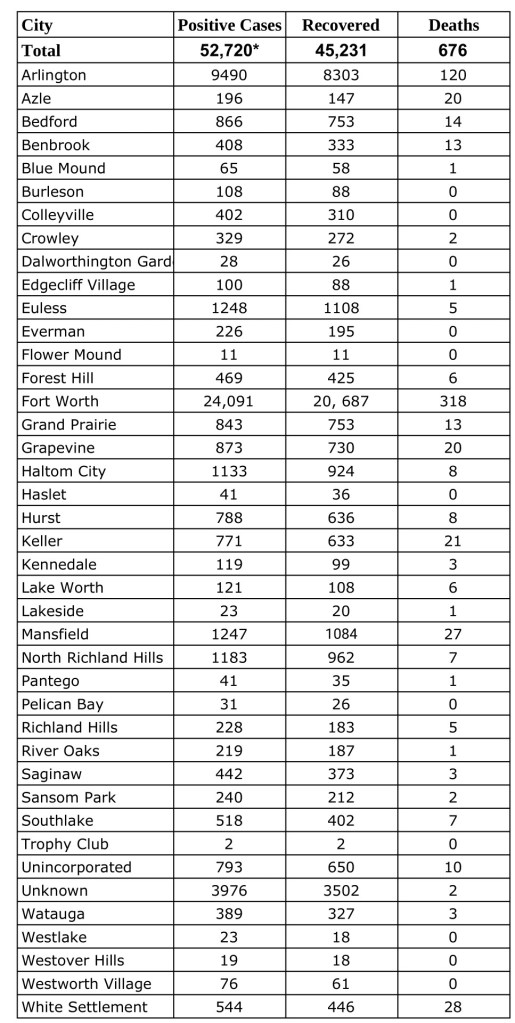
Data from Tarrant County Public Heath’s (TCPH) report of COVID-19 activity in Tarrant County, updated Monday, October 12, 2020.Find more COVID-19 information from TCPH here.
These data are provisional and are subject to change at any time.
Deaths and recovered cases are included in total COVID-19 positive cases.
This piece was originally published in the September/October issue of the Tarrant County Physician. You can read find the full magazine here.
As is tradition, despite what may be going on in the world (global pandemic, public demonstrations, etc.) every year, sometime in late June or early July, the wheel of medical education continues to turn. The TCU and UNTHSC School of Medicine continued this cycle on July 6, 2020. And just like that, our school went from one class to two, officially welcoming its second class of 60 medical students. The students in the Class of 2024 are from 18 states within the U.S., with 38 percent of them from Texas. Fifty-five percent are male and 45 percent are female. The new students come from 45 different undergraduate higher education institutions.
And just like that, there were two, and we continue our journey of developing a new medical school.
Similarly to our now second-year medical students, our first-year medical students are having to discover the brave new world of virtual medical education due to COVID-19. Despite this distance, our new students show the same enthusiasm for diving in that is always present in a brand-new class. This enthusiasm helps to invigorate those of us involved in medical education, and it helps us to continue to appreciate the honor it is to be a physician as well as an educator.
I was fortunate to participate in an interprofessional education event with our new first years as well as senior nursing students from TCU, held virtually of course. Our students were able to work through the concepts of communication in the clinical environment with the nursing students. They were also able to gain insight from the nursing students who have already been working in the clinical environment. It reminds me how important it is that our learners start working together while training. We highlight the concept that medicine is a team sport, and we must work together to obtain optimal outcomes for our patients.
The medical education wheel continues to turn.
By the time you read this, our second-year students will have completed the first of three phases of our curriculum, which is traditionally considered the basic science content. After years of planning and a global pandemic occurring more than halfway through our first year, it is hard to believe that this milestone has already occurred. Our students will now begin the transition to the clinical learning environment (barring any changes that may occur due to COVID-19). They will have the opportunity to step away from the computer screen and step back onto the campus for their Transition to the LIC course.
They will first get acquainted with the new normal of wearing a mask while trying to interact and gain rapport with simulated patients. They will also practice and hone clinical skills that were not able to be taught virtually. They will learn new procedures and have opportunities to practice. They will discover different medical environments, such as the operating room, labor and delivery, the inpatient setting, the emergency room, and outpatient clinic, and how they will play a role in those settings. They will also learn about the appropriate donning and doffing of personal protection equipment as well as telehealth that is now more commonplace due to the COVID-19 pandemic.
Once they complete their transitions course, the students will move into the hospital setting to continue their education. We are grateful to our physician and hospital partners in the community who have worked with us to bring our students into their clinical practice and hospital settings. To quote Sir William Osler, “To study the phenomena of disease without books is to sail an uncharted sea, while to study books without patients is not to go to sea at all.”1
And just like that, the medical education wheel continues to turn.
References 1. Boston Medical and Surgical Journal, January 17, 1901, page 60.
Kroger Health will offer drive-thru vaccinations noon to 6 p.m. Friday, Oct. 9 and 9 a.m.-3 p.m. Saturday, Oct. 10 in the Chevrolet parking lot at Dickies Arena, 3464 Trail Drive.
Kroger Health, the health care division of The Kroger Co., announced a partnership with the City of Fort Worth and Tarrant County as part of a comprehensive flu shot program designed to provide recommended vaccines amid the COVID-19 pandemic.
The Centers for Disease Control and Prevention estimates that during an average flu season, 8% of the U.S. population gets sick from the flu, with an average of 500,000 flu-related hospitalizations.
To make an appointment
If you do not speak English well, call the Tarrant County Public Health Information Line at 817-248-6299.
Si no habla inglés, por favor llame al Tarrant County Public Health línea de información a 817 248-6299.
Nếu quý vị không rành Tiếng Anh, xin vui lòng gọi đường dây thông tin Tarrant County Public Health (Y Tế Cộng Đồng Quan Tarrant) theo số 817 248-6299.
Walk-ups are welcome on Friday and Saturday.
Event details:
Flu shots will be provided at no cost, with or without insurance. Children must be six months or older.
Flu shots are available at no out-of-pocket cost to those with Medicare B and are also fully covered by many insurance plans. Bring identification and an insurance card.
For the safety of patients and the health care team, vaccinations are limited to one arm per vehicle door. Wear short sleeves.
Data from Tarrant County Public Heath’s (TCPH) report of COVID-19 activity in Tarrant County, updated Thursday, October 8, 2020.Find more COVID-19 information from TCPH here.
These data are provisional and are subject to change at any time.
Deaths and recovered cases are included in total COVID-19 positive cases.
Data from Tarrant County Public Heath’s (TCPH) report of COVID-19 activity in Tarrant County, updated Tuesday, October 6, 2020.Find more COVID-19 information from TCPH here.
These data are provisional and are subject to change at any time.
Deaths and recovered cases are included in total COVID-19 positive cases.
Data from Tarrant County Public Heath’s (TCPH) report of COVID-19 activity in Tarrant County, updated Monday, October 5, 2020.Find more COVID-19 information from TCPH here.
These data are provisional and are subject to change at any time.
Deaths and recovered cases are included in total COVID-19 positive cases.
Data from Tarrant County Public Heath’s (TCPH) report of COVID-19 activity in Tarrant County, updated Thursday, October 1, 2020.Find more COVID-19 information from TCPH here.
These data are provisional and are subject to change at any time.
Deaths and recovered cases are included in total COVID-19 positive cases.





 Tarrant County Physician Online