COVID-19 testing sites to be added throughout Fort Worth

The City of Fort Worth and Tarrant County are expanding COVID-19 testing for residents throughout the city.

Tests will be available at these locations:

  1. Tuesday, Aug. 11, FWISD Scarborough-Handley Field parking lot 6201 Craig St.
  2. Wednesday, Aug.12, Tarrant County College-Northwest Campus, 4801 Marine Creek Parkway.
  3. Thursday, Aug. 13, Beth Eden Missionary Baptist Church, 3208 Wilbarger St.
  4. Friday, Aug. 14, Christ Church Fort Worth Assembly of God, 5301 Altamesa Blvd.

Tests will be available at these locations for one day only before the test site moves to a new location.

Tests will be available from 8-11 a.m. and 2-5 p.m. daily. Tests at all sites are available by online appointment. Residents who do not have access to a computer may call 817-248-6299 to schedule an appointment.

“Fort Worth will continue to collaborate with partners to ensure COVID-19 testing is readily available and accessible to all residents throughout all of Fort Worth,” said Mayor Betsy Price. “Testing plays a critical role in our continued efforts to prioritize public health, keep Fort Worth’s economy open and get our children back in school.”

In coming weeks, additional sites will be added as suitable locations are identified.

“It is vitally important that we bring more testing to Tarrant County,” said Tarrant County Judge Glen Whitley. “We’re excited to expand our partnership with the City of Fort Worth to add more testing across the county, making it easier for residents to get tested.”

The city’s emergency response volunteers will continue to staff two COVID-19 testing sites, which are currently open:

  1. J.P. Elder Middle School, 709 N.W. 21st St. 8 a.m.-noon.
  2. Dickies Arena’s Chevrolet Parking Garage, 3464 Trail Drive. 2-6:30 p.m.

City staff from Police, Fire and Code Compliance departments, along with certified city volunteers for emergency response, are staffing the sites and guiding patients through the self-administered saliva sample collection process. Tests are offered at no cost to the public; however, insurance information is collected, where possible.

Learn more about COVID-19 testing options in Fort Worth and Tarrant County.

View updated testing numbers.

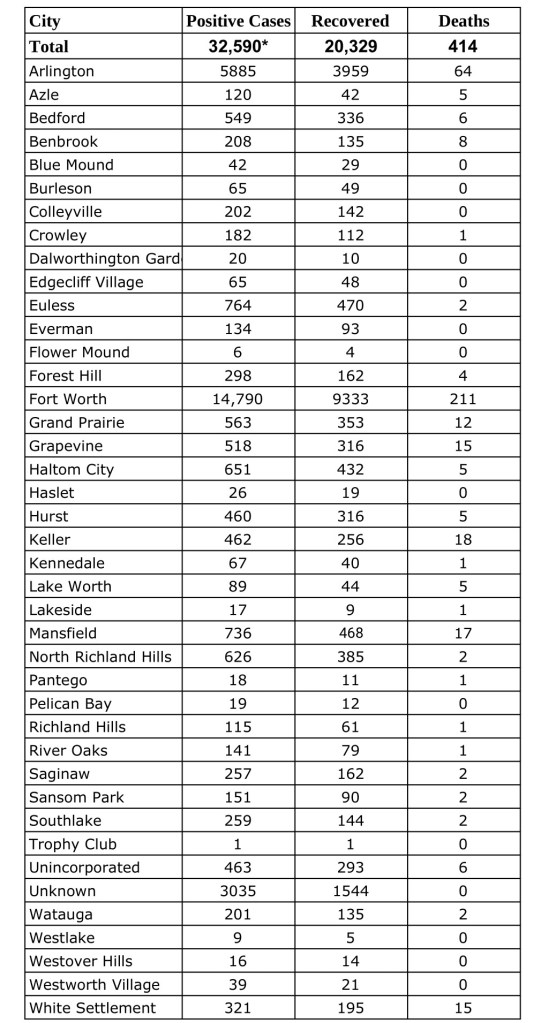
Tarrant County COVID-19 Activity – 8/7/20

COVID-19 Positive cases: 32,590*

COVID-19 related deaths: 414

Recovered COVID-19 cases: 20,329

Data from Tarrant County Public Heath’s (TCPH) report of COVID-19 activity in Tarrant County, updated Friday, August 7, 2020. Find more COVID-19 information from TCPH here.

* These data are provisional and are subject to change at any time.

Deaths and recovered cases are included in total COVID-19 positive cases.

Provide This Letter to COVID-19 Patients Returning to Onsite Work

Originally published by the Texas Medical Association.

By now you’ve probably treated a lot of COVID-19 patients, many of whom have recovered from the illness.

Although employees are not required by law to present a letter from a physician clearing them to return to work, many employers request one.

If your practice doesn’t already have such a letter, the Texas Medical Association has created one that you can customize for your practice.

The letter, which is available here, outlines guidance from the Centers for Disease Control and Prevention (CDC) on when employees who have exhibited symptoms or who have tested positive should return to work. It also explains a negative swab test is not required by law for employees to return to work.

The letter is one of several COVID-19-related documents TMA has created that you can customize for your practice’s and patients’ individual needs. Those resources as well as up-to-date news, information, and tips can be found on the TMA COVID-19 Resource Center.

Tarrant County COVID-19 Activity – 7/31/20

COVID-19 Positive cases: 28,410*

COVID-19 related deaths: 381

Recovered COVID-19 cases: 14,397

Data from Tarrant County Public Heath’s (TCPH) report of COVID-19 activity in Tarrant County, updated Friday, July 31, 2020. Find more COVID-19 information from TCPH here.

* These data are provisional and are subject to change at any time.

Deaths and recovered cases are included in total COVID-19 positive cases.

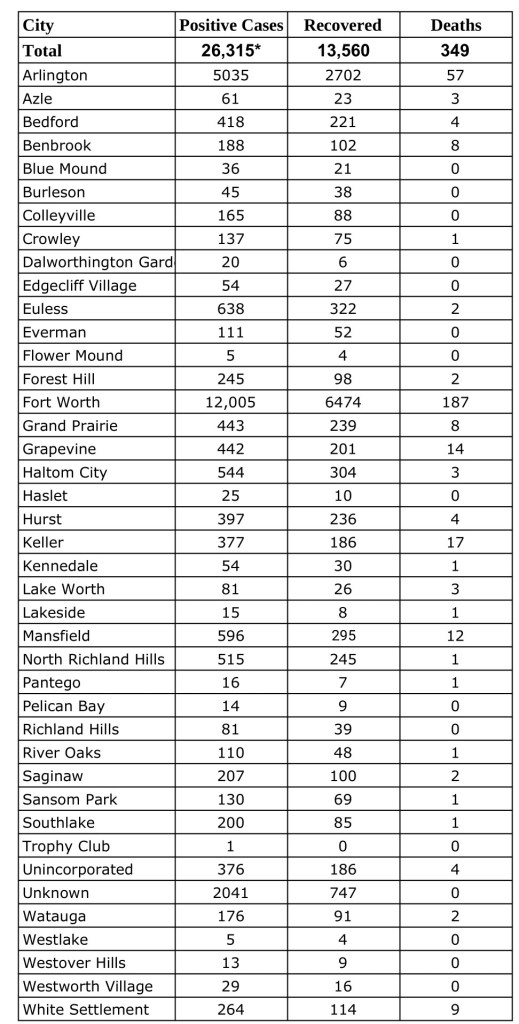
Tarrant County COVID-19 Activity – 7/28/20


COVID-19 Positive cases: 26,315*

COVID-19 related deaths: 349

Recovered COVID-19 cases: 13,560

Data from Tarrant County Public Heath’s (TCPH) report of COVID-19 activity in Tarrant County, updated Tuesday, July 28, 2020. Find more COVID-19 information from TCPH here.

* These data are provisional and are subject to change at any time.

Deaths and recovered cases are included in total COVID-19 positive cases.

Tarrant County COVID-19 Activity – 7/23/20

COVID-19 Positive cases: 23,967*

COVID-19 related deaths: 319

Recovered COVID-19 cases: 11, 680

Data from Tarrant County Public Heath’s (TCPH) report of COVID-19 activity in Tarrant County, updated Thursday, July 23, 2020. Find more COVID-19 information from TCPH here.

* These data are provisional and are subject to change at any time.

Deaths and recovered cases are included in total COVID-19 positive cases.

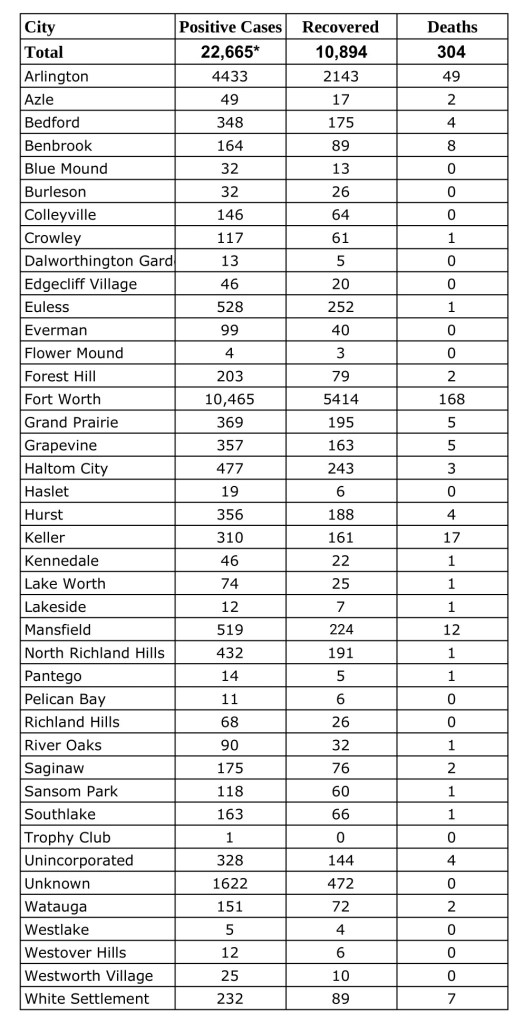
Tarrant County COVID-19 Activity – 7/21/20


COVID-19 Positive cases: 22,665*

COVID-19 related deaths: 304

Recovered COVID-19 cases: 10,894

Data from Tarrant County Public Heath’s (TCPH) report of COVID-19 activity in Tarrant County, updated Tuesday, July 21, 2020. Find more COVID-19 information from TCPH here.

* These data are provisional and are subject to change at any time.

Deaths and recovered cases are included in total COVID-19 positive cases.

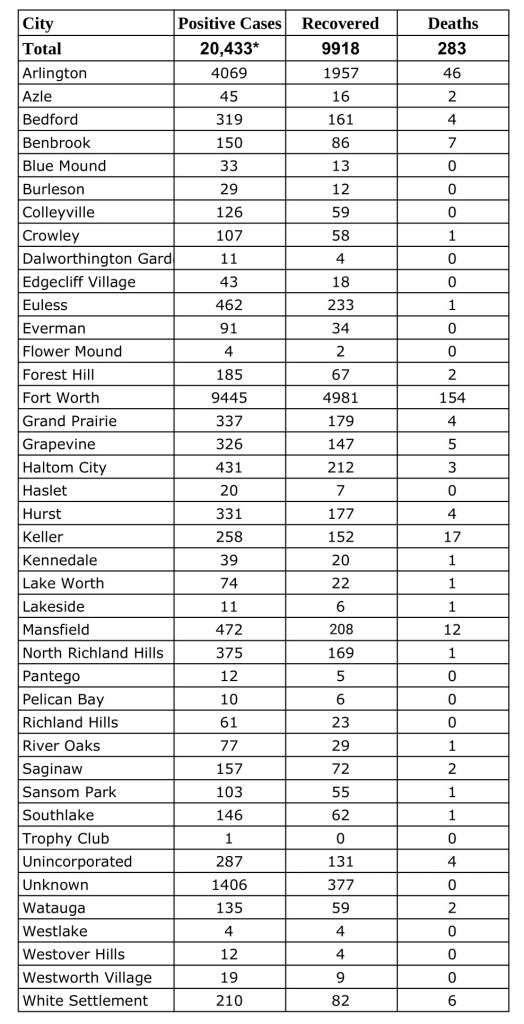
Tarrant County COVID-19 Activity – 7/16/20

COVID-19 Positive cases: 20,433*

COVID-19 related deaths: 283

Recovered COVID-19 cases: 9918

Data from Tarrant County Public Heath’s (TCPH) report of COVID-19 activity in Tarrant County, updated Thursday, July 16, 2020. Find more COVID-19 information from TCPH here.

* These data are provisional and are subject to change at any time.

Deaths and recovered cases are included in total COVID-19 positive cases.

COVID-19 Testing, Isolation, and Quarantine Answers

As COVID-19 numbers continue to rise, misconceptions and confusion surrounding the virus have also increased. As more individuals come in contact with COVID-19, questions regarding best practices for isolation, quarantine, and how to obtain testing have circulated. In response, the North Texas Medical Society Coalitions (NTMSC) has provided answers for the most commonly asked questions.

Q. Does an individual need to get tested if he or she has COVID-19 symptoms?

A. Persons with symptoms of potential COVID-19 infection, including the following, should consider getting tested to confirm COVID-19. Always talk with your physician about the necessity and best method for obtaining a test:

  1. fever, cough, shortness of breath, chills, muscle pain, new loss of taste or smell, vomiting or diarrhea, and/or sore throat;
  2. anyone 65-years-old or older;
  3. anyone with chronic health issues (diabetes, asthma, heart issues, etc.);
  4. first responders or essential workers; and
  5. persons without symptoms who have been actively engaged in large group settings, such as public gatherings or congregations of people, within the past 15 days.

Q.  Does an individual need to get tested if they were exposed to someone who is COVID-19 positive but are not showing any symptoms themselves?

A.  Probably not. Persons who have been exposed to someone with confirmed COVID-19 but who are not symptomatic do not need to obtain a test unless it is required by an employer, school, or other third party. In all cases the person who was exposed should quarantine themselves for 14 days to ensure they do not develop symptoms. Even if the person obtains a test and it comes back as negative, it is important to complete the 14 days of quarantine since tests may give false negatives if the virus has not fully developed in infected individuals.

Q. What is the difference between isolation and quarantine?

A.  Individuals who are confirmed positive for COVID-19 but who are not sick enough to require admission to a hospital should isolate themselves to one room in their home and avoid all interaction with family members and pets. Individuals who have been exposed to someone who has COVID-19 but do not know if they contracted the virus should quarantine themselves inside their house for 14 days to ensure they do not develop symptoms.

Q. If someone has COVID-19 and has symptoms, at what point can the individual stop isolating themselves?

A. The individual should remain in isolation until three days after a fever has subsided, respiratory symptoms have improved, and it has been at least 10 days after the first on-set of symptoms. Some employers may require two negative COVID-19 nasal swab tests done at least 24 hours apart before allowing isolated individuals to return to the workplace.

Q. If an individual tests positive for COVID-19, but does not have any symptoms, how long should he or she isolate themselves?

A. Anyone who is confirmed COVID-19 positive without symptoms should isolate for 10 days. 

Q. If someone has contact with an individual who tests positive for COVID-19, do they need to quarantine themselves? If so, for how long?

A. Anyone who has been exposed to, or in close contact with, an individual who tests positive for COVID-19 needs to quarantine for 14 days, as it may take that long for symptoms to develop.

Q. What does being in “close contact” mean?

A.  Close contact means:

  1. Being within six feet of someone who has COVID-19 for 15 minutes or longer;
  2. Taking care of someone who has COVID-19;
  3. Having physical contact with someone who has the virus;
  4. Sharing eating or drinking utensils with someone who has COVID-19; and
  5. Being sneezed on or coughed on by someone who has the virus.

Q. Where can I get tested?

A. Individuals who need COVID-19 testing should contact their physicians for recommendations; if further resources are needed, they should check Txcovidtest.org to see what options are available.

Individuals are always encouraged to talk to their doctor first about the appropriate steps to take to keep themselves and their family safe in regard to COVID-19. Physicians can also provide the best advice about managing COVID-19, such as if a test is necessary or where to obtain a test.

Knowing how to respond when encountering COVID-19 is an important part of reducing the number of cases in North Texas. Combining this information with the proactive measures of masking, hand washing, maintaining physical distance, and staying home when possible empowers individuals in the community to protect themselves and others. 

About North Texas Medical Society Coalition: 

The NTMSC represents more than 11,500 physicians in the communities of Collin-Fannin, Dallas, Denton, Grayson, and Tarrant County. Founded in 2020, NTMSC works with community healthcare partners, including public health departments, hospitals, and business leaders, to advise on medical recommendations to serve the health care needs of the residents of North Texas. 
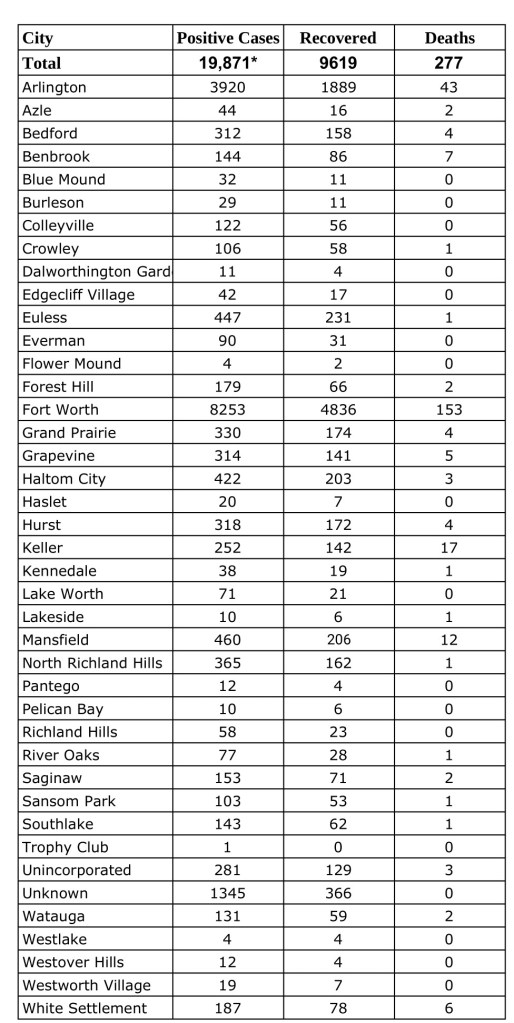
Tarrant County COVID-19 Activity – 7/15/20

COVID-19 Positive cases: 19,871*

COVID-19 related deaths: 277

Recovered COVID-19 cases: 9619

Data from Tarrant County Public Heath’s (TCPH) report of COVID-19 activity in Tarrant County, updated Wednesday, July 15, 2020. Find more COVID-19 information from TCPH here.

* These data are provisional and are subject to change at any time.

Deaths and recovered cases are included in total COVID-19 positive cases.

Design a site like this with WordPress.com
Get started