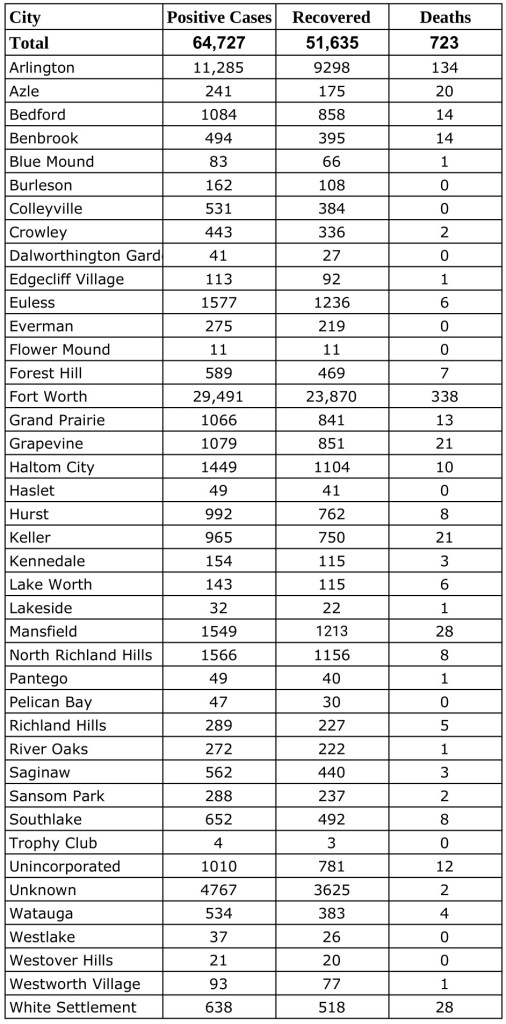
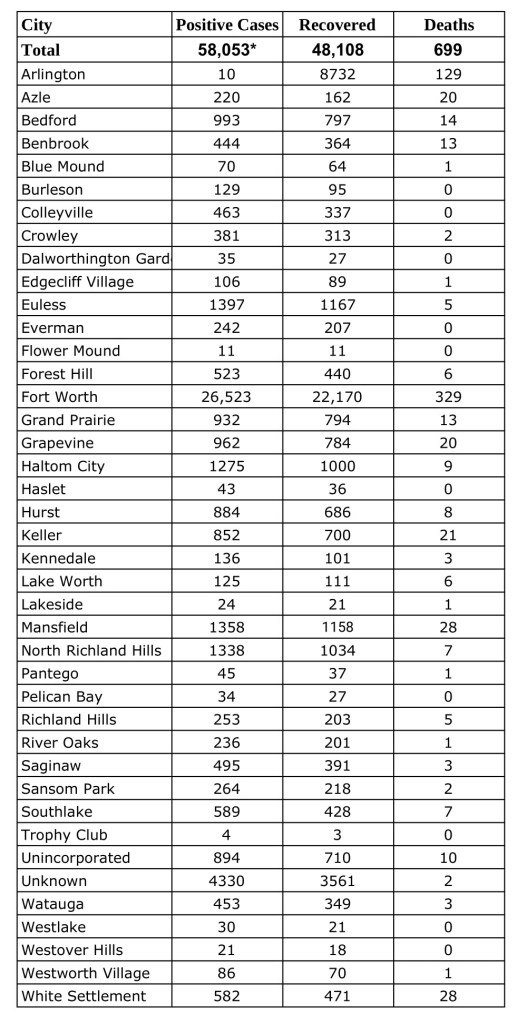
Data from Tarrant County Public Heath’s (TCPH) report of COVID-19 activity in Tarrant County, updated Tuesday, October 27, 2020.Find more COVID-19 information from TCPH here.
*These data are provisional and are subject to change at any time.
Deaths and recovered cases are included in total COVID-19 positive cases.
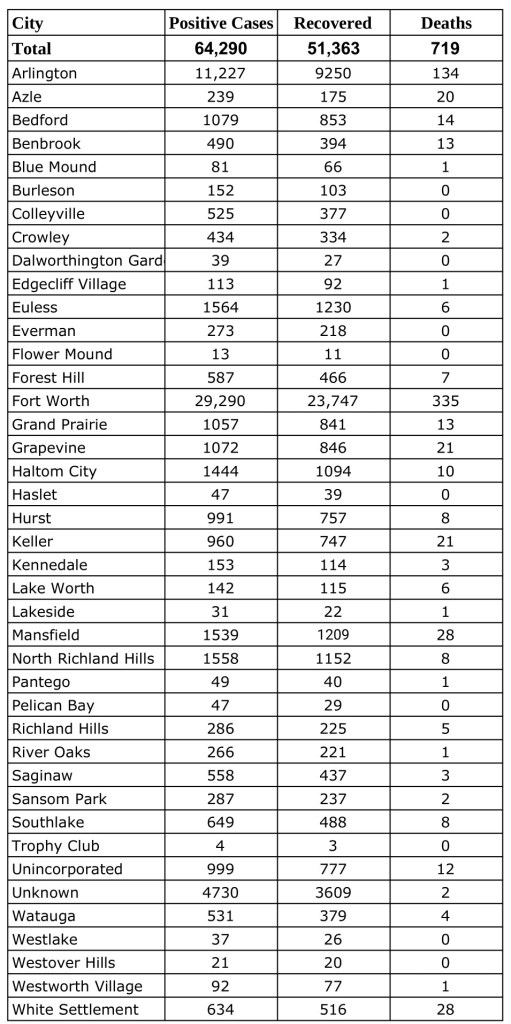
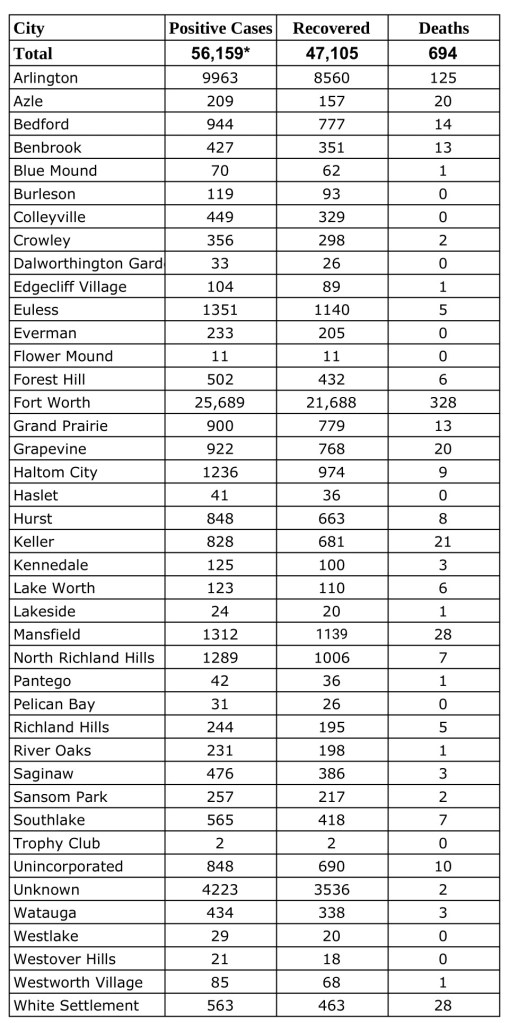
Data from Tarrant County Public Heath’s (TCPH) report of COVID-19 activity in Tarrant County, updated Monday, October 26, 2020.Find more COVID-19 information from TCPH here.
These data are provisional and are subject to change at any time.
Deaths and recovered cases are included in total COVID-19 positive cases.
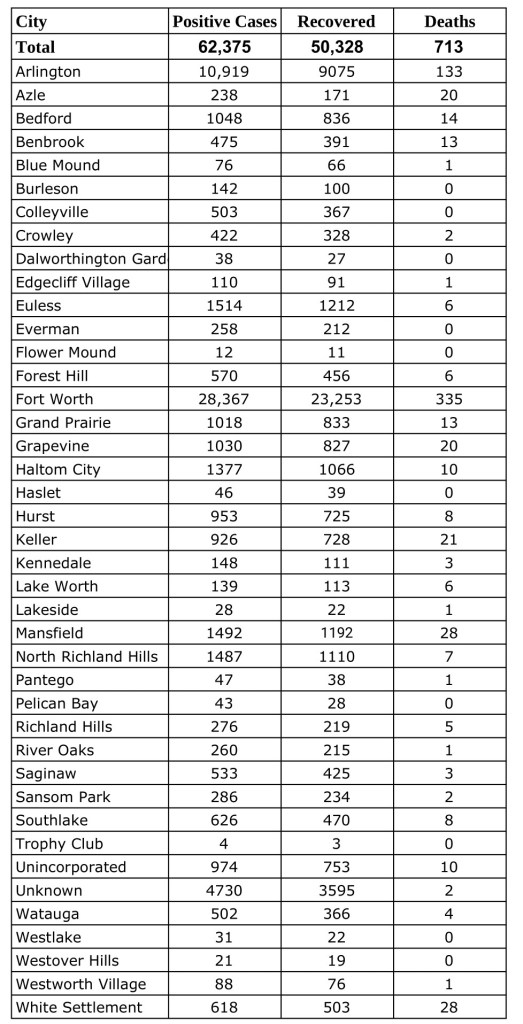
Data from Tarrant County Public Heath’s (TCPH) report of COVID-19 activity in Tarrant County, updated Friday, October 23, 2020.Find more COVID-19 information from TCPH here.
These data are provisional and are subject to change at any time.
Deaths and recovered cases are included in total COVID-19 positive cases.
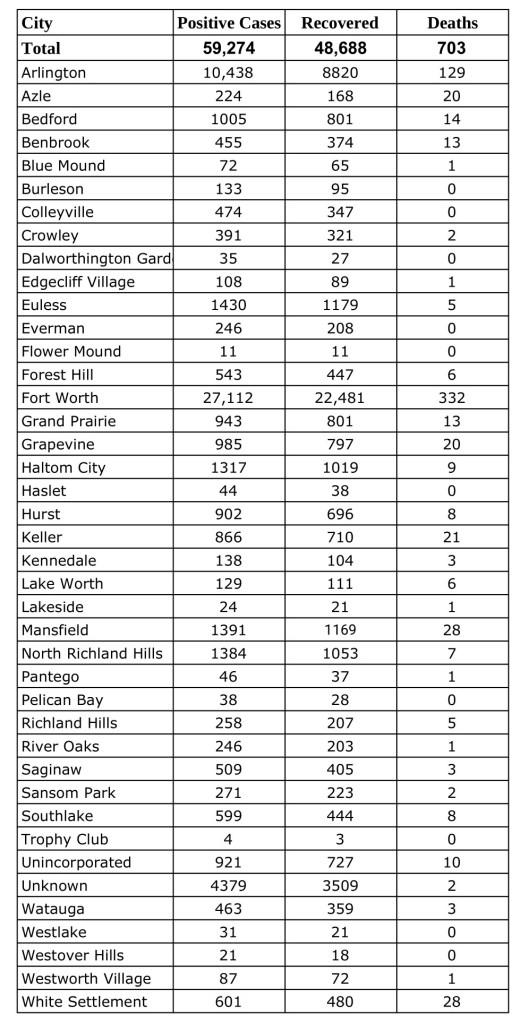
Data from Tarrant County Public Heath’s (TCPH) report of COVID-19 activity in Tarrant County, updated Sunday, October 18, 2020.Find more COVID-19 information from TCPH here.
These data are provisional and are subject to change at any time.
Deaths and recovered cases are included in total COVID-19 positive cases.
Data from Tarrant County Public Heath’s (TCPH) report of COVID-19 activity in Tarrant County, updated Friday, October 16, 2020.Find more COVID-19 information from TCPH here.
These data are provisional and are subject to change at any time.
Deaths and recovered cases are included in total COVID-19 positive cases.
Data from Tarrant County Public Heath’s (TCPH) report of COVID-19 activity in Tarrant County, updated Wednesday, October 14, 2020.Find more COVID-19 information from TCPH here.
These data are provisional and are subject to change at any time.
Deaths and recovered cases are included in total COVID-19 positive cases.
Data from Tarrant County Public Heath’s (TCPH) report of COVID-19 activity in Tarrant County, updated Tuesday, October 13, 2020.Find more COVID-19 information from TCPH here.
These data are provisional and are subject to change at any time.
Deaths and recovered cases are included in total COVID-19 positive cases.
Data from Tarrant County Public Heath’s (TCPH) report of COVID-19 activity in Tarrant County, updated Monday, October 12, 2020.Find more COVID-19 information from TCPH here.
These data are provisional and are subject to change at any time.
Deaths and recovered cases are included in total COVID-19 positive cases.
By Catherine Colquitt, MD, Tarrant County Public Health Medical Director
This piece was originally published in the September/October issue of the Tarrant County Physician. You can read find the full magazine here.
There is still much controversy regarding efficacy of masking during the COVID-19 pandemic, so I reviewed some of the thousands of peer-reviewed scientific articles addressing this topic since SARS exploded onto the world stage in 2003. Epidemiologists, infection perfectionists, and most if not all practicing physicians field questions from patients, friends, health care workers, and first responders about masking, and, while a comprehensive literature survey is beyond my scope, I came away from my reading heartened by evidence which clearly supports masks as a source control measure (a means of preventing transmission of infection from a source to others) AND endorses the use of masks, especially respirator and surgical masks, to PROTECT the wearer as well.
Masks, along with social (or physical) distancing, and hygiene (hand and surface disinfection, and cough and sneeze control) are the mainstays of control of droplet-spread pathogens and are critically important when COVID-19 hospital resources are strained, when treatments are reserved only for the sickest of those hospitalized, and in the absence of a vaccine or treatment for outpatients with COVID-19.
The science of evaluating masks is very complicated and typically involves at least three parameters: filtration efficacy (percentage of particles prevented from escaping the wearer’s mask), the pressure gradient across the mask (affects filtration efficacy and the comfort of the wearer), and fit, or face seal, of the mask on the wearer (droplets can escape more easily around looser edges of the mask on the wearer’s face).
The National Institute of Occupational Safety and Health (NIOSH) is responsible for conducting research and making recommendations for the prevention of work-related injury and illness and is a resource for information regarding healthcare and occupational PPE in setting on COVID-19. NIOSH also assesses important PPE to confirm efficacy and develops crisis strategies for coping with PPE shortages. NIOSH is responsible for the “N95” label on the mask you have likely been fit-tested to wear. The “95” generally indicates filtration efficacy of 95 percent of particles in the challenge aerosol (usually 0.1 micron diameter latex sphere aerosol) from the nose and mouth of the wearer. The “N” indicates that the respirator is NOT resistant to oil, “R” is somewhat resistant to oil, and “P” is oil-proof. (The oil resistance matters in some industrial settings in which the oils to which the respirator filters are exposed can remove the electrostatic charges from the filter media and thereby compromise filter efficacy.)
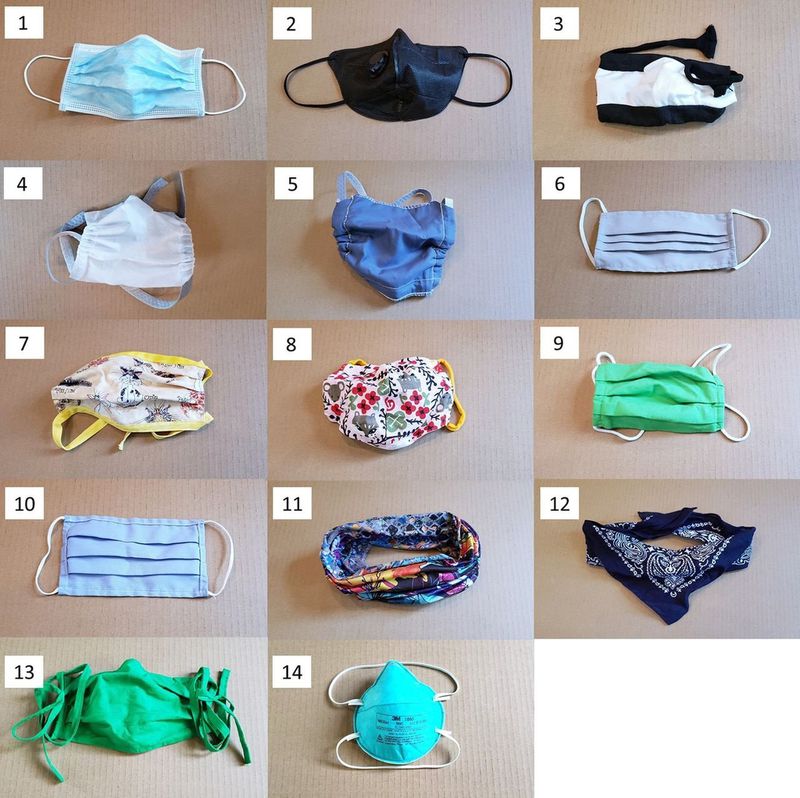
Fig. 1. Pictures of face masks under investigation. We tested 14 different face masks or alternatives and one mask (not shown). Photo Credit: Emma Fischer, Duke University.
In 2008, VanderSande et al. evaluated professional and homemade masks (made from tea cloth) for their efficacy in reducing respiratory infections in the general population and found that cloth masks provided a “modest degree” of protection to the wearer, while surgical masks were 25 times more effective and respirator masks were 50 times more effective at protecting the wearer than homemade cloth masks.1
S. Rengasamy et al., writing in Annals of Occupational Hygiene in 2010, analyzed filtration performance of cloth masks for particles 20-1000 nanometers in diameter and found instantaneous penetration level of 40 percent to 90 percent across the range of fabrics they tested.1
Fischer et al presented a low-cost technique for assessing filtration efficacy through various mask fabrics during speech and confirmed excellent filtration efficacy of respirator and surgical masks (figure 1), fair efficacy of some multilayered cotton, polyester, and mixed fabric masks, poor filtration efficacy with some cotton weaves as well as knitted masks and bandanas, and, somewhat remarkably, very poor filtration efficacy for fleece face coverings (often used in gaiters or “neck tubes”). (See figure 2) Fleece performed worse than no face covering at all, presumably by dispersing larger droplets into several smaller ones, thereby increasing the droplet count.
Davies et al., in Disaster Medicine and Public Health, tested the efficacy of homemade masks as protection in an influenza pandemic and offered that homemade masks should be used only “as a last resort” to prevent droplet transmission from infected individuals, but a homemade mask would be “better than no protection.”4
Scientists continue to study how and when and whom to mask since SARS and H1N1, and aerosol science will continue to evolve and to refine our use of PPE during and after the COVID-19 pandemic, but the overwhelming published scientific opinion supports the use of masks and, the better the mask, the better the protection for the wearer and those he or she faces.
Ready! Set! Mask!
References 1. VanderSande et al. 2008. PLOS ONE 3 (7) e2118.
2. S. Rengasamy et al. Annals of Occupational Hygiene, 2010. Vol 54, No 7, pp 789-798.
3. Fischer et al. Science Advances. SciAdv.10.1126/sciadv.abh3083, 2020.
4. Davies et al. Disaster Medicine and Public Health Preparedness. 2013 August: 7 (4) 413-418.
Kroger Health will offer drive-thru vaccinations noon to 6 p.m. Friday, Oct. 9 and 9 a.m.-3 p.m. Saturday, Oct. 10 in the Chevrolet parking lot at Dickies Arena, 3464 Trail Drive.
Kroger Health, the health care division of The Kroger Co., announced a partnership with the City of Fort Worth and Tarrant County as part of a comprehensive flu shot program designed to provide recommended vaccines amid the COVID-19 pandemic.
The Centers for Disease Control and Prevention estimates that during an average flu season, 8% of the U.S. population gets sick from the flu, with an average of 500,000 flu-related hospitalizations.
To make an appointment
If you do not speak English well, call the Tarrant County Public Health Information Line at 817-248-6299.
Si no habla inglés, por favor llame al Tarrant County Public Health línea de información a 817 248-6299.
Nếu quý vị không rành Tiếng Anh, xin vui lòng gọi đường dây thông tin Tarrant County Public Health (Y Tế Cộng Đồng Quan Tarrant) theo số 817 248-6299.
Walk-ups are welcome on Friday and Saturday.
Event details:
Flu shots will be provided at no cost, with or without insurance. Children must be six months or older.
Flu shots are available at no out-of-pocket cost to those with Medicare B and are also fully covered by many insurance plans. Bring identification and an insurance card.
For the safety of patients and the health care team, vaccinations are limited to one arm per vehicle door. Wear short sleeves.




 Tarrant County Physician Online