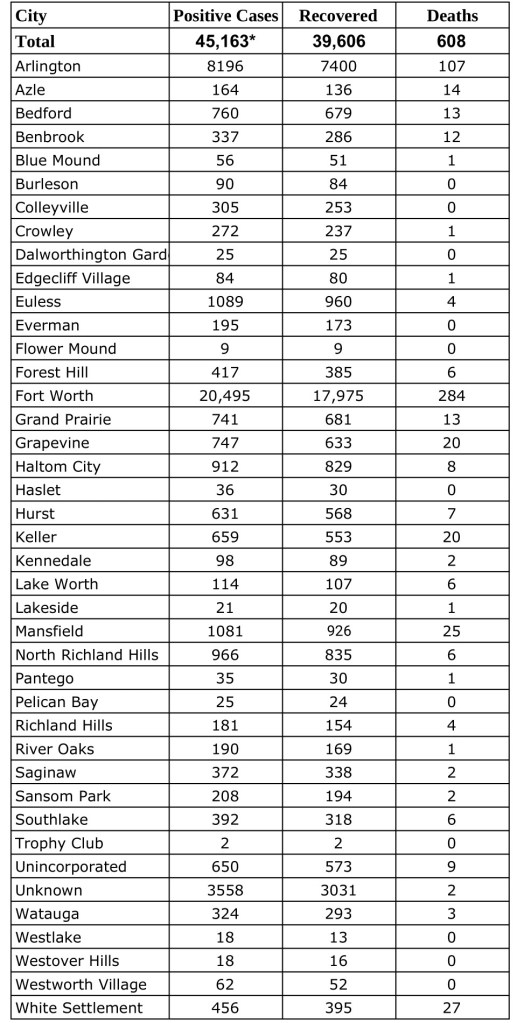
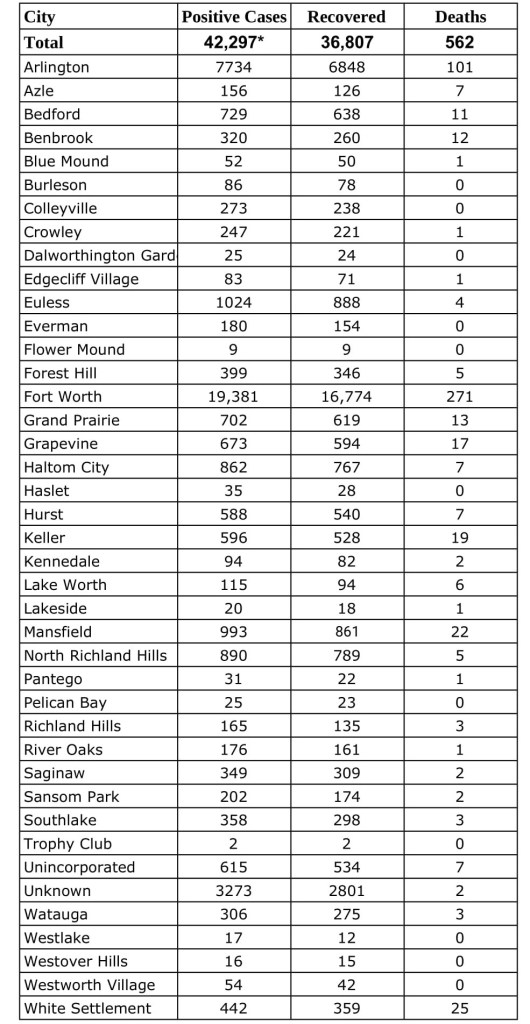
Data from Tarrant County Public Heath’s (TCPH) report of COVID-19 activity in Tarrant County, updated Tuesday, September 15, 2020.Find more COVID-19 information from TCPH here.
* These data are provisional and are subject to change at any time.
Deaths and recovered cases are included in total COVID-19 positive cases.
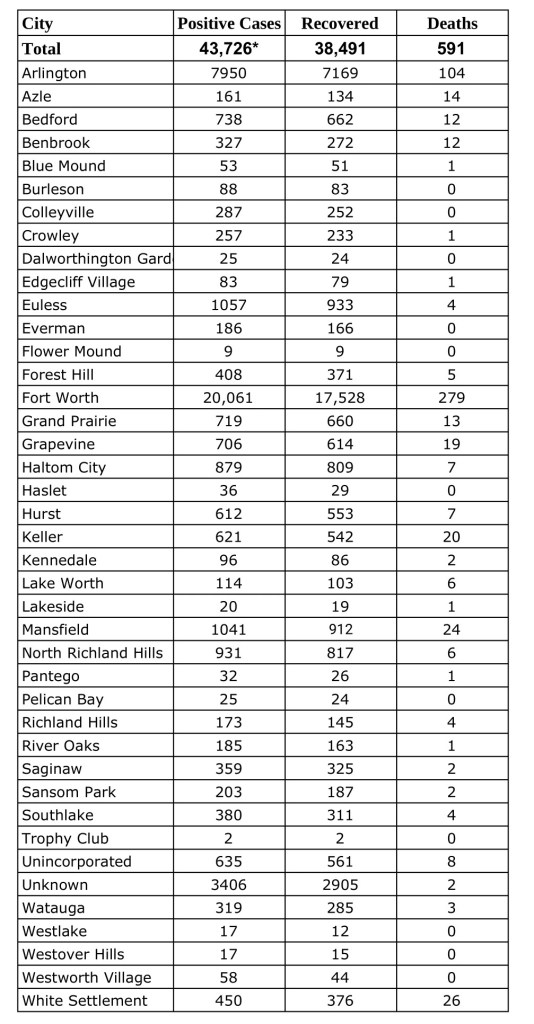
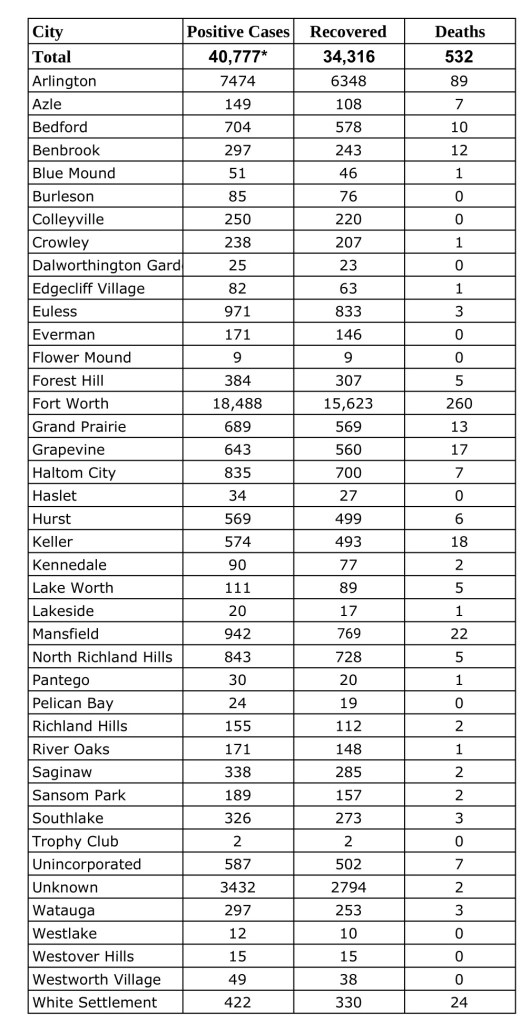
Data from Tarrant County Public Heath’s (TCPH) report of COVID-19 activity in Tarrant County, updated Monday, September 14, 2020.Find more COVID-19 information from TCPH here.
* These data are provisional and are subject to change at any time.
Deaths and recovered cases are included in total COVID-19 positive cases.
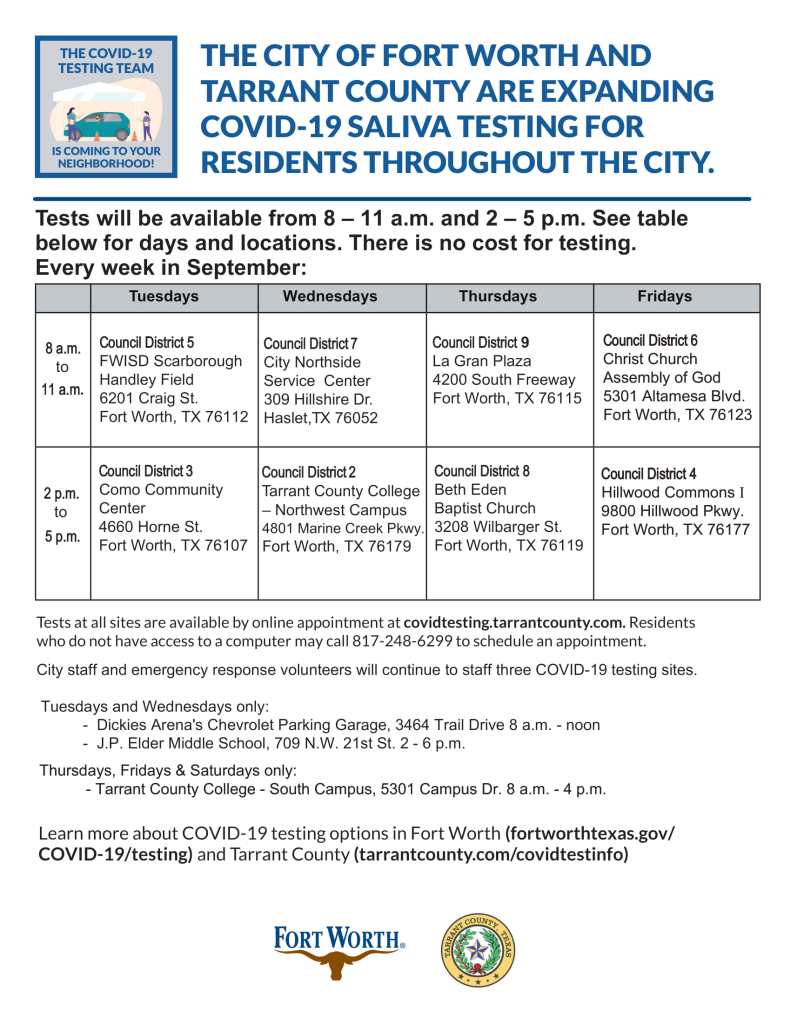
The below flyers provide information on COVID-19 testing that is being provided free of charge for residents of Tarrant County. The tests being offered are self-administered and saliva-based.
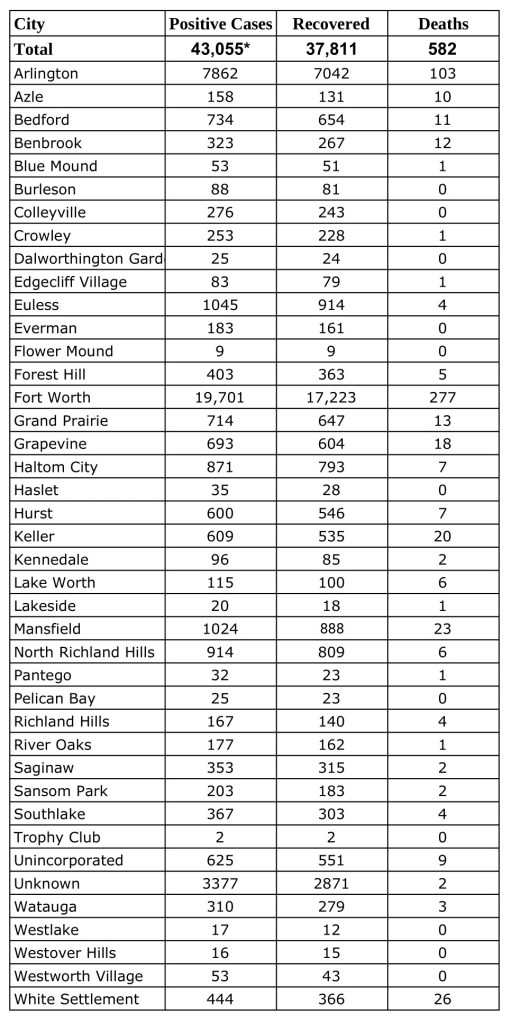
Data from Tarrant County Public Heath’s (TCPH) report of COVID-19 activity in Tarrant County, updated Friday, September 11, 2020.Find more COVID-19 information from TCPH here.
* These data are provisional and are subject to change at any time.
Deaths and recovered cases are included in total COVID-19 positive cases.
Data from Tarrant County Public Heath’s (TCPH) report of COVID-19 activity in Tarrant County, updated Thursday, September 10, 2020.Find more COVID-19 information from TCPH here.
* These data are provisional and are subject to change at any time.
Deaths and recovered cases are included in total COVID-19 positive cases.
Data from Tarrant County Public Heath’s (TCPH) report of COVID-19 activity in Tarrant County, updated Tuesday, September 8, 2020.Find more COVID-19 information from TCPH here.
* These data are provisional and are subject to change at any time.
Deaths and recovered cases are included in total COVID-19 positive cases.
Tarrant County Public Health is working with the community to provide several locations for residents to get tested for COVID-19. Appointments are available at multiple testing sites across Tarrant County. Complete the screening questionnaire to qualify for an appointment.
Tests at all sites are available by online appointment at covidtesting.tarrantcounty.com. Residents who do not have access to a computer may call 817-248-6299 to schedule an appointment. Screenings are available in English and Spanish. People who need assistance in other languages, such as Vietnamese, can call the Tarrant County Public Health information line at 817-248-6299.
Testing is available for children five years of age or older. Anyone under the age of 18 must be accompanied by a parent or guardian. For questions about getting your child under five tested, please contact their medical provider.
Data from Tarrant County Public Heath’s (TCPH) report of COVID-19 activity in Tarrant County, updated Thursday, September 3, 2020. Find more COVID-19 information from TCPH here.
* These data are provisional and are subject to change at any time.
Deaths and recovered cases are included in total COVID-19 positive cases.
Data from Tarrant County Public Heath’s (TCPH) report of COVID-19 activity in Tarrant County, updated Thursday, August 27, 2020.Find more COVID-19 information from TCPH here.
* These data are provisional and are subject to change at any time.
Deaths and recovered cases are included in total COVID-19 positive cases.
Originally published in the July/August issue of the Tarrant County Physician.
by Kenton K. Murthy, DO, MS, MPH Deputy Local Health Authority & Assistant Medical Director, Tarrant County Public Health
It has been three months since Texas had its first reported COVID-19 case, and since then, the number of cases has risen dramatically. As of June 25, there are more than 125,000 cases and 2,249 deaths in Texas.1 In Tarrant County, the total number of cases to date is 10,363 with 218 confirmed deaths.2
Shortly after reopening, there were signs that COVID-19 had plateaued and perhaps decreased, but our latest numbers seem to unfortunately indicate the opposite.2
Texas, overall, has seen hospitalizations increase dramatically.3 While Tarrant County hospitalization rates are also increasing, we have not seen our hospitals become overwhelmed as other counties are experiencing.3 However, we are not that far off.
Currently, almost 70 percent of our hospital beds in Tarrant County are occupied, of which eight percent are occupied from confirmed COVID-19 patients.2 However, given the increase in the total number of new cases (especially those in the younger population), and increasing cases in long-term care facilities, it may be just a matter of time before we start seeing a surge of hospitalizations as seen in Dallas, Travis, Harris, and Bexar counties.3
Long-term care centers, and correctional facilities continue to be hot spots, while child care facilities are now starting to have outbreaks as well.4,5 Long-term care centers and correctional facilities are our most vulnerable groups and may see the highest mortality rates, so it is vital that we continue to test, track, and isolate these individuals. The continued use of PPE in caring for patients in these settings is also important.
While we are currently in Phase 3 of Texas Reopening, with amusement parks, media events and fine arts permitted to open and operate up to 50 percent capacity, and restaurants allowed to operate up to 75 percent capacity, the governor has since paused reopening of Texas due to the sudden surge of new cases.6,7
Locally, starting June 26th, Tarrant County will require face masks at all businesses and all outdoor gatherings larger than 100 people. The order does not include churches, although it is strongly encouraged that church goers and other members of the public wear a mask when inside or when social distancing is not possible.8
In addition to face coverings and masks, businesses must also continue to encourage their employees to hand wash frequently with soap and water for 20 seconds, use hand sanitizer with at least 60 percent ethyl or grain alcohol (ethanol) or 70 percent isopropyl or rubbing alcohol, maintain social distancing, and regularly clean and disinfect frequently touched areas. Businesses should also screen employees for increased temperatures and COVID-19 symptoms before they start work and immediately send staff and employees with symptoms home to self-isolate.9
“We must remain vigilant during this pandemic and not let our guard down.“
As our physician colleagues reopen their practices, they must also continue to keep patients and staff safe. With that in mind, the Texas Medical Association has posted a step-by-step guide called Road to Practice Recovery: A Guide for Reopening Your Practice Post-COVID-19. This guide covers everything from financial operations to clinical operations.10 Some of the same practices that other businesses employ should also be used for physicians’ offices.
Upon any examination or procedure with a patient, it’s especially important for clinical staff to use full PPE, including N95 masks, goggles or face shield, gloves, and a gown.10 While currently Tarrant County does not have a ban on elective surgeries, doctors, nonetheless, should prioritize procedures and hold off non-urgent surgeries or other medical intervention to decrease the risk of COVID-19 transmission as well as to preserve bed space for coronavirus patients. Telemedicine and telehealth practices should be used as much as possible to continue to serve patients without putting themselves or ourselves at risk.10
At Tarrant County Public Health, our HIV clinic has changed almost entirely to a telehealth model with a few exceptions. We’re also now screening everyone entering our building for COVID-19 symptoms and doing touchless thermometer temperature checks. We’ve installed plastic and Plexiglass barriers in our waiting rooms and have patients wait in their cars rather than in small waiting rooms prior to their appointments.
While it is vital we reopen our Texas economy, it is just as important to do this as safely as possible. We must remain vigilant during this pandemic and not let our guard down. Physicians have a strong voice in our community, so let’s reemphasize to our patients that they must continue to socially distance whenever possible, practice good hand hygiene, and wear an appropriately protective facemask.
We’re all in this together, so let’s continue to keep each other safe.





 Tarrant County Physician Online