By Sean Price
Originally published in Texas Medical Association’s December 2021 issue of Texas Medicine. It was republished with TMA’s permission in the March/April 2022 issue of Tarrant County Physician.
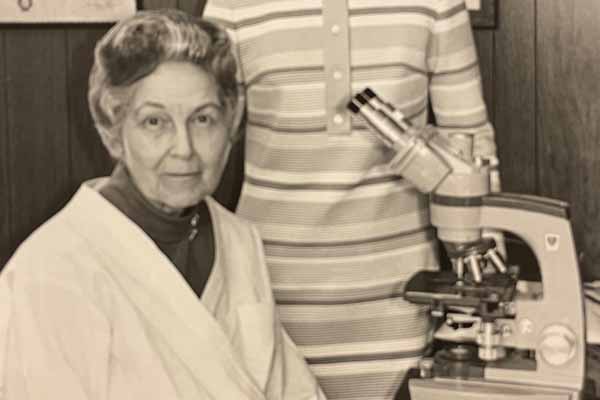
On May 27, 1936, May Owen, MD, answered a scientific riddle in a speech before the Texas Medical Association, explaining research that would soon make her a statewide celebrity.
The name of the paper she read that day, “Peritoneal Response to Glove Powder,” sounded vague to nonexperts. But the other clinical pathologists who gathered to listen understood that Dr. Owen had uncovered that a common medical practice posed a threat to patients.
The mystery started nearly 16 months earlier when a fellow Fort Worth physician alerted Dr. Owen to the case of a 19-year-old woman with unexplained fibrous membranes and tumorous nodules growing in her abdomen. The woman had had her appendix removed two years previously, and something about that operation had gone wrong.
After months of research, Dr. Owen proved that the unusual growths plaguing the woman had been caused by the talcum powder used at the time to coat surgical gloves. Human tissue couldn’t absorb the powder, so if just a little bit inadvertently fell into a wound during an operation, it caused infection, scar tissue, and other problems.
Dr. Owen read her paper before a mostly appreciative audience that gave her a standing ovation, according to her biography, May Owen, MD, by Ted Stafford, which is the source for most of this article. But when most of the crowd sat down, one man remained standing and began to shout.
“I have been sitting here listening to this woman spout off about the dangers of glove powder,” he said. “I don’t believe a word she has said.”
He continued ranting until the meeting’s chair ruled him out of order and told him to be quiet. Later that day, Dr. Owen won an award from the Texas Society of Pathologists, just one of many she would earn, including an honorary doctor of science degree from her alma mater, Texas Christian University (TCU).
The man’s outburst rattled Dr. Owen, reminding her of just how far she had come as a woman in medicine – and how far women like her still had to go to win acceptance. But she never lost confidence in herself or her findings.
“I knew if I lived to be 100, that [discovery] would be my most important contribution to humanity,” she recalled.
The research forced surgical glove makers to switch to a starch-based powder the human body could absorb. Texas newspapers clamored to interview this “woman doctor” – partly because her work had caused such an uproar and partly because so few women physicians existed anywhere at the time.
Dr. Owen’s pioneering work continued in the decades to come, making her the first female president of the Texas Society of Pathologists in 1946, the first female president of the Tarrant County Medical Society in 1947, and the first female president of TMA in 1960.
She had help from friends and relatives during her difficult rise from poor farm girl to honored Fort Worth physician, and that made her a conscientious mentor to hundreds of young physicians and people interested in medical careers.
One of them was Margie Peschel, MD, who started her career in Fort Worth as a resident in 1959, when women were still rare in the medical profession. She later became a pathologist who ran what is now Carter BloodCare from 1976 to 1997.
“I always felt lucky to be in Tarrant County because Dr. Owen set the example that women are welcomed,” she said in an interview with Texas Medicine.
From farm to medical school
Dr. Owen was born in 1892 in Falls County, just southeast of Waco, the sixth of eight children. She grew up doing hard work on the family cotton farm, and her parents, Jack and Lilli Owen, allowed her to go to school only after her morning chores were done.
Dr. Owen’s mother died when she was nine years old, and her father – whom she describes in her biography as autocratic and demanding – became even more so. He put more chores on his daughter and scoffed when she told him she intended to be a doctor.
“Get that silly idea out of your head right now,” she recounted him saying, according to her biography. “Your place is here on the farm. We will not discuss this matter anymore. Do you understand?”
Dr. Owen’s father tolerated her finishing school up to seventh grade, but only the intervention – and financial assistance – of an older brother allowed her to go first to high school and then to college at TCU in Fort Worth, graduating in 1917. In 1921, she became the first woman to graduate from what is now the University of Louisville School of Medicine in Kentucky.
Dr. Owen’s father did not actively prevent his daughter’s education, but he also never helped it and never acknowledged her accomplishments. Nor did he answer the many letters she sent after she became a physician.
“Her father never honored her,” Dr. Peschel told Texas Medicine. “It was sad. We would drive from Fort Worth to Austin for TMA meetings, and she shared things like that – that her daddy never did recognize her.”
During the 1920s and 1930s, Dr. Owen worked mostly as a pathologist for Terrell’s Laboratories in Fort Worth, and the owner – Truman Terrell, MD – was her friend and mentor. He loaned her the money to attend medical school. She also did advanced study at the Mayo Clinic in Rochester, Minn., and Bellevue Hospital in New York.
Despite her intense training, some fellow physicians – frequently older doctors – still refused to accept her medical opinions. In one case, when a surgeon argued that she was wrong, Dr. Owen found a clever way to win him over.
“I split the specimen in half and did my examination on one section and reported my findings to the surgeon,” she told her biographer. “The other half was sent to the pathologist at Massachusetts General Hospital in Boston. When his report came back, it agreed precisely with what I had reported. After a while the people who had doubted my ability and competence began to accept my work without question.”
Dr. Owen also earned the respect of veterinarians early in her career because her rural background gave her an understanding of animals and farming. In 1931, a vet at the Fort Worth Stockyards asked for her help in identifying a mystery disease that was killing sheep. Some suspected anthrax. But Dr. Owen discovered that the molasses cake being fed to the sheep to fatten them up was giving the animals diabetes. This discovery changed the way sheep were raised worldwide.
Despite what coworkers recount as a crushing work schedule, she remained active in all levels of organized medicine, and she encouraged medical students and young physicians to join organizations like TMA. By the time Dr. Peschel became a pathologist in 1964, Dr. Owen knew just who to talk to to get her colleague assigned to committees in TMA and other medical organizations.
“She was so active,” Dr. Peschel said. “She introduced me to everybody at TMA and the pathologists in the state. She just knew all these people. She was an excellent mentor.”
Dr. Owen expressed a deep debt to the people who helped her get a start in medicine.
“I know I could never have done it alone,” she said in her book.
As TMA president, Dr. Owen established TMA’s Physicians Benevolent Fund to help physicians in times of distress. She led the charge with a $2,500 contribution of her own, and since 1961, the fund has distributed more than $4.38 million in financial assistance.
“We all know of cases where our colleagues have suffered illness, death, or other misfortunes,” Dr. Owen said to TMA board members when requesting the fund’s creation.
She contributed money to students individually and also helped establish the May Owen Irrevocable Trust through TMA to provide low-interest loans to medical students. When Texas Tech University Health Sciences Center in Lubbock opened in 1973, Dr. Owen helped provide the library’s first 20,000 volumes and established the school’s first endowed chair.
In old age, Dr. Owen continued to work hard until her health failed. She died on April 12, 1988, at age 96.
“She said, ‘We should all be so lucky to work at something we love until the day we die,’” Dr. Peschel said. “She did that.”

 Tarrant County Physician Online