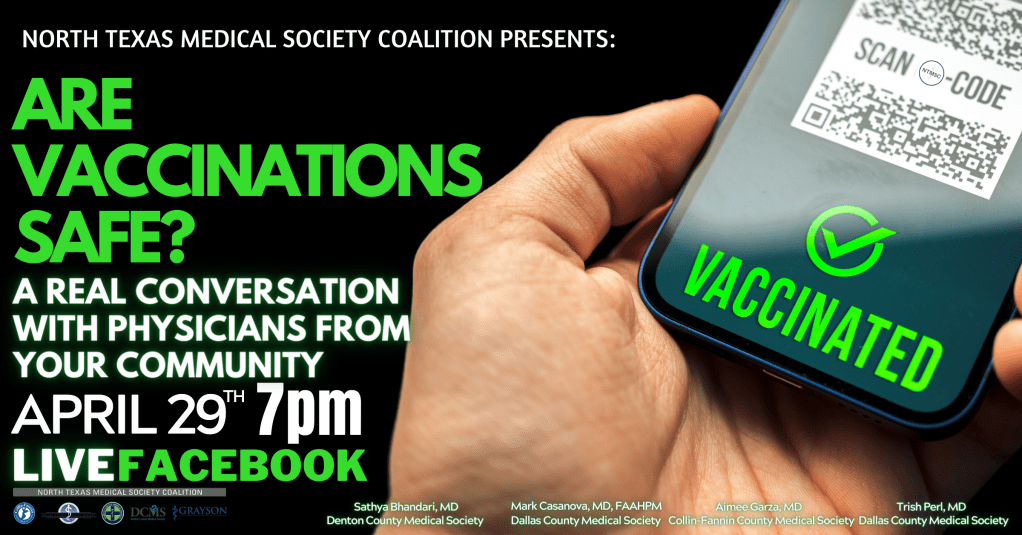
Tune in to the North Texas Medical Society (NTMSC) Facebook pagetonight at 7pm, for a live discussion with your community physicians on COVID-19 vaccinations. Join Dr. Mark Casanova (Dallas County Medical Society), Dr. Trish Perl (Dallas County Medical Society), Dr. Aimee Garza (Collin-Fannin County Medical Society), and Dr. Sathya Bhandari (Denton County Medical Society) to get answers to your top questions.
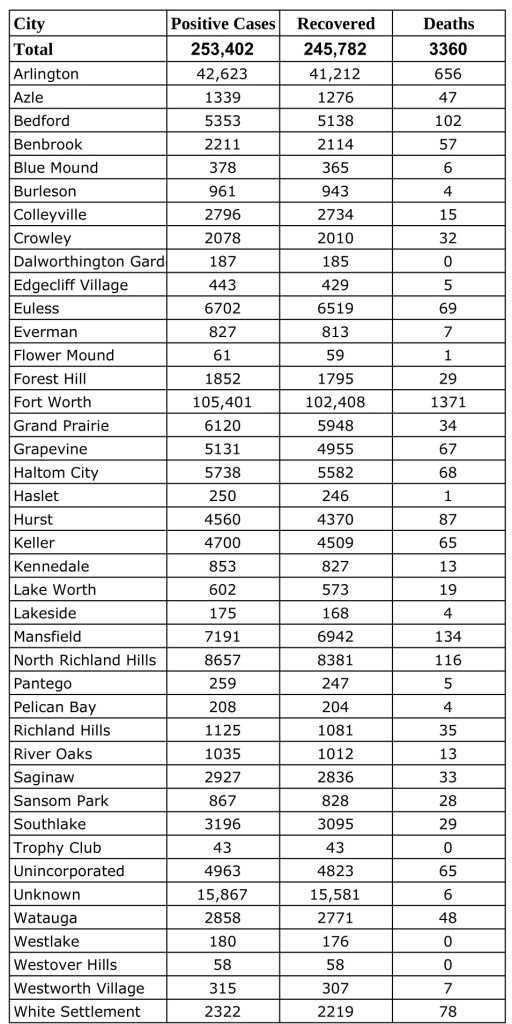
Data from Tarrant County Public Heath’s (TCPH) report of COVID-19 activity in Tarrant County, updated Thursday, April 22, 2021.Find more COVID-19 information from TCPH here.
*These data are provisional and are subject to change at any time.
Deaths and recovered cases are included in total COVID-19 positive cases.
Data from Tarrant County Public Heath’s (TCPH) report of COVID-19 activity in Tarrant County, updated Tuesday, April 20, 2021.Find more COVID-19 information from TCPH here.
*These data are provisional and are subject to change at any time.
Deaths and recovered cases are included in total COVID-19 positive cases.
This article was originally published in the March/April issue of the Tarrant County Physician. You can read find the full magazine here.
The last words I wrote in this journal were printed in January 2020, after a family trip to Disney World:
“I returned to work in this New Year, in this new decade, invigorated. My optimism stems from the smiles of my baby girl and her beautiful mother. It stems from an understanding that our imaginations power our spirit and our spirit powers our hearts. This year, 2020, will be an amazing year for all of us because I will will it to be so. The world is full of magic. We are so blessed to be physicians. I needed a particular princess to remind me of this. Search your feelings, you know it to be true. I hope your year is starting out as well as mine. I pray that all of us can find perspective and optimism somewhere in this world, so that despite the bureaucrats and the obstacles and the hazards along our journey, we can continue to serve our patients in this, the highest of all callings in the Galaxy.”
This was quite obviously written before a viral pandemic spread across the United States, infecting countless numbers of our families, friends, and loved ones, killing over 500,000 Americans. It was written before our world changed forever.
Overwhelmed. Exhausted. Fatigued. These are the emotions that have defined our existence on the front lines of the COVID-19 pandemic over the last year. We have watched helplessly as many of our patients and loved ones have slipped away. We have held the hands of patients who have passed away in respiratory isolation, their closest loved ones on phones and miles away, not allowed into the hospital. But I have seen Joy, when the infection overwhelms but the body and spirit fight on, conquering the virus and returning our patients to health. We have seen families reunited after long battles in the hospital ICU or at home in quarantine. We have seen Hope. We have known Love. I have seen the fantastic power of the human spirit. I have seen God’s love, and the power of prayer. There were moments when I felt that I could no longer fight for myself or anyone else, when the exhaustion would creep into my bones, and leave me battered, bruised, and almost beaten. But we are physicians. And we work with amazing, powerful nurses, medical assistants, medical techs, therapists, and hospital administrators—a formidable health care team. So I saw unexpected acts of bravery, acts of selflessness, moments that were etched into my soul forever. I saw us fight an unknown adversary. I have been privy to courage and honor, as we wrapped our patients in an armor of hope. I have seen hands that are raw from washing and sanitizing and wringing but showed no signs of relenting or retreat or defeat.
And in early January of 2021, at the hospital where I have seen and experienced all of this, there was a moment where my hope was recovered, where I became recharged and ready to step back onto the battleground. I saw the proverbial light at the end of the tunnel, the sun peeking over the horizon at the end of a cold dark night. The promise of a new day. The vaccine.
“Overwhelmed. Exhausted. Fatigued. These are the emotions that have defined our existence on the front lines of the COVID-19 pandemic over the last year.”
As I received that second dose, I wondered how any of us survived this year. I wept tears of joy, thinking that I finally knew in that moment that we would make it through this war. The tears burned with the memory of all those we have lost. It didn’t need to get this bad. Why did we have to lose so many? And how many more will we lose? The answer depends now on our resolve. We must resolve to vaccinate as many of our patients as we can as soon as possible. As a medical community, we should assist our public health departments, hospitals, clinics, and our federal, state, and local governments to roll out these vaccines with great efficiency. The only way we will win this war now is by vaccinating the masses and following the public health guidelines to wash our hands, distance, and wear masks.
I returned to work in this New Year, 2021, reinvigorated. My optimism stems from the smiles of my colleagues, which have been renewed with hope that the tide is turning. My optimism stems from an understanding that our imaginations power our spirit and our spirit powers our hearts, and that science and ingenuity and heart will prevail with the advent of this vaccine. This year, 2021, will be an amazing year for all of us because I will will it to be so. The world is full of magic. We are so blessed to be physicians. Search your feelings, you know it to be true. I hope your year is starting out as well as mine. I pray that all of us can find perspective and optimism somewhere in this world, so that despite the ill effects of COVID-19 on all of our lives, and the obstacles and the hazards along our journey that was 2020, we can continue to serve our patients in this, the highest of all callings. I want to thank all of my colleagues and compatriots who have shared this year with me and my family. We have shown that together we are stronger, and we will overcome. My name is Hujefa Vora, and this is the Last Word.
Data from Tarrant County Public Heath’s (TCPH) report of COVID-19 activity in Tarrant County, updated Thursday, April 15, 2021.Find more COVID-19 information from TCPH here.
*These data are provisional and are subject to change at any time.
Deaths and recovered cases are included in total COVID-19 positive cases.
Data from Tarrant County Public Heath’s (TCPH) report of COVID-19 activity in Tarrant County, updated Tuesday, April 13, 2021.Find more COVID-19 information from TCPH here.
*These data are provisional and are subject to change at any time.
Deaths and recovered cases are included in total COVID-19 positive cases.
This article was originally published in the March/April issue of the Tarrant County Physician. You can read find the full magazine here.
Medical school has one primary goal: passing on humanity’s medical knowledge to a new generation. There are a few challenges to accomplishing this goal. First is a static problem, i.e., the sheer magnitude of information. Second is a dynamic problem, i.e., the rate of change of this information. Humankind’s medical knowledge is growing and being refined at an incredible rate. These forces are constantly at play in medical school, and they only become more obvious the deeper one’s understanding of a topic becomes. Learning more means absorbing all of the idiosyncrasies and all of the exceptions as well as confronting the burden of complexity. This is a problem that our species has been dealing with forever. Just take the ancient story of Adam and Eve; life was simple until they ate the apple and had to deal with the consequences of knowledge.
“Drinking from a fire hydrant” is the analogy often used to describe the intensity of learning in medical school. This is what medical students volunteer for beginning in year one, and it will continue until we retire. The best and only solution is old-fashioned hard work and careful thinking. This is the reality that you have to accept if you choose to be a doctor. Unfortunately, this same reality of drinking from a fire hydrant now applies to our whole society that is woefully unprepared for the flood of medical knowledge and information.
Our society’s fire hydrant does not come in the form of a pathology textbook, but in the form of the Internet and social media. Everyone is bombarded with health content, and the mishandling or misinterpretation of this information has many potential problems. These can range from wasted patient resources to creating false expectations—they can even lead to physical harm. As doctors we become familiar with information overload and have the opportunity to develop strategies to handle it. We learn to be skeptical, research thoroughly, test our assumptions, and rely on experts. It is sometimes easy to assume the whole world has some of these strategies too, but this is obviously not the case. I don’t even need to give a specific example, just browse Twitter or Facebook for a few minutes and I am certain one will present itself. Ideally, everyone would have instant access to a healthcare worker to help them navigate the things they see online. This is currently impossible, so many patients will have to sort through the overload of truth and misinformation on their own. In light of this problem, I am reminded of a famous quote by a pillar of our profession:
“One of the first duties of the physician is to educate the masses”1
–Sir William Osler.
I believe that we can benefit society by educating our patients about strategies to sort through medical information they find online. Strategies like having some skepticism toward this information, researching it through reputable sources, and trying to disprove something they see on social media before they believe it. Strategies that we have had the opportunity to develop through our medical education.
I am like most second-year medical students and I am probably too eager to share what I have learned with those around me. What has been surprising to me is that most of the health questions my friends and family ask or the incorrect assertions I hear are different from what I expected. For every time I get to explain how someone’s medication works, there are five times of disputing something someone saw on social media. I understand that not everyone has the benefit of medical school, but I fear that the massive amount of online health information has the potential to cause harm if people do not have basic strategies to handle it.
In closing, I will admit that the quote I used was not complete. The full quote says that “One of the first duties of the physician is to educate the masses not to take medicines.” I completely misrepresented the quote because it demonstrates how the simplest strategies can be used to check the validity of something you read. One Google search is all it takes to gather evidence that I was not being completely truthful with Dr. Osler’s claim. That being said, if Osler were alive today, I believe he would agree with the sentiment that “One of the first duties of the physician is to educate the masses not to believe everything they see online.”
1Osler, William, Robert Bennett Bean, and William B. Bean, Sir William Osler Aphorisms: from His Bedside Teachings and Writings, (New York: Schuman. 1950).
Data from Tarrant County Public Heath’s (TCPH) report of COVID-19 activity in Tarrant County, updated Thursday, April 8, 2021.Find more COVID-19 information from TCPH here.
*These data are provisional and are subject to change at any time.
Deaths and recovered cases are included in total COVID-19 positive cases.
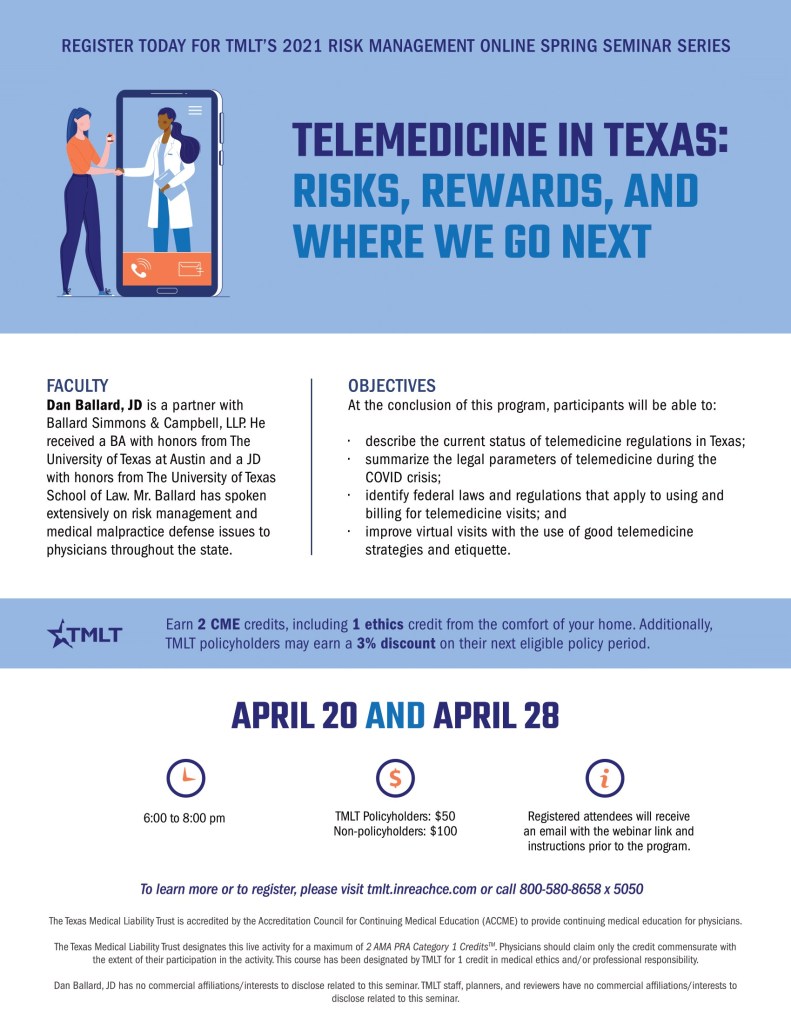
Interested in learning more about the risks and rewards of using telemedicine in your office? This month, TMLT will be hosting an ethics CME on the topic. The seminars will take place on April 20 and 28 and will be streamed live.
You can register here. If you have any questions, call 800-580-8658, ext. 5050.
All Oscar wanted to do on that cold, wet January day was to push his car out of the mud. Instead, he ended up in the ED.
“I felt a pop in both knees and my whole weight came down on my left knee,” he says. “I had to wait for the pain to pass and when I got up, I was not able to walk the same . . . I went to the hospital and was told to look for an orthopedic surgeon.”
There was a problem, though. The 64-year-old grandfather of seven did not have medical insurance and could not afford to see a specialist. To make matters worse, the injuries he sustained forced Oscar to quit his job as a dishwasher for a local restaurant.
“The pain from walking was unbearable,” he says. “My wife had to look for a job to financially support both of us.”
The couple, who had been married for 45 years, were determined to find a solution. Oscar went to Mercy Clinic to see one of their volunteer physicians, when he was referred to Project Access Tarrant County.
This wasn’t Oscar’s introduction to PATC—he was seen in 2017 by PATC volunteer Dr. Frank “Trey” Moore, urology, for treatment of kidney stones. While his urology care ended out being non-surgical, his physician realized that Oscar’s knee injuries would likely need more extensive treatment.
He was quickly connected to PATC volunteer Dr. Bret Beavers, orthopedic surgery, of the Orthopedic and Sports Medicine Institute. Dr. Beavers determined that Oscar needed surgery to treat cartilage and tendon tears in both of his knee, so PATC coordinated his care at Park Hill Surgery Center.
“Dr. Beavers is very friendly, and he explained everything to me,” Oscar says. “My treatment at Park Hill Surgery Center was amazing. I did not feel any pain from beginning to end.”
After two surgeries, one in each knee, Oscar’s condition quickly improved. One of the best outcomes was that he was finally able to rest peacefully, something he had missed while suffering from his injuries.
“Sleeping used to be very difficult for me because I would toss and turn all night due to the pain,” Oscar says. “Thank you, Dr. Beavers, for helping me. May God bless you so you can continue helping people like me.”




 Tarrant County Physician Online