COVID-19 Vaccine Clinics for the Week of June 25

Tarrant County Public Health hosts numerous pop-up COVID-19 clinics across Tarrant County each week in partnership with public and private organizations listed below. Each site has the Moderna and Pfizer vaccines and at times the Johnson & Johnson. Children five and older are eligible for the vaccination. Parents need to bring proof of the child’s age and their own ID for the vaccination. Booster vaccinations are available at all of the vaccination locations.

  
TCPH would like to bring a COVID-19 vaccination clinic to businesses, churches and organizations in the community who are interested in hosting a pop-up clinic. It’s easy and free to host a clinic.
 
In addition to the vaccination opportunities below, the cities of Arlington, Fort Worth, Mansfield, North Richland Hills, Hurst, and Tarrant County College have also added opportunities for vaccinations. To find a local vaccine site, the County created a vaccine finder page: VaxUpTC website.

Pop-Up COVID-19 locations:

Everman Public Library
Saturday, June 25: 10 a.m. to 2 p.m.
100 North Race St.
Everman, TX 76140

Austin Company-Health Expo
Saturday, June 25: 11 a.m. to 4 p.m.
2029 North Main St.
Fort Worth, TX 76164

Greater Saint Stephen First Church
Monday, June 27: 1 p.m. to 5 p.m.
3728 East Berry St.
Fort Worth, TX 76105

Vaxmobile – Saint John Cathedral  
Thursday, June 30: 9 a.m. to 4 p.m.
2501 East Berry St.
Fort Worth, TX 76105

Worth Heights Community Center
Thursday, June 30: 3 p.m. to 6 p.m.
3551 New York Ave.
Fort Worth, TX 76110

Lamar High School    
Friday, July 1: 10 a.m. to 2 p.m.
1400 W. Lamar Blvd.
Arlington, TX 76012

Tarrant County Public Health CIinics:

Northwest Public Health Center
Monday to Friday: 8 a.m. to 12 p.m. and 1 to 5 p.m.
3800 Adam Grubb Road
Lake Worth, TX 76135

Bagsby-Williams Health Center
Monday to Friday: 8 a.m. to 12 p.m. and 1 to 5 p.m.
3212 Miller Ave.
Fort Worth, TX 76119

Southeast Public Health Center
Monday to Friday: 9 a.m. to 12 p.m. and 1 to 6 p.m.
536 W Randol Mill
Arlington TX, 76011

Main Public Health Center
Monday to Friday: 8 a.m. to 12 p.m. and 1 to 6 p.m.
1101 S. Main Street
Fort Worth, TX 76104

Southwest Public Health Center
Monday to Friday: 8 a.m. to 12 p.m. and 1 to 5 p.m.
6551 Granbury Road
Fort Worth, TX 76133

Watauga Public Health Center
Monday to Friday: 8 a.m. to 12 p.m. and 1 to 5 p.m.
6601 Watauga Road
Watauga, TX 76148

The Vaxmobile is a partnership between Tarrant County Public Health and Trinity Metro to bring COVID-19 vaccines to underserved communities throughout Tarrant County. The 60-foot bus converted to a fully equipped mobile vaccine clinic, will make weekly stops in the areas with the lowest vaccination rates on Thursdays. Vaccinations are also available at the six Tarrant County Public Health clinics listed above every day of the week.

For more information go to coronavirus.tarrantcounty.com or call the Tarrant County Public Health information line, 817-248-6299, Monday – Friday 8 a.m. to 6 p.m.
Tarrant County to begin administering COVID-19 vaccine to infants and toddlers

Tarrant County Public Health will begin administering the COVID-19 vaccine to children six months to five years of age at all TCPH clinics, public pop-up clinics, and the Vaxmobile starting on Wednesday, June 22, 2022.

Both the Pfizer and Moderna vaccines will be available to protect this age group. Infants six months through four years of age receiving the Pfizer vaccine series will need to get two doses, three weeks apart, and a third at least two months later. The dosage of Pfizer for infants is one-tenth of the dosage for adults. The Moderna vaccine series for infants six months through five years of age will consist of two doses, four to eight weeks apart, and it will be a quarter of the dosage of Moderna for adults. A third dose of Moderna has been approved for immunocompromised infants in this age group, at least one month after the second dose.

The CDC now recommends the COVID-19 vaccine for children and adolescents six months of age and older. COVID-19 has become one of the top 10 causes of pediatric death, and tens of thousands of children and teens have been hospitalized because of the virus. While children and adolescents are typically at lower risk than adults of becoming severely ill or hospitalized from COVID-19, the effects of the virus are unpredictable. Vaccination is the best way to protect children from COVID-19.

The COVID-19 vaccine is safe and effective. Before it was authorized for children across age groups, scientists and medical experts reviewed safety and effectiveness data from clinical trials involving thousands of children.

Tarrant County Public Health Clinics:

Northwest Public Health Center
Monday to Friday: 8 a.m. to 12 p.m. and 1 to 5 p.m.
3800 Adam Grubb Road
Lake Worth, TX 76135

Bagsby-Williams Health Center
Monday to Friday: 8 a.m. to 12 p.m. and 1 to 5 p.m.
3212 Miller Ave.
Fort Worth, TX 76119

Southeast Public Health Center
Monday to Friday: 9 a.m. to 12 p.m. and 1 to 6 p.m.
536 W Randol Mill
Arlington TX, 76011

Main Public Health Center
Monday to Friday: 8 a.m. to 12 p.m. and 1 to 6 p.m.
1101 S. Main Street
Fort Worth, TX 76104

Southwest Public Health Center
Monday to Friday: 8 a.m. to 12 p.m. and 1 to 5 p.m.
6551 Granbury Road
Fort Worth, TX 76133

Watauga Public Health Center
Monday to Friday: 8 a.m. to 12 p.m. and 1 to 5 p.m.
6601 Watauga Road
Watauga, TX 76148

COVID-19 causes respiratory illness with cough, fever and shortness of breath and may lead to bronchitis and severe pneumonia. For more information go to the TCPH coronavirus page or call the Tarrant County Public Health information line, 817-248-6299, Monday – Friday 8 a.m. to 6 p.m. and Saturday 10 a.m. to 2 p.m.

The Hidden Costs of COVID-19

Public Health Notes

By Catherine Colquitt, MD

This article was originally published in the March/April 2022 issue of the Tarrant County Physician. You can read find the full magazine here.

In response to soaring overdose deaths across the U.S. during the pandemic, the American Medical Association (AMA) Advocacy Resource Center published a brief on Nov. 21, 2021, cataloging increased overdose deaths state-by-state. They decried decreased access to “evidence-based care for substance use disorder, chronic pain, and harm reduction services.”1

The AMA also sent a letter to the U.S. Centers for Disease Control and Prevention urging requirements for health insurers to eliminate barriers to opioid treatment for patients who would benefit from these therapies (think prior authorizations for prescriptions and faxed referrals for specialists). The letter also supported the Biden Administration’s 2022 National Drug Control Strategy, which highlights increased production of medications for substance use disorders, harm reduction strategies (including needle and syringe exchange programs), access to naloxone without prescription, and elimination of health insurer obstacles which prevent persons with chronic pain from accessing pain management.

In addition, a letter from AMA’s Dr. James Madara, MD, to Regina M. LaBelle, the acting director of the Office of National Drug Control Policy, on July 9, 2021, stated that healthcare inequities and social determinants of health fueling the overdose epidemic and disproportionately affecting the “marginalized and minoritized” must be addressed.2

The National Vital Statistics System recently released its “Provisional Drug Overdose Death Counts” for 2021 for the fifty states and the District of Columbia.4 The total overdoses will likely be revised upwards as case compilations for 2021 are completed and reports verified, but the provisional death toll is staggering. Over the 12-month period which ended in June 2021, overdose deaths rose from 47,523 to 98,022, and in Tarrant County, our overdose deaths mirror the national trend with 350 overdose deaths for the 12-month period ending March 2021, compared with 185 overdose deaths for the 12-month period ending January 2021. (Tarrant County data are not yet available for April – December 2021 on the NVSS dashboard.) 

Overdose deaths provide one measure of the toll of COVID-19 in the U.S. and expose need for redress of healthcare inequities, access to medication for opiate use disorders, substance use disorder treatment, mental healthcare access, and access to pain management. Another way the impact of COVID-19 is being assessed is through peer-reviewed publications exploring the hidden costs and benefits of conventional in-person (commuter) work versus work from home. 

“Over the 12-month period which ended in June 2021, overdose deaths rose from 47,523 to 98,022, and in Tarrant County, our overdose deaths mirror the national trend with 350 overdose deaths for the 12-month period ending March 2021, compared with 185 overdose deaths for the 12-month period ending January 2021.”

The results of such studies are uneven and the responses necessarily somewhat subjective when subjects are questioned regarding their feelings about in-person versus telework; in general, workers viewed telework more favorably when they volunteered for it and when their schedules included a combination of both in-person and telework. When mandatory, some teleworkers experienced increased “work-family conflict” as the lines between work and domestic life blurred during telework. Teleworkers and conventional in-person workers reported variable effects on depression, exhaustion, fatigue, and energy level.5

Using data from the American Time Use Survey, authors asked workers to record in a diary where they worked (whether they commuted or not) and noted that male teleworkers in this study reported lower pain, stress, and tiredness levels, but that there was no difference in these measures among female commuters versus non-commuters.6

In another study based on the American Time Use Survey, the designers compared pain in working-at-home versus conventional workers and found no difference in pain reporting between the two groups. However, working-at-home fathers reported increased stress and working-at-home mothers reported decreased happiness.7

COVID-19 is, at the very least, an engine powering academic inquiry, which may have unexpected future benefits for the way healthcare is delivered and work is done.  In the meantime, we must continue the important work of educating, advocating, and caring for our communities.

References
1. AMA Advocacy  Resource Center:  Issue brief: Nation’s drug-related overdose and death epidemic continues to worsen, Updated 11/12/2021 

2. AMA letter to Regina M. LaBelle, Acting Director of Office of National Drug Control Policy, 7/9/2021

3. AMA letter to the U.S. Centers for Disease Control and Prevention, June 2020

4. National Vital Statistics System Provisional Drug Overdose Death Counts – NVSS dashboard for current data, with final data when available from https://www.cdc.gov/nchc/nvss/mortality_public_use_data.htm

5. Oakman J et al. A rapid review of mental and physical health effects of working at home: how do we optimize health? BMC Public Health (2020) 20:1825

6. Song Y, Gao J. Does telework stress employees out? A study on working at home and subjective well-being for wage/salary workers J Happiness Stud 2019;21(7):2648-68

7.   Gimenez-Nadal JI, Molina JA, Velilla J. Work time and well-being for workers at home: evidence from the American Time Use Survey. Int J Manpow 2020; 41(2): 184-206

How to Use and Store At-Home COVID-19 Tests Properly to Avoid Potential Harm

The U.S. Food and Drug Administration (FDA) is alerting people that there is a potential for harm if  at-home COVID-19 tests are not used according to the manufacturer’s test instructions. Here are their recommendations for safe and effective at-home testing:

Recommendations  

  • Keep all parts of at-home COVID-19 test kits out of reach from children and pets before and after use. 
  • Store the at-home COVID-19 test in its box until you are ready to use it. 
  • Follow the manufacturer’s step by step test instructions exactly.  
    • Read the Warning, Precautions, And Safety Information in the test instructions for a description of chemical ingredients and recommendations for safe handling and what to do if they accidentally touch your skin or eyes. 
    • Keep the liquid solution away from the skin, nose, mouth, and eyes. Do not swallow the liquid solution. 
    • Use only the swab in the test kit to collect a nasal sample. 
  • After you perform the test: 
    • Follow all test instructions for how to throw away the used test parts.   
    • Wash your hands thoroughly with soap and water. 

Get medical help right away by contacting your local poison control or health care provider if:  

  • Skin or eye irritation does not go away after exposure. 
  • A person or animal swallows the liquid solution. 

Avoid Potential Harm from Incorrect Use of At-Home COVID-19 Tests 

At-home COVID-19 diagnostic test kits include different parts such as a test cartridge, nasal swab, and small plastic vials containing liquid solutions needed to perform the test. The liquid solutions may include chemical ingredients, such as sodium azide, that help the test work properly or act as preservatives. The test chemicals can be irritating or toxic if they get on your skin, nose, or eyes or if they are swallowed. 

The FDA has received reports of injuries caused by incorrect use of at-home COVID-19 tests, including: 

  • Injuries caused by people accidently putting liquid test solution in their eyes when small vials of test solution were mistaken for eye drops.   
  • Injuries caused by placing nasal collection swabs into the liquid solution prior to swabbing the nose (the liquid solution is not supposed to touch your body).  
  • Injuries caused by children putting test parts in their mouth and swallowing liquid test solution. 

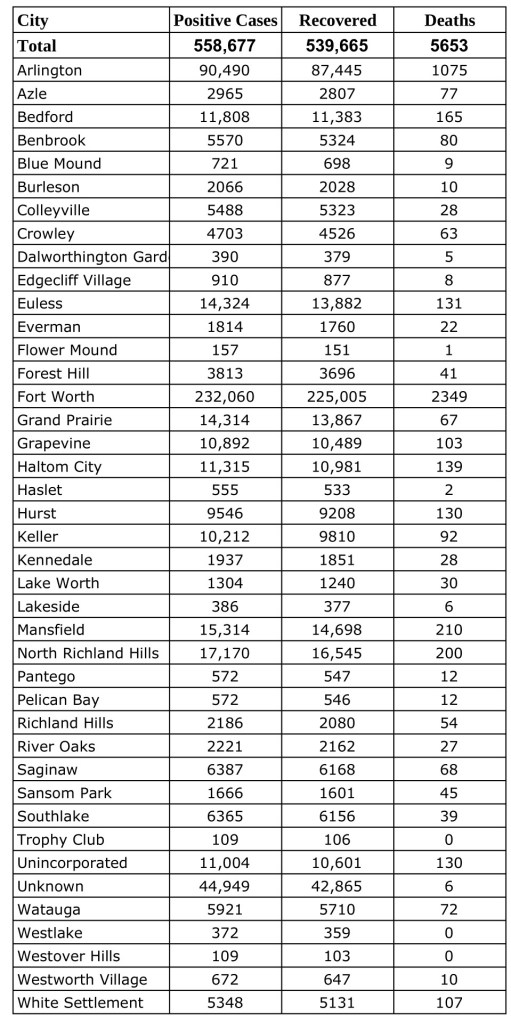
Tarrant County COVID-19 Activity – 03/02/22


COVID-19 Positive cases: 558,677

COVID-19 related deaths: 5653

Recovered COVID-19 cases: 539,665

Data from Tarrant County Public Heath’s (TCPH) report of COVID-19 activity in Tarrant County updated Wednesday, March 2, 2o22. Find more COVID-19 information from TCPH here.

*These data are provisional and are subject to change at any time.

Deaths and recovered cases are included in total COVID-19 positive cases.

COVID-19 trends in Tarrant County and questions about the pandemic’s future

Tarrant County Public Health Director Vinny Taneja and Allergist/Immunologist Robert Rogers, MD, spoke with Lili Zheng of NBC5 on the state of COVID-19 in Tarrant County and the things that could impact the direction on the pandemic in the coming months:

“I think the real wildcard is, do enough people have immunity to prevent another surge? That’s one. Another would be, are we going to deal with another variant?”

Dr. Robert Rogers

You can watch the video below or read the full story here.

CDC Approves Moderna Adult COVID-19 Vaccine

Moderna’s adult COVID-19 vaccine has now earned full approval following recommendation’s from both the Food and Drug Administration and the Centers for Disease Control and Prevention’s (CDC’s) immunization panel.

On Feb. 4, after CDC’s Advisory Committee on Immunization Practices unanimously voted to recommend Moderna’s two-shot series, CDC Director Rochelle Walensky, MD, quickly endorsed that recommendation.

“If you have been waiting for approval before getting vaccinated, now is the time to join the nearly 212 million Americans who have already completed their primary series,” Dr. Walensky said in an agency statement. “CDC continues to recommend that people remain up to date on their COVID-19 vaccines, including getting a booster shot when eligible.”

The adult version of the Moderna vaccine is for people aged 18 and older. Pfizer’s two-shot vaccine, which was granted full approval in August 2021, is for use in people 16 and older.

SELF-CARE FOR HEALTH CARE WORKERS DURING A PANDEMIC

Public Health Notes

by Catherine Colquitt, MD – Tarrant County Public Health Medical Director

This piece was originally published in the January/February 2022 issue of the Tarrant County Physician. You can read find the full magazine here.


Almost two years into the COVID-19 pandemic, healthcare workers (HCWs) and those who study them are cataloging HCW burnout and compassion fatigue at epic levels. But experts who study HCWs have been describing and attempting to address these phenomena long before anyone could have imagined the impact of COVID-19 on our world and the healthcare systems we inhabit.

Very early in the course of the world’s experience with COVID-19, investigators began to sound alarms about the secondary trauma HCWs may sustain by caring for those infected with the virus. There was concern about HCWs being forced to make decisions about allocation of scarce resources, placing themselves and those they love at risk for infection through their work-related COVID-19 exposure, and having to deliver bad news to patients in person and to their families remotely.  There was also concern about the moral injury caused by the deaths of so many in their care from a disease for which treatments remain somewhat limited. 

Lai et al in JAMA Network was one of the first authors to publish on mental health outcomes of pandemic HCWs in China.1 The paper evaluated 1,257 HCWs in Chinese hospitals with Fever Clinics or COVID-19 wards and found that a large proportion of survey respondents expressed symptoms of depression, anxiety, insomnia, and emotional distress. Their findings supported the need for a range of responses including various psychological support services. 

Later in 2020, researchers in Italy examined “professional quality of life” in the context of the COVID-19 pandemic and sorted 627 subjects into two groups: those caring for COVID-19 patients and those not working with COVID-19 infected patients.2 They found statistically significant differences between HCWs caring for those with COVID-19 and those who were not, and those differences centered around perception of stress, anxiety, and depression as assessed by various scales akin to the PHQ9, a questionnaire designed to identify subjects at high risk for depression. These investigators found higher levels of “stress, burnout, secondary trauma, anxiety, and depression” among HCWs caring for COVID-19 patients, but they found no difference in their survey aimed at assessing “compassion satisfaction” between the two groups.  Compassion satisfaction for these researchers “encompasses positive aspects of working in healthcare” and the embodiment of “empathy and a strong desire to care for those who are suffering.” 

Perhaps most encouraging in the Italian study was the finding that compassion satisfaction among HCWs treating COVID-19 patients allowed these HCWs to use their capacity for empathy and the emotional support they received from coworkers, family, and friends to function effectively during the pandemic without losing hope or a sense of purpose. The Italian study concluded that “the mental health of frontline workers demands more study” to devise preventive and intervention strategies. 

What can such prevention and intervention strategies look like? Mental Health America (MHA) surveyed HCWs with a web-based tool from June to September 2020, and the majority of respondents reported stress, anxiety, and feeling overwhelmed.  They also reported concern about exposing loved ones to COVID-19, as well as emotional and physical exhaustion, inadequate emotional support, and inadequate time and energy to parent effectively.3 The MHA survey respondents included 52 percent with potential COVID-19 exposure at work, 20 percent with no COVID-19 exposure at work, and 28 percent with definite COVID-19 exposure at work.  The majority of MHA survey respondents reported compassion fatigue and only 31 percent reported feelings of gratitude, 28 percent of hope, and 20 percent of pride. In addition, 38 percent of those surveyed reported increased tendencies to smoke, drink alcohol, and/or use drugs. 

MHA has a 24-hour Crisis Line for frontline COVID-19 workers, who can call 1-800-273-TALK (8255) or text “MHA” to 741741 to speak to a trained crisis counselor. 

Now psychologists and other researchers are analyzing the results of these studies and similar data to develop strategies for protecting the mental health and well-being of HCWs and other frontline workers during this pandemic and in future disaster scenarios.  Greenberg et al, writing for BMJ in March of 2020, suggested several strategies, such as adequate staffing and resources.4 This would include providing personal protective equipment and access to mental health services on demand, establishing forums in which staff members at all levels can discuss “the emotional and social challenges” of caring for COVID-19 patients, establishing other channels for peer support, and actively monitoring of the mental health and well-being of all staff.

We have all experienced COVID-19 through individual lenses as HCWs in different settings, but few of us have ever lived through a pandemic of this magnitude. We must work to remain resilient, hopeful, and grateful with help from our peers and friends. 

References

1. Lai, Jianbo et al. “Factors Associated with Mental Health Outcomes Among Health Care Workers Exposed to Coronavirus Disease 19.” JAMA Network. March 2020. https://jamanetwork.com/journals/jamanetworkopen/fullarticle/2763229

2. Trumello, Carmen et al. “Psychological Adjustment of Healthcare Workers in Italy during the COVID-19 Pandemic: Differences in Stress, Anxiety, Depression, Burnout, Secondary Trauma, and Compassion Satisfaction between Frontline and Non-Frontline Professionals.” International Journal of Environmental Research and Public Health. November 12, 2020. Doi: 10.3390/ijerph17228358

3. https://mhanational.org/mental-health-healthcare-workers-covid-19

4. Greenberg, Neil at el. “Managing Mental Health Challenges Faced by Healthcare Workers During COVID-10.” The BMJ. 2020. doi: https://doi.org/10.1136/bmj.m1211

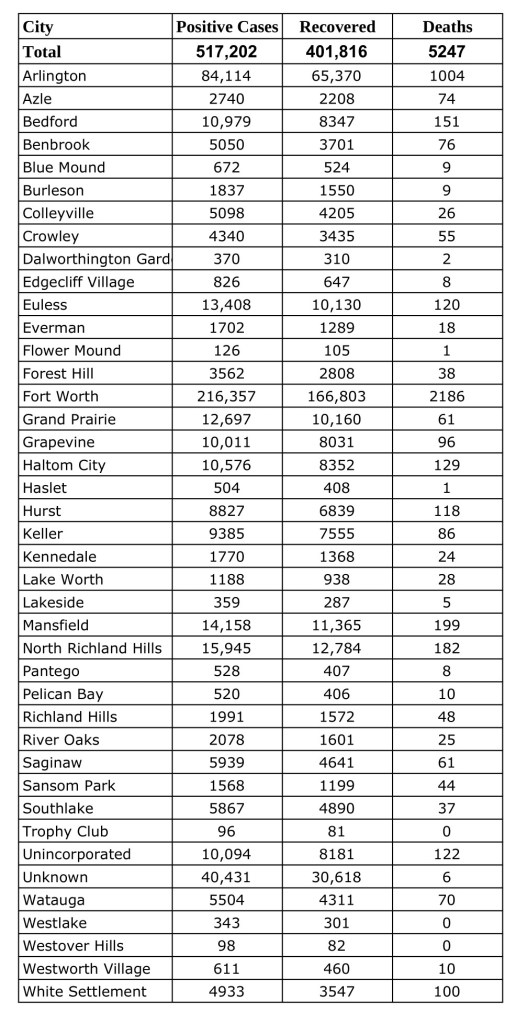
Tarrant County COVID-19 Activity – 01/28/22


COVID-19 Positive cases: 517,202

COVID-19 related deaths: 5247

Recovered COVID-19 cases: 401,816

Data from Tarrant County Public Heath’s (TCPH) report of COVID-19 activity in Tarrant County updated Friday, January 28, 2o22. Find more COVID-19 information from TCPH here.

*These data are provisional and are subject to change at any time.

Deaths and recovered cases are included in total COVID-19 positive cases.

Design a site like this with WordPress.com
Get started