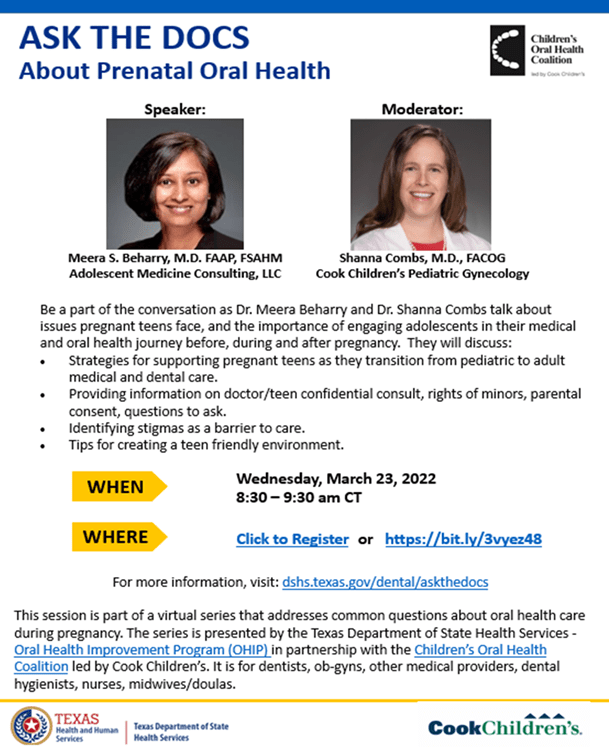
Don’t Miss Out – be part of the conversation on Wednesday, March 23, 2022, 8:30 am – 9:30 am CT.
In honor of International Adolescent Health Week, Drs. Shanna Combs and Meera Beharry will host an Ask the Docs discussion centered around the unique issues pregnant teens face, and the importance of engaging adolescents in their medical and dental health journey before, during and after pregnancy.
This event was created for dentists, physicians, dental hygienists, nurses, doulas, mid-wives, and social workers.
The objectives for this Ask the Docs session include:
Strategies for supporting and helping pregnant teens and families as they transition from pediatric to adult medical and dental care
Providing information on doctor/teen confidential consult, rights of minors, parental consent needs, questions to ask
Identifying stigmas as a barrier to care
Tips for creating a teen friendly environment
This session is part of a virtual series that addresses common questions about oral health care during pregnancy. This series is presented by the Texas Department of State Health Services – Oral Health Improvement Program (OHIP) in partnership with the Children’s Oral Health Coalition let by Cook Children’s.
The U.S. Food and Drug Administration (FDA) is alerting people that there is a potential for harm if at-home COVID-19 tests are not used according to the manufacturer’s test instructions. Here are their recommendations for safe and effective at-home testing:
Recommendations
Keep all parts of at-home COVID-19 test kits out of reach from children and pets before and after use.
Store the at-home COVID-19 test in its box until you are ready to use it.
Follow the manufacturer’s step by step test instructions exactly.
Read the Warning, Precautions, And Safety Information in the test instructions for a description of chemical ingredients and recommendations for safe handling and what to do if they accidentally touch your skin or eyes.
Keep the liquid solution away from the skin, nose, mouth, and eyes. Do not swallow the liquid solution.
Use only the swab in the test kit to collect a nasal sample.
After you perform the test:
Follow all test instructions for how to throw away the used test parts.
Skin or eye irritation does not go away after exposure.
A person or animal swallows the liquid solution.
Avoid Potential Harm from Incorrect Use of At-Home COVID-19 Tests
At-home COVID-19 diagnostic test kits include different parts such as a test cartridge, nasal swab, and small plastic vials containing liquid solutions needed to perform the test. The liquid solutions may include chemical ingredients, such as sodium azide, that help the test work properly or act as preservatives. The test chemicals can be irritating or toxic if they get on your skin, nose, or eyes or if they are swallowed.
The FDA has received reports of injuries caused by incorrect use of at-home COVID-19 tests, including:
Injuries caused by people accidently putting liquid test solution in their eyes when small vials of test solution were mistaken for eye drops.
Injuries caused by placing nasal collection swabs into the liquid solution prior to swabbing the nose (the liquid solution is not supposed to touch your body).
Injuries caused by children putting test parts in their mouth and swallowing liquid test solution.
Federal data estimate that during 2020, more than 11 million Texans were living with substance use disorder. A new $23 million public awareness campaign from the Texas Health and Human Services Commission (HHSC) is aiming to keep that number from growing.
The campaign, which HHSC announced in a March 8 release, will focus on “reducing stigma, building community connection and resilience, and changing social norms to prevent substance use.”
HHSC awarded contracts totaling $23.2 million to two entities as part of the campaign:
$16.7 million to FleishmanHillard, a public relations and marketing agency, which will focus the campaign on Texas youth, young adults, and families who are most at risk, as well as community leaders who can reach them; and
$6.5 million to the Center for Health Communication at The University of Texas at Austin to develop an interactive digital tool to improve the referral process for existing substance use disorder treatment, prevention, and recovery services, and to conduct research to support messaging for the prevention campaign.
HHSC says the campaign aims to reach about 2.5 million Texans. The funds are coming from nearly $253 million HHSC received in federal substance abuse prevention and treatment funds during 2021, including from the American Rescue Plan Act.
During a short break from medical school during Summer 2021, Sereena Jivraj, a second-year medical student at the TCU School of Medicine, had a burning desire to create something.
“I’ve had these ideas in the back of my mind for some time,” Jivraj said. “I’ve spent so much time around children whether that was tutoring or babysitting and I’ve always been reading children’s books for years and it just felt like I’ve been so involved with kids in the past that it would be cool to keep it going in the future.”
Sereena Jivraj, a second-year medical student at the TCU School of Medicine, holds her newly published children’s books entitled “Connor and His Composting Adventures” and “Ella and Her Vaccine Soldiers.”
In “Connor and His Composting Adventures,” Connor learns what the difference is between compost and regular trash. Throughout the course of the story Connor learns what everyday items can be composted and how to prevent trash from ending up in a landfill.
“The point is just to educate kids and even parents on what composting is,” Jivraj said. “A lot of people when you speak to them about it they’ve never heard of it. What I really wanted to do is be able to instill that knowledge from a young age. Hopefully that will make it easier to make changes in our society one day in the future.”
Her second children’s book called “Ella and Her Vaccine Soldiers” is about young Ella’s visit to her doctor. Ella learns how important vaccines are and how they can turn into “mini soldiers” to help her body fight viruses and diseases.
“With COVID-19 around last few years and previously with flu shots, I can remember everyone being afraid to go to the doctor just because they knew a shot was coming,” Jivraj said. “I want kids’ fears to be diminished so they can have a healthy relationship with their doctors and not fear them because you’re really brave when you get these vaccinations. I don’t want this fear of vaccines to prevent you getting the help that you need.”
Writing the books was a process that helped Jivraj tackle some of her own issues with long form writing. She reached out to the medical school’s Compassionate Practice® team after she did some volunteer work gathering donations for homeless individuals in Fort Worth and felt compelled to pen a poem about her experience.
“I used it as a way to get out my emotions and help me decompress,” Jivraj said. “I went to the Compassionate Practice® team and that kind of gave me the confidence to do this because I always felt like writing was my weakness.”
She also talked to Samir Nangia, M.D., a Physician Development Coach at the medical school, about the idea of penning the children’s books. During their chats, Dr. Naniga said that her urged Jivraj not to put her ideas off and take some time during her break to pursue them.
“In some instances, through coaching we can help students become more efficient with their time management and help them discover what resources they need to make their dreams a reality,” Dr. Nangia said. “However, in some instances all it takes is that motivation and emotional support. Both of which were true in Sereena’s case.”
In addition to embracing her creativity, Jivraj said that she chose to author children’s books so the information would be easy to understand and accessible to all people.
“This is a book that you can read to your child in your belly or read to your newborn,” Jivraj said. “Because just exposing them to the vocabulary and to the words it helps create those processes in their brains so when they are exposed to it later on, they are not completely confused about it.”
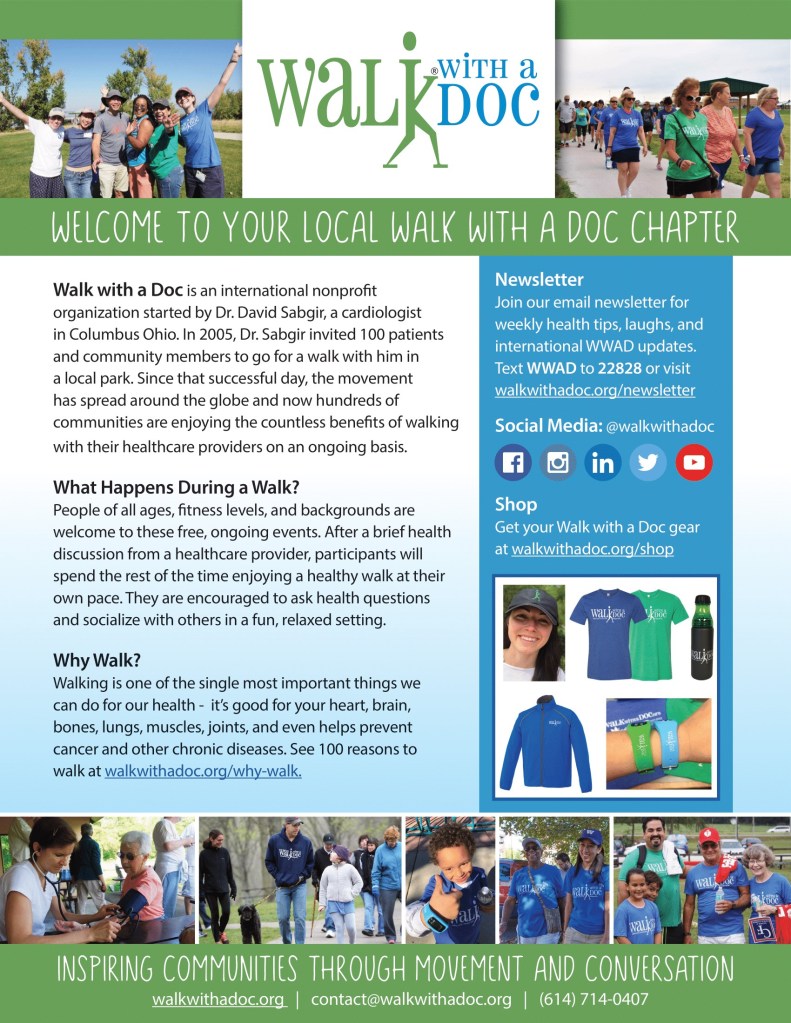
Join our local chapter of Walk with a Doc on Saturday, March 12, for a fun morning walking, talking about health, and meeting people in our community. You can find information about the spring dates here.
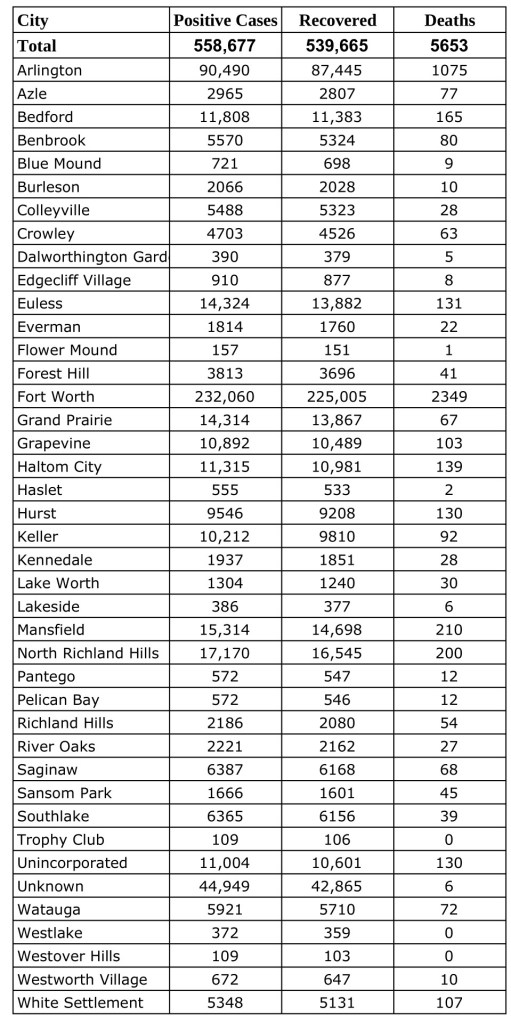
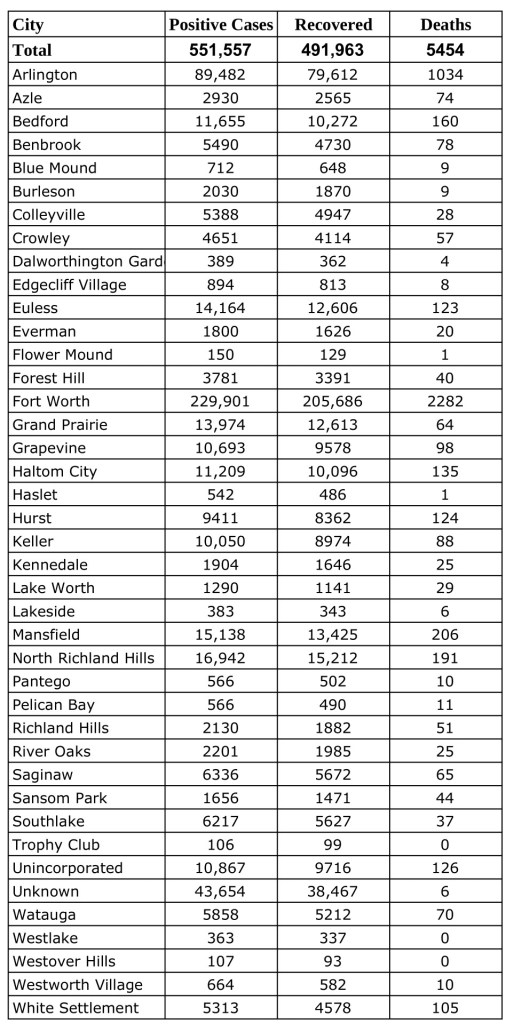
Data from Tarrant County Public Heath’s (TCPH) report of COVID-19 activity in Tarrant County updated Wednesday, March 2, 2o22.Find more COVID-19 information from TCPH here.
*These data are provisional and are subject to change at any time.
Deaths and recovered cases are included in total COVID-19 positive cases.
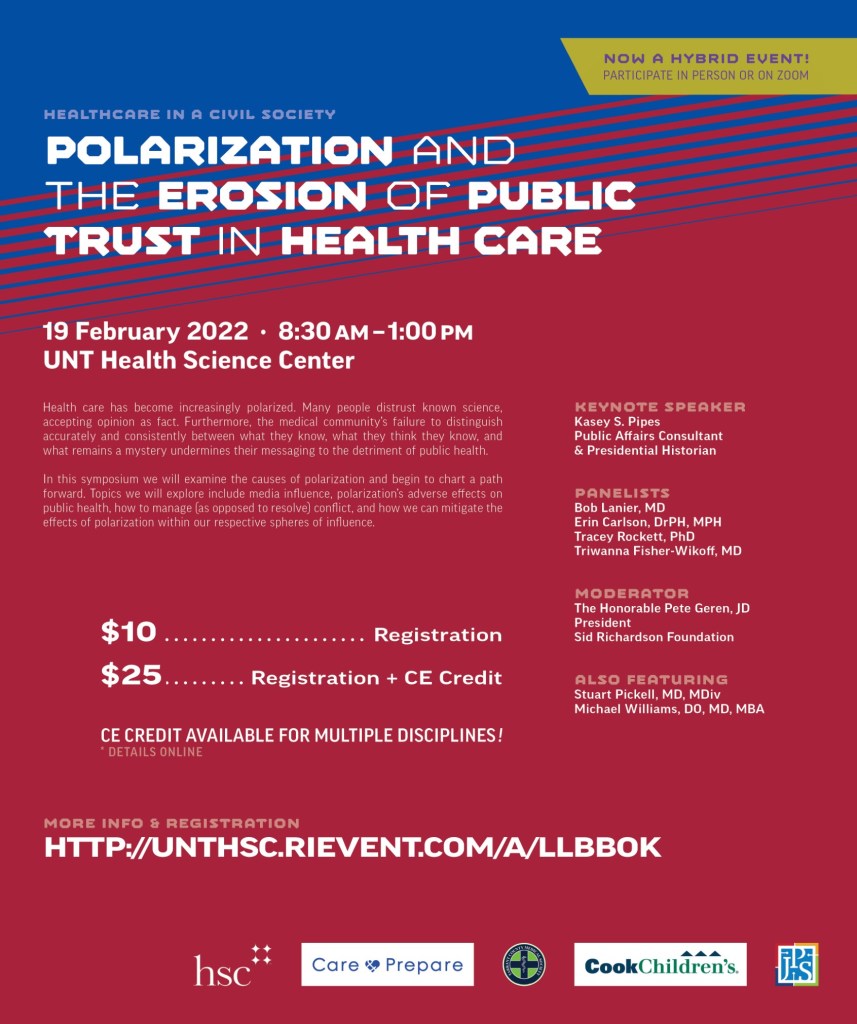
Tomorrow, Feb. 19, 2022, the Tarrant County Academy of Medicine Ethics Consortium, in partnership with the Tarrant County Medical Society, will host their annual Healthcare in a Civil Society symposium. This year’s program, “Polarization and the Erosion of Public Trust in Healthcare,” is an interactive event that takes an in-depth look at the impact of political polarization on healthcare.
“Our nation is beset by radical polarization,” says Stuart Pickell, MD, TCMS president-elect and chair of the consortium. “Historically, healthcare policy has been one topic on which we have been able to find common ground. What happened to transform it from something broadly bipartisan to incredibly divisive? This event will explore how we got to this point and begin to chart a path forward.”
The goal is to engage leaders of all perspectives in a civil conversation centered on the healthcare issues that are important to the Tarrant County community without the rhetoric that often undermines these conversations. This hybrid in-person/Zoom event will be held at the UNT Health Science Center from 8:30am to 1:00pm and provides continuing education credit for multiple healthcare disciplines.
While this symposium highlights discourse between community leaders, anyone who is interested in this critical topic is welcomed and encouraged to join the conversation. Those who are interested in participating can register here.
The event includes a breakout session allowing participants to explore the issues more deeply in small groups. A number of topics will be addressed, including:
How the media can influence public opinion and promote polarization
The impact of polarization on the public trust and public health
How polarization creates conflict (e.g., in how people refer to science as an absolute) and how to manage it
How people in health care professions can mitigate the effects of polarization within their spheres of influence when talking with patients
The event will be moderated by former congressman and current Sid Richardson Foundation President Pete Geren, who will be joined by panelists Bob Lanier, MD; Erin Carlson, DrPH, MPH; Tracey Rockett, PhD; and TCMS Secretary-Treasurer Triwanna Fisher-Wickoff, MD. The keynote speaker will be public affairs consultant and presidential historian Kasey S. Pipes, and the event will also feature Dr. Pickell and UNT System Chancellor Michael Williams, DO, MD, MBA.
The Tarrant County Medical Society is a professional organization that has been dedicated to the improvement of the art and science of medicine for the residents of Tarrant County since 1903. TCMS serves over 4,000 physicians, residents, medical students, and Alliance members, and is a component society of the Texas Medical Association.
Tarrant County Academy of Medicine was incorporated as a 501(c) (3) organization in 1953 to work in conjunction with the Tarrant County Medical Society. TCAM was created to enhance medical education, support community wellness, and preserve Tarrant County’s rich medical history.
This piece was originally published in the January/February 2022 issue of the Tarrant County Physician. You can read find the full magazine here.
Our nation is beset by radical polarization and erosion of trust. On Saturday, February 19th from 8:30 to 1:00 p.m., Tarrant County Medical Society’s Ethics Consortium will present a CME symposium entitled “Healthcare in a Civil Society 2022” that will explore the factors that have contributed to our present state of bifurcation.
While political discourse has always been polarized, our ability to voice divergent points of view and find common ground has been a hallmark of American democracy, and an important reason why it has worked.
Healthcare policy has been one topic on which we have been able to find common ground. Starting in World War II, trade unions sought alternatives when Congress passed the Stabilization Act (1942), which prohibited employers from increasing wages to their employees. Successful lobbing led Congress to include a provision making health insurance tax deductible to employers, but not to individuals.1 In 1965, Congress established the Medicare and Medicaid programs, thereby creating basic health insurance for the elderly and poor. In both cases there was broad bipartisan support. When Congress passed the Affordable Care Act in 2010, however, not a single Republican voted for it. What happened in those 45 years that transformed healthcare policy from something broadly bipartisan to incredibly divisive?
One reason Medicare and Medicaid achieved bipartisan support is that in 1965, Congress looked and behaved differently. John Dingell, a 60-year congressman from Michigan, noted that when he began serving in the House in 1955, members saw themselves first as representatives of their state, second as representatives of an institution (the House or the Senate), and only third as members of either party. By the time he left Congress in 2015, the order had reversed.2 Furthermore, in the 1960s, we still had left-leaning Republicans and right-leaning Democrats. Crossing party lines was common. People with opposing viewpoints knew each other because they met together, ate together, and socialized together. The result was good legislation achieved by compromise and trust. This is no longer true. While some congressional leaders continue to work well with people “across the aisle,” this has become more the exception than the norm.
If the political process has created a breeding ground for polarization, the advent of “news on demand” has catalyzed it. People can get the “news” they want when they want it from the sources that provide what they want to hear. There is no incentive for these sources to present complex issues in a balanced or nuanced way. Why should they?
By 2014, Pew Research noted that 92 percent of Republicans were to the right of the median Democrat, and 94 percent of Democrats were to the left of the median Republican.3 It’s certainly worse now. While appealing to their bases, each side fails to take into consideration the fact that, in science, what we believe to be true today may be wrong tomorrow. Political leaders have conveyed or distorted information and created policy based on an incomplete understanding of the facts to the detriment of public health. And the medical community hasn’t always been helpful. Our failure to distinguish accurately and consistently between what we know, what we think we know, and what remains a mystery about the current virus, has undermined our messaging to a politically charged and skeptical public.
The public’s reaction to the COVID-19 vaccine serves as a classic example. Many people allowed their position regarding the vaccine to be informed by political narrative rather than by scientific evidence. Lost in the rhetoric is the amazing story of Hungarian-born biochemist Katalin Karikó who, while working as a researcher at the University of Pennsylvania over 25 years ago, had a vision that mRNA could be leveraged for therapeutic effect. Over the last 15 years she nurtured that vision and refined the technology until it became a cure in search of a disease. With COVID-19 it had its disease. How do you put that in a sound bite? And if you manage to, how does it make it past the political noise?
It would be disingenuous to blame this polarization on any single event like the Affordable Care Act or the COVID-19 pandemic. They didn’t cause it. Metaphorically speaking, they are the hurricane that washes ashore and, in its aftermath, reveals off the coast a long-lost pirate ship. The pirate ship was always there, under the surface, but now everyone can see it.
But there is hope. Patients continue to trust us – the physicians they know – even if they are wary of our media representatives. In fact, because physicians adhere to an ethical code dating back over two millennia, we continue to be among the most trusted professionals in modern society, often jockeying with nurses for the #1 position.4 We have a fiduciary responsibility to our patients, and they know it. Our ethical obligation is to serve them – not an insurance company or a hospital, and certainly not a political party.
I call attention to this issue because it will be the focus of Healthcare in a Civil Society 2022. This CME event will explore how we got to this point and begin to chart a path forward. Kasey Pipes, a public affairs consultant, presidential historian, and former speechwriter for George W. Bush, will help us identify the factors that have contributed to polarization. Pete Geren, former congressman and current president of the Sid Richardson Foundation, will again moderate the expert panel that will address:
How the media influences public opinion and promotes polarization and mistrust
The impact of polarization on the public trust and public health
How polarization creates conflict (e.g., in how people refer to science as an absolute) and how to manage it
How people in health care professions can mitigate the effects of polarization within their spheres of influence when talking with patients
The event includes a breakout session allowing participants to explore the topic more deeply in small groups.
One thing I enjoy about being a physician is interacting with a diverse group of people. Part of the challenge for me is understanding where my patients are coming from and meeting them where they are to help them achieve their health goals. I make a concerted effort not to see my patients as “cases” – as diseases to be treated – but as people to be valued and loved. I think this ethos underlies our vocation, and it’s one of the reasons why medical professionals continue to enjoy the public’s trust. And it’s this trust that will help us neutralize the polarizing influences our political rhetoric has on public health. Join us in February and help us explore this important topic more completely.
About Healthcare in a Civil Society
Healthcare in a Civil Society is an annual forum sponsored by the Tarrant County Medical Society’s Ethics Consortium. It seeks to engage leaders of varying perspectives in a civil conversation focusing on the healthcare issues that are important to our community devoid of the rhetoric that often undermines these conversations.
References
1. Feldstein, Martin and James Poterba, editors. Empirical Foundations of Household Taxation. National Bureau of Economic Research. University of Chicago Press, 1996. p. 137. ISBN: 0-226-24097-5. http://www.nber.org/books/feld96-1. Conference Date: January 20-21, 1996.
2. Seib, Gerald. “Gerrymandering Puts Partisanship in Overdrive; Can California Slow It?” Wall Street Journal. November 29, 2021. Seib paraphrased Dingell’s comments in the article.
3. Pew Research Center. “Political Polarization in the American Public: How Increasing Ideological Uniformity and Partisan Antipathy Affect Politics, Compromise and Everyday Life.” June 2014.
Data from Tarrant County Public Heath’s (TCPH) report of COVID-19 activity in Tarrant County updated Tuesday, February 15, 2o22.Find more COVID-19 information from TCPH here.
*These data are provisional and are subject to change at any time.
Deaths and recovered cases are included in total COVID-19 positive cases.




 Tarrant County Physician Online