Are you using the best mask to limit your exposure to the coronavirus?
As the number of COVID-19 cases continue to rise in North Texas, the importance of protective measures also increases.
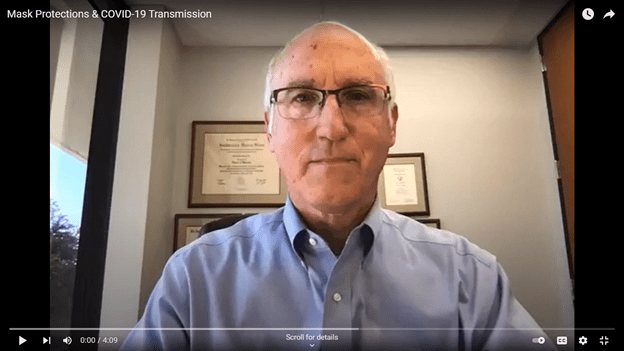
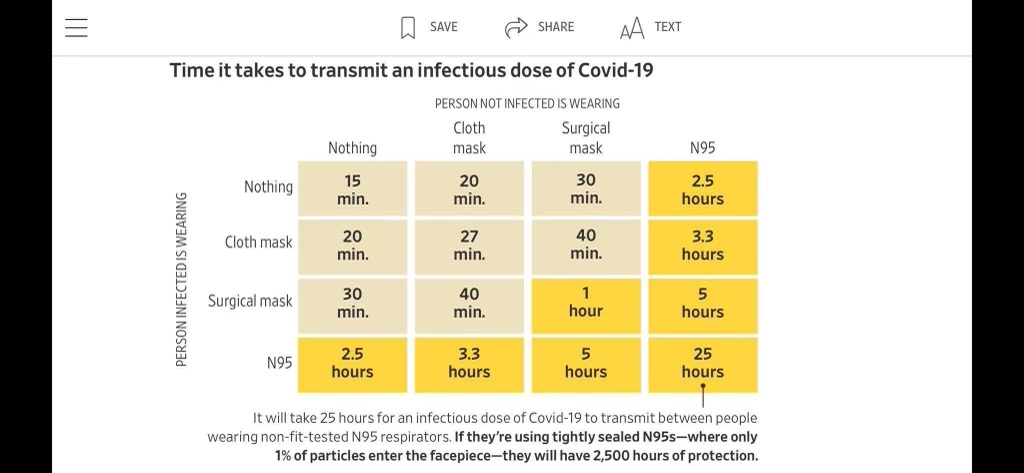
In the below North Texas Medical Society Coalition video, Fort Worth physician Dr. Robert Rogers, who is also part of the Tarrant County Medical Society, explains the different levels of protection provided by cloth, surgical, and KN95 masks, and how those differences impact his own decisions.
For more information on the transmission rates/mask types Dr. Rogers mentions in the video, please refer to the below chart:
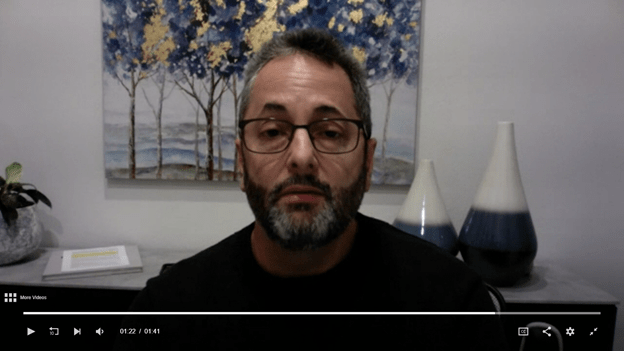
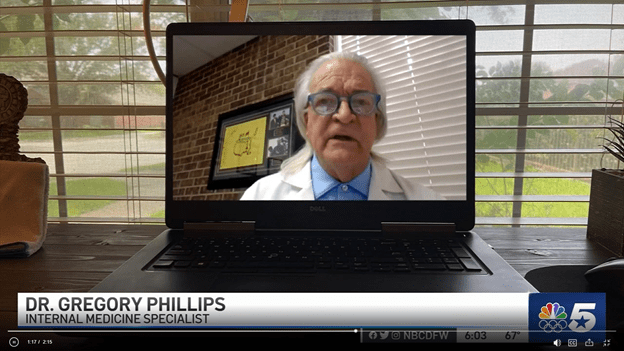
Have questions about socializing in light of the rising COVID numbers that have impacted holiday plans for many, including several local restaurants who had to temporarily close their doors? Check out Fort Worth physician Dr. Gregory Phillips’ interview with Lili Zheng of NBC5 to see what he has to say on the topic:
The Lifestyle Health Sciences graduate students at The University of North Texas Health Science Center have collaborated with Empower Fort Worth to create a survey that explores how to better meet the needs of helping professionals who serve our community through their work. This includes first responders, healthcare professionals, therapists, lawyers, and clergy.
If you work in any of these roles, please consider taking this short (5 minute), anonymous survey. You can do so here.
The goal of this survey is to identify the services and resources needed to best support the personal wellbeing of helping professionals and address their risk of experiencing burn-out or struggling with their mental health.
by Catherine Colquitt, MD Tarrant County Public Health Medical Director
This article was originally published in the November/December issue of the Tarrant County Physician. You can read find the full magazine here.
With local hospitals and emergency responders struggling to meet the space and staffing challenges brought on by the COVID-19 Delta variant, monoclonal antibody infusions (and subcutaneous injections when applicable for REGEN-COV) are being used to treat early COVID-19 infections. These are effective options in persons who don’t require hospitalization for COVID-19, aren’t hypoxic (or, if chronically O2-dependent, aren’t needing to augment their percentage of supplemental O2), or even as postexposure prophylaxis for persons at high risk for severe disease and poor outcome if they contract COVID-19 after an exposure.
The science underlying the development of the three monoclonal products granted Emergency Use Authorization (EUA) by the FDA capitalizes on the importance of the COVID-19 spike protein as a means of host cell entry. When viral particles are tagged by SARS-CoV-2 monoclonal antibody therapies, the monoclonal antibody-tagged viruses can’t enter host cells and replicate.
The mRNA vaccines, encoded for the COVID-19 spike protein and currently in wide usage, target the same essential viral spike protein by stimulating the host to transcribe the spike protein mRNA. They mount an immune response to that transcribed viral spike protein which the host’s immune system will then remember and repeat (anamnestic response) when COVID-19 viral particles present the spike protein to the now-vaccinated host’s primed immune system.1
Three SARS-CoV-2 monoclonal antibody formulations have been granted EUA by the FDA, though the first monoclonal SARS-CoV2 product (the coformulation bamlanivimab and etesevimab) is no longer authorized in the U.S. because of the decreased susceptibility of Beta and Gamma COVID-19 variants to it.2 Two combinations remain in use— the coformulation monoclonal casirivimab and imdevimab (REGEN-COV), which binds to nonoverlapping epitopes of the spike protein, and sotrovimab (XeVudy). Both are given under EUA’s for mild to moderate COVID-19 infections in persons 12 years or older weighing at least 40 kg and at high risk for severe COVID-19 infection. REGEN-COV use in postexposure prophylaxis is also granted under its EUA for COVID-19-exposed persons not yet fully vaccinated and for persons who are vaccinated but regarded as unlikely to respond well to COVID-19 vaccinations.3 Locally, only REGEN-COV is in use at present.
Comorbidities to consider in deciding who to refer for SARS-CoV-2 monoclonal therapy after onset of mild to moderate illness (early is best but both products are approved through day 10 after symptom onset) include:
Age 65 and older
BMI over 25kg/meter squared
For 12 to 17 years old, BMI over 85th percentile for height and age
Pregnancy
Chronic kidney disease
Diabetes mellitus
Immunosuppressive disorder or treatment
Cardiovascular disease, including hypertension and congenital heart disease
Chronic lung disease, including COPD
Moderate to severe asthma
Interstitial lung disease
Cystic fibrosis
Pulmonary hypertension
Sickle cell disease
Neurodevelopmental disorders such as cerebral palsy or other conditions “conferring medical complexity such as congenital abnormalities and genetic or metabolic syndromes, and medical-related technology dependence such as tracheostomy, gastrostomy or feeding jejunostomy, mechanical ventilation, etc.”4
Data supporting the use of both SARS-CoV-2 monoclonal products currently in use is persuasive if primary outcomes of all deaths and hospitalizations through day 29 after administration of the products is the measure. For REGEN-COV there was an absolute reduction in death and hospitalization of 2.2 percent and a relative reduction of 70 percent in the treatment group versus placebo. For XeVudy, using the same primary outcome measures of all-cause mortality and hospitalization through day 29, the treatment group experienced a 6 percent absolute reduction and an 85 percent relative risk reduction compared with the placebo group.5
Some special considerations for the use of SAR-CoV-2 monoclonal products:
Variants: So far both products are rated as efficacious against variants available to test, including Delta and Mu, though this is a rapidly changing field of study.
Vaccinations Against COVID-19: Contraindicated in the 90 days following monoclonal administration due to theoretical concerns regarding a blunted immune response to COVID-19 vaccination.
Monitoring After Infusion: For one hour in a health care setting.
Drug Interactions: None so far identified.
Pregnancy: Monoclonals can be used in pregnancy and should certainly be considered when a pregnant woman has additional risk factors (beyond pregnancy alone) for severe COVID-19 disease.
Reactions to SARS-CoV-2 Monoclonal Products: Injection site reactions (pain, redness, swelling, pruritus, injection site ecchymosis) in approximately 1 percent and infusion related reactions such as urticaria, pruritus, flushing, pyrexia, shortness of breath, chest tightness, nausea, vomiting, and, rarely, anaphylaxis. In general, the REGEN-COV current dose of 600mg of casirivimab and 600mg of imdevimab is significantly better tolerated than the previously higher dosed formulations.
Lactation: No data yet available.
Hepatic impairment: No dose adjustment needed.
And please remember – COVID-19 monoclonal therapeutics are not a substitute for COVID-19 vaccination!
Locations of Tarrant County Infusion Centers:
JPS Urgent Care Center
1500 S. Main Street, Fort Worth , Texas 76104
Call 817-702 1451 for appt.
North Central Texas COVID-19 Regional Infusion Center
Additional Infusion Center resources are available at www.tarrantcounty.com or by phone at HHS Protect Public Data Hub (1-877-332-6585 in English and 1-877-366-0310 in Spanish).
The JPS Board of Managers has announced the appointment of Dr. Karen Duncan as the administrator for the Tarrant County Hospital District, to serve in the role of president and chief executive officer for JPS Health Network, effective January 1, 2022. The move follows outgoing president and CEO Robert Earley’s retirement announcement two weeks ago.
“It is a testament to the strength of JPS that we found the right person to lead the health network into the future within our own ranks,” said Dr. Charles Webber, chairman of the JPS Board of Managers. “Dr. Duncan has been a steadfast champion of providing our community with the care they need and deserve, and I look forward to her leadership.”
Duncan currently serves as the network’s chief operating officer, and has been with JPS for five years. In that time, she has been responsible for transforming the community health network of medical homes and clinics, and most recently has steered the implementation of the JPS Future Plan, the bond-supported development of healthcare services and sites throughout the county.
“JPS is on the right track, and Dr. Duncan has been an integral part of that,” said Dorothy DeBose, incoming chair of the JPS Board of Managers. “We are fortunate to have a leader of her caliber ready to continue the great work we’ve already seen. We will work closely with her to design a succession plan for the organization that recognizes the current need for stability while continuing JPS’ growth.”
“I am both humbled and honored to serve as CEO of such a highly esteemed and accomplished healthcare system,” said Duncan. “JPS is well positioned to lead the transformation of healthcare delivery in Tarrant County and to improve lives within the many communities we serve. I look forward to working alongside a committed Board, a strong executive and leadership team and an amazing JPS team.”
Just last week JPS Health Network received top marks for patient safety and quality measures from the Leapfrog Group, the latest in a growing list of accreditations and honors for network which include Best Hospital for America by Washington Monthly and the Lown Institute and Outstanding Healthcare System by D CEO Magazine.
Tarrant County Public Health hosts numerous pop-up COVID-19 clinics across Tarrant County each week in partnership with public and private organizations listed below. Each site has the Moderna and Pfizer vaccines and at times the Johnson & Johnson. Vaccination are now available for children ages five and older at all of the TCPH locations. Booster doses continue to be available for those:
In addition the to the vaccination opportunities below, the cities of Arlington, Fort Worth, Mansfield, North Richland Hills, Hurst, and Tarrant County College have also added opportunities for vaccinations that are listed on our vaccine finder website.
TCPH would like to continue to partner with businesses, churches and other organizations in the community who are interested in hosting a COVID-19 pop-up clinic. It’s easy and free to host a clinic. Those interested can sign up for a public or private event at VaxUpTC.com.
Pop-Up COVID-19 locations:
Rep. Chris Turner and Commissioner Devan Allen Saturday, Nov. 6: 10 a.m. to 2 p.m. Bowie High School 2101 Highbank Drive Arlington, TX 76018
Watauga Fire Department Monday, Nov. 8: 8 a.m. to 12 p.m. 7901 Indian Springs Road Watauga, TX 76148
La Gran Plaza Monday, Nov. 8: 10 a.m. to 6 p.m. 4200 South Freeway Fort Worth, TX 76115
Hurst Fire Station Tuesday, Nov. 9: 10 a.m. to 6 p.m. 2100 Precinct Line Rd Hurst, TX 76054
Immaculate Heart of Mary Wednesday, Nov. 10: 11 a.m. to 3 p.m. 108 E. Hammond Street Fort Worth, TX 76115
N. Richland Hills Fire Station 5 Wednesday, Nov. 10: 2 to 7 p.m. 7202 Dick Fisher Drive S. North Richland Hills, TX 76180
Sundance Square Pavilion Friday, Nov. 12: 11 a.m. to 7 p.m. Near the intersection of 4th and Main Streets Fort Worth, TX 76102
Northwest Public Health Center Monday to Friday: 8 a.m. to 12 p.m. and 1 to 5 p.m. 3800 Adam Grubb Road Lake Worth, TX 76135
Bagsby-Williams Health Center Monday to Friday: 8 a.m. to 12 p.m. and 1 to 5 p.m. 3212 Miller Ave. Fort Worth, TX 76119
Southeast Public Health Center Monday to Friday: 8 a.m. to 12 p.m. and 1 to 7 p.m. 536 W Randol Mill Arlington TX, 76011
Main Public Health Center Monday to Friday: 8 a.m. to 12 p.m. and 1 to 6 p.m. 1101 S. Main Street Fort Worth, TX 76104
Southwest Public Health Center Monday to Friday: 8 a.m. to 12 p.m. and 1 to 5 p.m. 6551 Granbury Road Fort Worth, TX 76133
Watauga Public Health Center Monday to Friday: 8 a.m. to 12 p.m. and 1 to 8 p.m. 6601 Watauga Road Watauga, TX 76148
COVID-19 causes respiratory illness with cough, fever and shortness of breath and may lead to bronchitis and severe pneumonia. For more information go to coronavirus.tarrantcounty.com or call the Tarrant County Public Health information line, 817-248-6299, Monday – Friday 8 a.m. to 6 p.m. and Saturday – Sunday 10 a.m. to 2 p.m.
Pfizer’s COVID-19 vaccine, Comirnaty, for children ages 5 to 11 years old is now available in Tarrant County. Parents and legal guardians should first talk to their pediatrician or local pharmacy to obtain their vaccination. Tarrant County Public Health will also be offering the children’s vaccine for those who cannot obtain it elsewhere.
The Pfizer COVID-19 vaccine received final approval for use with children from the CDC on Tuesday, Nov. 2, 2021. On Oct. 29 the vaccine received its Emergency Use Authorization from the EPA. The EPA and CDC reviewed extensive data from trials to ensure the vaccine is safe for younger children. Critical points found during the studies include:
Effectiveness: Immune responses of children 5 – 11 years of age were comparable to those of individuals 16 through 25. In addition, the vaccine was found to be 90.7 percent effective in preventing COVID-19 in children 5 – 11.
Safety: The vaccine’s safety was studied in approximately 3,100 children age 5 – 11 who received the vaccine and no serious side effects have been detected in the ongoing study.
Dosage: The dose is just one-third (10 micrograms) of the dose for those 12 years of age and older (30 micrograms).
Children age 5 – 11 will receive two doses, 21 days apart, similar to those in the older groups already vaccinate. If a child cannot receive their second dose at 21 days, they are encouraged to get their second dose as soon as possible. Once the series has begun, there is no reason to restart; just finish up when it is possible. At this time, a booster dose is not recommended for children.
“The more than 204,000, 5 to 11 year-olds in Tarrant County will now be able to receive a COVID-19 vaccine and help reduce the spread across our community,” said Tarrant County Public Health Director Vinny Taneja. “The fastest and easiest way to get a vaccine will be through the family pediatrician or at the local pharmacy. Public Health will offer the vaccine at each of its clinics across the County for those who need it.”
While younger children do not typically have severe outcomes when they contract COVID-19, they do act as spreaders taking it from home to school or from school to home, school to sports, school to daycare. In Tarrant County, there have been six deaths of people under the age of 18.
The COVID-19 vaccines are free to the recipients, whether they are insured or uninsured.
COVID-19 causes a respiratory illness with cough, fever and shortness of breath and may lead to bronchitis and severe pneumonia. For more information, go to coronavirus.tarrantcounty.com or call the Tarrant County Public Health information line, 817-248-6299, Monday – Friday 8 a.m. to 6 p.m. and Saturday – Sunday 10 a.m. to 2 p.m.
Watch below to hear TCMS President Angela Self, MD, explain how the monoclonal antibody treatment, which was recently taken for Fort Worth Mayor Mattie Parker, is an effective tool for COVID-19 treatment.
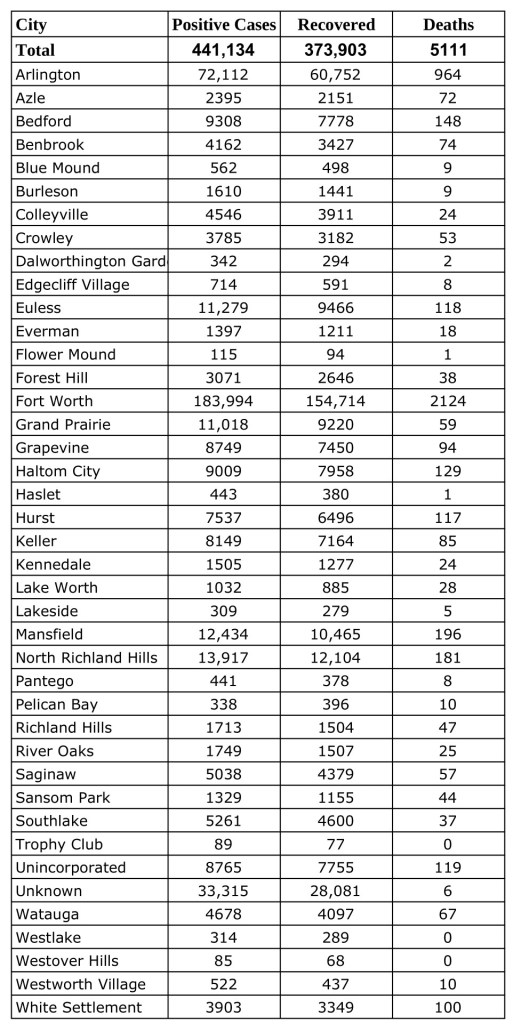
Data from Tarrant County Public Heath’s (TCPH) report of COVID-19 activity in Tarrant County updated Monday, October 11, 2021.Find more COVID-19 information from TCPH here.
*These data are provisional and are subject to change at any time.
Deaths and recovered cases are included in total COVID-19 positive cases.