A message to the community from Tarrant County physicians
The current surge in COVID-19 cases in the Tarrant County area is having serious consequences that could impact patient outcomes.
Hospitals are currently at, or over, their staffing capacity with very few open ICU beds available across Tarrant County.
Doctors, nurses, and other healthcare professionals are straining to meet the overwhelming needs in the hospitals.
COVID-19 hospitalizations aren’t just a problem of the unvaccinated, they also strain the resources that are needed to treat other medical conditions and emergencies.
To avoid this, we urge the community to recognize this current crisis and take the simple and familiar steps that are proven to be effective against the spread of COVID-19.
We must continue to wear our masks, wash our hands, and be cautious about how we gather.
Because the Delta variant is the most contagious variant yet and has the potential for spread by both vaccinated and unvaccinated individuals, we encourage everyone to wear a mask in public while indoors and outdoors when unable to socially distance.
In addition, those who are not fully vaccinated should limit gathering with those outside of their household, especially while indoors.
Vaccination is the safest and most effective way by which we can protect ourselves from this deadly virus and get back to normal.
With over 350 million doses of COVID-19 vaccine given in the U.S., evidence of the safety and effectiveness of the vaccines is overwhelming.
Being fully vaccinated results in an 8-fold reduction of having symptomatic COVID-19, a 25-fold reduction in being hospitalized and a 25-fold reduction in death from COVID-19. We strongly encourage every eligible person to get vaccinated – immediately.
As a community, we are at a tipping point. Let’s move in the right direction.
Each one of us can do our part to stop the spread, break the cycle, and defeat this pandemic once and for all. The choice is ours.
The Tarrant County Medical Society is a membership organization for the physicians serving the Tarrant County community. TCMS has been dedicated to the improvement of the art and science of medicine since 1903.
Come to MedStar’s headquarters Get vaccinated by First Responders & view our 9-1-1 Communications Center
Friday, August 20, 2021 10am–4pm 2900 Alta Mere Drive, Fort Worth, TX 76116
18 years and older are eligible for 1st dose. 12 years and older are eligible for 2nd dose. Parent must be present with a minor to receive the vaccine.
Insured and uninsured welcome. If insured, please have insurance info ready when registering and present health insurance and identification for on-site vaccination.
JPS Health Network announces the opening of a new outpatient Behavioral Health clinic that will both increase the number of patients it can treat and allow it to enhance the services it offers people in need of care.
Called the JPS Center for Behavioral Health Recovery, the facility has replaced the outdated, Hemphill Outpatient Behavioral Health clinic, which was on the southwest corner of the JPS campus in Fort Worth. The facility is located a few blocks to the north in a more inviting and more purposefully designed building at 601 W. Terrell Avenue.
Slightly larger than the Hemphill site, the new clinic features a much more efficient use of space. Doctors, nurses and other team members cared for about 160 people each day at the former building. They expect to be able to greatly expand their capacity to serve those with behavioral health needs at the new site.
“I challenge people who say facilities don’t have anything to do with the quality of care that we can provide to patients,” said Teneisha Kennard, Executive Director of Behavioral Health Ambulatory Services at the health network. “We prioritize treating our patients with dignity and respect, and this new building will show our patients and community our commitment to caring for them. There is dignity, respect, and a sense of worth in this new building.”
The Center for Behavioral Health recovery will unite traditional outpatient Behavioral Health services offered at Hemphill including evaluation, diagnosis, medication management, brief psychotherapy, psychological testing, and group therapies with access to primary care physicians and lab testing under one roof.
Features of the new Behavioral Health clinic include:
Space for a primary care physician and phlebotomists who can perform tests on-site instead of sending patients to the main hospital, requiring an extra trip back and forth.
Dedicated space for psychological testing and for psychologists to meet with patients
More open and inviting spaces that will contribute to a more constructive environment for patients
Easier to get to, with more on-site parking and a bus stop in front of the building for patients who rely on public transportation.
The new location, which previously served as the home of the JPS Center for Cancer Care, has been extensively remodeled since cancer services were moved in May 2019 to a much larger, updated JPS Oncology and Infusion Center on 8th Avenue.
The Hemphill site will be torn down in the coming weeks, and turned into a parking lot to facilitate the next moves in the health network’s $800 million bond construction project. Tentative Phase I plans call for a new Psychiatric Emergency Center to be built on existing employee parking lots closer to the center of the main JPS campus.
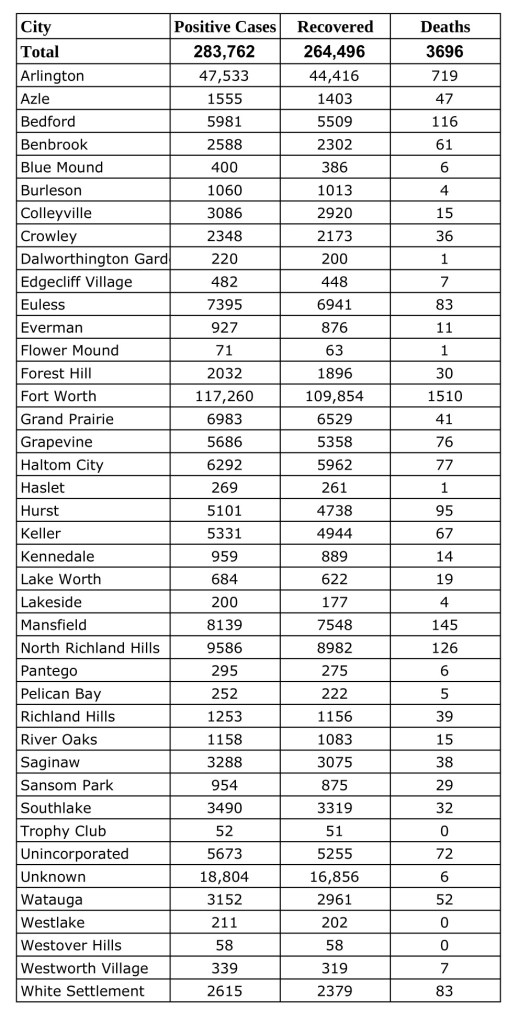
Data from Tarrant County Public Heath’s (TCPH) report of COVID-19 activity in Tarrant County, updated Friday, August 13, 2021.Find more COVID-19 information from TCPH here.
*These data are provisional and are subject to change at any time.
Deaths and recovered cases are included in total COVID-19 positive cases.
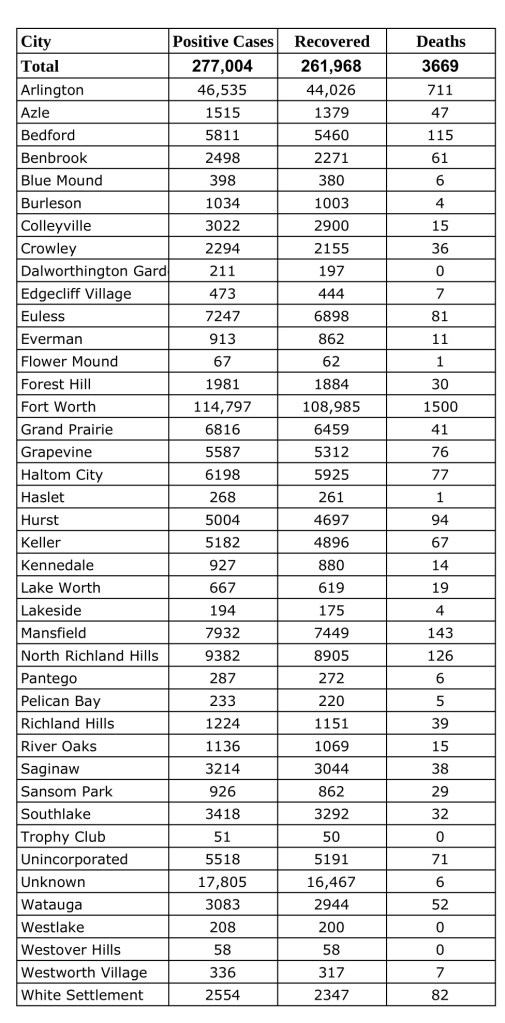
Data from Tarrant County Public Heath’s (TCPH) report of COVID-19 activity in Tarrant County, updated Thursday, August 5, 2021.Find more COVID-19 information from TCPH here.
*These data are provisional and are subject to change at any time.
Deaths and recovered cases are included in total COVID-19 positive cases.
JPS Health Network is committed to helping ensure our community has the most up-to-date information about the COVID-19 pandemic. Due to an increase in the number of positive cases in Tarrant County, the Network is resuming a daily information phone line to provide facts about COVID-19 cases at JPS.
Starting today, information will be available as a recording updated every morning at 10 a.m. Callers can access the recorded message by calling 817-702-9500.
The recording will provide information including the number of inpatients who are undergoing treatment for COVID-19 at John Peter Smith Hospital. The phone line was in operation for about a year during the height of the pandemic, and was suspended in mid-June as the number of cases at the hospital dwindled.
This article was originally published in the July/August issue of the Tarrant County Physician. You can read find the full magazine here.
On the heels of the COVID-19 pandemic, pediatric suicide and mental health diseases are at all-time highs. According to the Centers for Disease Control and Prevention, suicide was the second leading cause of death for individuals between the ages of 10 and 34 in 2019.1 This research also noted that suicide rates have risen by 35 percent from 1999 to 2018 across the United States.1,2 With the arrival of the novel coronavirus pandemic and resulting social distancing, financial losses, and increased morbidity and mortality, we have seen an increase in the already high number of mood and anxiety disorders across all age groups. Children and adolescents have been especially impacted because of parental distress, social isolation, and difficulty adjusting to the virtual school environment. Many children with a pre-existing psychiatric diagnosis have experienced an exacerbation while others have experienced mental health symptoms for the first time, not knowing how to cope with the stress of their severely altered circumstances. Because the pandemic is currently ongoing, there is scarce research available to quantify the increase in mental health needs in the pediatric population due to COVID-19 and its restrictions.
Primary care providers and pediatricians have been on the front lines and often are the only point of contact for many patients before a suicide attempt. In 2015, researchers used National Institute of Mental Health-funded Mental Health Research Network data from 2009-2011 and found that 38 percent of patients who attempted suicide had made some type of healthcare visit within the week of the attempt, 64 percent within the month, and 95 percent within the year.3 This data shows us that primary care providers are integral in identifying and treating vulnerable patients that may not have access to psychiatric services.
Due to this urgent need for further pediatric mental health care services, the 86th Texas Legislature passed Senate Bill 11 in 2019, enacting the Child Psychiatry Access Network (CPAN), a telephone consultative service for primary care providers caring for children and adolescents with mental health needs. The caller will be greeted by a member of our team who will ask general questions about the call and can provide resources such as outpatient therapists, local partial hospitalization programs, and/or pediatric inpatient programs in the area if needed. If there are diagnostic questions or the need for support with treatment planning, consultation with a pediatric mental health provider can be arranged the same day.
Your local CPAN team wants to support you as you treat your pediatric patients’ mental health needs. The University of North Texas Health Science Center (UNTHSC) has partnered with John Peter Smith Health Network (JPS) to provide these services for Tarrant County and eight of the surrounding counties, including Parker, Wise, Cooke, Erath, Palo Pinto, Jack, Montague, and Clay. This service is free of charge with a response time of within five minutes for resourcing requests and 30 minutes for consultation with a child psychiatry provider. CPAN is ready to provide support to Texas primary care providers Monday through Friday from 8 am to 5 pm. Just call 1-888-901-CPAN, press 1 for North and North East Regions and press 1 again for the UNTHSC/JPS hub. You will be able to obtain needed resources or a consultation immediately. You can also contact the CPAN coordinator, Janet Thompson, at JThompso04@jpshealth.org to enroll, though enrollment is not required to make a call. We look forward to partnering with you to help your pediatric populations and their families.
2“Vital Signs: Trends in State Suicide Rates – United States, 1999–2016 and Circu stances Contributing to Suicide – 27 States, 2015.” Centers for Disease Control and Prevention. Centers for Disease Control and Prevention, June 10, 2019. https://www.cdc.gov/mmwr/volumes/67/wr/mm6722a1.htm?s_cid=mm6722a1_w.
Data from Tarrant County Public Heath’s (TCPH) report of COVID-19 activity in Tarrant County, updated Monday, July 26, 2021.Find more COVID-19 information from TCPH here.
*These data are provisional and are subject to change at any time.
Deaths and recovered cases are included in total COVID-19 positive cases.
Imagine your vision slowly getting worse, almost like a timer counting down. You aren’t sure of the colors on a traffic signal so driving becomes hazardous. Now, thanks to our generous donors and volunteers, 52-year-old patient, Ben, describes getting much-needed cataract surgery as “I feel like I was reborn.”
Ben can’t think of a better way to describe the moment he opened his eyes, and at last, could see clearly.
Previously, Ben, who is a kitchen manager, says his day-to-day life was a challenge.
“The restaurant where I work at is very fast paced, and I would get lost and behind due to my loss of vision. I couldn’t watch TV; I couldn’t see at night due to glare. I was scared to drive at night.”
Ben knew he needed help and needed to support his wife and daughter, but the cataract in his left eye continued to get worse, making his vision cloudy and unreliable. Ben went to Mission Arlington and was referred to an ophthalmologist to have the cataract removed, but he was unable to afford the surgery.
Project Access Tarrant County (PATC) works with other local nonprofits to refer patients to our team of volunteer doctors and clinics. Services are provided at reduced costs so patients like Ben are able to receive critical medical care.
Ben’s wife received treatments from PATC previously, so he reached us to us. After consultation with Dr. Tyler Moore, we coordinated with Baylor Surgicare who provided the venue for the procedure and Anesthesia Associates, Fort Worth Division of USAP, who provided the anesthesia care.
Ben and his family knew that it would be impossible to pay for the surgery without insurance and that cost would not be a barrier thanks to supporters to PATC.
Dr. Moore performed the surgery, and Ben couldn’t be more thrilled with the outcome.
“I couldn’t see if the light was red or green and I’d have to ask my wife for help, but now I no longer feel upset and mad that I couldn’t do what I wanted,” he says. “I can drive again comfortably. It’s totally different than when I was scared to drive.”
Donor support allows patients like Ben to resume normal life activities
“I am so thankful,” Ben says. “Project Access has changed my life.”
Data from Tarrant County Public Heath’s (TCPH) report of COVID-19 activity in Tarrant County, updated Monday, July 12, 2021.Find more COVID-19 information from TCPH here.
*These data are provisional and are subject to change at any time.
Deaths and recovered cases are included in total COVID-19 positive cases.




 Tarrant County Physician Online