Tarrant County Public Heath’s (TCPH) report of COVID-19 activity in Tarrant County, updated Saturday, March 21, 2020 at 9:30 a.m.Find more COVID-19 information from TCPH here.
As the number of COVID-19 cases in Texas and around the country grows, what steps should your clinic take to ensure the safety of your staff and patients?
The Texas Medical Association COVID-19 Task Force has updated its “Frequently Asked Questions” that answer many of the questions you might have about caring for people who have been exposed to the virus.
Among the questions answered:
How to minimize exposure to COVID-19 in your clinic;
Types of infection prevention control measures to implement in your clinic;
How to best prepare staff;
Infection prevention and control precautions to take if a patient with possible COVID-19 requires evaluation at an emergency department (ED); and
Infection prevention and control recommendations to give to patients with suspected COVID-19 who are well enough to go home.
The FAQ is based on guidance from the Centers for Disease Control and Prevention (CDC), the Department of State Health Services (DSHS), and other health organizations.
You can find the latest news, resources, and government guidance on the coronavirus outbreak by visiting TMA’s COVID-19 Resource Center regularly.
Watch Psychiatrist Dr. Brian Dixon discuss how to cope with anxiety and stress during the COVID-19 pandemic in his interview with NBC5. This originally aired on 3/19/20.
TexMed 2020 will not take place in Fort Worth on May 1-2, Texas Medical Association President David C. Fleeger, MD, announced Tuesday. The TMA House of Delegates, however, will convene in a virtual format on those same dates, using a focused agenda to address the key issues before the house.
“After careful consideration of the evolving COVID-19 situation in Texas, with input from local and state health officials and TMA’s Coronavirus Task Force, the TMA Board of Trustees has determined that TexMed 2020 will not take place in Fort Worth on May 1-2,” Dr. Fleeger said. “The health and safety of our members is paramount as you are on the front lines of the fight to control the spread of the virus and treat infected patients.”
Dr. Fleeger asked House of Delegates members to keep May 1 and May 2 open on their calendars and told them to expect additional information on the virtual house meeting over the coming weeks.
“While we regret that our members will not gather in Fort Worth, TMA leadership and staff are working to keep the association moving forward, and to provide alternate solutions where possible,” he said. These include:
Chairs of TMA boards, councils, committees, and sections will determine if and when those bodies will convene virtually. Members of TMA’s boards, councils, committees, and sections can expect additional communications from TMA staff.
Where possible, the CME education planned for TexMed 2020 will be made available to members via TMA’s online Education Center.
Information from exhibitors at the TexMed 2020 Expo Hall will be hosted online through the end of the year for members to explore the latest practice solutions and services.
The TMA Foundation Gala will transition to a different format. Ticketholders will receive additional information in the coming weeks.
Doctors Launch Nationwide Initiative to Improve Care DuringCOVID-19 Pandemic
The Texas Medical Association (TMA) joined The Physicians Foundation, American Medical Association, Florida Medical Association, and Massachusetts Medical Society in launching The Telehealth Initiative to help physicians start telehealth care. With the current health crisis, the organizations sped the initiative’s launch to help physicians shift to telehealth to meet patients’ needs from their homes where they cannot transmit COVID-19 or other diseases to other people.
The COVID-19 pandemic reinforces the need for physicians’ access to practical resources that will enable them to operate telehealth services to care for their patients efficiently. Through The Telehealth Initiative, physicians are able to diagnose and direct patients efficiently and safely, while improving patient outcomes.
“Physicians know how important it is for us to give our patients the option of obtaining safe, high-quality medical care digitally,” said David C. Fleeger, MD, president of TMA. “TMA wants to provide tools and pragmatic guidance for physicians, so that we can embrace telemedicine and appropriately offer it to our existing patients and maintain continuity of care.”
The program helps participating physicians redesign their practices to successfully provide telehealth services to their patients. Additionally, the initiative is providing free, online access to resources to encourage all physicians to consider and launch telehealth services. The Telehealth Initiative’s resources for physicians include:
“The generous grant from The Physicians Foundation allows TMA to accelerate our work and get this information to physicians quickly, which is vital as we see COVID-19 take its grip on the public’s daily routine,” Dr. Fleeger added.
TMA is the largest state medical society in the nation, representing more than 53,000 physician and medical student members. It is located in Austin and has 110 component county medical societies around the state. TMA’s key objective since 1853 is to improve the health of all Texans.
About The Physicians Foundation
The Physicians Foundation is a nonprofit seeking to advance the work of practicing physicians and help them facilitate the delivery of high-quality health care to patients. As the health care system in America continues to evolve, The Physicians Foundation is steadfast in its determination to strengthen the physician-patient relationship and assist physicians in sustaining their medical practices in today’s practice environment. It pursues its mission through a variety of activities including grant-making, research, white papers and policy studies. Since 2005, the Foundation has awarded numerous multi-year grants totaling more than $50 million. In addition, the Foundation focuses on the following core areas: physician leadership, physician wellness, physician practice trends, social determinants of health and the impact of health care reform on physicians and patients. For more information, visitwww.physiciansfoundation.org.
Watch WFAA’s coronavirus town hall from 3/19/20, where a number of North Texas leaders, including EMS Director Veer Vithalani, MD, gathered together to discuss the most recent developments in the COVID-19 pandemic and what is being done in response to the outbreak.
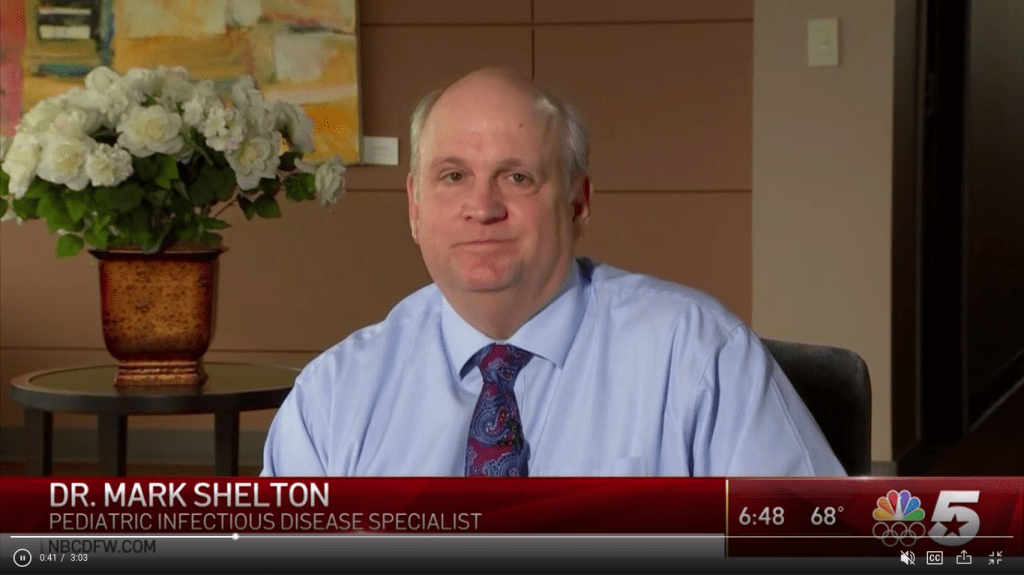
Watch the below video to hear Pediatric Infection Disease Specialist Dr. Mark Shelton explain “community spread” and answer some of your top coronavirus questions.
To help Texas physicians safely and effectively treat patients during the COVID-19 pandemic, several changes to telemedicine visits have taken effect, including payment for services and which platforms can be used.
“Physicians have important new tools to care safely for our most vulnerable patients in this crisis thanks to the timely actions by the Trump administration, Gov. Greg Abbott, Texas Medical Board President Sherif Zaafran, MD, and Insurance Commissioner Kent Sullivan,” TMA President David C. Fleeger said. “We are working closely with congressional leaders to expand telemedicine payment parity to all health plans so we can provide the high quality of care all Texas patients deserve.”
Insurers to Cover Visits
Governor Abbott on Tuesday waived certain regulations and directed the Texas Department of Insurance (TDI) to issue an emergency rule relating to telemedicine provided through state-regulated insurance plans.
Contracted or preferred physicians and other health care professionals will be eligible for payment from TDI-regulated insurance plans for medical visits they conduct over the phone instead of in person at the same rate they would receive for in-person visits. The Texas Medical Board will issue guidance in the coming days, including administrative guidance for billing to ensure claims are processed smoothly, the governor’s office said.
Effective immediately, the U.S. Health and Human Services (HHS) Office for Civil Rights will not penalize physicians for noncompliance with HIPAA when they serve patients in good faith through common, nonpublic-facing communications technologies, such as FaceTime or Skype.
This applies to services provided via telehealth for any reason, regardless of whether the service is related to the diagnosis and treatment of health conditions related to COVID-19, the office said.
HHS encourages physicians to notify patients of the potential security risks of using these services, but notification is not required. Physicians should not use public-facing communication services like Facebook Live, Twitch, and TikTok. Physicians should still document the visit as though it took place in person.
Physicians may want to check with individual payers regarding their telemedicine requirements in light of the HHS announcement.
Medicare Telehealth Expands
The Centers for Medicare & Medicaid Services (CMS) has temporarily broadened telehealth access to Medicare patients.
Under a new 1135 waiver effective March 6:
Medicare can pay for office visits furnished via telehealth in all areas of the country (not only rural areas) and in any setting, including in a patient’s home.
These visits are considered the same as in-person visits and are paid at the same rate as regular, in-person visits. CMS will allow payment for any telehealth-covered code, even if unrelated to COVID-19 diagnosis, screening, or treatment.
Physicians may reduce or waive cost-sharing for telehealth visits paid by federal health care programs.
HHS will not enforce the established-relationship requirement that a patient must have seen the physician within the last three years.
As described above, physicians may provide services using smart phones that have audio and video capabilities.
You can also find the latest news, resources, and government guidance on the coronavirus outbreak by visiting TMA’s COVID-19 Resource Center regularly.
In response to Gov. Greg Abbott’s COVID-19 “state of disaster” declaration, the Texas Medical Board (TMB) has taken several steps to help Texas physicians safely and effectively care for patients.
On Thursday, the TMB issued a waiver that allows telephone refills of valid prescriptions for treatment of chronic pain by a physician with an established chronic pain patient.
“Due to the seriousness of the opioid crisis and the need to ensure there is proper oversight of chronic pain management, this suspension is only in effect until April 10, 2020,” the agency said. “The physician(s) remains responsible for meeting the standard of care and all other laws and rules related to the practice of medicine. The standard of care must still be maintained related to the treatment of chronic pain patients.”
Earlier this week, TMB allowed expanding the use of telemedicine, temporarily waived license and permit renewal requirements, and allowed retired physicians to return to active status (See below).
“During this critical time, medical providers will need to focus their attention and energy on the health and well-being of our fellow Texans,” said TMB President Sherif Z. Zaafran, MD. “The Texas Medical Board will be doing all that it can to help assist Texas physicians, and other licensees under our authority, in making sure they stand ready and able to treat patients across the state.”
Texas Medical Association President David C. Fleeger praised the TMB action.
“The physicians of Texas greatly appreciate the speed with which the TMB has made these changes to help us better care for our patients in this crisis,” Dr. Fleeger said. “We are committed to working closely with Dr. Zaafran and TMB Executive Director Brint Carlton to identify and recommend additional necessary changes as the situation progresses.”
Expanded Use of Telemedicine
During the disaster period, telemedicine – including the use of telephone only – may be used to establish a physician-patient relationship, TMB said.
“This expanded use of telemedicine may be used for diagnosis, treatment, ordering of tests, and prescribing for all conditions. The standard of care must be met in all instances.”
Texas laws and regulations on telemedicine have changed considerably to expand access over the past several years. More information on expanding your telemedicine services can be found on the TMA website.
Licensing Requirements
TMB will take into account “extenuating circumstances surrounding the completion of license/permit renewal requirements such as renewal deadlines and completion of continuing education hours” for all license and renewal permit holders regulated by TMB.
Many CME courses, including those offering ethics and professional responsibility credit, are available to TMA members for free on the TMA Education Center thanks to a generous grant from the TMA Insurance Trust.
Retired Physicians Returning to Active Status
Retired physicians whose licenses have been placed on official retired status for less than two years can return to active status during the disaster period, TMB said.
The TMB website includes frequently asked questions (FAQs) on returning to active status, additional requirements, and exemptions for retired physicians to provide voluntary charity care.
Licensing for Out-of-State Physicians
Out-of-state physicians will be allowed obtain a Texas limited emergency license or hospital-to-hospital credentialing “for no more than thirty (30) days from the date the physician is licensed or until the disaster declaration has been withdrawn or ended, whichever is longer,” TMB said.
Governor Abbott fast-tracked temporary licensing of out-of-state physicians last week.
You can also find the latest news, resources, and government guidance on the coronavirus outbreak by visiting TMA’s COVID-19 Resource Center regularly.
If you haven’t already posted a sign on your practice or facility door advising patients what to if they might have been exposed to COVID-19, the Texas Medical Association Covid-19 Task Force has created one for you.
The sign, which you can customize for your practice, asks patients if they have symptoms, if they’ve been exposed to the virus, and if they’ve traveled in the past 14 days. Patients who answer yes are told to call the practice from somewhere away from the entrance and wait for instructions.
The Task Force also has updated its “Frequently Asked Questions” that answer many of the questions you might have about caring for people who have been exposed to the virus while keeping your staff and facility safe.
You can find the latest news, resources, and government guidance on the coronavirus outbreak by visiting TMA’s COVID-19 Resource Center regularly.






 Tarrant County Physician Online