On July 16, Project Access Tarrant County (PATC) held its second Salud enTus Manos class. For those unfamiliar with it, Salud en Tus Manos (“Health in Your Hands”) is a new initiative under PATC that addresses the social drivers of health (SDOH) faced by many of our patients. These classes, provided through Texas Health Community Hope as part of our Community Impact Grant, are designed for patients with diabetes and/or hypertension who live in one of five priority ZIP codes: 76010, 76011, 76104, 76105, and 76119.
The July class, “Managing Your Medications,” guided participants through the entire prescription process—from the doctor’s visit where a medication is prescribed to understanding labels, following directions, and knowing how to request refills.
Why This Curriculum Matters Medication adherence is a challenge nationwide, especially for chronic conditions like diabetes and hypertension. When compounded by SDOH such as language barriers, limited formal education, or financial insecurity, the consequences can be severe.
In fall of 2024, PATC saw this firsthand. A 39-year-old woman had waited more than a year for gynecological surgery. When she finally received a surgery date, her pre-op testing revealed dangerously uncontrolled diabetes. Records showed she had not returned to her primary care provider since her initial PATC referral, and she admitted she skipped follow-ups because she “felt fine.” Without those visits, she never received medication refills. Her surgery was canceled, delaying treatment another five months. Though she eventually had a successful procedure, her experience underscores the importance of consistent care and medication compliance—the very issues Salud en Tus Manos seeks to address.
Who We Reached Our July participants were foreign born with a median age of 45. All had lived in the United States for at least 18 years. The highest level of formal education completed was eighth grade, with 75 percent of the attendees’ education taking place outside the United States. Every participant had hypertension, and half also managed diabetes. All reported attending medical appointments every three to six months.
While all participants felt “extremely confident” in understanding their medications, half believed they could take prescriptions however they wished as long as the medication was prescribed, and all believed they could not receive their medications in their preferred language.
Encouragingly, the post-survey showed significant improvement: 100 percent of participants correctly recognized the importance of taking medication exactly as prescribed.
Hands-On Learning The class combined instruction with interactive activities. Participants identified warning labels, practiced interpreting dosage and timing instructions, and learned when and how to request refills—not only for their chronic condition medications but for all prescriptions. Like our first class in March, participant satisfaction scores reflected both engagement and impact. The curriculum is clearly filling an important knowledge gap and helping patients feel more confident in managing their health.
Looking Ahead Medication management is a crucial step toward improving long-term health outcomes, and Salud en Tus Manos is proving to be a meaningful resource for patients navigating barriers to care. With every class, PATC and its partners continue working toward healthier futures for our community. Our first class, “How to Communicate with Your Doctor,” gave patients the tools to ask questions and advocate for themselves during medical visits. This September, we will be offering that class again—this time with two sessions, one in English and one in Spanish. The program will continue to grow. The next planned class, “Food as Medicine,” specifically requested by half of past Salud en Tus Manos attendees, will explore how nutrition choices can support patients in managing chronic conditions and improving their overall well-being. Together, these classes are building a foundation for healthier lives—one step, one conversation, and one patient at a time.
BY SETU SHIROYA, MS-II TCU , WITH NEHA SOOGOOR, MS-II TCU; EDITED BY JAYESH SHARMA, MS-II TCU
Breathe in. Breathe out.
It is my first day in the clinic. My heart is racing in my white coat that I have little confidence wearing. My anxiety skyrockets, as do my feelings of not belonging.
What if my attending doesn’t like me? What if I make a mistake? What if my patient starts crying? How do I do a lung auscultation again? What does losartan do?
I can’t remember. I can’t think.
Breathe in. Breathe out.
I have been studying the whole day, my career-defining board exam is in one week, my head is throbbing, my eyelids are drooping. I am clicking through flashcards but nothing sticks. The days are merging into one; someone asked me for the day of the week, and I came up blank.
Breathe in. Breathe out. Breathe in. Breathe out.
Only one year into medical school, and everything feels like a dream. I’ve made it so far, yet the future seems so daunting. I love my life but also fear it at the same time. I want to keep going. I’m excited, but I’m nervous. Where am I in my life? Do I even belong here? Am I the only one thinking this?
Breathe in. Breathe out.
I say it to myself over and over again—my thoughts have been spiraling for days. I need to breathe. I need to calm down.
Breathe in. Breathe out.
I do belong here. I’ve made it so far in this journey; the hard work, the endless hours were not in vain. There is so much more to go and I remind myself that I am excited. I just need to take it one step at a time.
Breathe in. Breathe out.
I am going to be present for patients. I will be a doctor. One step at a time.
Breathe in. Breathe out.
The rampaging thoughts settle, my mind clears, and I open my eyes.
It’s going to be okay.
The morning alarm rings, and my first thought is always the same: “Can I sleep for five more minutes and not think about the long day ahead?” I have stressful exams to take and sometimes dread the workload awaiting me. It feels like the only quiet time I get is in the morning, when I am drinking coffee, working out, or just embracing the quietness. I try to find time to relax, but burnout feels like it is always looming over my shoulder. However, mindfulness and meditation have helped me reorient myself and develop a healthy way to process these feelings.
What does it truly mean to be mindful? To me, mindfulnessis staying grounded to what is in the present moment. It canbe easy to think of the past or try to anticipate the future.However, the only inevitability we hold is this presentmoment. Not a second before, not a second after.
How can we practice this? Mindfulness comes in many forms; some find relief in running or weightlifting, making it a point to have a constant regimen at the gym. Others find it through meditation, focusing on breathing and relaxing the mind. These share one commonality: a mental space we create where we stop thinking about the past or trying to anticipate the future, focusing instead on what is present within and around us. There isn’t one answer to seeking mindfulness; the greatest difficulty lies in knowing where to begin.
As medical students and future doctors we are expected to quickly calm ourselves after these stressful moments and proceed. Sadhguru, a guru who is the founder of the Isha Foundation, states: “Fear, anger, resentment, and stress are poisons you create in your mind. If you take charge of your mind, you can create a chemistry of blissfulness”.1 It is especially easy in a hectic and high-paced environment or period of life to get lost in our thoughts about the stressors we experience. Our thoughts are like clouds. We can either let them pass, or we can dive into them. Taking control of our mind to let the clouds pass, helping our mind become still and focus on the present, is difficult.
This is where meditation techniques can help train our mind. Meditation techniques often involve bringing awareness to a single action or sound. For example, they can be used to bring awareness to your breathing or the repetition of a few words. One method I use is called “4-7- 8 breathing.” Close your eyes. Breathe in for four seconds through your nose. Hold your breath for seven seconds. Breathe out for eight seconds through your mouth. As you inhale, stay aware of how the air flows through your body, from the tip of your nose to your navel. As you exhale, follow the air out from your navel to your mouth. Repeat this about two to three times.
At TCU Burnett School of Medicine, our Meditation and Mindfulness Student Interest Group aims to educate medical students about techniques such as 4-7-8 breathing and help them stay engaged in healthy mindful practices to avoid burnout. Our goal is to cultivate a supportive student community dedicated to mindfulness, fostering connection through monthly meditation sessions, inspiring physician guest speakers, and meaningful community volunteering.
It is going to be okay.
My mother always told me, “Take it one step at a time, oneday at a time.” As medical students, we’re often exposed topatients and situations that can take an emotional toll onour mental well-being; times such as witnessing a patient’sdeath or delivering a life-shattering diagnosis. Before wecan process what we’ve witnessed, we’re often thrownback into a fast-paced environment without a moment torest. In such a high intensity life, grounding ourselves withactivities that bring comfort and ease becomes crucial toour mental well-being. My hope is that we future physicianscan practice mindfulness early, so that we can be present forour patients. In turn, we can help our patients be mindful aswe work together throughout our most difficult moments tomaintain healthy behaviors.
IN 1885, ELEVEN YOUNG NUNS WITH LITTLE TO NO medical experience arrived in “bawdy” Fort Worth via horse-drawn carriage. Their charge was to staff the Missouri Pacific Infirmary. While their initial task was to tend to injured and ill railroad workers, by 1889, The Incarnate Word Order had purchased land and built a hospital that became known as St. Joseph Infirmary.1 In 1923, after a boy died from lack of medical treatment at a different local hospital, Mother Superior proclaimed that both those with means and without would have equal treatment at St. Joseph – including Black patients – when many other hospitals did not.2 During the Depression, Fort Worthians lined up for food distributed by the nuns. Renamed St. Joseph Hospital in 1966, the sisters continued staffing St. Joseph Hospital, working alongside Fort Worthʼs physicians, many of whom still have core memories of the sisters and the care provided until its closure in 2004.3
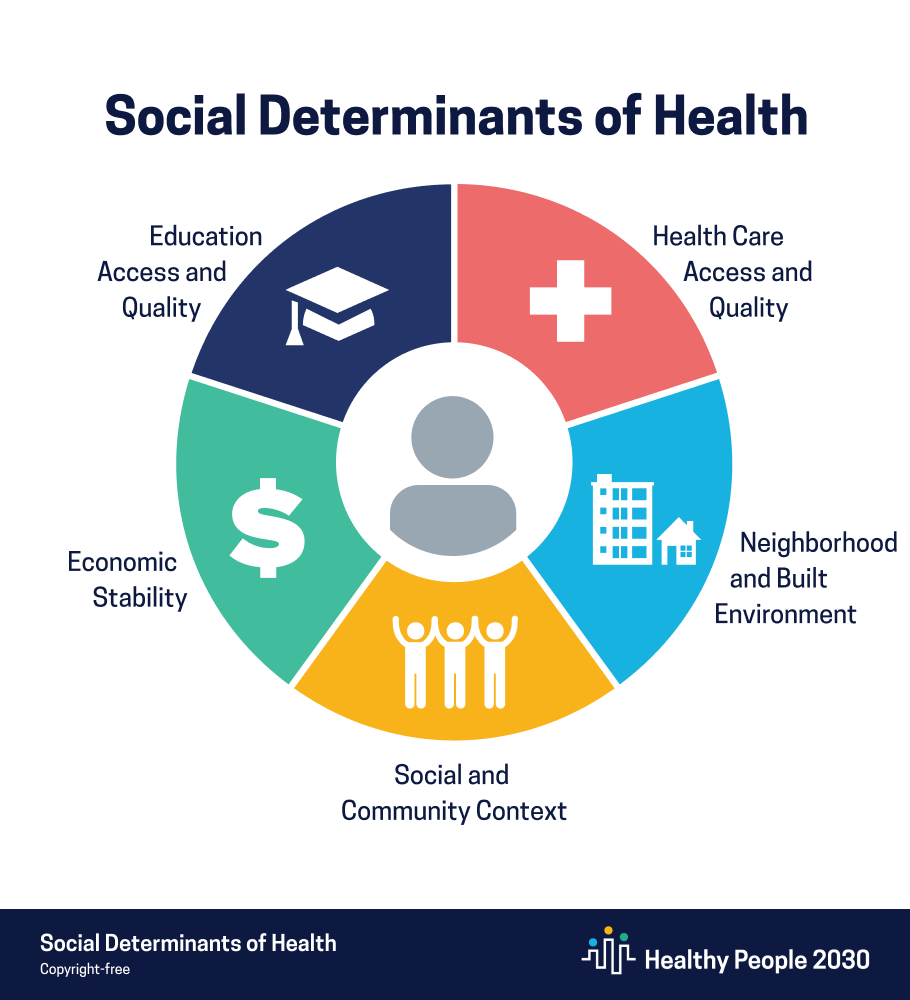
These sisters never heard the term “Social Determinants of Health,” but in Fort Worth, the nuns were pioneers of the practice. The Office of Disease Prevention and Health Promotion defines Social Determinants of Health (SDOH) as “the conditions in the environments where people are born, live, learn, work, play, worship, and age that affect a wide range of health, functioning, and quality of-life outcomes and risks.”4 The World Health Organizationʼs more simple definition is “non-medical factors that influence health outcomes.”5 These issues vary greatly and are different for every community and individual, but they each fall into one of five categories: economic stability, education access and quality, healthcare access and quality, neighborhood and environment, and social and community context.6
There is no one list of what these categories include, but the factors account for 50 to 70 percent of all health outcomes.7 The Nova Institute for Health of People Places and Planet claims that “A personʼs health . . . is determined far more by their zip code than by genetics or their family history.”8 This fact is sobering considering that Fort Worthʼs 76104, home of the Hospital District, has the lowest life expectancy in the state, first reported by UT Southwestern in 2019.9
Equitable access to timely healthcare is certainly among the SDOH that Project Access Tarrant County addresses, but since the beginning, PATC has striven to go much deeper than only access to specialty and surgical care.
The two factors most impacting SDOH for many low-income, uninsured Tarrant County patients are healthcare access and financial stability. These are inextricably linked, particularly for noncitizens who rely on their health to maintain employment and upon their continued employment for their health. Even among American citizens, the uninsured percentage of the Tarrant County (and all of Texas) population is 20 percent, double the national average; however, the percentage among Tarrant County Hispanics or Latinos is over 28.10
Healthcare access, the primary SDOH that PATC addresses, has a direct link to financial stability, especially when our intervention leads to continued or regained employment. In addition, PATC strives to identify other social determinants our patients face and address and/or refer to the best of our ability.
Primary Care In addition to the growing number of JPS neighborhood clinics, Tarrant County is home to a vital network of free, low-cost, or sliding scale clinics that provide essential primary care to the underinsured or uninsured population. These clinics are geographically scattered across the county, including locations in Fort Worth, Arlington, Mansfield, Grapevine, Crowley, and others. Most of these are community- or church-based clinics, but Tarrant County is also home to one federally qualified health clinic (with three locations) and an optometry clinic that is based on a sliding scale model but also takes private insurance.
While most PATC referrals come from these clinics (including JPS), we also receive referrals from our volunteer physicians, emergency departments, and the general public. The patients that come from places other than a primary care setting are more likely to have untreated (and sometimes undiagnosed) medical conditions. At least 28 percent of all active and pending PATC patients have diabetes and/or hypertension. Among Tarrant County Hispanics and Latinos, who comprise about 90 percent of all PATC patients, heart disease is the second leading cause of death, followed by diabetes at number six. In 2020, 30 percent of adults whose annual income was below $50,000 had not had a routine check-up in the past year. Because they lack basic primary care, they may not understand the importance of preventative medical care, or they may have other SDOH barriers. Others are simply unaware of what resources are available to them.
“Ray” recently met with PATC Case Manager Karla Aguilar. Referred by a PATC volunteer ophthalmologist who specializes in retina diseases, Ray has severe diabetic retinopathy requiring surgery. He told Karla he could barely see to work and relied on his wife to drive him everywhere. While simultaneously working on the paperwork needed for Rayʼs enrollment and surgery, Karla asked about the primary care Ray has been receiving. The answer was “none.” She helped him choose from PATCʼs partner clinics and made a direct referral. She seized the opportunity to educate him on the importance of primary care, especially with a chronic disease like diabetes. Ray seemed unaware that untreated diabetes can lead to serious health conditions, including a recurrence of his retina disease. Further into the discussion, Karla discovered that Rayʼs wife and their children, ages 12 and seven, were also without a primary care home. PATC referred the patientʼs wife to the same clinic as Ray and, since their children are citizens, referred them to a social service agency that can help them apply for Medicaid.
Healthcare Literacy Ray needed a primary care physician, but the underlying problem was not understanding its importance. Formal education isnʼt the only factor in understanding oneʼs own healthcare. Language, culture, and knowledge of resources also impact this SDOH. PATC caseworkers frequently educate patients on what many would consider common knowledge. They also empower patients to ask questions and understand their own health.
“Sandra” called former PATC Case Manager Diana Bonilla to complain about her PATC volunteer physician. “Heʼs not treating me correctly,” she vented. “I want a different doctor.” After some investigating, Diana learned that the patient was not asking any questions of the doctor (who, of note, is very well known in his field) – and the patient admitted that she felt that, as a charity patient, she did not have the “right” to ask questions about her own health. After a long conversation, Diana encouraged the patient to take written notes of what she didnʼt understand about her care and questions she had about her condition. After Sandraʼs next appointment with the same doctor, she called Diana back. She excitedly told Diana that her questions were patiently answered, she understood her diagnosis and the prescribed course of treatment, and she was thrilled to complete her care with this same physician. Healthcare literacy and patient empowerment likely prevented a patient from discontinuing her medical care. In this case, a delay of care would have had a devastating impact on her health and her familyʼs wellbeing.
Another PATC patient, “Enrique,” was enrolled in PATC for heart issues, but he also had a severe psychiatric diagnosis. His mother was his caregiver. She was often sad about her sonʼs mental health diagnoses, and, apparently as a coping mechanism, she told Diana that she had started sampling her sonʼs medication. “I want to see how it makes him feel.” Taking a deep breath (and quickly Googling), Diana explained to her that not only would his medication not make her “feel” the same way as it made Enrique feel but was also very dangerous. She read off a list of possible outcomes of taking a medication that was not prescribed to her by her doctor.
PATC also provides practical solutions to common SDOH, such as interpretation and transportation barriers. The 2022 Tarrant County Public Health Community Health Assessment reports that almost 6 percent of all Tarrant households have limited English proficiency; however, among Spanish-speaking households, that number is over 20 percent. Many non-English-speaking patients have adult family or friends they prefer to take with them for interpretation, but PATC has provided interpreters for close to one thousand medical appointments. Spanish is the main language requested, but we have also received referrals for patients who speak Arabic, Burundi, Farsi, French, Hindi, Korean, Mandarin, Mandigo, Nepalese, Persian, Portuguese, Swahili, Tanghulu, Urdu, Vietnamese, and Wolof. We provide in-person interpreters whenever possible; however, for some less common languages, we employ a national phone-based service.
Healthy People 2030’s social determinants of health. 4
Transportation is another potential barrier to care, especially in Tarrant County, where most municipalities have no public transit. While Arlington does have a rideshare program, it is the largest city in the United States with no public transportation. The cities that do have mass transit are limited and they usually donʼt cross city lines. Fortunately, most PATC patients have access to transportation. PATC can provide private rides for the ones who do not.
Vulnerable Communities Immigrants and people of color are among the most vulnerable communities in Tarrant County. Because the Tarrant County Commissionerʼs Court disallows undocumented individuals from enrolling in JPS Connection,11 the countyʼs indigent program, existing SDOH barriers are exacerbated. PATC excludes those enrolled in JPS Connection 11, so most of our patients are the undocumented, a segment PATC has dubbed the “never served” when it comes to specialty and surgical healthcare. Eighty-five percent of PATC patients are Hispanic who speak Spanish only. The remaining 15 percent are mostly undocumented patients of non-Hispanic origin. Covering racial inequality in the United States down to our own community would take years of Tarrant County Physician magazines, and the Robert Wood Johnson Foundationʼs report “What Can the Health Care Sector Do to Advance Health Equity?” gives an in-depth summary of the problems and roads to solutions for some of the factors.
One of the guiding principles of this report states, Pursuing health equity entails striving to improve everyone’s health while focusing particularly on those with worse health and fewer resources to improve their health. Equity is not the same as equality; those with the greatest needs and least resources require more, not equal, effort and resources to equalize opportunities.12
Conclusion Project Access excels at providing medical treatment, and this is, of course, why the program was created. We also enjoy showcasing the medical care provided. What we have not done as well is communicate the depth of services we offer to make sure that our patients not only have access to medical services, but that we also address the issues that have prevented the care in the first place. We are not a wide program, but we are deep. PATC will never be able to fix the global issues of inequality, poverty, and education; but we can (and do) address the issues facing our individual patients that impact their access to and understanding of their own care. Hopefully, they will possess more knowledge and tools for the next time they face a healthcare crisis.
References:
Steve Martin, “Goodbye St. Joseph Hospital.” Tarrant County Physician, 90, no. 8 (August 2012): 8-9, 16.
Regrettably, Black patients were confined to the St. Joseph basement, as were Black physicians. Riley Ransom, Sr., MD, opened the 20-bed Booker T. Washington Hospital, later known as the Fort Worth Negro Hospital and then the Ethel Ransom Memorial Hospital, in 1914. “1115 E. Terrell Ave: Tarrant County Black Historical & Genealogical Society,” TCBHGS, accessed March 2024, https://www.tarrantcountyblackhistory.org/1115-e-terrell-ave#:~:text=Booker%20T.,by%20the%20American%20 Medical%20Association.
“Social Determinants of Health,” Social Determinants of Health – Healthy People 2030, accessed March 2024, https://health.gov/healthypeople/priority areas/social-determinants-health.
Karen Hacker et al., “Social Determinants of Health—an Approach Taken at CDC,” Journal of Public Health Management and Practice 28, no. 6 (September 8, 2022): 589–94, https://doi.org/10.1097/phh.0000000000001626.
This article was originally published in the March/April issue of the Tarrant County Physician.
HISTORICALLY, STIGMA AGAINST MENTAL HEALTH, ACCESS to care, and discrimination contribute to worsened health outcomes. This is especially true for certain racial or ethnic groups such as those made up of Black and Hispanic individuals, as there are culturally negative views on mental health symptoms and/or treatment, a fear of mistrust of the medical community due to historical discrimination or mistreatments, or lack of access to mental health services.
To help address this, the Lay Mental Health Advocates (LMHA) program was created. This free, virtual training program is designed to teach laypersons the fundamentals needed to advocate for someone who is dealing with mental illness. LMHA focuses on teaching mental health advocacy by understanding how social determinants worse mental health and play key roles in overall health outcomes for marginalized communities. The social determinants of health are defined by the U.S. Department of Health and Human Services as “the conditions in the environments where people are born, love, learn, work, play, worship, and age that affect a wide range of health, functioning, and quality-of-life outcomes and risks.”
LMHA began as a volunteer project during my time as a research trainee at the National Institute of Allergy and Infectious Diseases before beginning medical school. In addition to conducting experiments in a traditional laboratory setting, I was a fellow of the National Institutes of Health Academy. This program allowed me to meet other trainee scientists equally as passionate about patient advocacy. Ultimately, the goal of this program was to implement a volunteer project that addresses health disparities in the local community.
We saw a need for interventional programs to fill the mental health gap that is particularly prevalent among marginalized communities. Our program consists of a weekly online workshop led by psychiatry residents or attendings from Duke University Hospital and local community leaders. they include interactive role-playing advocacy practice, case study reviews, and other informative components. Our eight-week-long program was modeled after the Johns Hopkins Medicine Lay Health Advocate Program and the Mental Health Allyship Program. Through LMHA, advocates can identify several different mental health conditions, gain a greater understanding of the factors that exacerbate health disparities, understand how to provide effective emotional support, and gain confidence in the role they can play in the lives of their community members by BEING mental health advocates.
The pilot program took place during Spring of 2021, and we had 100 participants whose ages ranged from 18-58. We are now on track to our third workshop series, with participants from across the county. In addition to that, we are currently expanding our team, working on our non-profit application, and establishing a volunteer program to work with the Duke Behavioral Health Inpatient Unit.
Watching this program grow beyond anything my team had imagined has been very rewarding. I wanted to share this journey with those of you reading to encourage you to continue advocating for yourself, your patients, and your community. If you ever see a problem that needs to be addressed or a gap that needs to be filled, just go for it- you never know what may come of it.
This article was originally published in the September/October 2022 issue of the Tarrant County Physician. You can read find the full magazine here.
On June 23, 2022, the Tarrant County medical community lost an amazing physician, who died by suicide. He was a remarkable person whose work touched so many lives—he was always willing to help others. He is greatly missed by all who knew him.
Unfortunately, physician suicide has become an all-too-common occurrence in the United States.
• Approximately 300–400 physicians die by suicide each year in the U.S.
• Among male physicians, the suicide rate is 1.41 times higher than the general male population.
• Among female physicians, it is even more pronounced at 2.27 times higher than the general female population.1
As terrible as this sounds, there is hope. Physicians who are proactive about their mental health are able to take better care of their patients as well as have more resilience in the face of stress. However, this is not so easy to accomplish.
There is already a stigma associated with mental health, and it is made even worse for physicians due to the concern of needing to report a diagnosis to our medical boards, licensing organizations, as well as to credentialing offices in the hospitals and health systems we work in. We as physicians also have difficulty taking care of ourselves in general, let alone when it comes to mental health, as we are the healers and must be perfect.
The truth is, being a physician is hard. We train for many years to be able to do the work that we do. We often share our war stories about medical school and residency, but when it comes to the deeper struggles we have, we tend to keep those to ourselves. We push them down and hide behind a smile (or a mask) and continue to pretend that everything is okay.
But it’s not okay.
We as a profession need to start taking care of ourselves and looking out for our colleagues. It is okay to tell someone when you are struggling and to seek out help when you need it. A psychiatrist friend puts it best—“Everyone needs a therapist. I have one.” At some point we all learned the physiology of the human body, and of the brain specifically. Sometimes that brain needs a little extra help from chemistry, and that is okay as well. If you have a thyroid problem, you do not put up a fight about taking a thyroid pill. The same goes when our brain chemistry needs a little help. We also need to reach out to one another, to check in and see if our colleagues are really doing okay and if they need any help or support. It’s okay to not be okay, but we need to recognize this and seek out the help we so desperately need, and to help our colleagues obtain the help that they need.
We also need to work from an advocacy standpoint so that physicians can seek the help that they need without the fear of needing to report their illness. All other aspects of medicine and healthcare are taken care of in a private manner between a physician and a patient. Why should mental health be any different? Until this changes, no number of wellness programs, resilience building, etc., will be able to fix the problem.
I encourage everyone to seek help when needed and to reach out to our colleagues, partners, and friends. We have worked tirelessly to get to the point we can practice medicine, and those around you want you to stay here.
References 1John Matheson, “Physician Suicide.” American College of Emergency Physicians. Accessed August 3, 2022.
National Suicide Prevention Lifeline 1-800-273-TALK (8255) Available 24/7
Crisis Text Line Text TALK to 741-741 Available 24/7
Physician Support Line 1 (888) 409-0141 Open seven days a week, 7:00am – 12:00am CST Psychiatrists helping their U.S. physician colleagues and medical students navigate the many intersections of our personal and professional lives. Free and confidential. No appointment necessary.
Emotional PPE Project emotionalppe.org The Project connects healthcare workers in need with licensed mental health professionals who can help.