Project Access Tarrant County – the Intern Experience

by Karla Aguilar, PATC Intern

When I began searching for internship opportunities needed for completion of my public health degree at UTA, I immediately thought of Project Access Tarrant County.

I originally became aware of PATC when my mom received their services a couple of years ago. Through that experience, I knew that PATC assisted patients with access to specialty medical care, but I was not fully aware of everything PATC did until I started interning. I have always had a passion for helping others and I knew that I wanted my intern experience to be at an organization that truly helped the community and upheld their values. I found just that and more at PATC.

My role is to facilitate and maintain patient re-enrollment; I am able to help patients gather the needed documents to meet our requirements. I also interview new patients via Zoom, completing their enrollment process. I have learned many skills that will be useful in any career I choose after my internship, and I am so glad I have had such a great group of women to help me succeed. I did not expect to have such an important role as an intern but PATC has challenged me in the best way possible. 

One of the most rewarding aspects of my internship is following up with patients who have finished their care and hearing about their experiences. There is one patient whose interview I will never forget. This patient was diagnosed with rheumatoid arthritis in her mid-twenties. She had been in severe pain for the past few years, and just recently, PATC was able to help her get a life-changing surgery that will allow her to walk again. During her interview, she shared with me all of the hard times she had endured, times that made her want to give up on life. In that moment, I realized just how big of an impact PATC makes on not just individual patients but their entire families. I was so glad we were able to help this patient, but I also felt amazing knowing I am now part of this organization and can continue serving my community.

“One of the most rewarding aspects of my internship is following up with patients who have finished their care and hearing about
their experience.”

Many people are fortunate enough to have access to healthcare, but there are many others who do not have the same opportunity. As a community, it is important that we provide resources to those who are underserved and that we understand their needs. I have been able to experience exactly how PATC is able to do just that not only from an administrative point of view but also from a medical perspective. It takes a village to make it work. From Kathryn, Diana, Angie, and TCMS to the volunteer doctors and their staffs, everyone works together to ensure that they are able to successfully meet our patients’ needs. Hearing patients’ stories about how we have changed their lives and their families is such a heartwarming feeling. There is nothing better than seeing our patients thrive.

Tarrant County COVID-19 Activity – 05/27/21


COVID-19 Positive cases: 260,564

COVID-19 related deaths: 3500

Recovered COVID-19 cases: 254,261

Data from Tarrant County Public Heath’s (TCPH) report of COVID-19 activity in Tarrant County, updated Thursday, May 27, 2021. Find more COVID-19 information from TCPH here.

*These data are provisional and are subject to change at any time.

Deaths and recovered cases are included in total COVID-19 positive cases.

TCMS Pediatrician Voted in as TMA President-Elect

Gary Floyd MD picture

Gary W. Floyd, MD, a Fort Worth pediatrician and longtime member of the Tarrant County Medical Society, was elected president-elect of the Texas Medical Association  on Saturday, May 15. TMA’s House of Delegates governing body announced elections during TexMed, the association’s annual conference, held virtually this year due to the pandemic. He will serve in this role for one year before assuming the presidency of America’s largest state medical society in 2022. 

“It’s an incredible privilege and responsibility – and very humbling – for the members of our TMA to elect me to be the spokesperson for our organization,” said Dr. Floyd. “I will never tire of advocating for our patients and our physician members.”

TMA’s president is the organization’s primary voice to external audiences and to physician members – for advocacy and policy efforts, and in news interviews.

Dr. Floyd has been very involved in TMA and other organized medicine organizations throughout his 42-year medical career. He chaired TMA’s Board of Trustees governing body for the past year, having served in that body for seven years. He led the board in a “disaster board” function last year, temporarily acting on urgent business in place of the association’s policymaking body since the pandemic prohibited an in-person House of Delegates meeting. Board members explored a new diversity initiative as well.

“As chair, I led our board to initiate a task force to study equity, diversity, inclusion, and racism,” he said. “I believe our TMA needs to seriously address these issues as we move further into the 21st century.”

Dr. Floyd also was reelected today by the TMA house as a delegate representing Texas in the American Medical Association House of Delegates. He has chaired the TMA Council on Legislation and served on the association’s Council on Constitution and Bylaws, and the Select Committee on Medicaid, CHIP, and the Uninsured. Dr. Floyd also was a district chair of TEXPAC, TMA’s political action committee.

Dr. Floyd has several objectives planned for his presidency next year, which mirror long-term goals of the association.

“My goals include aggressively protecting against intrusions into the practice of medicine by those who have not done the necessary training, in order to protect our patients and unsuspecting citizens in Texas,” he said. He also lists defending Texas’ liability reforms and defending against intrusions into what he calls “the sacred bond” between physicians and their patients. He believes in protecting physicians’ autonomy to make medical decisions with and for their patients. 

The pediatrician assumes the presidency as Texas continues to vaccinate against COVID-19 and return to normalcy in life and patient care.

“I actively practiced pediatrics over 40 years, but with the COVID pandemic, I retired from daily patient care,” he said. He continues to be very involved in medical management and organized medicine, however.

During the pandemic, TMA distributed millions of personal protective equipment masks to Texas physicians. TMA also guided many doctors in adopting telemedicine to remotely care for patients and provided other information and support for physicians to survive and thrive during the pandemic.

Dr. Floyd previously served as president of the Texas Pediatric Society and TCMS, and he was active in the American College of Physician Executives, and the Society for Pediatric Emergency Medicine. He is a fellow and board member of the American Academy of Pediatrics.

Dr. Floyd graduated from The University of Texas Medical Branch at Galveston and completed his pediatric residency at Children’s Hospital of Oklahoma, University of Oklahoma Health Science Center. He pursued his undergraduate studies at The University of Texas at Austin.

Board certified by the American Board of Pediatrics, Dr. Floyd has practiced in various settings in Texas and Oklahoma including general pediatrics, academic pediatrics, and  pediatric emergency and urgent care, and he has worked in administrative medicine and government affairs. He was the John Peter Smith Health Networks chief medical officer and executive vice president of medical affairs, then executive vice president of government and alumni affairs.

Active in the First Baptist Church of Keller, Dr. Floyd has been married 47 years to Karen Floyd, whom he met when they were in high school. “She is my best, most trusted friend,” he said. The couple has two married daughters, Holly Peterson, married to Ben Peterson, and Neely Pedersen, married to Craig Pedersen, DO, and two grandsons, with another due in October.

TMA is the largest state medical society in the nation, representing more than 55,000 physician and medical student members. It is located in Austin and has 110 component county medical societies around the state. TMA’s key objective since 1853 is to improve the health of all Texans.

Tarrant County COVID-19 Activity – 05/20/21

COVID-19 Positive cases: 259,847

COVID-19 related deaths: 3473

Recovered COVID-19 cases: 253,020

Data from Tarrant County Public Heath’s (TCPH) report of COVID-19 activity in Tarrant County, updated Thursday, May 20, 2021. Find more COVID-19 information from TCPH here.

*These data are provisional and are subject to change at any time.

Deaths and recovered cases are included in total COVID-19 positive cases.

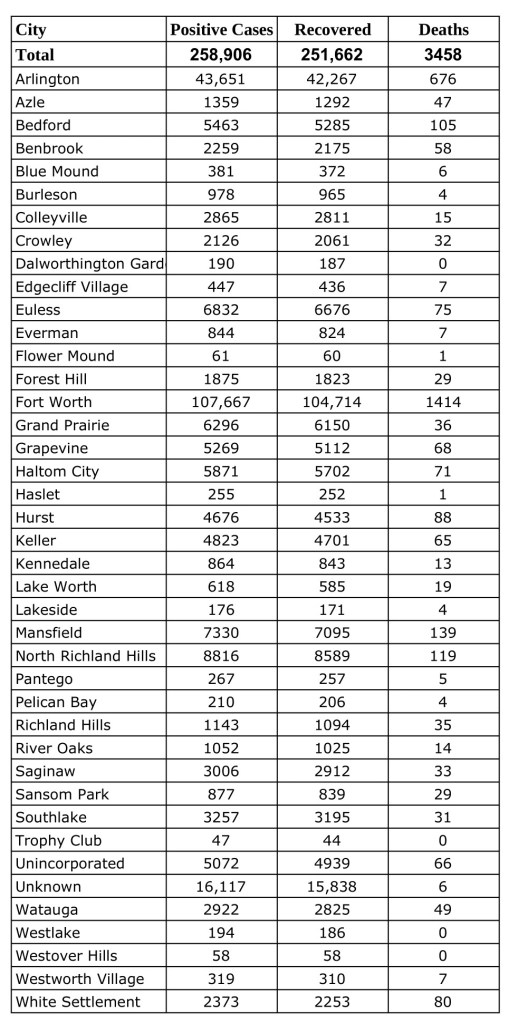
Tarrant County COVID-19 Activity – 05/13/21


COVID-19 Positive cases: 258,906

COVID-19 related deaths: 3458

Recovered COVID-19 cases: 251,662

Data from Tarrant County Public Heath’s (TCPH) report of COVID-19 activity in Tarrant County, updated Thursday, May 13, 2021. Find more COVID-19 information from TCPH here.

*These data are provisional and are subject to change at any time.

Deaths and recovered cases are included in total COVID-19 positive cases.

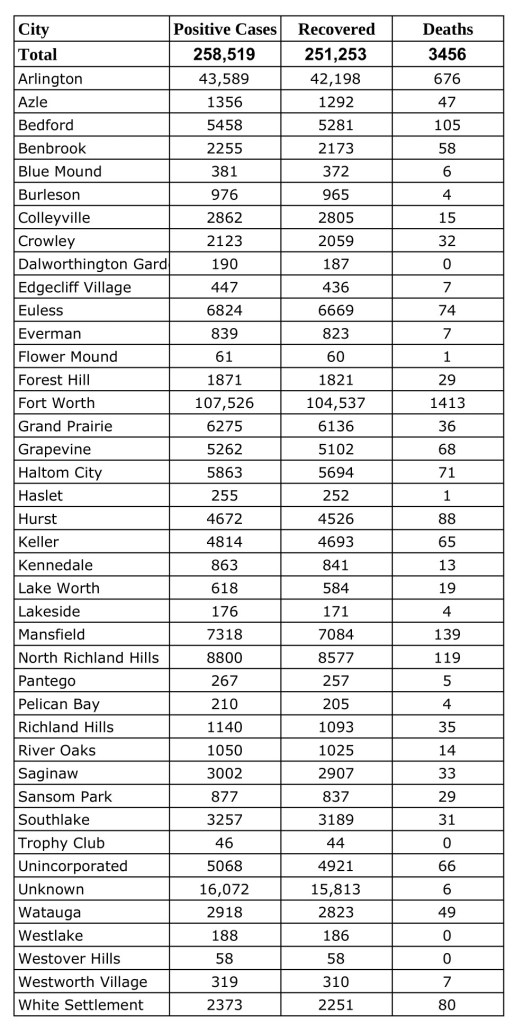
Tarrant County COVID-19 Activity – 05/11/21

COVID-19 Positive cases: 258,519

COVID-19 related deaths: 3456

Recovered COVID-19 cases: 251,253

Data from Tarrant County Public Heath’s (TCPH) report of COVID-19 activity in Tarrant County, updated Tuesday, May 11, 2021. Find more COVID-19 information from TCPH here.

*These data are provisional and are subject to change at any time.

Deaths and recovered cases are included in total COVID-19 positive cases.

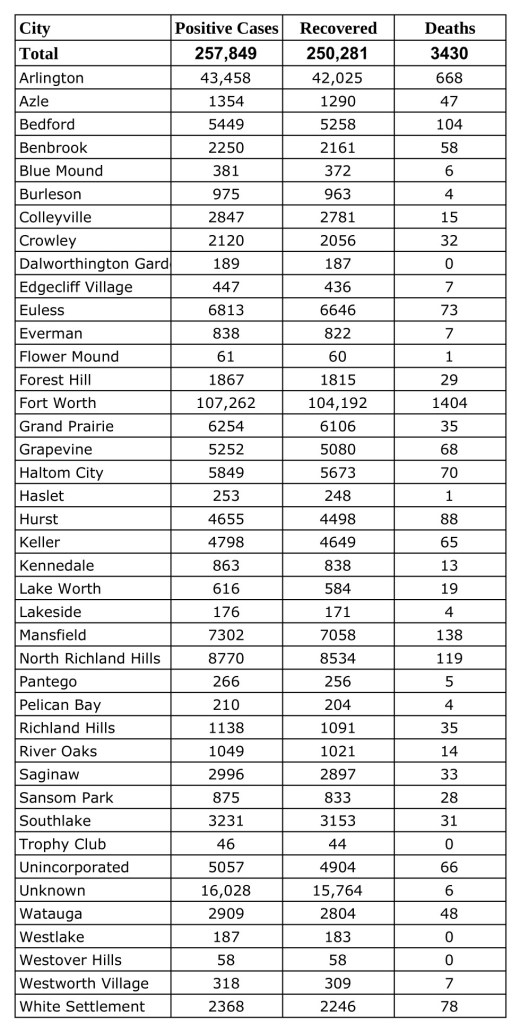
Tarrant County COVID-19 Activity – 05/06/21


COVID-19 Positive cases: 257,849

COVID-19 related deaths: 3430

Recovered COVID-19 cases: 250,281

Data from Tarrant County Public Heath’s (TCPH) report of COVID-19 activity in Tarrant County, updated Thursday, May 6, 2021. Find more COVID-19 information from TCPH here.

*These data are provisional and are subject to change at any time.

Deaths and recovered cases are included in total COVID-19 positive cases.

Governor Abbott, TDEM, and TMD Launch State Vaccine Call Center To Connect Organizations, Businesses With Mobile Vaccine Teams

Governor Greg Abbott, the Texas Division of Emergency Management (TDEM), and the Texas Military Department (TMD) today announced the launch of the State Mobile Vaccination Team Call Center. Beginning tomorrow at 8:00 AM CT, Texas businesses or civic organizations can call 844-90-TEXAS and select option three to schedule a visit from a state mobile vaccine team to vaccinate their employees, visitors, or members. To qualify for a visit, a business or civic organization must have 10 or more employees, visitors, or members who voluntarily choose to be vaccinated. Homebound Texans are also encouraged to call the hotline and select option one to request a state mobile vaccination team to visit their home.

“Vaccines are the most effective tool in Texas’ fight against COVID-19, and we are committed to making COVID-19 vaccines even more widely available to Texans across the state,” Governor Abbott said. “The State Vaccine Call Center will help connect businesses and civic organizations with these life-saving shots and ensure that more Texans have an opportunity to get vaccinated. I urge organizations and businesses to call 844-90-TEXAS and schedule a visit from a state mobile vaccine team. Here in Texas, COVID-19 vaccines will always be strongly encouraged and always voluntary.”

Governor Abbott and TDEM originally launched the State Mobile Vaccine Pilot Program in January 2021 to ramp up COVID-19 vaccination efforts in underserved areas of Texas. Since the program’s initial launch, the responsibilities of State Mobile Vaccine Teams have been expanded to meet various COVID-19 vaccination needs of communities across the state. These teams are made up of members of the Texas National Guard and coordinated by TDEM. 

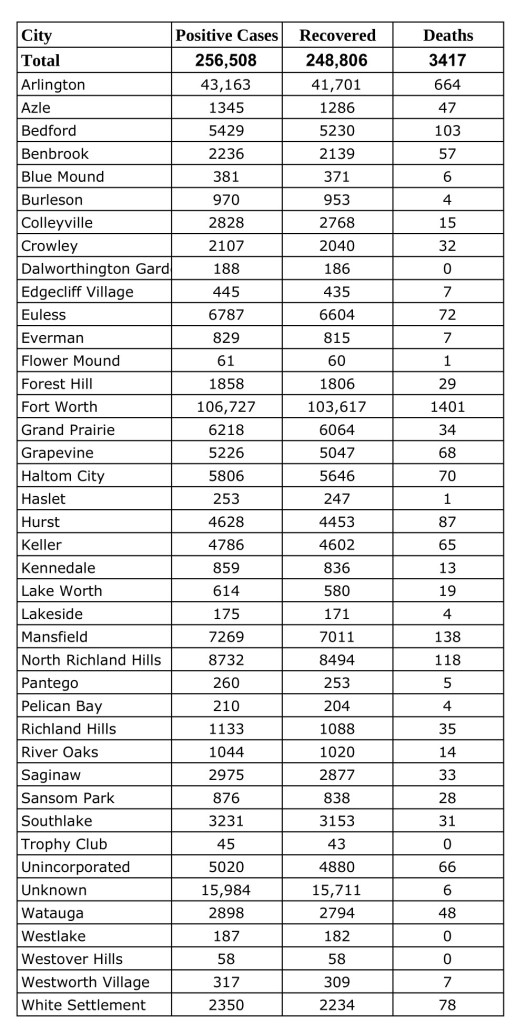
Tarrant County COVID-19 Activity – 04/29/21

COVID-19 Positive cases: 256,508

COVID-19 related deaths: 3417

Recovered COVID-19 cases: 248,806

Data from Tarrant County Public Heath’s (TCPH) report of COVID-19 activity in Tarrant County, updated Thursday, April 29, 2021. Find more COVID-19 information from TCPH here.

*These data are provisional and are subject to change at any time.

Deaths and recovered cases are included in total COVID-19 positive cases.

Scholarly Pursuit and Thesis

by Michael Bernas
Scholarly Pursuit and Thesis Program Director

This article was originally published in the March/April issue of the Tarrant County Physician. You can read find the full magazine here.


Have you ever been curious about an unknown in your practice? Do you ever find yourself thinking “what if…”? Have you always been curious about doing a little research, but not sure where to start? If so, you may be interested in participating in a research project with a medical school student from the TCU and UNTHSC School of Medicine. 

The program is called the Scholarly Pursuit and Thesis (SPT) course and it is a four-year research project that all students at the school undertake as part of their education. It was designed for students to explore medical research, practice critical inquiry, and use medical information literacy to become patient-centric physicians with life-long curiosity and learning skills. The course begins with students reinvigorating their curiosity and questioning skills. This is followed by some basic research training, including literature searching and appraisal skills, research question development, and human subjects training through the Collaborative Institutional Training Initiative program. Program faculty will help develop these skills and assist students throughout their research projects.

Many students have prior experience with research from their undergraduate or post-college education. During the first year, students work with their mentor to produce a prospectus that is similar to a small research grant application, detailing project parameters. During the next two years students work on projects with their mentors, and in the fourth year they produce a thesis as well as a poster for a public presentation.

Some common questions from potential research mentors include:

What is the role of the mentor? The mentor acts as a guide to the student in the research project. He or she will assist the student in designing the research project and often help with providing data or access to data for research. The mentor will work with the student as they monitor data collection and interpretation, will be available for questions, and will assist the student with the final thesis conclusions. 

What areas and topics are appropriate for student research projects? Mentors and projects can come from any field (see Table). The only requirements are that the project is researched effectively, includes some sort of intervention or examination (experiment, chart review, product design, data collection, etc.), has a good plan for analysis of results, and includes a discussion of the results with potential application and questions for the future.

How does a student decide what research project to do? Generally, there are four ways to develop the projects. Firstly, the mentor may already have some ongoing research that the student can join or carve a piece from. Secondly, often mentors have some questions that they have been curious about and want to explore further. Thirdly, students sometimes have their own specific question to start with as the basis for their project. Finally, after some discussion concerning issues and questions in a specific area, the mentor and student can design something completely new. Whatever way the decision is made, communication between the mentor and student helps drive this process. 

How much time will this take? Time with the student will vary from project to project and there are no specific program requirements. Overall, the mentor needs to commit to working with the student for four years (projects chosen and designed at approximately end of semester 1 and thesis submitted at approximately end of semester 7). However, during this time, due to obligations and schedules of both, this could mean meeting almost every week in some labs (approximately one hour) to perhaps only meeting every two to three weeks for some clinicians or mentors. As the project progresses, there may be less need for frequent interactions until data review and analysis. We anticipate that mentor-student meetings will also include some “life lesson” discussions and the potential to develop a lasting relationship.  

Do I need to have experience as a researcher? No, there are no requirements for prior experience, only your willingness to work with the student.

Does the student need to publish a manuscript on the results? There is no requirement that the students publish a manuscript before they graduate. However, it is the expectation that the majority of student projects will result in publication in addition to abstracts and posters/presentations from project results as appropriate.

What are the benefits to me as a mentor? All mentors will receive an academic appointment with the TCU and UNTHSC School of Medicine. In addition, you get to work with an enthusiastic and curious student for four years, who will perform most of the work. The curriculum design provides education in basic science (year 1) and clinical training (year 2) in an accelerated fashion, producing an experienced mini-physician to enhance your research team. Finally, students will have educational experiences throughout North Texas with the potential to share or expand your research. 

How do I learn more? This article is just an introduction. For more detailed information and any questions, please contact Program Director Michael Bernas at m.bernas@tcu.edu. 

Design a site like this with WordPress.com
Get started