Rule ignores statutory text and congressional intent, shrinks access to care for patients
The Texas Medical Association (TMA) filed a lawsuit in federal district court in Tyler, Texas, after the Biden administration failed to follow clear direction from Congress about how to implement the dispute resolution process set forth in the No SurprisesAct, legislation that was passed in 2020 to protect patients from surprise medical bills.
“TMA supports the patient protection intent of the No Surprises Act,” TMA President E. Linda Villarreal, MD, said. “However, TMA’s lawsuit challenges one component of the administration’s rule that ignores congressional intent and unfairly gives health plans the upper hand in establishing payment rates when a patient receives care from an out-of-network physician, oftentimes in an emergency.”
Congress intended to create a fair and unbiased process to resolve billing disputes between health insurance companies and physicians by ensuring that all relevant factors must be considered, with each given the weight deemed appropriate by the arbitrator. In contrast, the administration’s short-sighted approach will make it harder for patients to access care by driving down reimbursement rates and encouraging insurance companies to continue narrowing their networks. It will be difficult for small physician groups to keep caring for patients.
“The lawsuit filed yesterday ensures that the protections for patients against balance bills will go into effect on Jan. 1, 2022, while seeking to stop the imminent harm to physicians and hospitals created by an unfair arbitration process,” Dr. Villarreal said.
The recently released rule rewrites the statute by requiring the arbitrator in the independent dispute resolution process to presume that the qualifying payment amount (QPA), set by health insurance companies for patient cost-sharing purposes, is “the appropriate out-of-network rate.” This creates a bias that prioritizes offers closest to the QPA, rather than allowing arbitrators to exercise their discretion to weigh all relevant factors and select the reimbursement rate that most accurately reflects fair market reimbursement and individual circumstances.
The TMA lawsuit asks the court to strike this section of the rule and instead restore the fair, balanced dispute resolution process that Congress created. The lawsuit also alleges a violation of the Administrative Procedure Act, which requires a formal notice and comment period in advance of finalizing such a rule. The agencies failed to solicit and incorporate comments from stakeholders for this crucial aspect of the law.
“We wholeheartedly agree with U.S. Reps. Richard Neal’s (D-Mass.) and Kevin Brady’s (R-Texas) concern that the rule tips the scale in favor of insurance companies and will leave patients vulnerable,” Dr. Villarreal said. Representative Neal is chair of the U.S. House Ways and Means Committee, and Representative Brady is the past chair of the committee and currently ranking Republican member.
“We are disappointed the Biden administration ignored congressional intent and essentially set up the arbitration system to operate like a casino, with health insurers playing the role of the house,” Dr. Villarreal said. “Everyone knows the house always wins. With the current rule, patients, physicians, and our country lose.”
TMA is the largest state medical society in the nation, representing more than 55,000 physician and medical student members. It is located in Austin and has 110 component county medical societies around the state. TMA’s key objective since 1853 is to improve the health of all Texans.
This article was originally published in the July/August issue of the Tarrant County Physician. You can read find the full magazine here.
I remember working as a medic in New York and New Jersey and loving what I did all day, every day (and many times all night). When I got “the call” to go to med school, I knew that it would be years before I could do anything clinical—at least eight years. My first procedure was at 14 years old at Southern Nevada Memorial Hospital (now University Hospital), when a surgeon let me round with him on a patient and told me to pull the tube straight back. I pulled out a chest tube at 14. Where do you go from there? Well, the day I went back to taking food trays to rooms and getting the nurse when a patient needed their bedpan to be emptied. After high school, I started taking dental x-rays, and I took great x-rays without even using the rings and film holders. I spent those moments in the darkroom praying and soaking in the blessing of the esteemed opportunity that I had been given as an almost dental assistant. Those x-ray skills thrust me into a career in dental and then oral surgical assisting.
When life brought me back to my home state of Texas, I got my first job as an oral surgical assistant. Dr. Robert Thomas Perry hired me after looking at my résumé, which was handwritten on a 11-by-14-inch sheet of legal paper. Full disclosure, when he asked for my résumé, I did not know what that meant; he explained that it was a list of my experience. I was just about 21 years old by then, so he was an early inspiration for me. We would drive to remote sites to perform oral surgeries and I would read board review material to him for hours and hours as we drove from College Station to Corsicana and Huntsville. I learned so much about oral surgery from these hours of drives, which always included a stop for Blue Bell ice cream.
Dr. Perry and his wife, a CRNA, were very well liked in the community, though he struggled to establish great referral patterns from the general dentists. While he was away doing his oral surgery training, two other oral surgeons, Garrett and Gray, had set up practice. Their winning personalities and ability to network between Bryan and College Station proved to be a barrier to Dr. Perry getting much business in this good ole boy country. Dr. McElroy did send us patients. Dr. McElroy is known to have left Thanksgiving dinner for an emergency; he even showed up at his office to meet a patient with a severe toothache one Christmas Day. That patient was one of my relatives (I got him on multiple holidays). Dr. Perry had me credentialed at both local hospitals and one in another town. At St. Joe’s in Bryan, I went through a week-long orientation in the OR, watching various cases so that I could assist Dr. Perry there—I knew all of the instruments he used and when he used them. I didn’t just see oral surgeries; I had a front-row seat for everything that was happening in the OR that week. I remember watching a vag hyst (in horror) and then a breast biopsy where they had to go ahead with a mastectomy right then, after the frozen section came back positive. I was a high school graduate dental assistant, and I was in the OR.
You think it’s difficult to get someone to take a statin? Try telling them you’re going to put a tube down their throat.
I first started assisting Dr. Perry in the OR when he performed orthognathic surgery that included down-fracturing a maxilla. I was so happy and fulfilled in my work. I had arrived. When the local hospitals stopped using CRNAs in the mid 80s, Dr. Perry had to move his family back to Ohio, where he had trained. Sue, his wife, was actually the breadwinner. Dr. Perry once had a farmer pay him with a side of beef (tractor accident). Another elderly woman paid him by making fabric holders for his surgical instruments. He was not the only oral surgeon that I worked for who depended on the income of their spouse to stay afloat. After crying every day for two weeks over having to leave Dr. Perry due to the imminent practice closure, I moved back to New York, where I had lived right after high school. I went to work for another oral surgeon there and I also joined my volunteer ambulance corps.
I was a trainee at the South Orangetown Ambulance Corps when I took my EMT course and then immediately followed with my medic course, which I studied at White Plains Hospital. I worked in Rockland County with my ambulance corps and in Westchester County as part of my medic class. I remember being in Yonkers, where the medics put on bulletproof vests at the beginning of their shift. I drove around White Plains looking for an address where there was a patient with a GI bleed. The police kept telling me to step it up (the patient was bleeding out from varices). Basic Life Support (BLS) transported the patient before I arrived as I was not familiar with White Plains, having lived in Rockland County and only commuting to Westchester. I remember once, when responding to a cardiac arrest, we found upon our arrival that the husband had coded, too. I had to decide which code we would care for, and which one would have to wait for the second unit to arrive.
One time I regretted having taken this career path—it was in the moments before arriving on-scene at an accident involving a train. Thank God for my partner, who also worked for NYC EMS at the time. He was a calm and reassuring voice as we worked with the PD to locate the body parts. This was important, because when daylight came there would be parents driving kids to school and the carnage would be seen in the light of day. There was the time that I dropped my partner at a call with the volunteers (we worked as a pair from a fly car, which is used to carry equipment, and would split up as needed). I arrived at a scene where the wife called about her husband, who was unresponsive. I had to speak to the wife in a calm, reassuring way as I dragged her husband by the feet from the foot of the stairs to the middle of the living room floor where I would intubate, put on the monitor, start an IV and work the code until another BLS unit arrived to transport him to Nyack Hospital. An awake intubation on someone in distress from severe congestive heart failure is an exercise in coaching a patient. You think it’s difficult to get someone to take a statin? Try telling them you’re going to put a tube down their throat.
I knew I wanted to go to med school, but it wasn’t to be in New York, and I didn’t apply anywhere else. While working in White Plains I met fellow medics George Kiss and John Brebbia. They were both students at Saint George’s University School of Medicine. I also knew Dr. Stuart Rasch, an ER doc at Nyack who was an SGU grad. I applied. I got in. I went. I continued to work as a medic per diem during my breaks from school. I worked for several companies at one time—Mamaroneck, Portchester Rye, and Larchmont, which were volunteer agencies with paid medics, and Rockland Paramedic Services and Clifton-Passaic MICU in Passaic, New Jersey. The relationships that I made still endure. The experiences that I had continue to keep the paramedic in me alive. I miss days when I would arrive at the home of an elderly person having an MI or pull up on the scene of an MCI (mass casualty incident). The other day I was talking to a close friend on the phone, and he mentioned in passing that his dad was short of breath. The last time someone mentioned that in passing (in the pulpit at a church), they ended up in the cath lab getting stents the following day. This time it was a friend, and I knew his dad. I calmly asked, “Do your parents mind if I come over?” Though it was late at night, they agreed. I got dressed and went over and did a medic questionnaire and exam which led to an ER visit and hospital stay. Though the family is thankful that I was there, I am even more thankful, because they allowed me the opportunity to remember life when I would wake up and be excited to go to work every day, all day (and many times all night).
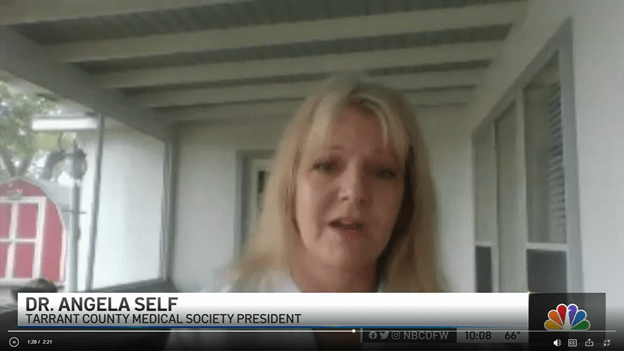
Watch below to hear TCMS President Angela Self, MD, explain how the monoclonal antibody treatment, which was recently taken for Fort Worth Mayor Mattie Parker, is an effective tool for COVID-19 treatment.
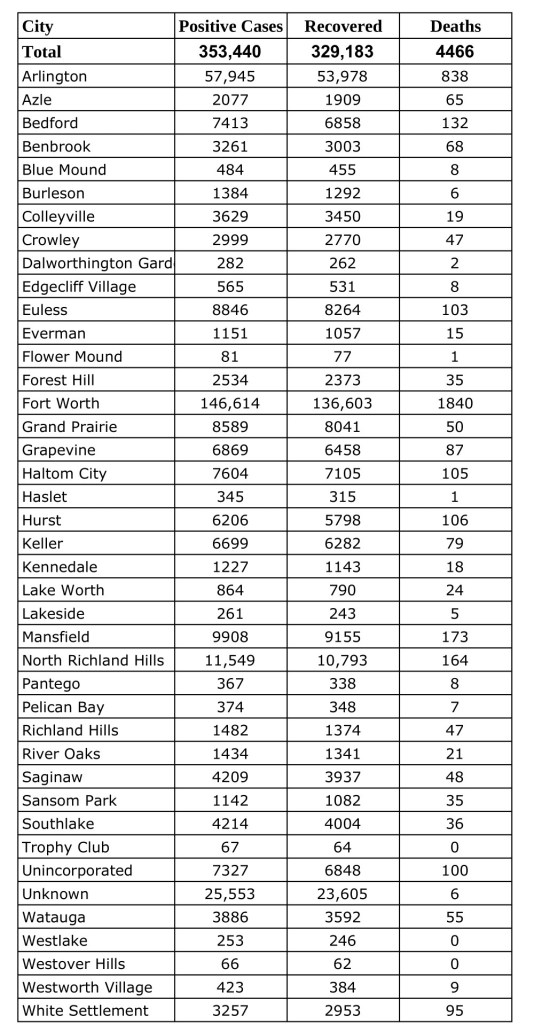
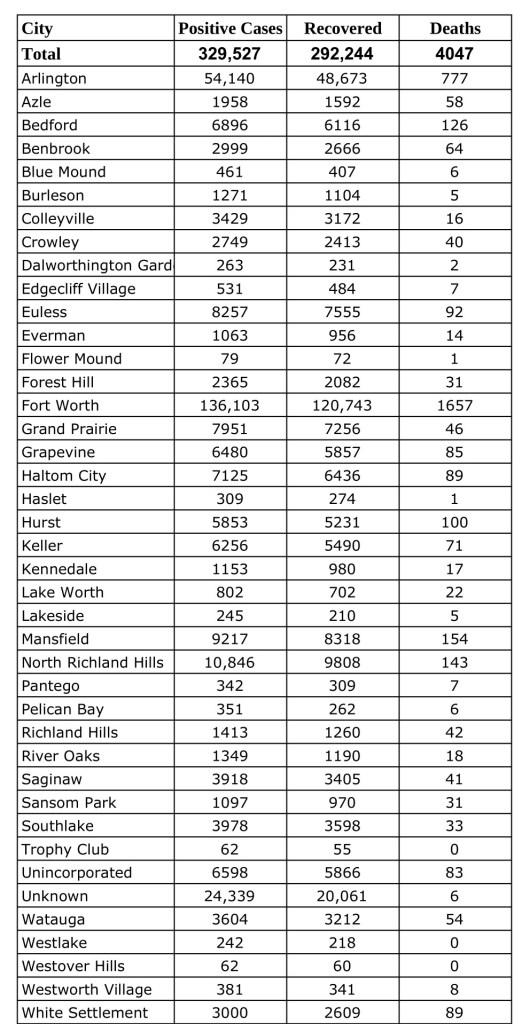
Data from Tarrant County Public Heath’s (TCPH) report of COVID-19 activity in Tarrant County updated Monday, October 11, 2021.Find more COVID-19 information from TCPH here.
*These data are provisional and are subject to change at any time.
Deaths and recovered cases are included in total COVID-19 positive cases.
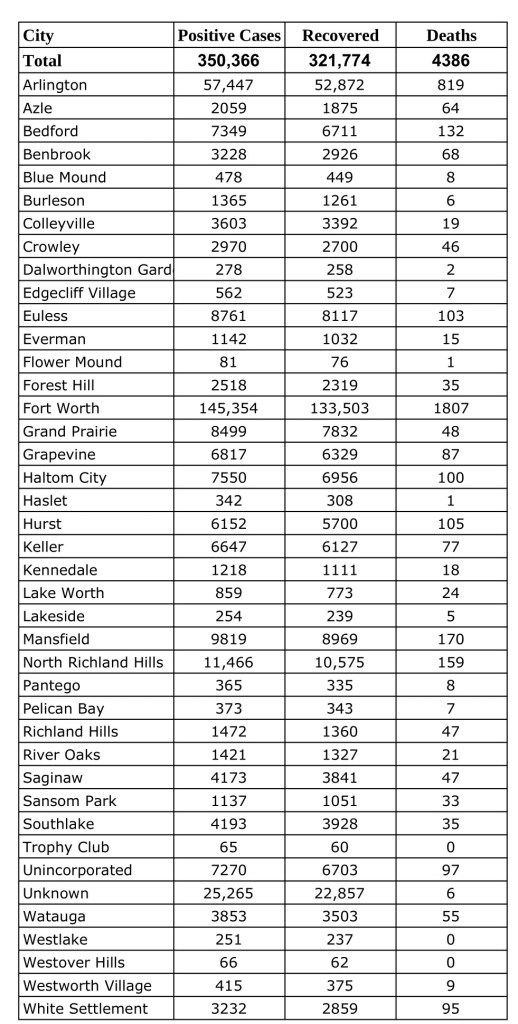
Data from Tarrant County Public Heath’s (TCPH) report of COVID-19 activity in Tarrant County, updated Wednesday, October 6, 2021.Find more COVID-19 information from TCPH here.
*These data are provisional and are subject to change at any time.
Deaths and recovered cases are included in total COVID-19 positive cases.
Imposter syndrome and how the little monster brings us down.
by Ashley Brodrick, OMS-III
This article was originally published in the July/August issue of the Tarrant County Physician. You can read find the full magazine here.
“Am I really cut out for this?” A question most medical students have asked themselves time and time again. Imposter syndrome is this little monster in the back of our minds that tells us we are inadequate; it grows every week, with every test, and with every medical encounter. It tells us we are destined to fail. It tells us we are never going to make it, we are never going to learn, and we are never going to be good doctors. This little monster puts doubts into our minds about our ability to be successful physicians. If you are lucky enough never to have been visited by this little monster, I applaud you.
Medical school is this arduous four-year journey that tests us mentally, physically, emotionally, and sometimes even brings us to our breaking point. Why is medical training so taxing on our emotions, leaving us feeling empty, drained, and questioning if we are made for this career? Medical school is competitive by nature, with a national acceptance rate of 43 percent. This means you must be the “best of the best,” graduating with extraordinarily high GPAs, and performing well on the MCAT. Don’t get me wrong, being a doctor is no easy task. You are responsible for another person’s life, something that I consider to be a tremendous honor. However, at what point do we start to take a step back and reconsider this competitive atmosphere that we have fostered for so long and look at applicants on a holistic level and not just a statistic on a sheet of paper. I can tell you I would rather have a doctor that understands my concerns and listens to me than one who scored in the 99th percentile on their standardized exams but never questions their diagnosis. I would rather have a doctor that IS questioning their diagnostic and treatment decisions for me—not because they don’t know the proper protocols, but because they care about getting my treatment right for me as an individual. M
I am no stranger to imposter syndrome; however, this little monster did not visit me until my second year. My first year of medical school was the year I thrived, leading me to believe that maybe I could make it through without letting that little monster get the best of me. My grades were above average, I was making friends, and I was becoming more confident in my ability to talk to patients (even if it was standardized and following a script). The real challenge for me came during my second year, when my self-doubt started setting in. I was having difficulty connecting the dots and putting everything together. My classmates seemed to be following the right path, understanding how the different diseases connect across organ systems, whereas I felt like I was stumbling every step of the way. Each block presented a new challenge and fed that little monster even more. While I could understand the information and explain it flawlessly to my friends, it was just not coming together on the tests. This inability to perform well on exams did a number on my mental health. You don’t realize how deep into a hole you are until you turn around and realize you can no longer see any light, making it impossible to escape. Each day I would wake up with my heart racing, but you know what I did? I told myself this was normal; this is what medical school is supposed to be like. Stressful, hard, and exhausting, it takes everything out of you along the way, while proving to everyone that you are the “best of the best,” having the highest level of education, being in the top 0.29 percent of the population. The one thing I did not tell myself was that medical school did not have to be this way.
Medical school puts you in a bubble, one that is hard to escape. You are surrounded by medicine 24/7, and during my first two years I found it difficult to talk about anything other than medicine when I was with my friends and family. Every time I went home it was always, “How is school going? Any recent tests? What are you learning now? Making good grades still?” It was never, “How are you handling everything? Is there anything you need help with?” I knew they were trying to show an interest in my education, and genuinely wanted to know what I was learning, but I did not have the energy to go into detail. So, I found myself falling into the same routine of saying, “School is going well, just the same every day. I spend 10 hours in the library and when I get home I take Sadie on a walk, then sit on my couch and watch TV until I do it all over again.” This wasn’t always the case. I was hanging out with my friends, going to dinners, TV show watch parties, doing normal adult things, but whenever I would tell people about this, I would be hit with, “Shouldn’t you be studying? How do you have time for all of that?” I decided it was not worth it to try to please everyone and explain myself, so I shut down and didn’t tell anyone outside of medicine what was going on in my life. To some degree I felt this fed that little monster even more, because I was not sharing all the extraordinary things I was learning. I was not sharing how I was learning to properly perform a physical exam on patients. I was not sharing the complex pathology behind diseases and how to treat them. I was not sharing how I was developing my communication skills with our standardized practice patients. I was not sharing how I was constantly being uplifted and supported by not only my classmates and friends, but also my professors and faculty advisors. Looking back, I think the main reason I decided to suppress and not discuss was because of my imposter syndrome. I felt that if I started to talk about a subject and got one thing wrong, then my months of learning proved nothing, showing that I didn’t belong in this field.
I had this grand idea in my mind of what my clinical years in school would be like, but the pandemic added hurdles and setbacks, which further contributed to my imposter syndrome. I’ve spent most of my third-year rotations online— 60 percent, to be exact—which has left me questioning if I really am ready to begin my residency. I’ve never witnessed a code, never rounded on in-patient care, my note writing skills are lacking, and frankly, I just have not had the experience I feel is necessary to graduate medical school. Thus, imposter syndrome is in full effect for me right now. I made it halfway through my third year when I realized I was just getting to my first full in-person rotation. Thankfully it was OB-GYN, the field I have fallen in love with and will be applying for in the 2022 residency match. I felt comfortable taking a gynecologic history, performing PAP smears, delivering placentas, assisting in the OR, and even having the incredible opportunity of catching a baby. Now, as I am nearing the end of my third year, I realized I had the expectation that I would know so much; however, I feel like I know so little and find myself looking forward to the day when it will all come together. When I look around at my other classmates, I realize I am surrounded by people who were at the top of their class, and while I am one of those people, I still find myself feeling inadequate. I still find myself wondering how they can connect the dots on their rotations and see the big picture. I still find myself wondering how they know what questions to ask. I still find myself wondering simply how they make it look so easy. The one benefit of spending most of my clinical time online is it has allowed me to have time for self-reflection. This year has allowed me to foster relationships with my friends in ways that would not have been possible with a full work schedule. This year has allowed me to make myself and my mental health a priority. Most of all, this year has shown me the amazing support system I have cheering me on every step of the way, especially during the hard times.
So, while I try my best to contain this little monster, there are days when it breaks free from the room it is kept in, and I sometimes am still unable to contain my feelings of being inadequate. When these days come, I’ve learned how to work through them. I remind myself of how far I’ve come to get here. I remind myself of the years of education and knowledge I have gained on this journey. I remind myself of the countless individuals who have supported me, encouraged me, and helped me on this path. I remind myself of what lies ahead, and while it is a long and arduous road, it is one I am happy to be on. Sacrificing the best years of my life to being confined to the library, where I am studying and absorbing an overwhelming amount of information, has been worth it to me. Some might ask why, and the only answer I can give is that whenever I am asked what I would do if I wasn’t in medicine, I honestly do not have an answer. So, this is how I lure the monster back into its room—by reminding myself of my worth, my perseverance, my triumphs, and my successes throughout this journey.
Part of me is curious if it is the competitive culture of medicine that contributes to imposter syndrome, or if it is the self-doubt we carry in ourselves because of how difficult the road is to becoming a doctor. My biggest question going into my fourth year is how do we combat this? How do we tell medical trainees that it is okay to have these doubts; that they are normal, and that you are still learning and absorbing everything around you? How do we tell them that medical school is hard, but you don’t have to endure it alone? I think the answer to these questions is acknowledging that everyone experiences imposter syndrome at least once, and it is okay to have these doubts. It is okay to take a step back and say, “Wait a minute, was that the right call? Was that the right diagnosis? Should I have treated my patient’s condition in a different way?” Acknowledging this monster allows us to not become complacent in our careers, ensuring we are doing the best job that we can. This is a big part of the reason I chose to pursue medicine—the constant educational and learning opportunities, the inability to ever become complacent in your job. My time in medical school has opened my eyes to the type of physician I want to be. I want to encourage and reassure the medical students I will one day work with that it is okay to not know the answer to everything. It is okay to ask questions out of curiosity, even if the answer is something that I view as common knowledge. It is okay to be nervous, it is okay to be scared, it is okay to simply not know things. Medical students are exactly what they are called: students. Here to learn, here to observe, and here to take in everything around them. They should be able to do this without fear of humiliation or being deemed incompetent. I want to be the type of resident that shows my students that I too suffer from imposter syndrome right there with them, and that with the right tools and strategies, it is possible to cage the monster.
My challenge to this generation of physicians is to look back on your time in medical school and think of a resident or preceptor that showed an interest in your education and made you feel like you belonged. Do you think you could have survived that rotation without their help? If you find yourself answering “yes,” I give my applause to you, but if you find yourself answering “no,” hold on to that thought, remembering it for when you have students of your own.
We don’t have to be alone on this journey. We should work together to normalize the conversation around the mental exhaustion medical school creates in individuals. We should work together to lift and encourage our peers. We should work together to ultimately say it is okay to have imposter syndrome, but here is how we can deal with it before it becomes something greater than we can contain.
2021 Gold-Headed Cane Award Recipient Susan Rudd Bailey, MD
by Allison Howard
This article was originally published in the September/October issue of the Tarrant County Physician. You can read find the full magazine here.
When Dr. Susan Rudd Bailey reflects on her years of leadership in organized medicine, she says there has been a consistent truth.
“Every organization, whether it’s Tarrant County Medical Society, whether it’s TMA, AMA—they always seem to have the right person in office at the right time.”
When the allergist and immunologist began her term as AMA president in June of 2020 in the midst of a global pandemic, she wondered why she was the right person for that moment. The self-proclaimed extravert has a leadership style that emphasizes relationship building and the importance of community, and she was facing a year of virtually leading the United States’ largest medical association at a critical moment for medicine. It was a daunting situation at best.
Despite that, Dr. Bailey had the perfect set of experiences to prepare her for that moment.
“Having been the Speaker at TMA and AMA—I spent basically 16 years doing that—and having a lot of media experience, along with immunology credentials, working with the media and the public was a relatively easy transition,” she says. “I was able to do a lot more and reach a lot more people because I wasn’t traveling. Traveling is a real time waster. Instead of doing two or three events a week, I could do two or three events a day.”
Thinking about the past year, the culmination of over 40 years of advocacy on the behalf of doctors and patients, Dr. Bailey is humbled and honored by the opportunities that she has been awarded. “What a privilege,” she says, as she smiles and shakes her head. “What a privilege.”
Dr. Bailey has practiced in Fort Worth her entire career, but it took her a while to get here. Though her family has lived in Tarrant County for generations, she was raised in Houston—“in the shadow of the Texas Medical Center,” she says, remembering a childhood where many of her friends’ parents were physicians.
That coupled with the influence of Dr. Bailey’s allergist, who treated her severe allergies and asthma with compassion and excellent care throughout her adolescence, propelled her toward her future.
“The quality of care we give our patients doesn’t just happen in the examining room. It happens in Austin, it happens in Washington, D.C.”
“I have been so blessed to know what I wanted to do very early on in my life,” Dr. Bailey says. “I mean, I put on my college scholarship applications that I wanted to be an allergist; not just a physician, but an allergist.”
She was in the charter class of the A&M College of Medicine and loved every moment of her medical training. At times, it was an adventure to participate in the then-new program; the first two years of classes were housed in the basement of the computer sciences building. The small class of 32 students built strong bonds that turned into lifelong friendships.
She graduated in 1981 and began her residency at the Mayo Clinic. It was a complete shift from her tight-knit medical school; this program is one of the largest in the country and housed over a thousand residents at the time. Despite the completely different setting, Dr. Bailey says that this is an experience she has valued throughout her career.
Dr. Bailey completed her residencies in pediatrics and allergy and immunology by 1987 and joined Fort Worth Allergy and Asthma Associates (FWAAA) in 1988. By then, she was a mother of two young children, trying to find a balance between her career and her family. She wanted to work part time but was concerned about finding a position that fit her needs.
Dr. Bob Lanier, who hired her, and the rest of the partners at FWAAA were supportive of her position, so she joined the group and has stayed there her entire career. The unique setup of their clinic, which is an expense sharing partnership, gives her the flexibility Dr. Bailey needed to focus on her family and be involved in groups like TCMS, TMA, and AMA.
Her longtime partner at FWAAA, Dr. Robert Rogers, feels she is an integral part of their clinic. “Her patients thrive under her care,” he says. “Sue has an unwavering sense of fairness, which has created a perfect environment for the business side of our practice. I have been fortunate to share so much of my life with this excellent physician and close friend.”
She anticipated she would find a good fit with the Tarrant County medical community, and that hope was confirmed before she even got here. In February of 1988, just a few short months before the move to Texas, she went to the AMA’s Winter Conference, an event that executives and presidents from state and county societies around the country would attend. She brought her youngest son with her, who was only two months old at the time.
“The two people at that meeting from TCMS were the late Leo Benavides, who was the executive director then and just such a wonderful man, and the president of the society at that time, who was Dr. John Smith,” Dr. Bailey says. “I had my son, Stephen, in his stroller, and at one point in time he got kind of fussy. So John picked him up and started soothing him and then kind of started dancing with him as we were listening to the music, and I thought to myself, oh yes, these are the people I want to be with. I had found my family.”
Dr. Bailey has a recommendation for doctors and medical students everywhere: get involved in organized medicine and learn to say “yes.”
“There are opportunities available – the county medical society needs good people, the TMA needs good people, your specialty society needs good people,” she says, sharing the passion from her own career. “For me, it was the importance of physicians being involved in advocacy, and in helping other physicians practice medicine in a better environment. The quality of care we give our patients doesn’t just happen in the examining room. It happens in Austin, it happens in Washington, D.C.”
This is something Dr. Bailey has practiced her whole career. She joined TMA and AMA during her years of medical school and began to attend meetings. As a resident, she was elected to chair the AMA’s advisory panel on women in medicine. As her career progressed, she served as speaker of the house for both TMA and AMA, and as president for TCMS, TMA, and now, AMA. She has been involved in countless committees and groups, assisting with policy, advocacy, and education.
She has brought many physicians to join her along the way. Dr. Melissa Garretson, who has referred some of her most challenging allergy patients to Dr. Bailey, has often been inspired by her. “Sue Bailey is a phenomenal allergist,” she says. “But her greatest gifts are as a mentor and friend. Sue has guided many of us on our journey of service to organized medicine.”
Leading and participating in groups has always fascinated Dr. Bailey, but her commitment goes beyond her affinity for working in a team.
“I think of being involved in organized medicine as a professional obligation. I really do,” Dr. Bailey says. “Things don’t happen organically. We have to be intentional about making sure that everyone is represented, that everyone’s voice is heard.”
One area she has seen this in is the development of sections dedicated to female physicians. Though she was happy to be able to participate when she joined AMA’s advisory panel on women in medicine so early in her career, Dr. Bailey was concerned she was being pushed to the side to worry about women’s issues while other doctors worried about the “real” problems.
“My feeling about women in medicine groups has done a complete 180 from where I was when I finished my residency; now I think it’s incredibly important,” Dr. Bailey says. “Thirty-six percent of the physicians in the U.S. are female, but we still face significant pay inequities, and only 18 percent of medical school deans and 25 percent of tenured faculty are women. There is obviously still work that needs to be done.”
Looking back at what has been done, and the many things that still need to be accomplished, Dr. Bailey says that she has learned two important lessons about leadership. Good leaders sometimes step back to give someone else a golden opportunity, and good leaders always support their team. She had the chance to practice this when she first planned to run for TMA president.
“The late, wonderful Ladon Homer called me and took me to lunch,” Dr. Bailey says, remembering that day with a smile. “He had said all along that he didn’t want to be TMA president, that he would be happy to be chair of the board and then he would be done, but I always felt that he needed to be TMA president. So he took me to lunch and asked me if I would mind if he went ahead and ran for TMA president in the year that I was going to run.
“It was a no-brainer for me. I said, ‘Yes! Do it. We need you.’ Some people asked me later if I was resentful of that. No! I’m so glad, because Ladon was an amazing TMA president. He was the right person at the right time for us.”
Dr. Bailey had her opportunity to serve as TMA president from 2010 to 2011, and with the implementation of the Affordable Care Act, she grew greatly as a leader as she navigated the different opinions and positions of the organizations and people she worked with.
“Leadership means that you will not always be advocating for your personal cause,” says Dr. Bailey. “There are times you have to take one for the team. A team, whether it’s a small group in an operating room or it’s thousands of physicians working together.
“You can have your arguments, you can have your disagreements and grind out policy, but when the decision is made, you all work together and leave your differences behind you. In the end, the credibility of the team far outlasts individual policy implications. If you lose your team, it doesn’t matter if you win.”
Dr. Bailey says so much of what she has done has been possible through the support of her loving husband, Doug; her two sons, Michael and Stephen Wynn; her daughter-in-law, Hannah; and her grandson, 11-year-old Jackson. She loves to spend time with them, and one benefit of completing her time in leadership is that she is now able to do that more often.
When not in the midst of a pandemic, Dr. Bailey also enjoys expressing her love of music by singing in her church choir at University Christian Church. She has had unforgettable experiences with her choir members, many of whom are her closest friends. A top highlight has been being able to sing at Carnegie Hall—six times.
Though Dr. Bailey loves organized medicine, she is ready to step back and focus on her practice and her family. She looks toward the possibilities of the future with anticipation as she limits her role at TCMS, TMA, and AMA to that of an “interested observer.”
“I have had 40 years to make a difference,” she says. “If I haven’t done what I needed to do in 40 years, said what I needed to say, accomplish what I needed to accomplish, then it’s nobody’s fault but mine. It’s time for younger people to occupy those committee chairs, to be the delegate, to get a chance to run the meeting. I’ve had my turn, and it’s been glorious, but now it’s someone else’s.”
As Dr. Steve Brotherton puts it after spending many years as her colleague in organized medicine, “Dr. Bailey has been an exemplary physician at all levels.” With great appreciation for her many years of selflessly serving the patients and physicians of Tarrant County and beyond, we congratulate Dr. Bailey— the Doctor’s Doctor.
This article was originally published in the September/October issue of the Tarrant County Physician. You can read find the full magazine here.
I will remember Project Access forever because not only did it save me, but it also helped my family.
I am twenty-eight years old. I have been married for seven years and I have a son and a daughter. Five years ago, I was diagnosed with rheumatoid arthritis. Doctors were shocked. They had never seen a patient my age with such severe rheumatoid arthritis.
My condition has affected everything. It has been the cause of my depression. I felt like giving up on life. I could not be a mom or a wife. My husband would always see me sick and in pain. I could not take my kids to the park. My son would ask me to kick a ball with him, but I could not do simple things.
It has been a major setback in my life. Since being diagnosed, I have had to quit three jobs because of my arthritis, especially in my knees.
This year has been hard because my pain has increased so much. It has been hard on me physically, emotionally, and mentally. One day, the pain was so unbearable that I went to the emergency room. After many tests, I was told that I needed an orthopedic surgeon. I knew that it was going to cost so much money. My husband told me that he did not care if he had to give up his whole paycheck for me to go to the doctor but that I was going to get the care I needed. That was when I started seeing Dr. David Brigati at Texas Bone and Joint. He immediately saw how bad my condition was and he told me he did not care what he had to do, that he was going to help me. He contacted Kathryn and that is when Project Access started helping me.
Dr. Brigati performed my double knee replacement at Baylor Surgicare. My life has changed so much since the surgery. I am 70-80 percent better. I can walk and get around on my own now, which is a huge accomplishment for me. I can finally drive and get in my car. I have been able to take myself to the grocery store. This past Sunday, my family and I went to the zoo. It was a big milestone for us because I was able to walk and go up and down the stairs. My husband kept asking me if I was okay because he couldn’t believe how much I was able to walk at the zoo.
Project Access also connected me to Baylor Community Care Clinic, where I have been seeing a therapist, and that has helped my mental health so much. The fact that I am now able to move freely and be more independent has helped me mentally. I feel so much better knowing that my family is not so concerned about me because they know I am improving day by day.
I will remember Project Access forever because not only did it save me but it also helped my family.
I have been connected to a rheumatologist, and I plan on starting treatment soon. Eventually I hope to go back to work because I can finally walk.
I want Dr. Brigati to know that I am forever grateful for him. He listened to me, understood me, and validated me. He did not just help me. He helped my husband, my kids, and my whole family. He helped me come back to life. I just want to say “thank you.” I do not have words to describe my appreciation. We need more doctors like him.
For a long time, I dealt with so much pain that was contributed to my depression. It has been very hard for me to get healthcare. I just wanted to stop trying. I did not know there are resources out there that are willing to help. It’s amazing to me that there are organizations that want to help others. I have seen how much the surgery and physical therapy costs and I am so fortunate to not have to pay for these services. I am so grateful that PATC was able to help me. Diana and Kathryn were so helpful, and I am grateful for their patience. They have been a huge blessing in my life. I will remember this forever because not only did it save me, but it helped my family.
Data from Tarrant County Public Heath’s (TCPH) report of COVID-19 activity in Tarrant County, updated Wednesday, September 15, 2021.Find more COVID-19 information from TCPH here.
*These data are provisional and are subject to change at any time.
Deaths and recovered cases are included in total COVID-19 positive cases.
by Catherine Colquitt, MD Tarrant County Public Health Medical Director
This article was originally published in the September/October issue of the Tarrant County Physician. You can read find the full magazine here.
With healthcare systems, policy makers, and community partners preoccupied with the ongoing COVID-19 pandemic, other infectious diseases are percolating in the United States and across the globe, reminding us that Hamlet was right: “There are more things in heaven and on earth, Horatio, than are dreamt of in your philosophy.”1
Recently, the National Vital Statistics System (NVSS) issued a rapid release describing the effects of COVID-19 on U.S. life expectancy, which declined overall by 1.5 years between 2019 and 2020, from 78.8 years to 77.3 years.2 It is the sharpest decline in U.S. life expectancy since 1943, when World War II casualties were to blame for the decline from 1942 to 1943. Life expectancy decreased by 3.0 years for persons of Hispanic origin, and by 2.9 years for the non-Hispanic Black population over the same time period. The magnitude of the drop in life expectancy and the disparate effects of COVID-19 based on race and ethnicity are sobering.
In addition, many epidemiologists and public health experts are anticipating a busy influenza and other respiratory virus season after very low incidences of flu and other non-COVID respiratory infections in 2020 (attributed to COVID-19 shutdowns of schools, workplaces and businesses, masking requirements, and social distancing guidance). The CDC says to plan for “resumption of seasonal flu virus circulation” in the population with decreased “immunity due to lack of flu activity since March 2020” along with “co-circulation of flu, SARS-CoV-2, and other viruses like RSV” which may “place a renewed burden on the health care system.”3
The Texas Department of State Health Services attributes drops in vaccination rates to “stay-at-home measures, school and school-based clinic closures, and business closures” during the COVID-19 shutdown along with healthcare providers “suspending or postponing wellness visits including vaccinations in some cases.”4 From April 2019 to April 2020, vaccination rates through TVFC program decreased by 43 percent and remain well below 2019 rates even now. ImmTrac2, the Texas Immunization Registry, reported on July 1, 2021, that age-specific benchmarks for most VFC-supported immunizations (including pertussis, Hepatitis B, Hemophilus influenzae, rubella, measles, mumps, and varicella) remain well below benchmarks with schools soon to reopen for in-person classes.
Dallas County Department of Health and Human Services reported 100 cases of Hepatitis A in 2020 (an increase from an annual average of 19 cases for the prior 10 years) and has already recorded 52 Hepatitis A cases in the first three months of 2021.5 The outbreak in Dallas County is associated with drug use (both injection and non-injection) and homelessness. Tarrant County is working with the Tarrant County Homeless Coalition and John Peter Smith Hospital among other partners to offer homeless Tarrant County residents Hepatitis A vaccines (highly efficacious at preventing future Hep A infections).
And in July, the CDC issued a statement on Monkeypox in Texas.6 The infected U.S. resident had recently returned from Nigeria and traveled by air from Lagos to Atlanta and then to DFW International Airport. A contact investigation is underway; Monkeypox is rare in the U.S. The last large outbreak occurred in 2003 and was associated with transmission from pet prairie dogs to humans. Monkeypox can cause serious morbidity and is usually contracted through contact with infected animals (bites, scratches, or dressing wild game) but can be transmitted via respiratory droplets, body fluid contact, or fomite spread (via contaminated clothing or bedding). More information about monkeypox is available at https://www.cdc.gov/pox virus/monkeypox,index/html.





 Tarrant County Physician Online