With a key deadline for clinicians in the Merit-Based Incentive Payment System (MIPS) approaching fast amid the COVID-19 pandemic, the Centers for Medicare & Medicaid Services (CMS) is giving those clinicians a month of extra time to submit their data.
CMS announced Sunday it is moving the deadline for MIPS-eligible clinicians to submit their 2019 MIPS data to April 30, instead of March 31.
Even if that’s not enough time, not submitting your data by then won’t hurt your bottom line. CMS also announced that MIPS-eligible clinicians who haven’t submitted their 2019 data by the April 30 date would simply receive a “neutral payment adjustment” – that is, no payment bonus and no 7% penalty – in calendar year 2021. (MIPS bonuses or penalties for a given performance year are assessed two years later.)
CMS announced the MIPS extension among a host of new measures under its “extreme and uncontrollable circumstances” policy in order to ease the burden on clinicians participating in a number of federal quality reporting programs.
Any clinicians who have already submitted their 2019 MIPS data, or submit their data by the April 30 deadline, will be scored and receive a payment adjustment under the normal method, CMS said. April 30 is also the new deadline for clinicians to revise their submitted data, if needed, by logging in to the QPP portal. For guidance on submitting your data, download this CMS guide (PDF).
CMS also reports it is evaluating options for providing additional relief for the 2020 QPP performance year (which would affect 2022 payments). Texas Medicine Today will update physicians when CMS releases more information.
The list of new exceptions and extensions for the QPP and other federal quality reporting programs is available here.
For questions, contact the QPP Service Center at (866) 288-8292 or by email.
Remember, you can find the latest news, resources, and government guidance on the coronavirus outbreak by visiting TMA’s COVID-19 Resource Center regularly.
Tarrant County Public Heath’s (TCPH) report of COVID-19 activity in Tarrant County, updated Monday, March 23, 2020 at 11:15 a.m.Find more COVID-19 information from TCPH here.
An update from Stephen Carlton, J.D., the executive director of the Texas Medical Board, published on 3/21/20. You can read the signed letter here.
The Texas Medical Board (TMB) issued initial guidance on February 7, 2020, regarding PMP checks after multiple inquiries. The guidance was intended to be helpful for licensees to understand the upcoming change in the law on March 1, 2020 and address their concerns. No TMB guidance is enforceable nor can they result in any enforcement or disciplinary action.
TMB held a meeting of the TMB Opioid Workgroup on February 18, 2020. One of the primarygoals was to obtain input regarding when to do mandatory PMP checks, who can do them, and how to document these checks. TMB took extensive input from the Opioid Workgroup Stakeholders. This collaborative effort resulted in the following consensus:
The mandatory PMP check is required only when a physician prescribes opioids, benzodiazepines, barbiturates, or carisoprodol to the ultimate user for take-home use upon leaving an outpatient setting, such as a doctor’s office or ambulatory surgical center, or upon discharge from an inpatient setting, such as a hospital admission, or discharge from an emergency department visit. A mandatory PMP check is not required before or during an inpatient stay, such as a hospital admission, or during an outpatient encounter setting, such as an emergency department or ambulatory surgical center visit
The physician may delegate the PMP check to any legally authorized personnel the same way physicians may delegate other tasks.
A copy of the PMP check may be placed in a patient’s medical records.
Staff anticipates bringing a proposed rule to the Board consistent with this updated guidance for possible publication as soon as March 5-6. TMB believes this updated guidance fulfills the intent of the law, reflects valuable stakeholder input, and enhances the protection of Texas patients.
Click here for TMB’s latest COVID-19 news and resources.
Politico (3/22, Rayasam) reports Texas Gov. Greg Abbott (R) “issued two executive orders mandating that the state’s health care facilities postpone elective medical procedures and suspending regulations to allow hospitals to treat two patients in one room in an effort to combat the spread of Covid-19.” Moreover, Abbott “announced the creation of a ‘strike force’ to help Texas procure medical supplies and said that he was deploying the National Guard to help providers organize testing areas and assist hospitals in creating more bed space.”
The AP (3/22, Bleiberg, Vertuno) reports Texas Gov. Greg Abbott announced “the National Guard could begin monitoring drive-in testing sites” today “and prodded the federal government to do more to help states secure more tests and medical supplies to fight the spreading coronavirus outbreak.” The article adds that Texas has not issued a shelter-in-place order, but Gov. Abbott said he may issue one if necessary and advised people to not leave their home unless it was essential.
Physicians, below are a number of printable COVID-19 materials TMA has compiled so they are easily accessible for your practice throughout the pandemic.
Today, the Centers for Medicare & Medicaid Services (CMS) announced unprecedented relief for the clinicians, providers, and facilities participating in Medicare quality reporting programs including the 1.2 million clinicians in the Quality Payment Program and on the front lines of America’s fight against the 2019 Novel Coronavirus (COVID-19).
Specifically, CMS announced it is granting exceptions from reporting requirements and extensions for clinicians and providers participating in Medicare quality reporting programs with respect to upcoming measure reporting and data submission for those programs. The action comes as part of the Trump Administration’s response to 2019 Novel Coronavirus (COVID-19).
“In granting these exceptions and extensions, CMS is supporting clinicians fighting Coronavirus on the front lines,” said CMS Administrator Seema Verma. “The Trump Administration is cutting bureaucratic red tape so the healthcare delivery system can direct its time and resources toward caring for patients.”
Specifically, CMS is implementing additional extreme and uncontrollable circumstances policy exceptions and extensions for upcoming measure reporting and data submission deadlines for the following CMS programs:
Provider Programs
2019 Data Submission
2020 Data Submission
· Quality Payment Program – Merit-based Incentive Payment System (MIPS)
Deadline extended from March 31, 2020 to April 30, 2020. MIPS eligible clinicians who have not submitted any MIPS data by April 30, 2020 will qualify for the automatic extreme and uncontrollable circumstances policy and will receive a neutral payment adjustment for the 2021 MIPS payment year.
CMS is evaluating options for providing relief around participation and data submission for 2020.
· Medicare Shared Savings Program Accountable Care Organizations (ACOs)
Hospital Programs
2019 Data Submission
2020 Data Submission
· Ambulatory Surgical Center Quality Reporting Program
Deadlines for October 1, 2019 – December 31, 2019 (Q4) data submission optional. If Q4 is submitted, it will be used to calculate the 2019 performance and payment (where appropriate). If data for Q4 is unable to be submitted, the 2019 performance will be calculated based on data from January 1, 2019 – September 30, 2019 (Q1-Q3) and available data.
CMS will not count data from January 1, 2020 through June 30, 2020 (Q1-Q2) for performance or payment programs. Data does not need to be submitted to CMS for this time period. * For the Hospital-Acquired Condition Reduction Program and the Hospital Value-Based Purchasing Program, if data from January 1, 2020 – March 31, 2020 (Q1) is submitted, it will be used for scoring in the program (where appropriate).
· CrownWeb National ESRD Patient Registry and Quality Measure Reporting System
· End-Stage Renal Disease (ESRD) Quality Incentive Program
· Hospital-Acquired Condition Reduction Program
· Hospital Inpatient Quality Reporting Program
· Hospital Outpatient Quality Reporting Program
· Hospital Readmissions Reduction Program
· Hospital Value-Based Purchasing Program
· Inpatient Psychiatric Facility Quality Reporting Program
· PPS-Exempt Cancer Hospital Quality Reporting Program
· Promoting Interoperability Program for Eligible Hospitals and Critical Access Hospitals
Post-Acute Care (PAC) Programs
2019 Data Submission
2020 Data Submission
· Home Health Quality Reporting Program
Deadlines for October 1, 2019 – December 31, 2019 (Q4) data submission optional. If Q4 is submitted, it will be used to calculate the 2019 performance and payment (where appropriate).
Data from January 1, 2020 through June 30, 2020 (Q1-Q2) does not need to be submitted to CMS for purposes of complying with quality reporting program requirements. * Home Health and Hospice Consumer Assessment of Healthcare Providers and Systems (CAHPS) survey data from January 1, 2020 through September 30, 2020 (Q1-Q3) does not need to be submitted to CMS. * For the Skilled Nursing Facility (SNF) Value-Based Purchasing Program, qualifying claims will be excluded from the claims-based SNF 30-Day All-Cause Readmission Measure (SNFRM; NQF #2510) calculation for Q1-Q2.
· Hospice Quality Reporting Program
· Inpatient Rehabilitation Facility Quality Reporting Program
· Long Term Care Hospital Quality Reporting Program
· Skilled Nursing Facility Quality Reporting Program
· Skilled Nursing Facility Value-Based Purchasing Program
For those programs with data submission deadlines in April and May 2020, submission of those data will be optional, based on the facility’s choice to report. In addition, no data reflecting services provided January 1, 2020 through June 30, 2020 will be used in CMS’s calculations for the Medicare quality reporting and value-based purchasing programs. This is being done to reduce the data collection and reporting burden on providers responding to the COVID-19 pandemic.
CMS recognizes that quality measure data collection and reporting for services furnished during this time period may not be reflective of their true level of performance on measures such as cost, readmissions and patient experience during this time of emergency and seeks to hold organizations harmless for not submitting data during this period.
CMS will continue monitoring the developing COVID-19 situation and assess options to bring additional relief to clinicians, facilities, and their staff so they can focus on caring for patients. This action, and earlier CMS actions in response to COVID-19, are part of the ongoing White House Task Force efforts. To keep up with the important work the Task Force is doing in response to COVID-19, please visit www.coronavirus.gov. For a complete and updated list of CMS actions, and other information specific to CMS, please visit the Current Emergencies Website
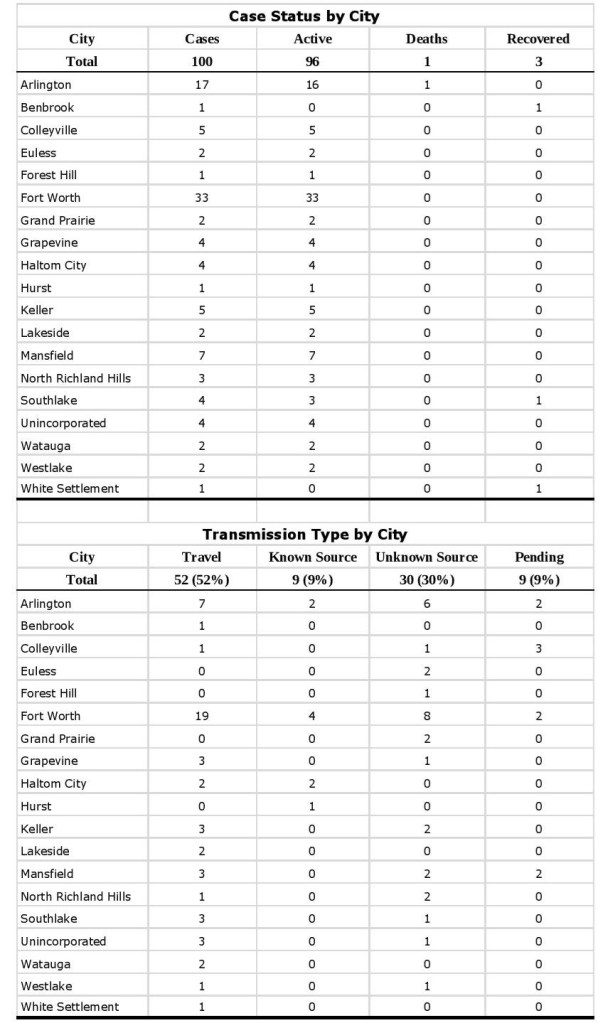
Tarrant County Public Heath’s (TCPH) report of COVID-19 activity in Tarrant County, updated Sunday, March 22, 2020 at 11:15 a.m.Find more COVID-19 information from TCPH here.
The new restrictions, which go into effect today at 6 p.m., will close in-person worship services but will allow worship support staff to facilitate online services.
The new rules will also close malls and other non-essential retail establishments, such as barber shops, hair salons, nail salons as well spas and massage parlors.
Essential services such as grocery stores, pharmacies and other establishments that sell household goods will remain open.
In-house dining at restaurants remains closed but drive-in, drive-through, takeout and delivery are still permitted.
There should be no gatherings of more than 10 people regardless of the situation. There is no distinction between the types of gatherings in the amended declaration.
“We cannot stress enough that Tarrant County residents practice social distancing where you stay at least 6 feet away from other individuals,” Whitley said. “You need to have sufficient space to have people be at least 6 feet apart. To whatever degree possible, we would encourage you to have sign-in logs to keep track of everyone you have come in contact with.”
COVID-19 causes respiratory illness with cough, fever, and shortness of breath, and may lead to bronchitis and severe pneumonia.
Tarrant County Public Health encourages everyone to continue to follow basic preventive measures to protect from COVID-19 and other respiratory viruses, including:
• Wash your hands often with soap and water for at least 20 seconds. If soap and water are not available, use an alcohol-based hand sanitizer as a supplement.
• Avoid touching your eyes, nose, and mouth with unwashed hands.
• Avoid close contact with people who are sick.
• Stay home when you are sick. If you have trouble breathing, or a persistent fever, call your primary care provider.
• Cover your cough or sneeze with a tissue or your sleeve.
• Frequently clean and disinfect touched objects and surfaces.