Blog Feed

A Thankful and Healthy New Year for Public Health

This article was originally published in the January/February 2023 issue of the Tarrant County Physician.

by Catherine Colquitt, MD, AAHIVS
Medical Director and Local Health Authority
Kenton K. Murthy, DO, MD, MPH, AAHIVS
Assistant Medical Director and Deputy Local Health Authority

During the holiday season, many were reunited in person to celebrate with loved ones after almost three years of relative seclusion.

There was much to be grateful for this season. While COVID-19 case counts and hospitalizations are rising in Texas and in Tarrant County, our present COVID rates pale in comparison to December 2020 or January 2021.1 And though influenza and Respiratory Syncytial Virus (RSV) infections are strikingly and unseasonably high, and the perils of a tridemic (COVID-19, influenza, and RSV) are on our minds, many of us and our patients and neighbors are fully vaccinated against COVID-19 and have already had the bivalent mRNA vaccines (for protection from the Wuhan and Omicron COVID-19 strains) as well as the current seasonal influenza vaccine.

As we shift gears from the COVID-19 pandemic to COVID-19 endemic,
we hope that our next iteration of COVID-19 vaccines will roll out side
by side with next season’s influenza vaccine. However, if new versions of COVID-19 vaccines are required to mitigate the spread of COVID-19 between now and then, our scientists and vaccine manufacturers, our distribution networks, the FDA, the Advisory Committee on Immunization Practices, the CDC, and state and local partners will work together to respond to future challenges.

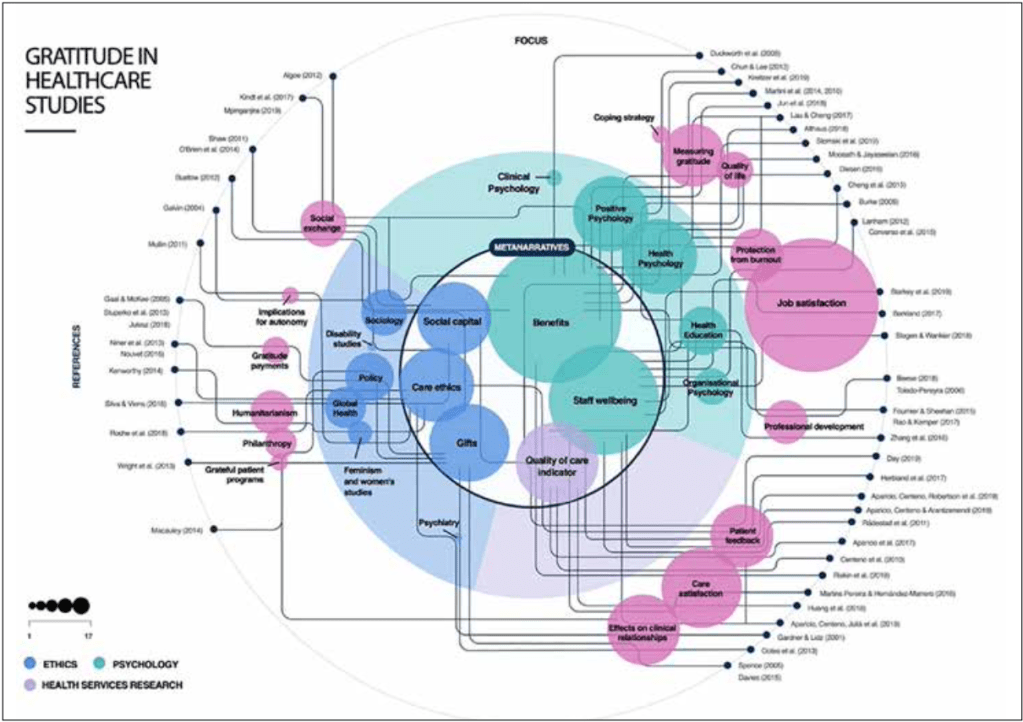
It seems fitting to consider what we have to be thankful for, and gratitude in healthcare is a very active field of study at present. A meta-review in Qualitative Health Research by Day et al reviewed recent works and referenced pioneering works on gratitude research dating to the early twentieth century and organized this vast body of work into six “meta- narratives: gratitude as social capital, gifts, care ethics, benefits of gratitude, gratitude and staff well-being, and gratitude as an indicator of quality of care.”2

Given the ubiquitous articles reporting on healthcare worker
burnout and the mental and physical consequences of COVID-19 on our workforce, Day et al suggested in their conclusion that more research is needed on “gratitude as a component of civility in care settings” and that further study might help researchers to understand the intersection of gratitude “with issues of esteem, community cohesion, and the languages of valorization that often accompany expressions of gratitude.”2

Individually, we might all take a moment to self-assess using a simple exercise such as the Gratitude Questionnaire – Six Item Form (GQ-6), or we might dig more deeply into the bibliography of “Gratitude in Health Care: A Meta-narrative Review” to study our own complicated relationship with gratitude more closely.2,3 Those in healthcare have been under great strain since COVID-19 first appeared on the scene, and perhaps a gratitude practice is just what the doctor ordered to help us to reboot and revive the sense of wonderment with which we began our careers.

References
1. Texas Department of State Health Services COVID -19 Dashboard.
2. Giskin Day, Glenn Robert, Anne Marie Rafferty. 2020 Gratitude in Health Care: A Meta-narrative Review. Qualitative Health Research. 2020 Dec; 30(14): 2303-2315
3. Gratitude Questionnaire – Six Item Form (GQ-6), taken from Nurturing Wellness by Dr. Kathy Anderson.

COVID-19 Vaccine Clinics for the Week of January 21

January 19, 2023 – (Tarrant County) – Tarrant County Public Health hosts numerous pop-up COVID-19 clinics across Tarrant County each week in partnership with public and private organizations listed below. Each site has the Moderna, Pfizer, and Novavax vaccines. Infants six months and older are eligible for the vaccination. Parents need to bring proof of the child’s age and their own ID for the vaccination. Booster vaccinations are available at all of the vaccination locations. 

  
TCPH would like to bring a COVID-19 vaccination clinic to businesses, churches, and organizations in the community thatare interested in hosting a pop-up clinic. It’s easy and free to host a clinic.
 
In addition to the vaccination opportunities below, the cities of Arlington, Fort Worth, Mansfield, North Richland Hills, Hurst, and Tarrant County College have also added opportunities for vaccinations. To find a local vaccine site, the County created a vaccine finder page: VaxUpTC website.

Pop-Up COVID-19 locations:

Stonegate Nursing and Rehabilitation  
Wednesday, Jan. 25: 10 a.m. to 2 p.m.
4201 Stonegate Blvd.  
Fort Worth, TX 76109

VaxMobile-City of Forest Hill  
Thursday, Jan. 26: 9 a.m. to 4 p.m.
6800 Forest Hill Dr.   
Forest Hill, TX 76140

Tarrant County Public Health CIinics: 

Northwest Public Health Center
Monday to Friday: 8 a.m. to 12 p.m. and 1 to 5 p.m.
3800 Adam Grubb Road
Lake Worth, TX 76135

Bagsby-Williams Health Center
Monday to Friday: 8 a.m. to 12 p.m. and 1 to 5 p.m.
3212 Miller Ave.
Fort Worth, TX 76119

Southeast Public Health Center
Monday to Friday: 9 a.m. to 12 p.m. and 1 to 5 p.m.
536 W Randol Mill
Arlington TX, 76011

Main Public Health Center
Monday to Friday: 8 a.m. to 12 p.m. and 1 to 5 p.m.
1101 S. Main Street
Fort Worth, TX 76104

Southwest Public Health Center
Monday to Friday: 8 a.m. to 12 p.m. and 1 to 5 p.m.
6551 Granbury Road
Fort Worth, TX 76133

Watauga Public Health Center
Monday to Friday: 8 a.m. to 12 p.m. and 1 to 5 p.m.
6601 Watauga Road
Watauga, TX 76148

For more information go to coronavirus.tarrantcounty.com or call the Tarrant County Public Health information line, 817-248-6299, Monday – Friday 8 a.m. to 6 p.m.

COVID-19 Vaccine Clinics for the Week of January 14

January 13, 2023 – (Tarrant County) – Tarrant County Public Health hosts numerous pop-up COVID-19 clinics across Tarrant County each week in partnership with public and private organizations listed below. Each site has the Moderna, Pfizer, and Novavax vaccines. Infants six months and older are eligible for the vaccination. Parents need to bring proof of the child’s age and their own ID for the vaccination. Booster vaccinations are available at all of the vaccination locations. 

  
TCPH would like to bring a COVID-19 vaccination clinic to businesses, churches, and organizations in the community that are interested in hosting a pop-up clinic. It’s easy and free to host a clinic.
 
In addition to the vaccination opportunities below, the cities of Arlington, Fort Worth, Mansfield, North Richland Hills, Hurst, and Tarrant County College have also added opportunities for vaccinations. To find a local vaccine site, the County created a vaccine finder page: VaxUpTC website.

Pop-Up COVID-19 locations:

Baker Chapel AME Church 
Saturday, Jan. 14: 10 a.m. to 2 p.m.
1050 E. Humboldt St.  
Fort Worth, TX 76104

Advent Health Care Center of Burleson  
Tuesday, Jan. 17: 9 a.m. to 11 a.m.
301 Huguley Blvd.   
Burleson, TX 76028

Vaxmobile-Southside Community Center 
Thursday, Jan. 19: 9 a.m. to 4 p.m.
959 E. Rosedale St. 
Fort Worth, TX 76104

Tarrant County Public Health CIinics: 

Northwest Public Health Center
Monday to Friday: 8 a.m. to 12 p.m. and 1 to 5 p.m.
3800 Adam Grubb Road
Lake Worth, TX 76135

Bagsby-Williams Health Center
Monday to Friday: 8 a.m. to 12 p.m. and 1 to 5 p.m.
3212 Miller Ave.
Fort Worth, TX 76119

Southeast Public Health Center
Monday to Friday: 9 a.m. to 12 p.m. and 1 to 5 p.m.
536 W Randol Mill
Arlington TX, 76011

Main Public Health Center
Monday to Friday: 8 a.m. to 12 p.m. and 1 to 5 p.m.
1101 S. Main Street
Fort Worth, TX 76104

Southwest Public Health Center
Monday to Friday: 8 a.m. to 12 p.m. and 1 to 5 p.m.
6551 Granbury Road
Fort Worth, TX 76133

Watauga Public Health Center
Monday to Friday: 8 a.m. to 12 p.m. and 1 to 5 p.m.
6601 Watauga Road
Watauga, TX 76148

For more information go to coronavirus.tarrantcounty.com or call the Tarrant County Public Health information line, 817-248-6299, Monday – Friday 8 a.m. to 6 p.m.

New TMA Task Force on Alternative Payment Models Charts a Path Toward Value-Based Care

By Emma Freer

Originally published by Texas Medical Association on January 11, 2023.

The shift from fee-for-service to value-based care is underway, with public and private payers introducing myriad new payment models in recent years. But many physicians find the variety of plans overwhelming, and the investments necessary to support them challenging.

To help clear these hurdles, the Texas Medical Association Board of Trustees approved last May the formation of a Task Force on Alternative Payment Models (APMs). Over the next two years, its diverse membership – which spans specialties, experience levels, practice types, and geographic regions – is charged with reviewing value-based care trends, prioritizing members’ needs, and serving as a touchstone of APM policy and activity.  

Norman Chenven, MD, founding CEO of Austin Regional Clinic (ARC) and co-chair of the task force, commends TMA for convening the group. He brings with him more than four decades of experience working with APMs, dating back to health maintenance organizations in the early 1980s.  

“It’s great for TMA to develop resources for physicians adapting to the inevitable challenges of these changing payment models,” he said.  

Under a value-based care model, physicians and other healthcare professionals are paid based on the quality of patient outcomes rather than the quantity of services provided.  

The Centers for Medicare & Medicaid Services (CMS) has a stated goal of transitioning all Medicare patients to value-based care arrangements by 2030. In the meantime, it continues to test initiatives such as the Enhancing Oncology Model and the Bundled Payments for Care Improvement Advanced Model. CMS also continues to address various issues, such as how to incentivize collaboration between primary care physicians and specialists. 

David Fleeger, MD, a colon and rectal surgeon in Austin, co-chair of the task force, and past president of TMA, says he expects private payers to follow CMS’ example.  

Although value-based models have grown more common, uptake remains slow. In a 2020 survey, the Deloitte Center for Health Solutions found 97% of physician respondents still relied mostly on fee-for-service payments, with roughly a third drawing a portion of their compensation from value-based payments. Moreover, less than a quarter received incentive payments of more than 5%. 

Kim Harmon, TMA’s associate vice president of innovative practice models, says value-based care can prove daunting because of its breadth of applications, from public and private payers to every kind of physician practice. It’s also difficult to identify which physicians participate in value-based arrangements because payers aren’t required to share such information.  

With these challenges in mind, the task force hopes to empower Texas physicians to implement value-based care by offering support and sharing institutional knowledge from early adopters. 

Dr. Chenven, for instance, can speak to the start-up costs that come with participating in value-based models. At ARC, his multispecialty group, these included investments in staff and information technology to ensure patients received preventive care and kept up with chronic care.  

“No individual office or small office is going to have those resources,” he said. “There has to be collaboration across [physicians] in the community.”  

The task force also can push CMS and private payers to develop APMs that are more accessible to a wider range of specialties and practice types, Dr. Fleeger says.  

“We need to make sure that whatever gets done raises all boats,” he said.  

The task force next meets later this month, when it will begin identifying and prioritizing TMA member physicians’ needs for education and other resources related to APMs. 

Dr. Chenven says this is a critical first step to demonstrate the value in value-based care to physicians.  

“It represents a huge culture change. It’s a change in the business model of medicine, and change is always hard,” he said. “So, you need thoughtful preparation to make it go smoothly.” 

COVID-19 Vaccine Clinics for the Week of January 7

January 5, 2023 – (Tarrant County) – Tarrant County Public Health hosts numerous pop-up COVID-19 clinics across Tarrant County each week in partnership with public and private organizations listed below. Each site has the Moderna, Pfizer, and Novavax vaccines. Infants six months and older are eligible for the vaccination. Parents need to bring proof of the child’s age and their own ID for the vaccination. Booster vaccinations are available at all of the vaccination locations. 

  
TCPH would like to bring a COVID-19 vaccination clinic to businesses, churches, and organizations in the community that are interested in hosting a pop-up clinic. It’s easy and free to host a clinic.
 
In addition to the vaccination opportunities below, the cities of Arlington, Fort Worth, Mansfield, North Richland Hills, Hurst, and Tarrant County College have also added opportunities for vaccinations. To find a local vaccine site, the County created a vaccine finder page: VaxUpTC website.

Pop-Up COVID-19 locations:

Beth Eden Baptist Church 
Saturday, Jan. 7: 10 a.m. to 4 p.m.
3308 Wilbarger St. 
Fort Worth, TX 76119

Cityview Nursing and Rehabilitation  
Tuesday, Jan. 10: 10 a.m. to 2 p.m.
5801 Bryant Irvin Rd.   
Fort Worth, TX 76132

Vaxmobile-Watauga City Hall 
Thursday, Jan. 12: 9 a.m. to 4 p.m.
7105 Whitley Rd. 
Watauga, TX 76148

Tarrant County Public Health CIinics: 

Northwest Public Health Center
Monday to Friday: 8 a.m. to 12 p.m. and 1 to 5 p.m.
3800 Adam Grubb Road
Lake Worth, TX 76135

Bagsby-Williams Health Center
Monday to Friday: 8 a.m. to 12 p.m. and 1 to 5 p.m.
3212 Miller Ave.
Fort Worth, TX 76119

Southeast Public Health Center
Monday to Friday: 9 a.m. to 12 p.m. and 1 to 5 p.m.
536 W Randol Mill
Arlington TX, 76011

Main Public Health Center
Monday to Friday: 8 a.m. to 12 p.m. and 1 to 5 p.m.
1101 S. Main Street
Fort Worth, TX 76104

Southwest Public Health Center
Monday to Friday: 8 a.m. to 12 p.m. and 1 to 5 p.m.
6551 Granbury Road
Fort Worth, TX 76133

Watauga Public Health Center
Monday to Friday: 8 a.m. to 12 p.m. and 1 to 5 p.m.
6601 Watauga Road
Watauga, TX 76148

For more information go to coronavirus.tarrantcounty.com or call the Tarrant County Public Health information line, 817-248-6299, Monday – Friday 8 a.m. to 6 p.m.

Federal District Court to Hear TMA “No Surprises Act” Rules Lawsuit

Certain surprise billing law final rules unlawfully harm physicians and patients 

Originally published by Texas Medical Association on December 19, 2022.

On Tuesday, Dec. 20, 2022 the U.S. District Court for the Eastern District of Texas will hear arguments in the Texas Medical Association’s (TMA’s) second lawsuit challenging certain portions of the Aug. 26, 2022, final rules implementing the federal No Surprises Act (NSA). District Judge Jeremy D. Kernodle will preside. This hearing addresses the second of three TMA lawsuits against federal agencies related to rulemaking under the surprise-billing arbitration law.

At issue are the rules affecting how payment disputes are resolved in certain situations in which a patient receives care from a physician or provider who is out of the patient’s insurance plan’s network. The payment disputes occur between health insurers and physicians or providers; patients are not affected or included. TMA is arguing that the challenged provisions of the final rule deprive physicians and providers of the arbitration process the law intended.

“We are, once again, asking for the law to be followed as Congress intended, and for the challenged provisions to be invalidated. There should be a level playing field for physicians and health care providers in payment disputes after they’ve cared for patients,” said TMA President Gary W. Floyd, MD.

TMA’s concern is over a final rule published by the U.S. departments of Health and Human Services, Labor, and the Treasury. In both its Oct. 28, 2021, lawsuit and the lawsuit being heard Tuesday, TMA alleges that the agencies – when implementing the federal surprise billing independent dispute resolution processes – adopted rules that conflict with the law and skew results in favor of insurers. TMA believes these rules are skewed to the detriment of both physicians and the patients they serve. TMA seeks to promote patient access to quality care and guard against health insurer business practices that give patients fewer choices of affordable in-network physicians and threaten the sustainability of physician practices.

“The final rules unfairly advantage insurers by requiring arbitrators to give outsized weight or consideration to an opaque, insurer-calculated amount – called the qualifying payment amount – when choosing between an insurer’s offer and a physician’s offer in a payment dispute,” Dr. Floyd said. “This is unfair to physicians, providers, and the patients we care for, so we had to seek fairness.” The qualifying payment amount (QPA) is an amount that is supposed to be the median in-network rate under the law but is deflated based upon the federal agencies’ methodology.

TMA’s first lawsuit – which the association won at the district court level – alleged that in the rules governing federal arbitrations between insurers and physicians, the federal agencies unlawfully required arbitrators to “rebuttably presume” the bid closest to the QPA was the appropriate out-of-network rate. TMA argued requiring arbitrators to heavily weight figures created by insurance plans provided them an unfair advantage.

Despite the district court’s initial ruling, TMA is arguing the agencies now have doubled down by issuing a new final rule that replaces the earlier presumption with a new set of requirements that give health insurers the same advantage. 

Each of the challenged requirements in the federal agencies’ final rule unlawfully tie arbitrators’ hands and place an unmistakable “thumb on the scale for the [health plans’ QPA],” the complaint states, even though the law does not call the QPA the “primary” or “most important” factor, nor does it diminish the importance of any other factors in the law. The final rules, for example, require arbitrators to “first consider” the QPA.

TMA filed its third NSA-related lawsuit in November, challenging certain portions of the law’s July 2021 interim final rules. That TMA lawsuit focuses on four ways in which the rule unfairly deflates QPAs. TMA contends portions of the rule skew negotiations in favor of health insurers so strongly that health insurers will force physicians out of insurance networks and physicians will face significant practice viability challenges, struggling to keep their doors open in the wake of the pandemic.

As for Tuesday’s federal hearing, “TMA was hopeful the federal agencies would write final rules fair to everyone, especially after the federal district court ruled the agencies’ previously challenged rules were not lawful,” Dr. Floyd said. “Unfortunately, the federal agencies returned with a plan tipping scales in health plans’ favor.”

 (Dial-in information to listen to the Dec. 20 court hearing: (571) 353-2301; meeting ID: 158301863#.)

TMA is the largest state medical society in the nation, representing more than 56,000 physician and medical student members. It is located in Austin and has 110 component county medical societies around the state. TMA’s key objective since 1853 is to improve the health of all Texans.

Texas Physicians Warn: Don’t Let Accidental Overdose Ruin Your Holidays (and Your Life)

Originally published by Texas Medical Association on December 13, 2022.

The holidays are a time of joy and celebration for many, but they could turn tragic if someone takes one pill they should not. Substance misuse – especially unwittingly taking street drugs that contain fentanyl – can destroy a life. 

“The use of mind-altering substances is always more prevalent during the holidays. Unfortunately, this holiday season the risks of death are much higher because so many pills contain illegally manufactured fentanyl (IMF),” said CM Schade, MD, member of the Texas Medical Association (TMA) and past president of the Texas Pain Society (TPS). A very small amount of IMF is deadly, and people taking drugs laced with IMF are completely unaware that the pill they are consuming could kill them.

As uncomfortable a subject as it might be to address, Dr. Schade urges parents to discuss this with teenagers and young adults at home on the holiday school break. He also suggests adults heed this advice, too.

“If you got a pill from a friend or bought it off the street and it has IMF in it, it could seriously harm or kill you. If it was in the medicine cabinet but not prescribed to you, it could seriously harm or kill you as well,” said Dr. Schade. “Don’t take a chance on these; it’s just not worth it.”

Dr. Schade has some tips for Texans to stay safe:

  • Don’t take pills containing opioids unless prescribed to you by a physician for a health issue like chronic or severe pain relief. The U.S. Drug Enforcement Administration warns that six out of 10 fake pills contain lethal doses of fentanyl. It is very difficult to tell counterfeit drugs from legitimate ones, so the danger is very real that someone may consume a pill that could be deadly.
  • During gatherings with loved ones, it is important to be vigilant with prescription medication. Lock up your medication. You don’t want anyone taking your prescription drugs knowingly or unknowingly.
  • If someone is struggling with opioid use disorder and is at risk of an overdose, be proactive and have the opioid antidote naloxone available in case of emergency. In Texas, naloxone is available at most pharmacies under a standing order from a physician.

Additionally, physicians point to resources for young people who might consider turning to drugs because of depression and anxiety, as well as resources for people who need help with substance use disorder and behavioral health needs.

Throughout the year, TMA and TPS physicians have been raising awareness about the dangers of illegally manufactured fentanyl. In September, Dr. Schade testified before the Texas House Committee on Public Health presenting new legislative solutions to address the problem. Among other recommendations, TMA and TPS advocated for relaxing opioid prescribing guidelines so patients with chronic pain get the help they need and don’t turn to street drugs, making naloxone available over the counter, and legalizing fentanyl testing strips so someone could test whether a pill has IMF in it.

“Whether someone unwittingly took a bad pill for recreational use, or to sleep better, or because they feel depressed, or for whatever reason, it’s simply a bad decision to take something off the streets or not prescribed to you,” Dr. Schade said. “The result could be tragic anytime, but even worse during the holidays.”

TMA is the largest state medical society in the nation, representing more than 56,000 physicians and medical student members. It is located in Austin and has 110 component county medical societies around the state. TMA’s key objective since 1853 is to improve the health of all Texans.
TPS is a 501c6 nonprofit organization that represents over 350 pain specialists in Texas. It is the largest state pain society in the nation.

Medicare Fee Schedule a Mixed Bag for 2023

By Emma Freer

Originally published by Texas Medical Association on December 7, 2022.

The Centers for Medicare & Medicaid Services (CMS) recently posted the 2023 Medicare Physician Fee Schedule, which takes effect Jan. 1 and brings with it a mixed bag of consequences for physicians.

The Texas Medical Association continues to fight certain elements of the final rule, including a nearly 4.5% physician pay cut and additional changes to the already-byzantine Merit-Based Incentive Payment System (MIPS). But the association also celebrates the victories in the regulation, including expanded cancer coverage and reduced administrative requirements.

TMA experts discuss the key updates from the final rule in the new, on-demand 2023 Medicare Update webinar. It is free to TMA members, and you can earn 1 AMA PRA Category 1 Credits™ that may count as ethics credit. 

A physician paycut and other concerns

The 2023 fee schedule lowers the conversion factor that determines physician payments by 4.47% compared with the 2022 formula, leaving many physicians concerned about their bottom line. Barring intervention by Congress, the cut would be one of many to take effect next year, including a sequester cut and other reductions mandated by law, totaling 8.5%.

Robert Bennett, TMA vice president of medical economics, is hopeful Congress will act to avert the cuts, but he cautions lawmakers could wait until January to do so retroactively.

“There are so many issues being debated in Washington, D.C. right now,” he said during the event. “I’m worried this is a back-burner issue for them.”

TMA urges members physicians to download its Medicare Payment Cuts Toolkit, which outlines ways to press lawmakers to intervene.

In the meantime, TMA joined the American Medical Association and others in organized medicine in writing to Congressional leadership on Dec. 1.

“Put simply, the cost of Congressional inaction is an across-the-board cut that will further amplify the financial hardship physician practices are already facing while inhibiting Medicare from delivering on its promises to seniors and future generations,” the signatories wrote.

TMA also has joined forces with AMA and scores of state and specialty medical societies to push for comprehensive Medicare physician payment reform. Such a long-term fix would prevent the need for physicians to lobby their representatives multiple times a year about impending pay cuts – or risk their practice viability.

As in previous years, the fee schedule also includes changes to MIPS, one of two pathways under Medicare’s Quality Payment Program. CMS says the changes focus on MIPS Value Pathways (MVPs) – a new, optional reporting framework set to debut in the 2023 performance year – and limit adjustments to traditional MIPS in an effort to spur participation in MVPs.

TMA has repeatedly asked CMS to reconsider MVPs and to focus instead on the development of voluntary, physician-led alternative payment models (APMs). Still, Mr. Bennett encouraged physicians who participate in MIPS to consider MVPs, which he said function as a hybrid between fee-for-service MIPS and value-based care APMs.

CMS is hosting a webinar on Dec. 14 from 1-2 pm CT about MVPs, including its rollout and how physicians can submit an MVP candidate for consideration. You can register for the virtual event via Zoom.

Fee schedule gains

Despite these concerns, the 2023 fee schedule includes meaningful gains when it comes to the Medicare Shared Shavings Program (MSSP), evaluation and management (E/M) coding and payment, certain pandemic-era flexibilities, electronic prescribing of controlled substances, and colorectal cancer screening. 

TMA welcomes some of the changes to MSSP, which its experts say could reduce barriers to participation. For instance, CMS will make advanced investment payments available to certain new accountable care organizations, which they could use to purchase the technology and data management resources and to hire the care coordinators necessary to participate in the program.

At the same time, TMA has asked CMS to consider phasing in – and even limiting – recoupment of any advance funding to encourage long-term participation as well as providing new opportunities to engage specialists in Medicare’s value-based programs.

CMS also will institute significant changes to E/M coding in the new year, heeding recommendations from TMA and AMA. These include simplified documentation requirements and increased payment for services provided at several sites, including hospitals, emergency departments, nursing homes, and patient’s homes.

Although this is a positive development, Mr. Bennett said these payment increases contributed to the 4.47% reduction in the conversion factor, given federal budget neutrality requirements.

CMS also delayed the implementation of a confusing policy related to split (or shared) visits, which determines who should bill for a shared visit. The fee schedule maintains the existing guidelines, and CMS will revisit the issue in its 2024 fee schedule.

In addition, the 2023 fee schedule offers some guidance on telehealth coverage once the federal public health emergency (PHE) related to COVID-19 ends. With it, CMS has extended certain telehealth flexibilities for 151 days after the PHE ends, including allowing:

  • Practices to use non-HIPAA complaint telehealth platforms; and
  • Medicare patients to access telehealth services anywhere, including at home, and via audio-only options, among other changes.

This aligns with Congress’ action in March, when it passed a spending package extending these same flexibilities for 151 days after the PHE ends.

Shannon Vogel, TMA associate vice president of health information technology, said physicians should anticipate making changes once the PHE and the 151-day grace period end, such as phasing out non-HIPAA compliant telehealth platforms and audio-only telehealth services. But she added that they still have time to do so.

“At this point, we feel pretty confident that the PHE will probably extend through about mid-April or so,” she said, which would put the end of the grace period in mid-September.

The PHE is currently slated to expire in January. However, the federal government has said it will give states 60-days’ notice of its end, a deadline that came and went in mid-November. Although the government hasn’t announced a new deadline, it previously has extended the emergency declaration in 90-day increments.

As recommended by TMA and others in organized medicine, CMS will delay until 2025 financial penalties for physicians who don’t electronically prescribe controlled substances. Although TMA supports this move, it has pushed CMS to go further by scrapping such penalties altogether, especially for those practices that do not do high volume e-prescribing.

Starting next year, Medicare patients also will benefit from expanded coverage of colorectal cancer screening tests, following advocacy by TMA and others in organized medicine. CMS gradually will reduce coinsurance payments for Medicare patients who undergo unplanned colorectal screening tests until 2030, when the federal agency will waive such copayments altogether.

TMA endorsed this policy change in its comment letter, writing that it would “reduce the financial burden facing Medicare [patients] whose screenings result in a diagnostic procedure” as well as “promote utilization of colorectal cancer screenings that save lives.”

The Doctor’s Doctor – Gregory J. Phillips, MD

Gold-Headed Cane Award Recipient

By Allison Howard

This article was originally published in the November/December 2022 issue of the Tarrant County Physician.

When Dr. Gregory Phillips starts seeing patients for the day, it isn’t in his office, as you might expect for an internist. No—he begins by making rounds at Texas Health Harris Methodist and HCA Medical City hospitals, checking up on any of his patients who are currently admitted. 

“I am usually at the hospital, I don’t know, 6:00, 6:30?” Dr. Phillips says. “And then I usually get to my office at 8:00.”

Going to see his patients in the hospital makes Dr. Phillips a bit of a unicorn in the medical world; the red tape of credentialing complications and readily available hospitalists have made the practice nearly obsolete. But Dr. Phillips has seen admitted patients throughout his over 40 years of practicing medicine in Fort Worth, and it means the world to them. 

“I saw a 94-year-old lady in the office today with her daughter, and I said, ‘What was your good experience and bad experience with your hospitalization at Harris?’’ says Dr. Robert Keller, who works with Dr. Phillips at his private practice, Fort Worth Medical Specialists. “And they said, ‘Dr. Phillips showed up every day at the same time, and we could ask all of our questions and he knew all of the answers.’”

Dr. Keller, who spent years as Dr. Phillips’ call partner before joining his practice in 2021, pauses to reflect as he recalls the conversation. “That’s a classic story for Greg. He is devoted to his patients . . . I call it ‘covenantal care.’ His contract with his patients is not simply economic, it’s not simply medicine – it’s covenantal. You’re in this together.”

But Dr. Phillips’ commitment to medicine and the community extends beyond his own practice. Throughout his career he has been dedicated to organized medicine, educating medical students, supporting the arts, and advocating for the underserved of our community. And, yes, his patients.

That is why Dr. Phillips’ colleagues are recognizing him as the 2022 Tarrant County Medical Society Gold-Headed Cane recipient, an honor that is given to the “Doctor’s Doctor” for their excellence in patient care and impact on the practice of medicine in Tarrant County. 

“Dr. Phillips is a ‘Doctor’s Doctor,’” says his friend and fellow physician Dr. David Donahue. “Colleagues consult him for care and counsel.  Dr. Phillips’ possession of the golden cane represents a credit to his fellow physicians and is a justifiable tribute to him.  The award takes on a new significance.  We congratulate him.”  

______

For Dr. Phillips, becoming a physician wasn’t inspired by a single moment or person. You might say it is part of his nature – because if you ask him, it was always a defining part of his life. 

“I can remember from my earliest days,” he says.

“You know, people ask you what you want to be, and I think I always said I wanted to be a doctor. I’ve never really thought of anything else. And if I weren’t a doctor, I honestly don’t know what I’d be doing.”

Perhaps it isn’t surprising – his family has a strong medical background. His father was a dentist, his mother a nurse, and his two uncles and grandfather were doctors. Dr. Phillips likes to joke that his lifelong commitment to medicine took a weight off of his five younger siblings and their cousins. 

“Once I said I’d be the doctor, no one else had to do that,” he says, laughing. “I was going to be the doctor out of our generation. They were all free to do whatever they wanted.”

Dr. Phillips never wavered from his vision and began his journey to becoming a physician in Fort Worth shortly after graduating from high school – but he didn’t necessarily plan to stay here. 

“I never thought I’d be spending my life in Texas,” he says. “I think of myself as a West Coast kind of guy.”

After graduating Summa Cum Laude with a degree in biology from Texas Wesleyan University in 1970, he attended medical school at UT Southwestern in Dallas, and completed his residency in internal medicine at the St. Louis University Medical School in Missouri. It was when he began a fellowship in clinical nutrition at the University of California Davis that Dr. Phillips hit a bump in the road. 

“I went to California, thinking I would take this fellowship and stay in academics, but the state of California ran out of money in 1978; as a result, the medical school eliminated the entire clinical nutrition program,” says Dr. Phillips. “I found a job in Fort Worth that year in 1979, and I’ve been here ever since.”

Though he has been in private practice since coming back to Texas, Dr. Phillips has still been involved in the educational side of medicine through Tarrant County’s two local medical schools—he is an adjunct clinical professor of medicine at the Texas College of Osteopathic Medicine at UNT and an assistant professor of internal medicine at the Anne Burnett Marion School of Medicine at TCU.

Though it was a deviation from his original academic plans, Dr. Phillips has found his work as in internist incredibly rewarding. Throughout his career he has built a thriving practice that has fostered long-term relationships with patients and given him ample opportunity to exercise his passion for nutrition and preventative healthcare. 

“I didn’t even know what internal medicine was when I started medical school,” says Dr. Phillips. “I knew I wanted to be a doctor and had spent summers working as a surgical orderly here in Fort Worth at one of the hospitals, so I knew that I didn’t want anything to do with surgery. So then, when you go through training in medical school, you realize that there’s this whole specialty called ‘internal medicine.’ You don’t do operations, you don’t deliver babies, you don’t see kids. It’s all adult primary care medicine. Once I realized that was an actual specialty, that was what I decided that I wanted to do.” 

Dr. Phillips smiles. “It’s almost like they made that specialty just for me.”

______

While he impacts the Tarrant County community every day by caring for his patients, Dr. Phillips’ dedicated involvement in organized medicine gives him a much broader reach. Beyond his TMA and TCMS membership, he is a member of the American Heart Association, American College of Physicians, National Lipid Association, and the Association of Black Cardiologists (ABC).

“My friend who was presenting about the ABC at a meeting was saying, ‘If you care for minority and underrepresented populations, you should join our organization,’” Dr. Phillips explains, noting that it might seem odd that he is a member of the Association of Black Cardiologists when he is neither Black nor a cardiologist. “But Dr. Ferdinand said, ‘You don’t have to be a cardiologist; you don’t even have to be Black. You can join our organization.’”

So that’s what Dr. Phillips did. 

“It’s just one example of getting involved with an organization that has part of its mission to see what it can do to help healthcare for disadvantaged, disenfranchised populations,” he says. 

Throughout his work in organized medicine, Dr. Phillips has served in numerous roles, including as our 2016 TCMS president and as a Project Access volunteer. He has sat on many boards and committees, including the Board of Directors for the American College of Physicians Texas Chapter, the Southwest Lipid Association, and the Recovery Resource Council. 

Eric Niedermayer, CEO of the Recovery Resource Council, says that Dr. Phillips has had a tremendous impact on the organization, which is focused on fostering wellness and recovery for those struggling with addiction and trauma.

“[Dr. Phillips] has truly given of his time, talents, and resources every year,” he says. “During the summer of 2022, he helped the Council’s Overdose response team obtain $100,000 of Narcan to distribute to survivors of fentanyl and other opioid overdoses by providing the necessary authorization for this life-saving intervention . . . To me, he is a person I can count on to do whatever he can whenever he is asked to help. That makes him a rare find for any non-profit that is always faced with new challenges or opportunities.”

He uses the same approach for each organization he has joined – if he is going to be a member, he is going to be involved. This is what eventually led to one of his career highlights: from 1990 to 1991, he served as the president of the Texas Affiliate of the American Heart Association, and he was then appointed to the American Heart Association’s National Board of Directors from 1993 to 1995. 

“So this little kind of average internal medicine doctor from Fort Worth would have no business there,” says Dr. Phillips. “I don’t do research; I don’t write grants. I’m not the chairman at the department of a famous medical school. But I’m at these meetings with all of these famous people. And it’s because I demonstrated a commitment to the mission of the organization and showed that I participate and help whatever needs to be helped.”

______

While medicine is certainly a passion for Dr. Phillips, it isn’t the cap on his interests. He loves supporting the arts and is especially involved in sponsoring local efforts. He is a patron of both the Circle Theatre and Bruce Wood Dance.

“It’s also been very rewarding because I’m not in any way an artistically talented person, but being able to work with the theater group or the dance company . . . to support their work with both time and money, is something that I’ve been able to do,” Dr. Phillips says.

He has also been an active member of Texas Wesleyan University’s Board of Trustees for over ten years, and he is currently serving on their Executive Committee. Much like his interest in the arts, Dr. Phillips views this as a way to broadly make an impact for good through the value his alma mater brings to its students and the greater Fort Worth community. Dr. Tom Cockerell, his former neighbor and longtime friend, says that civic involvement has always been a priority for Dr. Phillips, alongside his work in medicine.

“Through the years Greg has been able to continually balance a busy practice with family and civic and professional leadership demands at the local and national level,” says Dr. Cockerell. “Anyone who knows Greg admires his amiable nature, his recognition of and loyalty to important enterprises, and his good sense.”

Though he says his hobby is going to meetings, Dr. Phillips also enjoys playing golf when he has the chance. But between his practice and the different groups he is involved in, he always makes time for his family. 

“I save my time off to go be with them,” says Dr. Phillips. 

Whether it’s visiting his son, Lauren, in Lubbock; or his daughter, Karen, her spouse, Kyle, and his two grandchildren, Elodie and Ezra, in Santa Fe; getting to spend time with them is the highlight of his year. 

As Dr. Phillips looks to the future, two things are very clear to him: he wants to keep practicing medicine and fighting for equity. 

“I don’t have a plan to retire,” he says. “And I do think that people in the profession who do have time and financial resources and influence to try bringing the whole population up is something to try to focus on. I don’t know exactly where I fit into that whole puzzle, but I hope that during the rest of my career that can be one of the priorities that I have – to continue working on improving the healthcare of people who have been disadvantaged for so long.”

It is Dr. Phillips’ legacy of driven yet compassionate care for the patients of Tarrant County that has led his colleagues to recognize him as the 2022 Gold-Headed Cane recipient. With much appreciation for his service, past, present, and future, we congratulate Dr. Phillips as “the Doctor’s Doctor.”

COVID-19 Vaccine Clinics for the Week of December 10

December 9, 2022 – (Tarrant County) – Tarrant County Public Health hosts numerous pop-up COVID-19 clinics across Tarrant County each week in partnership with public and private organizations listed below. Each site has the Moderna, Pfizer, and Novavax vaccines. Infants six months and older are eligible for the vaccination. Parents need to bring proof of the child’s age and their own ID for the vaccination. Booster vaccinations are available at all of the vaccination locations. 


TCPH would like to bring a COVID-19 vaccination clinic to businesses, churches, and organizations in the community that are interested in hosting a pop-up clinic. It’s easy and free to host a clinic.
 
In addition to the vaccination opportunities below, the cities of Arlington, Fort Worth, Mansfield, North Richland Hills, Hurst, and Tarrant County College have also added opportunities for vaccinations. To find a local vaccine site, the County created a vaccine finder page: VaxUpTC website.

Pop-Up COVID-19 locations:

FWISD-Eastern Hills High School 
Saturday, Dec. 10: 9 a.m. to 2 p.m.
5701 Shelton Street. 
Fort Worth, TX 76112

R.D. Evans Community Center 
Tuesday, Dec. 13: 12 p.m. to 4 p.m.
3242 Lackland Rd.    
Fort Worth, TX 76116

Federacion Zacatecana   
Wednesday, Dec. 14: 10 a.m. to 2 p.m.
4323 East Lancaster Ave.    
Fort Worth, TX 76103

Patriot Pointe Apartments   
Friday, Dec. 16: 12 p.m. to 2 p.m.
2151 Southeast Loop 820    
Fort Worth, TX 76119

Tarrant County Public Health CIinics: 

Northwest Public Health Center
Monday to Friday: 8 a.m. to 12 p.m. and 1 to 5 p.m.
3800 Adam Grubb Road
Lake Worth, TX 76135

Bagsby-Williams Health Center
Monday to Friday: 8 a.m. to 12 p.m. and 1 to 5 p.m.
3212 Miller Ave.
Fort Worth, TX 76119

Southeast Public Health Center
Monday to Friday: 9 a.m. to 12 p.m. and 1 to 5 p.m.
536 W Randol Mill
Arlington TX, 76011

Main Public Health Center
Monday to Friday: 8 a.m. to 12 p.m. and 1 to 5 p.m.
1101 S. Main Street
Fort Worth, TX 76104

Southwest Public Health Center
Monday to Friday: 8 a.m. to 12 p.m. and 1 to 5 p.m.
6551 Granbury Road
Fort Worth, TX 76133

Watauga Public Health Center
Monday to Friday: 8 a.m. to 12 p.m. and 1 to 5 p.m.
6601 Watauga Road
Watauga, TX 76148

For more information go to coronavirus.tarrantcounty.com or call the Tarrant County Public Health information line, 817-248-6299, Monday – Friday 8 a.m. to 6 p.m.

Design a site like this with WordPress.com
Get started