Mobile COVID-19 test collecting will be available in the community starting tomorrow. Registration is required for testing- see the below flyer for more information.
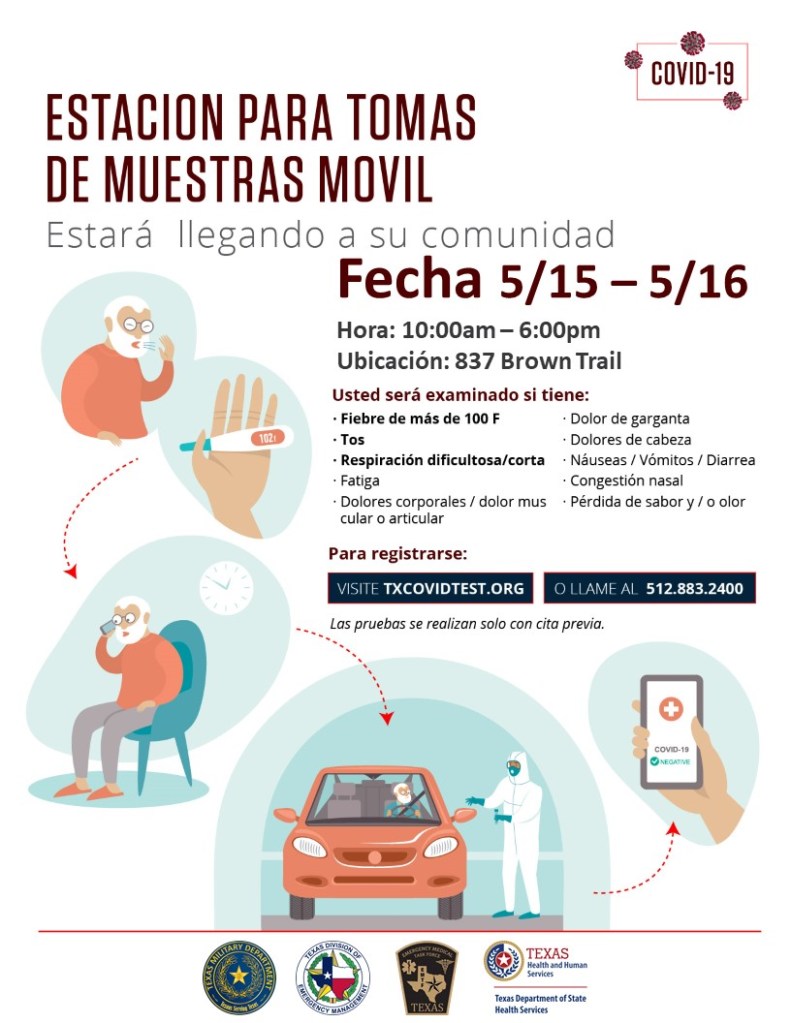
Versión en español a continuación.
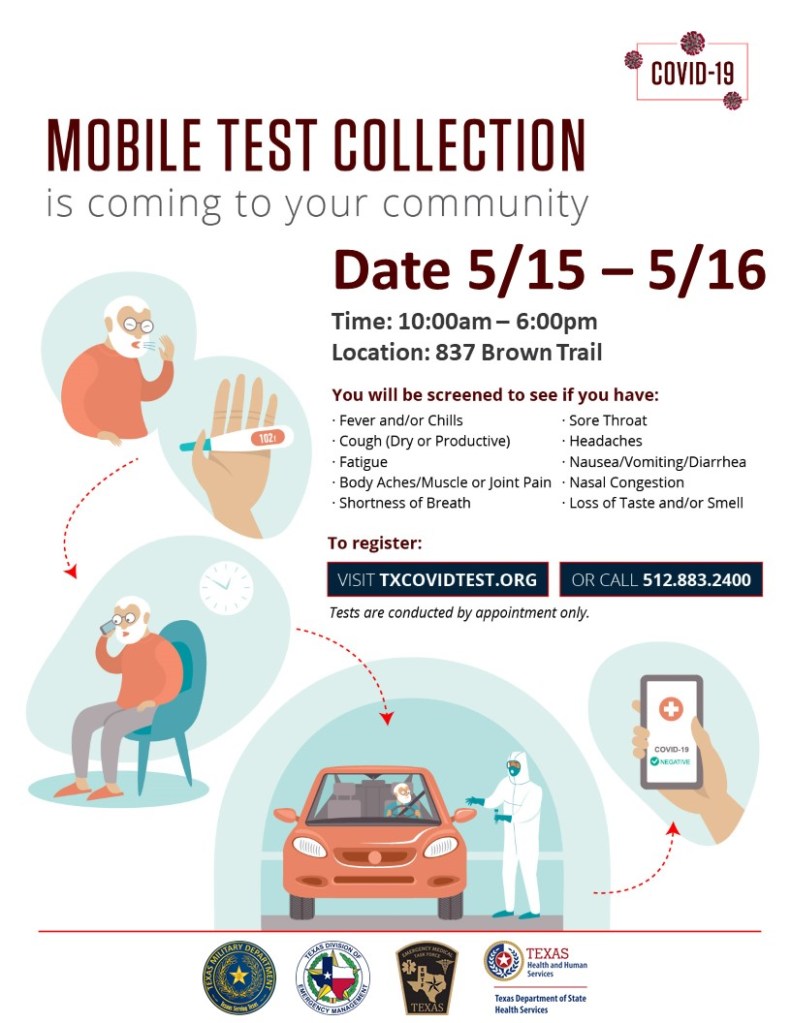
Mobile COVID-19 test collecting will be available in the community starting tomorrow. Registration is required for testing- see the below flyer for more information.
Versión en español a continuación.
Numbers of COVID-19 cases are still rising in many communities, so we must remain vigilant. The North Texas Medical Society Coalition encourages you to maintain safe physical distancing practices to protect yourself and those around you. In this short video, coalition member Jonathan Williams, MD, a physician practicing in Grayson County, talks the protective measures to take and why they are more important than ever.

The North Texas Medical Society Coalition (NTMSC) is calling for additional measures as statistics show a surge of COVID-19 cases in smaller counties. Large counties, such as Dallas and Tarrant, are continuing to struggle with high numbers of COVID-19 patients, but their cases have been effectively managed through existing hospital systems. As the number of cases have increased, the growth has spread into smaller surrounding counties–areas that do not have the support of multiple hospital systems.
“Why should a doctor in Fort Worth care about the number of COVID-19 patients in Sherman? We have a highly mobile population in North Texas, making us more vulnerable to a rapid spread of the Coronavirus. This has already spread across the globe and it’s only 90 miles from Sherman to Fort Worth,” states Fort Worth physician, Robert Rogers, MD.
Over the last two weeks COVID-19 cases have more than doubled in daily hospital care of presumptive COVID-19 cases in Grayson County alone. As North Texas counties slowly start to reopen, revised projections reflect rising cases doubling more than rates of recoveries.
| North Texas Infection Rate Statistics | ||
| County | May 5, 2020 | May 12, 2020 |
| Collin | 804 | 939 |
| Fannin | 20 | 23 |
| Dallas | 4370 | 6123 |
| Denton | 806 | 946 |
| Grayson | 53 | 105 |
| Tarrant | 2624 | 3745 |
Ultimately, if rural hospitals become overwhelmed, patients will seek care in the larger counties. The pandemic outcome depends on a balance between physical distancing, adequate testing, and contact tracing.
“The power is with the people; everyone has to take ownership to protect themselves and others,” states Grayson County physician, Jonathan Williams, MD.
NTMSC wants to remind the community to continue practicing safe physical distancing measures. Even though businesses are beginning to re-open, remember that some areas are at the height of risk. Because many individuals are no longer staying home, safety measures are more critical than ever to suppress the curve to a degree that is manageable in North Texas.
About North Texas Medical Society Coalition:
The NTMSC represents more than 11,500 physicians in the communities of Collin-Fannin, Dallas, Denton, Grayson, and Tarrant County. Founded in 2020, the NTMSC works with community healthcare partners, including public health departments, hospitals, and business leaders, to advise on medical recommendations to serve the health care needs of the residents of North Texas.
COVID-19 Positive cases: 4076*
COVID-19 related deaths: 114
Recovered COVID-19 cases: 821
Data from Tarrant County Public Heath’s (TCPH) report of COVID-19 activity in Tarrant County, updated Wednesday, May 13, 2020. Find more COVID-19 information from TCPH here.
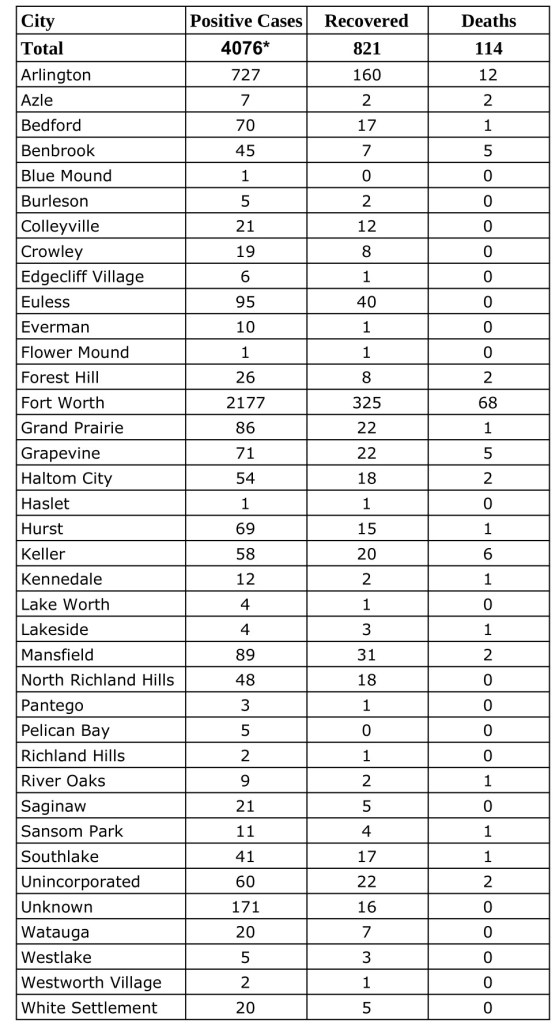
* These data are provisional and are subject to change at any time.
Deaths and recovered cases are included in total COVID-19 positive cases.
Thursday, May 14, at 11am, Tarrant County Public Health is hosting a COVID-19 Tele-Town Hall with updates and resources for senior citizens. If you are a senior citizen and/or caring for a senior, you don’t want to miss hearing from these community experts on the work being done in Tarrant County. You can join by calling 817-541-7163 at 11am.
The guests will be:
There will also be an update from Dr. Venny Taneja, Director of Tarrant County Public Health
Thursday, May 14, 2020
11:00am – 12:00pm
Dial 817-541-7163 to join If you have a question please email commissionerprecinct2@tarrantcounty.com with the subject line, “Senior Citizen Tele-Town Hall Question” or reply to this email.

The President’s Paragraph from the May/June 2020 issue of the Tarrant County Physician.
by Tilden L. Childs III, MD, TCMS President
At the beginning of this year, I was asked by several people what my goals were for the Tarrant County Medical Society during my presidency. What projects was I planning to work on? At the time, I half-jokingly responded that I did not really have anything particular in mind (although I did), but that I was sure something would come along. Well, as we all know now, something big and important and scary came along: COVID-19, the disease caused by the novel coronavirus now known as SARS-COV-2. The disease has caused an unprecedented disruption in the world. This was succinctly documented by The Economist magazine with a cover illustration of the world labeled with a “Closed” sign. As this is a rapidly evolving medical crisis with drastic implications for all walks of life and for our future, anything specific that I share with you at the time of writing this article may likely be out of date at the time of publication. However, here are some of my thoughts today.
First of all, I would like to share with you my unwavering appreciation and my awe at the overwhelming response of our medical communities at the local, county, state, and national levels. At the local and county levels, the TCMS leadership is working with and coordinating with the Tarrant County Public Health Department and with our city and county representatives and governmental agencies through our representation by Dr. Veer Vithalani, Acting Medical Director of Medstar EMS. The Tarrant Medical Operations Center (TMOC) has been activated by Dr. Vithalani to help coordinate the medical response in the community. We are also working with the local healthcare systems through our TCMS COVID-19 Task Force. TCMS is helping to facilitate the transfer of information to our local physicians as well as to provide a valuable resource to the media and the public. Additional TCMS projects include assembling a list of medical volunteers, helping to recruit and distribute personal protection equipment (PPE) obtained from community and public resources to local physicians’ offices, and monitoring the availability and progress of COVID-19 testing in Tarrant County.
Also, TCMS is working with the Dallas County Medical Society to review the recommendations previously developed in the North Texas Mass Critical Care Guidelines document. Additionally, TCMS is working closely and integrally with the Texas Medical Association (TMA). The TMA has marshaled many resources together, has implemented a COVID-19 Task Force, and conducts daily telephone conference calls through the TMA Incident Command Center. The TMA daily morning telephone calls have approximately 100 participants. The TMA gives excellent daily updates of all of the activities being performed by the TMA as well as working closely with the members on the various concerns that have arisen during the course of the medical response to COVID-19. The American Medical Association (AMA) has been working at the federal level as well. Of course, numerous resources are available online. TCMS provides information and updates on our blog. Additional information is available and is updated daily on the TMA and AMA websites.
“In times such as now, we all need courage- the courage to persevere, to serve, and to honor our commitment to our patients and our profession.“
What I have observed at this point in time is that containment has given way to mitigation, which has given way to suppression, with increasingly severe restrictions on our daily life. This includes “shelter in place” restrictions and the closing of non-essential businesses. Of course, the goal of all of this is to “flatten the curve” of new infections over time so as to try to keep from overwhelming the healthcare system. Current estimates predict a decline in the curve sometime in mid-April to early May, and this appears to be occurring!
Suppression strategies may work for a while, but what is the exit strategy? What will the “re-opening” of our society look like? Will it be relaxation of societal restrictions in conjunction with continued surveillance through extensive testing and contact tracing, new or improved treatments/medications, vaccinations, the eventual development of “herd immunity,” or what? The threat and severity of a “second wave” of infections following the relaxation of restrictions remains to be seen. Will COVID-19 become a seasonal disease? Will a vaccine be developed in time to prevent a recurrence of this crisis? This is doubtful, with current estimates of 1-5 years to develop a vaccine. Possibly the virus will become less virulent over time. Perhaps the “new normal” will represent a significant modification of our daily routines and practices as we learn to cope with this virus. Will tele-medicine/telehealth become entrenched in our practices? As always, time will tell.
For our healthcare system and particularly the members of the healthcare team, this has been and continues to be a time of great challenge and sacrifice. The uncertainty of the current situation and of the future is scary and anxiety provoking. We want clarity of the threat and the knowledge upon which we can trust and then to act accordingly to care for our patients and society as a whole. As this crisis has evolved, it has become painfully clear that expectations of a strong and swift federal government response were unfulfilled. However, I do believe this is not due to the lack of leadership by the medical profession at the highest levels of government.
The ongoing critical lack of PPE and the slow ramp up of testing has been incredibly stressful and indeed threatening, if not outright harmful, to the health and welfare of our medical personnel on the front lines. This in turn threatens our ability to provide the necessary care for future patients. The impending surge (at the time of this writing) also threatens our patients with a lack of ventilators for the ICUs. Fortunately, American ingenuity and a “can do” attitude is rising to the challenge.
In times such as now, we all need courage—the courage to persevere, to serve, and to honor our commitment to our patients and our profession. Although the winds and waves of the world are bashing against us, take heart. Have an anchor. Social distancing does not mean spiritual distancing. Be strong and keep the faith. I look forward to seeing you all, each and every one of you, again soon!
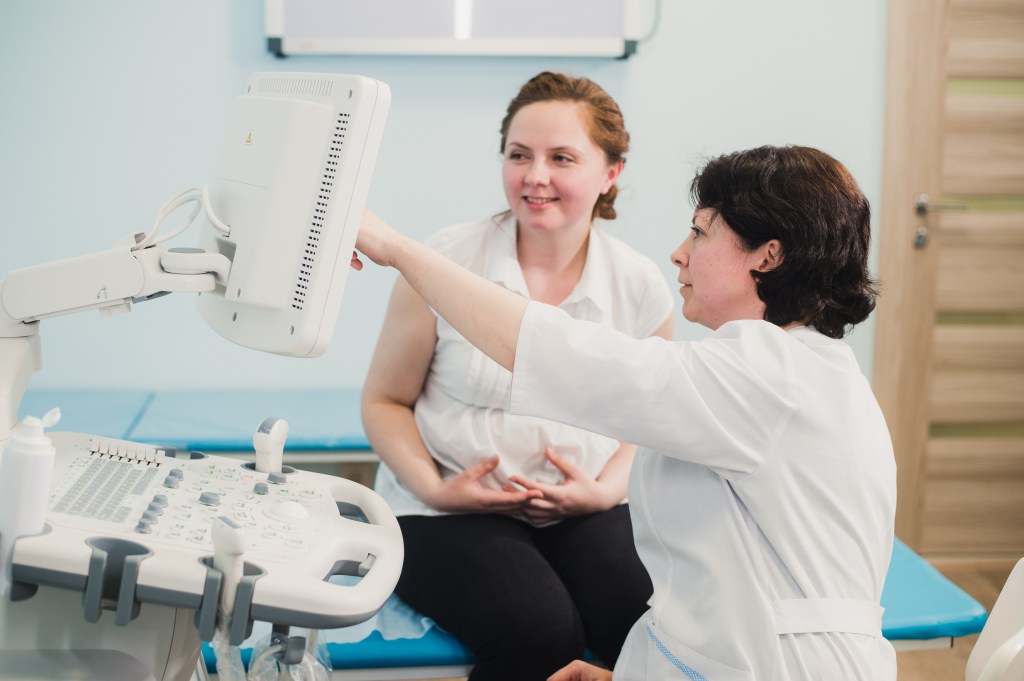
Pick up your phone at 7 pm (CT) Monday, May 18, for the Texas Medical Association’s next Tele-Town Hall meeting on COVID-19, specifically for Texas OB/Gyns. Hear from Texas physicians who will share COVID-19-related epidemiological trends, clinical best practices, and tips for improving your practice’s financial viability, including how to effectively use telemedicine and patient outreach.
Our tentative list of speakers includes:
There’s no need to RSVP or register for this event. TMA will call the home telephone number on file in your membership records. If you prefer we call a different number – or don’t call at all – please email that information to the TMA Knowledge Center by 5 pm (CT), Thursday, May 14.
TMA designates this townhall for a maximum of 1 AMA PRA Category 1 Credit™.
During this interactive, hour-long event, you can ask questions of our panel. TMA President Diana Fite, MD, will host, and Eugene Toy, MD, chair of the American College of Obstetricians and Gynecologists District XI (Texas) will moderate the call.
Get the latest information about the coronavirus on the TMA COVID-19 Resource Center.
Created by the Texas Medical Association. Read their article about it here.
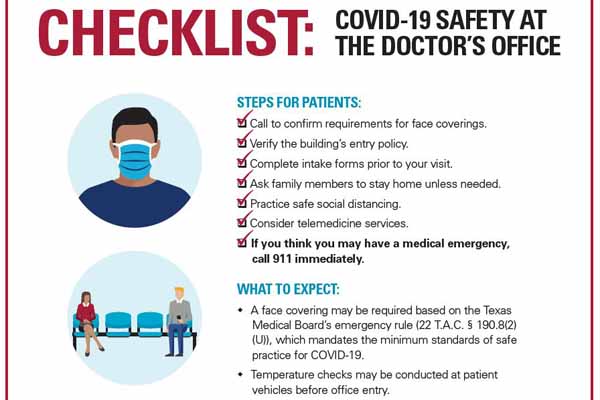
But patients coming to your practice – for COVID-19 care or other health issues – might not be aware of all you’ve done.
The Texas Medical Association is here to help.
TMA has created a digital poster you can share with patients before they arrive that outlines your COVID-19 safety precautions. The poster includes steps for patients, such as calling ahead to learn your practice’s facemask policy, completing intake forms before arriving, and asking family members to stay home. You can send it to patients before their appointments, post it on your website, and share it on your social media accounts.
The “COVID-19 Safety at the Doctor’s Office Checklist” also outlines some of the steps you might’ve taken, including checking patients’ temperature in their vehicle, and social distancing in the waiting room. Also, TMA soon will publish a version for you to download, print, and post in your office.
If you’re looking for more tips and resources to increase patient visits safely, TMA’s practice viability experts have organized the information you in need in one document: Road to Practice Recovery: A Guide for Reopening Your Practice Post-COVID-19.
In addition, TMA’s COVID-19 Resource page includes posters and tools to inform your patients and staff about staying safe, including a COVID-19 social media toolkit, and a minimum standards of safe practice notification required by the Texas Medical Board.
The resource page is updated frequently with new information and resources so check back often.
COVID-19 Positive cases: 3810*
COVID-19 related deaths: 109
Recovered COVID-19 cases: 809
Data from Tarrant County Public Heath’s (TCPH) report of COVID-19 activity in Tarrant County, updated Tuesday, May 12, 2020. Find more COVID-19 information from TCPH here.

* These data are provisional and are subject to change at any time.
Deaths and recovered cases are included in total COVID-19 positive cases.
The COVID-19 pandemic led to a public health emergency the damaged medical practice viability. Physicians are in the difficult position of having to navigate operational, financial, and clinical challenges while still staying up-to-date with compliance, payment, and coverage issues. These changes have had a significantly negative impact. According to TMA’s COVID-19 telephone town hall meeting in mid-April, 36 percent of poll respondents indicated that they have lost between half and three quarters of their revenue since the start of the pandemic. Another 24 percent have lost three-quarters to all of their
revenue.
As the COVID-19 curve flattens and trends downward, you can take decisive actions to restore your practice operations. TMA’s practice viability experts have organized the information you may need to successfully reopen
your practice in one resource: Road to Practice Recovery: A Guide for Reopening Your Practice Post-COVID-19. From evaluating staffing levels and managing patient appointments, to ensuring patient safety and communicating regularly with patients and staff, this guide will provide the information practices need to more confidently head in the right direction.
Refer to TMA’s COVID-19 Practice Viability web page for additional tools, resources, and frequently asked questions regarding operational challenges that affect your practice’s viability.
 Tarrant County Physician Online