TMA Statement on U.S. District Court Decision to Grant Its Summary Judgment Motion

Find the original statement here.

Statement by Diana L. Fite, MD, Texas Medical Association (TMA) immediate past president, in response to the U.S. District Court for the Eastern District of Texas’ ruling on TMA’s motion for summary judgment in its lawsuit opposing federal regulatory agencies’ unlawful approach to dispute resolution under the No Surprises Act.

“TMA is pleased that the court granted its motion for summary judgment in its lawsuit challenging the federal agencies’ unlawful approach to resolving disputes under the No Surprises Act. This decision is a major victory for patients and physicians. It also is a reminder that federal agencies must adopt regulations in accordance with the law.  

“This decision is an important step toward restoring the fair and balanced process that Congress enacted to resolve disputes between health insurers and physicians over appropriate out-of-network payment rates. The decision will promote patient access to quality care when they need it most and will guard against health insurer business practices that give patients fewer choices of affordable in-network physicians and threaten the sustainability of physician practices.”

TMA is the largest state medical society in the nation, representing more than 56,000 physician and medical student members. It is located in Austin and has 110 component county medical societies around the state. TMA’s key objective since 1853 is to improve the health of all Texans.

Court Hearing Approaches in TMA Surprise Billing Lawsuit

By Amy Lynn Sorrel

Published by the Texas Medical Association  on January 28, 2022. Read the original article here.

With a Feb. 4 court hearing on the horizon, the Texas Medical Association recently reiterated its strong opposition to a part of a federal rule that medicine says unfairly favors health insurers when directing arbiters to resolve payment disputes between insurers and physicians under the federal surprise billing law. 

TMA sued federal agencies to challenge a component of the No Surprises Act rule, under which arbiters conducting the payment dispute resolutions are required to default to the “qualifying payment amount” (QPA) as the appropriate out-of-network rate. TMA says the QPA is supposed to be the median in-network rate under the law but is deflated based upon the federal agencies’ methodology. The association’s lawsuit asks the court to strike this so-called “rebuttable presumption” provision of the rule in order to align it with the law, which directs arbiters to consider a range of relevant factors. 

TMA has asked the U.S. District Court in Tyler to decide its lawsuit as soon as possible without going to trial. The hearing on that motion for summary judgment is set for this Friday, Feb. 4.   

As federal agencies weigh in on the case in defense of their rule, a court brief filed by TMA on Jan. 24 reasserts that the regulation fails to implement the No Surprises Act the way Congress wrote it, and the consequences for patients include reduced access to care and health care consolidation. 

Congress spent years working on the No Surprises Act so it would not limit patients’ access to medical services, while protecting them from surprise medical bills, says TMA President E. Linda Villarreal, MD. 

“The last thing federal regulators should do is make health care more expensive and less accessible for people when they need it, especially during a pandemic,” she said. “The courts must reject the federal agencies’ flawed approach, because it goes against the public interest and our democratic process.” 

Dozens of national and state organizations share similar concerns and have supported TMA’s legal efforts or filed their own challenges to the rule. 

TMA’s filing also rejects the federal agencies’ claims that TMA does not have standing to pursue its case. 

TMA’s lawsuit does not delay or seek to change the No Surprises Act’s patient protections from surprise medical bills, which went into effect Jan. 1.

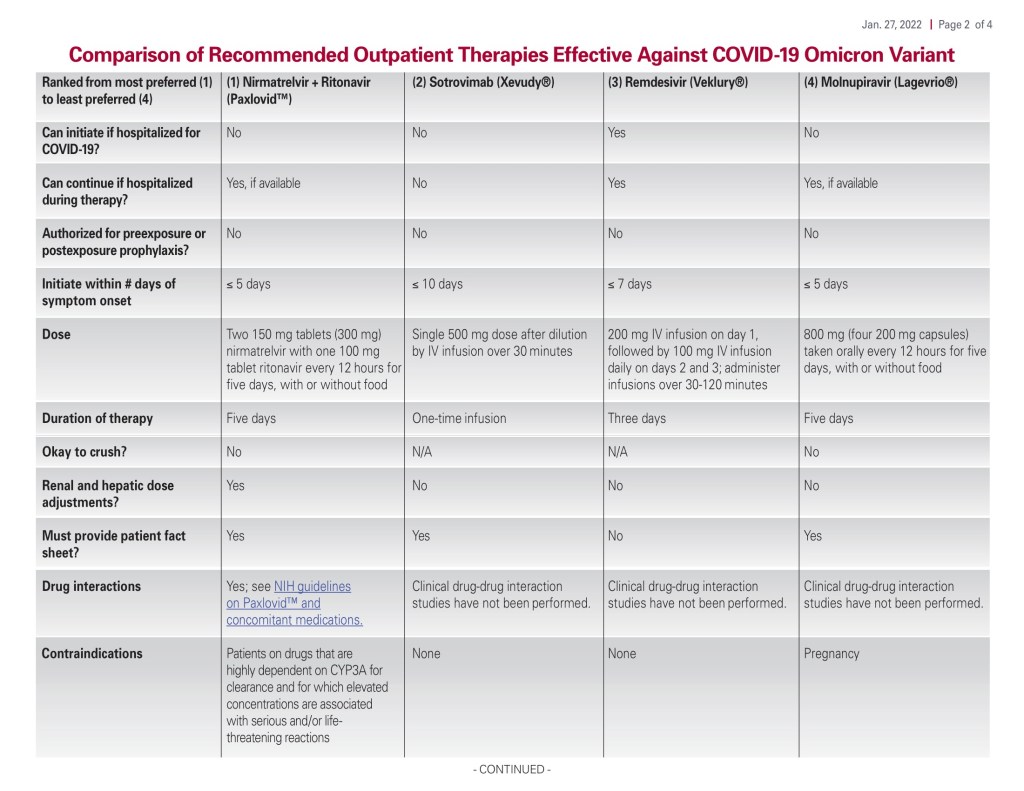
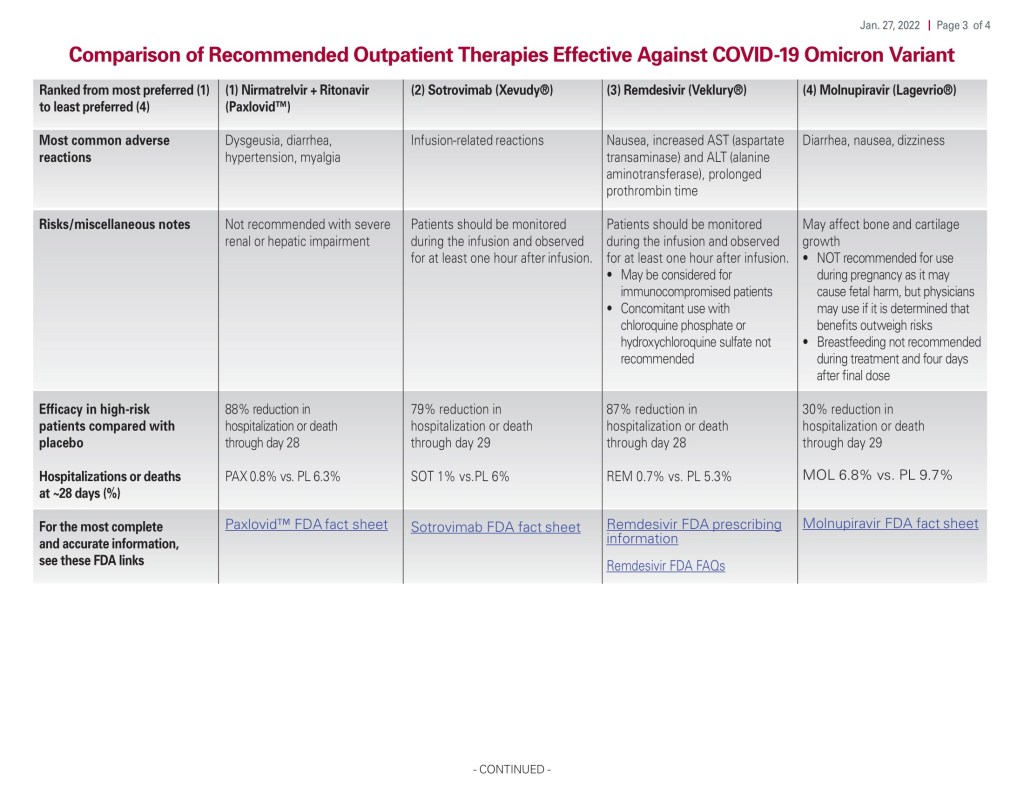
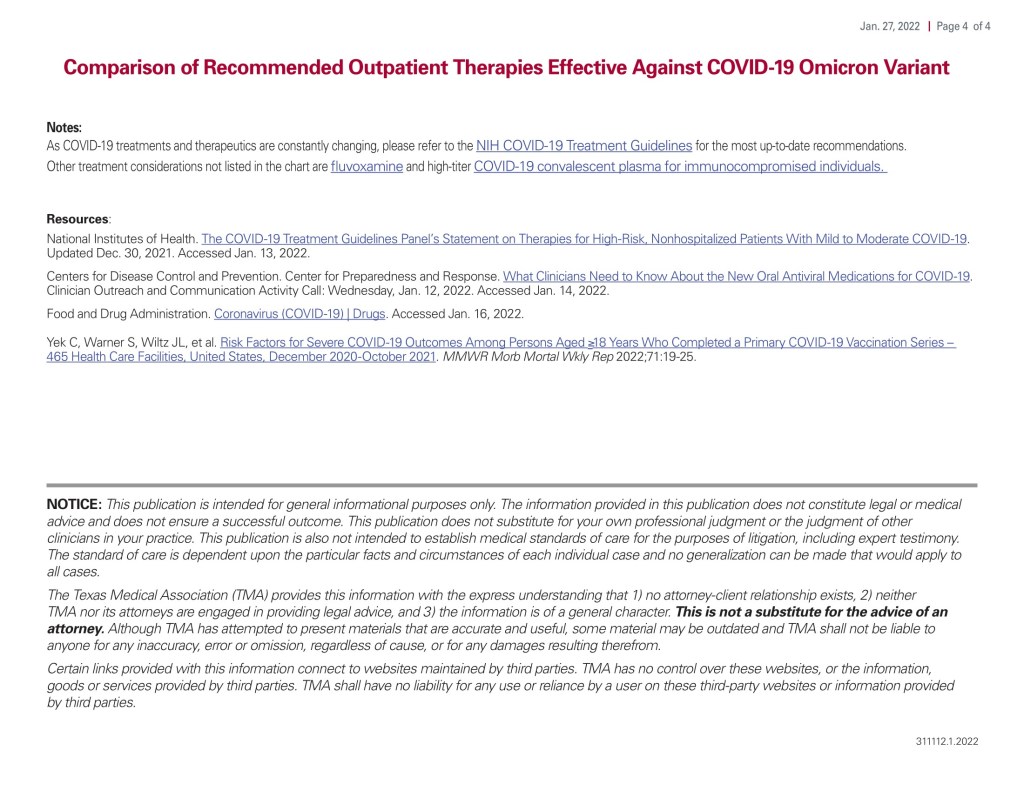
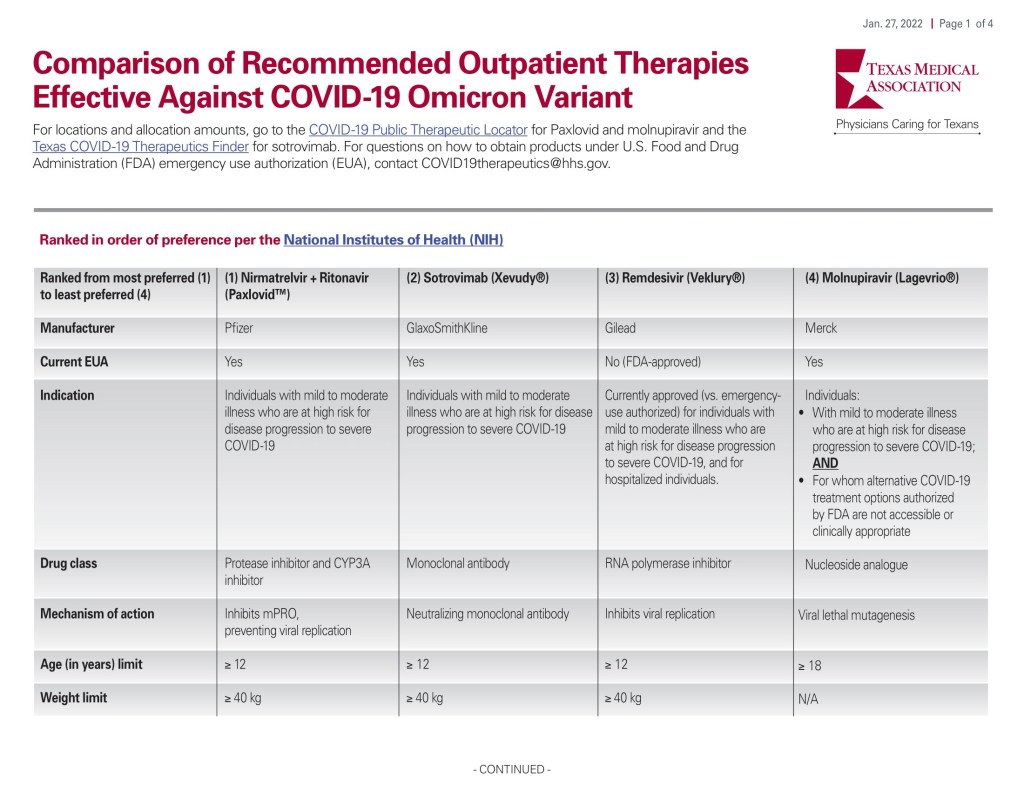
TMA Chart Compares COVID Outpatient Therapeutics – View Here

The chart includes dosages, situational considerations (such as whether the patient can continue on the drug if hospitalized during the therapy), contraindications, and more. Also included are links to fact sheets and locators for the treatments.

You can download the chart, and find much more information, on TMA’s COVID-19 Resource Center.

Help State Fight Antimicrobial Resistance: Apply to Regional Committees

multidrug_resistant_bacteria_2

Physicians all over Texas can apply for the chance to help stop the spread of multidrug-resistant organisms as part of an Antimicrobial Stewardship Regional Advisory Committee (ASRAC) for one of Texas’ public health regions.

The Texas Department of State Health Services (DSHS) is now accepting applications for new members of the regional advisory committees, established by the passage of a Texas Medical Association-supported law in 2019, House Bill 1848 by Rep. Stephanie Klick (R-Fort Worth). The committees will attempt “to address antimicrobial stewardship in long-term care facilities and to improve antimicrobial stewardship through collaborative action.”

TMA considers the establishment of the committees a valuable opportunity for members with relevant expertise to take a leadership role on the topic in their communities.

Each committee will consist of physicians, directors of nursing or an “equivalent consultant with long-term care facilities,” public health officials knowledgeable about antibiotic stewardship, and “other interested parties.” Members must attend regular committee meetings (virtual or in-person), which will be held at least once every 12 months, as well as subcommittee activities, if required. Members also may need to travel to designated locations within the public health region for those meetings and activities.

The deadline for applying is Feb. 15 at 5 pm CT. Applicants will need to list contact information of a reference who can speak to your interest in and/or involvement with collaborative action designed to improve antimicrobial stewardship. Submission of a letter of recommendation also is required.

For more information, visit the DSHS Antimicrobial Stewardship page or email the agency.

Travel expenses arising from attending ASRAC meetings or other activities will not be reimbursed.

PAC-ing a Punch for Medicine: Involvement in TEXPAC Lays Foundation for Legislative Victories

By Joey Berlin

Published by the Texas Medical Association  for the January 2022 issue of Texas Medicine. Read the original article here.

Well before he became an internist in Temple, Jimmy Widmer, MD, witnessed firsthand the significance of political activism as a high school student in 2003 when medicine-friendly lawmakers in the Texas Legislature passed House Bill 4 – the sweeping medical liability reforms that stopped the frivolous lawsuits, obscene liability premiums, and a physician exodus that were destroying the practice of medicine in the state. 

He has relatives in medicine, so Dr. Widmer’s parents knew what sham lawsuits and their ripple effects were doing to the state’s physician community, and they did their part to help. 

“We were the only house on the street with a ‘4’ sign,” Dr. Widmer recalled. “I remember that to this day.” 

Now that he’s at the helm of TEXPAC, the Texas Medical Association’s political arm, Dr. Widmer urges his TMA colleagues to join the effort to unify medicine’s voice in politics. 

TEXPAC leaders say victories like HB 4 happen because of grassroots, physician-driven efforts to elect friends of medicine to office. The same goes for more recent major victories like the new law that allows physicians to earn exemptions from insurers’ prior authorization requirements, or the overwhelmingly successful stands against nonphysicians’ attempts to practice medicine. 

TEXPAC helps generate those victories with a dogged, systematic evaluation of candidates who have the profession’s best interests at heart, endorsing and funding the ones who demonstrate their medical mettle. It’s the Party of Medicine, not of Democrats or Republicans; a candidate’s stances on TMA’s top issues, and the impressions of TEXPAC physicians in a candidate’s district, are what carry the most sway. 

Even in what he describes as a caustic modern political landscape, Dr. Widmer says staying on the sidelines isn’t an option, with medicine under attack from every direction. 

“No longer can we afford as physicians to have the mentality that, ‘I’m just gonna go to my office, practice, and [then] go home.’ There’s too much at stake,” he said. “There are too many people trying to do what we have gone to school and trained years to do. We have to stand up for that, and we have to get active and get involved.” 

Members’ role 

The annual financial contribution required of a TEXPAC member – while an important piece of the puzzle – is just one aspect of what the organization needs from its participants, says TEXPAC Executive Director Christine Mojezati. 

Physicians who join TEXPAC have the flexibility to make their membership as involved as they want or are able. That can just mean paying your dues, but TEXPAC asks its doctors to do more to fully help medicine’s cause. Some of the most important activities a TEXPAC member can engage in are: 

• Participating in your county medical society, including taking part in its legislative committee and/or candidate evaluation process. 

• Getting to know the legislators in your district or area, such as by visiting them in their local office, calling them for a conversation, or taking them to coffee or lunch. Doing so gives physicians a chance to relate stories about their practice and how certain policies are affecting their day-to-day life and their patients. 

• Responding to TMA Action Alerts, which mobilize members to contact lawmakers on particular issues or legislation of urgent importance. 

“Financial contributions not only gain us access but also give us a seat at the table,” Ms. Mojezati said. “But there’s nothing like the personal stories of a physician about how they cared for their patient, or why a certain bill or law would affect how they would care for their patient.” 

An entry point to getting acquainted with your local elected officials is participating in TMA’s monthly First Tuesdays at the Capitol lobbying events during regular sessions of the Texas Legislature, says Fort Worth allergist-immunologist Robert Rogers, MD, a past chair of TEXPAC. First Tuesdays – which went virtual in 2021 because of the COVID-19 pandemic – allows physicians face time with legislators, an avenue for cultivating the relationships that lead to receptive ears. 

“It is really meaningful for our elected representatives and senators to actually know us – to be able to recognize you by name when they see you in the Capitol or in their local office,” Dr. Rogers said. “That doesn’t mean we always get everything we want. But it’s much easier to have a discussion about issues with the people that you’ve already developed a relationship with.” 

Those conversations – and other vital TEXPAC activities – aren’t merely confined to the four-plus months when the legislature meets every odd-numbered year. In fact, much of the work comes during the interim period between sessions, when TEXPAC makes itself available as a resource both to legislators and to candidates running in even-numbered years. The interim, Ms. Mojezati explains, is when legislation is written, refined, and prefiled, and when there’s time for stakeholder meetings. 

“TEXPAC provides all the background information that any of us would need to be able to go in and discuss issues that are important” in conversations with lawmakers, Dr. Rogers added. “It’s really helpful to do that during the interim, because [lawmakers] have a lot more time to meet with us and discuss things.” 

Finding medicine’s friends 

If one impediment to joining TEXPAC is believing that your voice won’t be heard in an organization of thousands of members, think again.  

In evaluating candidates for an endorsement, TEXPAC’s focus is highly localized, says Sara Austin, MD, an Austin neurologist and chair of TEXPAC’s Candidate Evaluation Committee. That means when you provide input on whom medicine should support in your district, you and your community colleagues won’t be drowned out by thousands of others hundreds of miles away. 

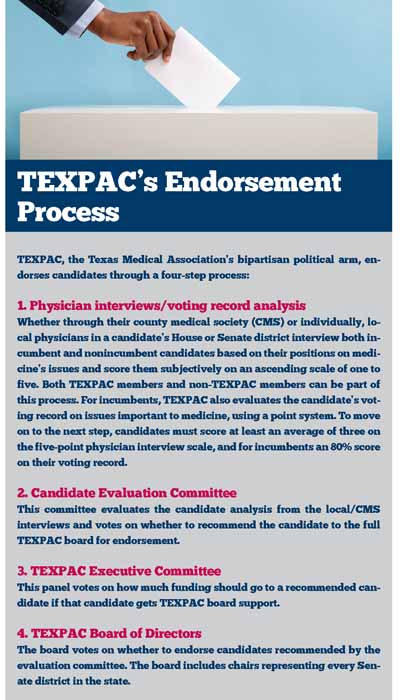
For incumbents running to keep their seat, eligibility for TEXPAC endorsement comes down to meeting two criteria: an objective analysis of their voting record and a subjective score based on the candidates’ meetings and interactions with local physicians, both TEXPAC members and nonmember physicians. (See “TEXPAC’s Endorsement Process,” this page.) 

Jan-Feb_22_TM_Cover_Texpac_Sidebar

TEXPAC evaluates candidates on a point system based on how they voted on key bills most important to medicine’s agenda: Voting with medicine on a particular bill is worth one point; not doing so is worth zero. Candidates lose points if they filed or signed onto an antimedicine measure, such as a bill that would dangerously expand other practitioners’ scope of practice or seeking to raise the medical liability damages cap. An 80% score on that point system allows for a possible endorsement. 

The subjective portion consists of physicians – with the help of detailed TEXPAC candidate briefing documents – interacting with candidates and grading them on a scale of one to five, the higher the better. Averaging a score of three is required for consideration for an endorsement. 

The “80 and three” rule is a weed-out process for incumbents. Candidates who pass both of those tests and earn local physicians’ recommendation for an endorsement must then pass muster with the Candidate Evaluation Committee, which sends its recommendations to the full TEXPAC board for approval. 

For new candidates with no voting record to evaluate, the interviews and interactions with local physicians and county medical societies largely determine which aspiring officeholders make it to the Candidate Evaluation Committee. Incumbents also need to prove they’re willing to sit down and listen to their district’s doctors. 

“There are some incumbents who never vote with the House of Medicine, so we definitely don’t endorse those people,” Dr. Austin said. “[We also] try to find out from the local physicians if that [legislator] was available or accessible [to meet]. That’s important.” 

For state Sen. Charles Schwertner, MD (R-Georgetown), TEXPAC was “instrumental in helping me understand the lay of the land” when he first ran for a House of Representatives seat in 2010 as a “very green” candidate. TEXPAC also was instrumental in helping him obtain early financing and in fundraising efforts. He launched his run with local support from the Williamson County Medical Society. 

“That’s what TEXPAC is all about: making sure that the individuals that are friends of medicine have the amount of resources necessary to get their campaign message out, and then hopefully win election and be able to serve,” Senator Schwertner said. 

TEXPAC endorsements also involve a degree of pragmatism, Dr. Rogers adds. In addition to a candidate’s promedicine stance, the Party of Medicine considers his or her likelihood to win.  

“We have a couple of major objectives in the candidate process. One is to try to help elect people that are naturally inclined to support what we do, if there’s a competitive race,” he said. “We also know that there are a lot of races that are not competitive at all, and who’s going to get elected is very clear. And we need to have influence with people that are actually going to be in the building making decisions. That means that we might endorse the candidate that isn’t apparently very helpful to TMA, but that really could be helpful on a specific issue.” 

Sometimes, Dr. Rogers added, one helpful vote on one specific bill “can happen from somebody that isn’t a natural friend.” 

If you’re a TEXPAC member whose candidate did not earn endorsement, the organization’s Physicians For program offers another way to support your preferred candidate by connecting TEXPAC doctors with other physicians in their House or Senate district to rally around their preferred candidate. 

The program “has proven to be very successful,” said Ms. Mojezati, TEXPAC’s executive director. “Not only has it helped candidates be victorious in races but it also helps because [in] any situation where TEXPAC either did not endorse them or didn’t make any endorsement, we now have physician relationships with that candidate. We never want to not have friends in the Capitol.” 

TEXPAC has maintained success rates of 95% or greater with its endorsements during recent election cycles. For instance, during the 2020 state primary elections and a handful of ensuing runoffs – which usually involve most of Texas’ most competitive races – TEXPAC made more than 130 endorsements, and 98% of those candidates won and moved on to the general election. In the November 2020 general election, 97% of TEXPAC-endorsed candidates won their sought office.

Overcoming apathy 

TEXPAC acknowledges physicians’ reluctance to get involved in politics: “It’s a highly charged arena right now,” notes Dr. Widmer, TEXPAC’s chair.  

And there’s a level of apathy, Dr. Rogers adds; physicians just want to do their jobs. 

But much progress has happened on TEXPAC’s watch, from tort reform in 2003 to the 2021 legislation allowing physicians to earn a “gold card” out of the prior authorization process.  

Back during the days of tort reform, long before jumping into politics, Senator Schwertner was a young physician taking part in the first-ever First Tuesdays in 2003. HB 4’s success that year was the product of a unified approach between physicians and business interests, and that unity and having “as many allies to the House of Medicine” as possible are key to legislative success, he said.  

More recently, he noted, TEXPAC has been vital in bolstering TMA’s fight against scope-of-practice bills and “the onerous profitmaking and tactics of insurance companies,” such as narrow networks. 

“Medicine is a highly regulated, government-controlled, and actually government-funded profession. As such, it is vital to those individuals from just a … professional standpoint to be involved,” Senator Schwertner said. “If you’re not being an active participant, and voting and helping choose candidates … that share your ideals, then someone else is doing it for you. And you’re going to live under the laws that those other individuals pass.” 

Casting aside the repulsion of modern red-versus-blue politics – and doing what’s best for patients and the practice of medicine – is important to medicine’s success, Dr. Widmer adds. 

“If we keep that as the focus of what we’re doing with TEXPAC, then we will be stronger for it. We will have a more cohesive, hopefully larger body, and we’ll be able to make a bigger impact.” 
Join TMA’s Virtual Winter Conference on Jan. 28 & 29

Register to participate in the 2022 TMA Winter Conference with your physician colleagues on January 28 and 29. The conference has transitioned to a fully virtual event due to the surge of COVID-19 cases.

Virtual Conference Schedule


Friday, Jan. 28

TMA virtual business meetings take place throughout the day; you can find the complete schedule here. There are no in-person events scheduled.

  • On-demand, inside the virtual platform:
    • TMA Foundation Grants and Donor Recognition – videos
    • Vaccines Defend What Matters – public health initiative
    • Turn It Off Today – public health initiative
  • Expo Hall Hours – 11am – 2pm
    Virtual exhibits and one-on-one appointments with exhibitors are available.
    • 11am – Noon – “Hidden Icon Search” game; winner will recieve a 1-year subscription to the Headspace App.


Saturday, Jan. 29

TMA virtual business meetings continue; you can find the complete schedule here. CME sessions are available via livestream.

  • Live stream, inside the virtual platform: 
    • 9-9:10 am – Opening Remarks
      E. Linda Villarreal, MD, President, TMA
    • 9:10-9:30 am – AMA Awards Recognition
    • 9:30-10:15 am – COVID-19 Update with DSHS (CME)
    • 10:15-11 am – Ask the Expert: Employee Vaccinations (CME)
      Sheri Williams, TMA and Laura Goodson, JD
    • 11 am-Noon – Extra Life: A Short History of Living Longer
  • Expo Hall Hours – 8am – 1pm
    Virtual exhibits and one-on-one appointments with exhibitors are available.
    • 8am – 1pm – “Word Scramble” game; prizes will be awarded to winners.

So-Called “Mild” Omicron Still a Serious Threat, Physicians Warn

By Brent Annear

Published by the Texas Medical Association on January 14, 2022. Read the original article here.

As the massive spike of COVID-19 cases continues, the degree of infectiousness and lack of the best and most available treatment worries Texas Medical Association leaders about what the next few weeks will bring. They say important medical advice bears repeating with patients

The omicron variant’s illness has been described by some people as “less severe,” but physicians urge their colleagues to help patients keep their guard up. In addition to making people sick enough to miss several days of work and school, the virus remains a serious threat to people at high risk for severe illness. Some physician practices have had to close due to COVID-19-related staff shortages or have gone to 100% telehealth visits.

“This illness may seem mild to some, but right now we don’t have enough effective treatment if too many high-risk patients get sick all at the same time,” said John Carlo, MD, a TMA COVID-19 Task Force member.

So far, only a single monoclonal antibody treatment (sotrovimab) is effective against the omicron variant. Supplies are extremely limited.

“On top of this, the omicron variant is incredibly infectious, even more so than previous variants,” Dr. Carlo added.

The Texas Department of State Health Services has reported more than half a million cases since Jan. 1.

“The good news is we know how to protect ourselves,” Dr. Carlo said. “Vaccination with a booster, diligent and effective mask-wearing, and avoiding poorly ventilated indoor settings are effective.”

Physicians also worry about Texas hospital beds filling up too quickly, as area hospitals already face staffing shortages due to sick workers. “We want to make sure we have the space for every patient who needs care,” Dr. Carlo said.

TMA’s COVID-19 Task Force recommends reiterating to patients the following protective measures:

  • Get vaccinated against COVID-19: Get the booster shot as soon as eligible, too.
  • If you must leave your home: Physically distance yourself, wash your hands frequently, and wear your mask anytime you need to be near someone when outside your home. Wear the best mask you can get: N95 masks are best, followed by KN95 masks, then surgical masks, then multi-ply cloth masks that fit snugly around your face. Wear masks if you can’t socially distance, even if outside, and even if everyone attending is vaccinated and boosted.
  • If you must gather with others from outside your home: Choose an outdoor or well-ventilated space.
  • If exposed to someone who has tested positive for COVID-19 (you were within 6 feet of him or her for at least 15 minutes in 24 hours): Quarantine away from others for at least five days and get tested after five days even if you do not develop symptoms. 
    • Watch for symptoms. If you have no symptoms after five days, wear a well-fitted mask for the next five days anytime you’re near anyone and avoid being around people who are at high risk.
    • If fully vaccinated or you have had a confirmed case of COVID-19 within the past 90 days, it is not necessary to quarantine, but you still should wear a well-fitted mask when around others for 10 days and get tested after five days even if symptoms do not develop. 
  • If you test positive for COVID-19 or have mild symptoms, regardless of vaccination status: Isolate for at least five days and until you are fever-free and your symptoms improve (stay away from other people, including people in your own household). (This applies to mild-symptom or zero-symptom cases.) After five days’ isolation, wear a well-fitted mask for five more days whenever you’re around others, avoid travel, and avoid being around those who are at high risk.
  • If you have severe symptoms: Isolate for at least 10 days and consult your doctor before ending your isolation. If you develop any serious symptoms, such as trouble breathing, seek emergency medical care immediately. 

“This current wave is spreading faster than ever before, and the only way to slow this down is for everyone – not just some people, but everyone – to be vigilant,” said Dr. Carlo.

From the Archives

Physician Frustrations: Who will be our future?

By Shanna Combs, MD

This piece was originally published by TMA on Blogged Arteries, a forum for physician opinion and commentary, on February 28, 2018.

shannacombs

I spoke with a young woman recently who is working on her application to medical school. She had the same excitement and nervousness regarding the application process that I had when I began my journey into medicine. Unfortunately, I was disheartened to find out that she had spoken to many physicians who had tried to talk her out of going to medical school and pursuing her dream of becoming a physician. 

I chuckled with her saying I had experienced the same thing. Unfortunately, she was even starting to question her desire to be a physician.

What happened to our field? Why are those of us in practice frequently found telling prospective students not to join our path and seek another one with better pay, better work-life balance, and more appreciation? 

Are there frustrations with the health care system, insurance, and electronic health records? Yes. 

Do we work long hours with minimal acknowledgment of our dedication? Yes. 

Do our years of study and practice get dismissed for the more vaunted Dr. Google? Yes. 

Do we sometimes forget why we even became a doctor? Yes. 

Do we also have the privilege to help patients through some of the most exciting as well as difficult times in their lives? Yes.

I find it an honor to be a physician. Do I deal with all the above concerns mentioned? Yes. 

What happened to our field? Why are those of us in practice frequently found telling prospective students not to join our path and seek another one with better pay, better work-life balance, and more appreciation? 

However, when a patient says thank you for my support during a difficult diagnosis, or I see the tears of joy on the face of a new mom as I hand her her baby for the first time, I remember why I became a doctor.

You can read the full article here.

Shanna Combs, MD, is an obstetrician/gynecologist practicing in Fort Worth. Currently, she is serving as the 2022 president of the Tarrant County Medical Society.

TMA Sues Feds Over Unfair Rule for Surprise Billing Law

Rule ignores statutory text and congressional intent, shrinks access to care for patients

The Texas Medical Association (TMA) filed a lawsuit in federal district court in Tyler, Texas, after the Biden administration failed to follow clear direction from Congress about how to implement the dispute resolution process set forth in the No SurprisesAct, legislation that was passed in 2020 to protect patients from surprise medical bills.

“TMA supports the patient protection intent of the No Surprises Act,” TMA President E. Linda Villarreal, MD, said. “However, TMA’s lawsuit challenges one component of the administration’s rule that ignores congressional intent and unfairly gives health plans the upper hand in establishing payment rates when a patient receives care from an out-of-network physician, oftentimes in an emergency.”

Congress intended to create a fair and unbiased process to resolve billing disputes between health insurance companies and physicians by ensuring that all relevant factors must be considered, with each given the weight deemed appropriate by the arbitrator. In contrast, the administration’s short-sighted approach will make it harder for patients to access care by driving down reimbursement rates and encouraging insurance companies to continue narrowing their networks. It will be difficult for small physician groups to keep caring for patients.

“The lawsuit filed yesterday ensures that the protections for patients against balance bills will go into effect on Jan. 1, 2022, while seeking to stop the imminent harm to physicians and hospitals created by an unfair arbitration process,” Dr. Villarreal said.

The recently released rule rewrites the statute by requiring the arbitrator in the independent dispute resolution process to presume that the qualifying payment amount (QPA), set by health insurance companies for patient cost-sharing purposes, is “the appropriate out-of-network rate.” This creates a bias that prioritizes offers closest to the QPA, rather than allowing arbitrators to exercise their discretion to weigh all relevant factors and select the reimbursement rate that most accurately reflects fair market reimbursement and individual circumstances.

The TMA lawsuit asks the court to strike this section of the rule and instead restore the fair, balanced dispute resolution process that Congress created. The lawsuit also alleges a violation of the Administrative Procedure Act, which requires a formal notice and comment period in advance of finalizing such a rule. The agencies failed to solicit and incorporate comments from stakeholders for this crucial aspect of the law.

“We wholeheartedly agree with U.S. Reps. Richard Neal’s (D-Mass.) and Kevin Brady’s (R-Texas) concern that the rule tips the scale in favor of insurance companies and will leave patients vulnerable,” Dr. Villarreal said. Representative Neal is chair of the U.S. House Ways and Means Committee, and Representative Brady is the past chair of the committee and currently ranking Republican member.

“We are disappointed the Biden administration ignored congressional intent and essentially set up the arbitration system to operate like a casino, with health insurers playing the role of the house,” Dr. Villarreal said. “Everyone knows the house always wins. With the current rule, patients, physicians, and our country lose.”

TMA is the largest state medical society in the nation, representing more than 55,000 physician and medical student members. It is located in Austin and has 110 component county medical societies around the state. TMA’s key objective since 1853 is to improve the health of all Texans.

TMA Urges Governor to Allow Local Mask, Vaccination Decisions

A Message from the TMA President

As physicians across the state toil against the third wave of the COVID-19 pandemic, Texas Medical Association leaders met with Gov. Greg Abbott’s office [on August 20] to ask for greater flexibility at the local level to respond to and slow the surge and its emotional and physical impacts on you and the health care system. 

As this latest wave has shown, we are seeing many more patients who are younger and sicker requiring hospitalization and intensive care, the vast majority of whom are unvaccinated. This is particularly concerning for kids under the age of 12 who do not yet have access to a vaccine. 

Because all disasters are local – and because so many of you have reached out to us – the TMA Board of Trustees, in an emergency meeting last Sunday, unanimously decided we needed to take action to reach out to the governor. 

On Friday, I led a meeting with the governor’s chief of staff, Luis Saenz, and deputy chief of staff Garland Pate. Joining me in the virtual meeting were TMA President-Elect Gary Floyd, MD; TMA Board of Trustees Chair Richard W. Snyder II, MD; TMA Board of Trustees Vice Chair G. Ray Callas, MD; and TMA Executive Vice President and CEO Michael J. Darrouzet. 

Our request to the governor on behalf of the TMA Board of Trustees: Please allow all institutions – including schools, school districts, hospitals, health care facilities, medical schools, and medical centers, regardless of funding source – to make local, independent decisions regarding vaccinations and the use of masks, preferably in consultation with physicians in those communities, and always using evidence-based data to inform their decisions. 

The lengthy discussion underscored the need for physicians and state leadership to continue educating Texans about the importance of getting vaccinated against COVID-19 and to address vaccine hesitancy. 

TMA understands and appreciates all you are doing during this difficult time to address the needs of your communities and your patients. We are taking steps to ensure your viability, resiliency, and knowledge of the current crisis. 

Please continue to share your stories, issues, and concerns. And we will always be keeping you abreast of the association’s advocacy activities in Texas Medicine Today and through the COVID-19 Resource Center.


Sincerely,

E. Linda Villarreal, MD
President
Texas Medical Association

Design a site like this with WordPress.com
Get started