Public Health Notes

Health Equity Through a Public Health Lens

by Catherine Colquitt, MD, Tarrant County Public Health Medical Director, and Yvette M. Windgate, ED.D.

This article was originally published in the March/April issue of the Tarrant County Physician.

As we turn the page on 2022 and our “tripledemic” surge recedes, let’s take a moment to reflect on health equity and disparities through the crucible of COVID-19.

Healthy People 2030 defines health disparities as “a particular type of health difference closely linked to social economic, and/or environmental disadvantage.” It further asserts that health disparities “adversely affect groups of people who have systematically experienced greater obstacles to health based on their racial or ethnic group, religion, socioeconomic status, gender, age, mental health, cognitive, sensory, physical disability, sexual orientation or gender identity, geographic location, or other characteristics historically linked to discrimination or exclusion.”1 Our collective goal is health equity, described by Healthy People 2030 as “the attainment of the highest level of health for all people.” Achieving health equity requires valuing everyone equally, with focused and ongoing societal efforts to address avoidable inequalities, historical and contemporary injustices, and the elimination of health and health care disparities.”1

In the early 2000s, U.S. Surgeons General began to issue reports on disparities in tobacco use and access to mental health care based on racial and ethnic demographics. Since those ground-breaking reports, issues including infant mortality, pregnancy-related seats, chronic disease prevalence, and overall measures of physical and mental health have been examined through the prism of health equity. Part of the impetus of the Affordable Care Act (ACA) was to provide strategies for securing access to healthcare for traditionally underserved groups. Impactful gains were made in numbers of persons insured and access to higher quality care. However, those gains were somewhat eroded in the former presidential administration by cuts to funding for AVA navigators and outreach efforts, and the authorization of state waivers, which allowed some states to decline Medicaid expansion by instead offering their own wavers.

COVID-19 further impacted healthcare coverage losses through lost jobs and wages, resulting in increasing economic hardships, housing difficulty, and food insecurity, disproportionately affecting Black and Hispanic workers, especially those in essential in-person jobs (i.e., transportation, manufacturing, grocery, pharmacy, retail, warehouse, food processing, and healthcare). Due to healthcare workforce shortages and operational changes (e.g., video clinic visits requiring patients to have internet access), these same groups also experienced challenges to healthcare access.

During COVID-19, certain groups (i.e., Alaskan Native, American Indian, Black, and Hispanic individuals) experienced higher death and illness rates than their White or Asian counterparts, likely due in part to their work in essential jobs, higher prevalence of preexisting comorbidities for poor COVID-19 outcomes, use of public transportation, and crowding at work or home.

Additionally, according to the Kaiser Family Foundation’s survey data (The Undefeated), Black adults are more likely than White adults to report certain negative healthcare experiences, such as a provider not believing them, or refusing a test, treatment, or pain medicine the patient believed he or she needed. the Undefeated survey data revealed that Black and Hispanic individuals were less likely to have been vaccinated against COVID-19 as of April 2021. While vaccination rates against COVID-19 have risen on all ground, the gaps between White, Asian, Black, and Hispanic demographic groups have not narrowed. The effect of the health disparities laid bare by COVID-19 has been profound and predated the pandemic. For example, in 2018, the average life expectancy was four years lower in Black individuals than in White individuals, with the lowest life expectancy in Black men. That unfortunate trend continues today. In Tarrant County, the 76109 zip code in Fort Worth, a majority White neighborhood, holds a life expectancy of 82.4 years. Nearby 76104, host to historically Black neighborhoods, like Morningside, has a life expectancy of 66.7, and it is even lower for Black men at 64 years.

What can we do to address these disparities and improve the health of our county and county? The Biden administration has prioritized initiatives aimed at addressing health disparities at the federal level through several executive orders and proclamations. Locally, Tarrant county Public Health (TCPH) has created a Community Health Equity and Inclusion (CHEI) division to promote health literacy and address health equity issues concerning county residents, with the greater goal of decreasing health disparities and inequities in Tarrant County. The CHEI division educates residents and public health professionals regarding health disparity and inequity issues and engages community partners (i.e., Fatherhood Coalition of Tarrant County, Mental Health Connection of Tarrant County, My Health My Resources of Tarrant County, United Way of Tarrant County, and Brave/R Together) to find solutions that promote diversity and health equity.

TCPH continues to collaborate with community partners on annual events, such as the African American Health Expo, the North Texas Wellness Fair, and the Senior Synergy Expo. We are also participating in community celebrations, school events, and COVID-19 testing and vaccination pop-up clinics. Recently, TCPH and fifty-sic agencies- including hospital systems, institutions of higher education, city and county governmental entities, charitable organizations, and faith-based organizations- have joined forces as the Tarrant County Unity Council. This council’s purposes are:

  • To identify and address health equity challenges for those disproportionately affected.
  • To build, leverage, and expand fair resource allocation to safe, affordable, and accessible health, housing, transportation, and communication that advance racial equity and address other inequitable social conditions, with the purpose of reducing or eliminating health disparities and health inequities.

References:

  1. Health Equity in Healthy People 2030, https://health.gov/healthypeople/priority-areas/health-equity-healthy-people-2030
  2. L Hamel et al, Kaiser Family Foundation: Key Findings from the KFF/Undefeated Survey on Race and Health 10/2020
  3. Life Expectancy by ZIP code in Texas, https://www.texashealthmaps.com/lfex
  4. Tarrant County Public Health, Family Health Services, Community Health Equity and Inclusion, Community Involvement, https://www.tarrantcounty.com/en/public-health/family-health-services/health-equity–community-outreach/previoud-activities.html?linklocation=Button%20List&linkname=Community%20Involvement
  5. Tarrant County Unity Council, https://www.tarrantcounty.com/en/public-health/family-health-services/health-equity–community-ooutreach/tarrant-county-unity-council.html

DEA Proposed Rules Address Telehealth Prescribing Post PHE

by Sean Price

Originally published by Texas Medical Association on March 8, 2023.

Physicians found new flexibility in prescribing controlled substances via telemedicine during the COVID-19 pandemic.

Now that the public health emergency is ending, the Drug Enforcement Administration (DEA) has proposed new rules for prescribers it says could preserve some of those flexibilities “with appropriate safeguards.”

Among other things, the new rules – if finalized – would allow physicians and health care professionals to prescribe, without a face-to-face visit, a 30-day supply of Schedule III and Schedule IV non-narcotic controlled drugs, after which an in-person follow-up would be needed for any refill. This class of drugs is the least likely to result in drug abuse, according to DEA. The proposal also would allow for prescribing a 30-day supply of buprenorphine to treat opioid use disorder without an in-person evaluation or referral.

“Improved access to mental health and substance use disorder services through expanded telemedicine flexibilities will save lives,” Department of Health and Human Services Secretary Xavier Becerra said in the announcement. “We still have millions of Americans, particularly those living in rural communities, who face difficulties accessing a doctor or health care provider in person.”

The agency emphasized that the rules do not affect telehealth services that do not involve controlled substance prescriptions. The Texas Medical Association is reviewing how the proposed regulations could interact with other federal and state regulations, says Shannon Vogel, TMA’s associate vice president of health information technology.

DEA has released summaries for both healthcare professionals and patients explaining how the proposed rules would affect prescription practices.

“This is a very good thing that they’re doing and a necessary thing” for access to care, said Mesquite pain management specialist C.M. Schade, MD, a former president of the Texas Pain Society.

Before the pandemic, physicians were limited in their telemedicine prescribing ability by the Ryan Haight Online Pharmacy Consumer Protection Act of 2008, he says. The act requires physicians to conduct at least one in-person medical evaluation of the patient before prescribing a controlled substance by means of the “internet,” which is defined to include telehealth.

“COVID did great things for telehealth, and one of them was breaking through the Ryan Haight Act,” Dr. Schade said.

Some policymakers and behavioral health advocates have expressed concern, however, that patients who need continuous medication therapy may have challenges obtaining an in-person visit within 30 days.

The rules were proposed on Feb. 24 and public comments are due on March 31. The agency has no set timeline for publishing the rules, though it is likely that will come before the PHE ends on May 11.

Physicians with questions and comments about the DEA changes or relevant state regulations can contact Ms. Vogel.

Feds to End COVID-19 Public Health Emergency in Mid-May

by Emma Freer

Originally published by Texas Medical Association on February 7, 2023.

After nearly three years and 11 extensions, the Biden administration recently announced the COVID-19 public health emergency (PHE) will finally expire May 11, fulfilling its commitment to give states at least 60 days’ notice of its expiration.

“If the PHE were suddenly terminated, it would sow confusion and chaos into this critical wind-down,” the Executive Office of the President wrote in a Jan. 30 statement.  

Still, the end of the PHE has significant consequences for Texas physicians and their patients.

The federal Families First Coronavirus Response Act temporarily increased federal Medicaid matching dollars by 6.2% for states that agreed to maintain Medicaid coverage for anyone enrolled in the program from March 2020 through the end of the PHE. 

That included Texas, where more than 2.5 million residents, predominantly postpartum women, and children, benefited from continuous Medicaid coverage. 

These matching dollars will phase out between April and December, according to a provision in the Consolidated Appropriations Act of 2023, a $1.7 trillion spending package that President Joe Biden signed into law on Dec. 29, 2022.  

To continue to receive these funds through the end of the year, states must comply with certain federal requirements, including agreeing not to terminate enrollment based on returned mail due to an incorrect address. 

In the meantime, state Medicaid officials have a plan for unwinding this coverage, but it requires redetermining millions of patients’ Medicaid eligibility in just eight months. The Texas Health and Human Services Commission (HHSC) will begin sending notices in March reminding patients to update their information.  

The Texas Medical Association has met regularly with HHSC over the past year to provide input on the state’s plan with the goal of achieving as smooth a transition as possible. Despite progress, such as streamlining the ways in which Medicaid patients can complete their eligibility applications, TMA remains very concerned about a looming coverage cliff. 

Fortunately, the end of the PHE coincides with some recent policy developments, including increased federal funding for navigators – community organizations that connect eligible consumers to federal marketplace health plans – and extended subsidies for the same plans. TMA experts say these changes could help some Texans who lose Medicaid coverage enroll in a different plan. 

The Consolidated Appropriations Act also makes permanent an option for states to provide 12 months of continuous Medicaid coverage to postpartum women. 

TMA would like to see the Texas Legislature take advantage of this option, one of the association’s top priorities this session. 

Moreover, the law requires states to provide 12 months of continuous Medicaid coverage to children, beginning Jan. 1, 2024. TMA is urging HHSC to align this provision with its redetermination process to minimize the burden on families and to prevent gaps in care.  

In addition, the Consolidated Appropriations Act extended certain pandemic-era telehealth flexibilities for Medicare patients through 2024, disentangling them from the status of the PHE. These flexibilities include: 

Waiving geographic site restrictions, which allow patients to access care from their homes; and 

Allowing physicians to use audio-only telehealth services.   

TMA and others in organized medicine recently wrote a letter to the Centers for Medicare & Medicaid Services (CMS), requesting the agency issue an interim final rule to align its telehealth policies and timeline (to expire 151 days after the end of the PHE) with those in the Consolidated Appropriations Act. Not doing so, they wrote, could create “an unintended barrier to vital health care services, as well as potential confusion” among clinicians and patients.  

Prior to the act’s passage, CMS made permanent the same telehealth flexibilities for Medicare patients accessing mental and behavioral health services as well as coverage of video-based mental health visits at federal qualified and rural health centers. 

Finally, the PHE’s end means physicians not using a HIPAA-compliant platform for telehealth will need to switch to one by May 12. 

Physicians can refer to CMS’ fact sheet regarding PHE waivers and flexibilities for more information.  

For more detailed coverage on how the end of the PHE will affect Texas physicians and patients, check out the January/February issue of Texas Medicine magazine.  

A Thankful and Healthy New Year for Public Health

This article was originally published in the January/February 2023 issue of the Tarrant County Physician.

by Catherine Colquitt, MD, AAHIVS
Medical Director and Local Health Authority
Kenton K. Murthy, DO, MD, MPH, AAHIVS
Assistant Medical Director and Deputy Local Health Authority

During the holiday season, many were reunited in person to celebrate with loved ones after almost three years of relative seclusion.

There was much to be grateful for this season. While COVID-19 case counts and hospitalizations are rising in Texas and in Tarrant County, our present COVID rates pale in comparison to December 2020 or January 2021.1 And though influenza and Respiratory Syncytial Virus (RSV) infections are strikingly and unseasonably high, and the perils of a tridemic (COVID-19, influenza, and RSV) are on our minds, many of us and our patients and neighbors are fully vaccinated against COVID-19 and have already had the bivalent mRNA vaccines (for protection from the Wuhan and Omicron COVID-19 strains) as well as the current seasonal influenza vaccine.

As we shift gears from the COVID-19 pandemic to COVID-19 endemic,
we hope that our next iteration of COVID-19 vaccines will roll out side
by side with next season’s influenza vaccine. However, if new versions of COVID-19 vaccines are required to mitigate the spread of COVID-19 between now and then, our scientists and vaccine manufacturers, our distribution networks, the FDA, the Advisory Committee on Immunization Practices, the CDC, and state and local partners will work together to respond to future challenges.

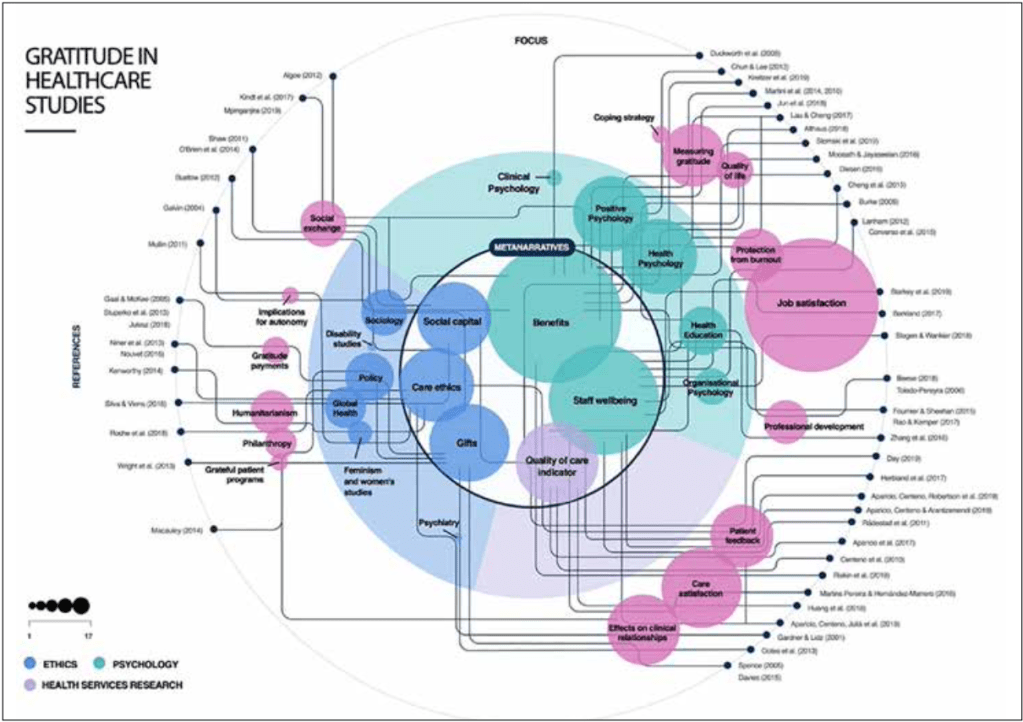
It seems fitting to consider what we have to be thankful for, and gratitude in healthcare is a very active field of study at present. A meta-review in Qualitative Health Research by Day et al reviewed recent works and referenced pioneering works on gratitude research dating to the early twentieth century and organized this vast body of work into six “meta- narratives: gratitude as social capital, gifts, care ethics, benefits of gratitude, gratitude and staff well-being, and gratitude as an indicator of quality of care.”2

Given the ubiquitous articles reporting on healthcare worker
burnout and the mental and physical consequences of COVID-19 on our workforce, Day et al suggested in their conclusion that more research is needed on “gratitude as a component of civility in care settings” and that further study might help researchers to understand the intersection of gratitude “with issues of esteem, community cohesion, and the languages of valorization that often accompany expressions of gratitude.”2

Individually, we might all take a moment to self-assess using a simple exercise such as the Gratitude Questionnaire – Six Item Form (GQ-6), or we might dig more deeply into the bibliography of “Gratitude in Health Care: A Meta-narrative Review” to study our own complicated relationship with gratitude more closely.2,3 Those in healthcare have been under great strain since COVID-19 first appeared on the scene, and perhaps a gratitude practice is just what the doctor ordered to help us to reboot and revive the sense of wonderment with which we began our careers.

References
1. Texas Department of State Health Services COVID -19 Dashboard.
2. Giskin Day, Glenn Robert, Anne Marie Rafferty. 2020 Gratitude in Health Care: A Meta-narrative Review. Qualitative Health Research. 2020 Dec; 30(14): 2303-2315
3. Gratitude Questionnaire – Six Item Form (GQ-6), taken from Nurturing Wellness by Dr. Kathy Anderson.

COVID-19 Vaccine Clinics for the Week of January 21

January 19, 2023 – (Tarrant County) – Tarrant County Public Health hosts numerous pop-up COVID-19 clinics across Tarrant County each week in partnership with public and private organizations listed below. Each site has the Moderna, Pfizer, and Novavax vaccines. Infants six months and older are eligible for the vaccination. Parents need to bring proof of the child’s age and their own ID for the vaccination. Booster vaccinations are available at all of the vaccination locations. 

  
TCPH would like to bring a COVID-19 vaccination clinic to businesses, churches, and organizations in the community thatare interested in hosting a pop-up clinic. It’s easy and free to host a clinic.
 
In addition to the vaccination opportunities below, the cities of Arlington, Fort Worth, Mansfield, North Richland Hills, Hurst, and Tarrant County College have also added opportunities for vaccinations. To find a local vaccine site, the County created a vaccine finder page: VaxUpTC website.

Pop-Up COVID-19 locations:

Stonegate Nursing and Rehabilitation  
Wednesday, Jan. 25: 10 a.m. to 2 p.m.
4201 Stonegate Blvd.  
Fort Worth, TX 76109

VaxMobile-City of Forest Hill  
Thursday, Jan. 26: 9 a.m. to 4 p.m.
6800 Forest Hill Dr.   
Forest Hill, TX 76140

Tarrant County Public Health CIinics: 

Northwest Public Health Center
Monday to Friday: 8 a.m. to 12 p.m. and 1 to 5 p.m.
3800 Adam Grubb Road
Lake Worth, TX 76135

Bagsby-Williams Health Center
Monday to Friday: 8 a.m. to 12 p.m. and 1 to 5 p.m.
3212 Miller Ave.
Fort Worth, TX 76119

Southeast Public Health Center
Monday to Friday: 9 a.m. to 12 p.m. and 1 to 5 p.m.
536 W Randol Mill
Arlington TX, 76011

Main Public Health Center
Monday to Friday: 8 a.m. to 12 p.m. and 1 to 5 p.m.
1101 S. Main Street
Fort Worth, TX 76104

Southwest Public Health Center
Monday to Friday: 8 a.m. to 12 p.m. and 1 to 5 p.m.
6551 Granbury Road
Fort Worth, TX 76133

Watauga Public Health Center
Monday to Friday: 8 a.m. to 12 p.m. and 1 to 5 p.m.
6601 Watauga Road
Watauga, TX 76148

For more information go to coronavirus.tarrantcounty.com or call the Tarrant County Public Health information line, 817-248-6299, Monday – Friday 8 a.m. to 6 p.m.

COVID-19 Vaccine Clinics for the Week of January 14

January 13, 2023 – (Tarrant County) – Tarrant County Public Health hosts numerous pop-up COVID-19 clinics across Tarrant County each week in partnership with public and private organizations listed below. Each site has the Moderna, Pfizer, and Novavax vaccines. Infants six months and older are eligible for the vaccination. Parents need to bring proof of the child’s age and their own ID for the vaccination. Booster vaccinations are available at all of the vaccination locations. 

  
TCPH would like to bring a COVID-19 vaccination clinic to businesses, churches, and organizations in the community that are interested in hosting a pop-up clinic. It’s easy and free to host a clinic.
 
In addition to the vaccination opportunities below, the cities of Arlington, Fort Worth, Mansfield, North Richland Hills, Hurst, and Tarrant County College have also added opportunities for vaccinations. To find a local vaccine site, the County created a vaccine finder page: VaxUpTC website.

Pop-Up COVID-19 locations:

Baker Chapel AME Church 
Saturday, Jan. 14: 10 a.m. to 2 p.m.
1050 E. Humboldt St.  
Fort Worth, TX 76104

Advent Health Care Center of Burleson  
Tuesday, Jan. 17: 9 a.m. to 11 a.m.
301 Huguley Blvd.   
Burleson, TX 76028

Vaxmobile-Southside Community Center 
Thursday, Jan. 19: 9 a.m. to 4 p.m.
959 E. Rosedale St. 
Fort Worth, TX 76104

Tarrant County Public Health CIinics: 

Northwest Public Health Center
Monday to Friday: 8 a.m. to 12 p.m. and 1 to 5 p.m.
3800 Adam Grubb Road
Lake Worth, TX 76135

Bagsby-Williams Health Center
Monday to Friday: 8 a.m. to 12 p.m. and 1 to 5 p.m.
3212 Miller Ave.
Fort Worth, TX 76119

Southeast Public Health Center
Monday to Friday: 9 a.m. to 12 p.m. and 1 to 5 p.m.
536 W Randol Mill
Arlington TX, 76011

Main Public Health Center
Monday to Friday: 8 a.m. to 12 p.m. and 1 to 5 p.m.
1101 S. Main Street
Fort Worth, TX 76104

Southwest Public Health Center
Monday to Friday: 8 a.m. to 12 p.m. and 1 to 5 p.m.
6551 Granbury Road
Fort Worth, TX 76133

Watauga Public Health Center
Monday to Friday: 8 a.m. to 12 p.m. and 1 to 5 p.m.
6601 Watauga Road
Watauga, TX 76148

For more information go to coronavirus.tarrantcounty.com or call the Tarrant County Public Health information line, 817-248-6299, Monday – Friday 8 a.m. to 6 p.m.

COVID-19 Vaccine Clinics for the Week of January 7

January 5, 2023 – (Tarrant County) – Tarrant County Public Health hosts numerous pop-up COVID-19 clinics across Tarrant County each week in partnership with public and private organizations listed below. Each site has the Moderna, Pfizer, and Novavax vaccines. Infants six months and older are eligible for the vaccination. Parents need to bring proof of the child’s age and their own ID for the vaccination. Booster vaccinations are available at all of the vaccination locations. 

  
TCPH would like to bring a COVID-19 vaccination clinic to businesses, churches, and organizations in the community that are interested in hosting a pop-up clinic. It’s easy and free to host a clinic.
 
In addition to the vaccination opportunities below, the cities of Arlington, Fort Worth, Mansfield, North Richland Hills, Hurst, and Tarrant County College have also added opportunities for vaccinations. To find a local vaccine site, the County created a vaccine finder page: VaxUpTC website.

Pop-Up COVID-19 locations:

Beth Eden Baptist Church 
Saturday, Jan. 7: 10 a.m. to 4 p.m.
3308 Wilbarger St. 
Fort Worth, TX 76119

Cityview Nursing and Rehabilitation  
Tuesday, Jan. 10: 10 a.m. to 2 p.m.
5801 Bryant Irvin Rd.   
Fort Worth, TX 76132

Vaxmobile-Watauga City Hall 
Thursday, Jan. 12: 9 a.m. to 4 p.m.
7105 Whitley Rd. 
Watauga, TX 76148

Tarrant County Public Health CIinics: 

Northwest Public Health Center
Monday to Friday: 8 a.m. to 12 p.m. and 1 to 5 p.m.
3800 Adam Grubb Road
Lake Worth, TX 76135

Bagsby-Williams Health Center
Monday to Friday: 8 a.m. to 12 p.m. and 1 to 5 p.m.
3212 Miller Ave.
Fort Worth, TX 76119

Southeast Public Health Center
Monday to Friday: 9 a.m. to 12 p.m. and 1 to 5 p.m.
536 W Randol Mill
Arlington TX, 76011

Main Public Health Center
Monday to Friday: 8 a.m. to 12 p.m. and 1 to 5 p.m.
1101 S. Main Street
Fort Worth, TX 76104

Southwest Public Health Center
Monday to Friday: 8 a.m. to 12 p.m. and 1 to 5 p.m.
6551 Granbury Road
Fort Worth, TX 76133

Watauga Public Health Center
Monday to Friday: 8 a.m. to 12 p.m. and 1 to 5 p.m.
6601 Watauga Road
Watauga, TX 76148

For more information go to coronavirus.tarrantcounty.com or call the Tarrant County Public Health information line, 817-248-6299, Monday – Friday 8 a.m. to 6 p.m.

COVID-19 Vaccine Clinics for the Week of December 3

December 1, 2022 – (Tarrant County) – Tarrant County Public Health hosts numerous pop-up COVID-19 clinics across Tarrant County each week in partnership with public and private organizations listed below. Each site has the Moderna, Pfizer, and Novavax vaccines. Infants six months and older are eligible for the vaccination. Parents need to bring proof of the child’s age and their own ID for the vaccination. Booster vaccinations are available at all of the vaccination locations. 


TCPH would like to bring a COVID-19 vaccination clinic to businesses, churches, and organizations in the community that is interested in hosting a pop-up clinic. It’s easy and free to host a clinic.
 
In addition to the vaccination opportunities below, the cities of Arlington, Fort Worth, Mansfield, North Richland Hills, Hurst, and Tarrant County College have also added opportunities for vaccinations. To find a local vaccine site, the County created a vaccine finder page: VaxUpTC website.

Pop-Up COVID-19 locations:

Mount Olive Baptist Church 
Saturday, Dec. 3: 10 a.m. to 2 p.m.
301 Sanford St.   
Arlington, TX 76012

Como Community Center 
Tuesday, Dec. 6: 9 a.m. to 1 p.m.
4660 Horne Street.    
Fort Worth, TX 76107

Diamond Hill Community Center  
Tuesday, Dec. 6: 9 a.m. to 1 p.m.
1701 Northeast 26th St.    
Fort Worth, TX 76106

Chisholm Trail Community Center  
Saturday, Dec. 6: 10 a.m. to 12 p.m.
4936 McPherson Blvd.   
Fort Worth, TX 76123

Haltom City Senior Center   
Wednesday, Dec. 7: 10 a.m. to 2 p.m.
3201 Friendly Ln.    
Haltom City, TX 76117

Highland Hills Community Center  
Thursday, Dec. 8: 10 a.m. to 2 p.m.
1600 Glasgow Rd.   
Fort Worth, TX 76134

Polytechnic Community Center  
Friday, Dec. 9: 9 a.m. to 1 p.m.
3100 Avenue I   
Fort Worth, TX 76105

Tarrant County Public Health CIinics: 

Northwest Public Health Center
Monday to Friday: 8 a.m. to 12 p.m. and 1 to 5 p.m.
3800 Adam Grubb Road
Lake Worth, TX 76135

Bagsby-Williams Health Center
Monday to Friday: 8 a.m. to 12 p.m. and 1 to 5 p.m.
3212 Miller Ave.
Fort Worth, TX 76119

Southeast Public Health Center
Monday to Friday: 9 a.m. to 12 p.m. and 1 to 5 p.m.
536 W Randol Mill
Arlington TX, 76011

Main Public Health Center
Monday to Friday: 8 a.m. to 12 p.m. and 1 to 5 p.m.
1101 S. Main Street
Fort Worth, TX 76104

Southwest Public Health Center
Monday to Friday: 8 a.m. to 12 p.m. and 1 to 5 p.m.
6551 Granbury Road
Fort Worth, TX 76133

Watauga Public Health Center
Monday to Friday: 8 a.m. to 12 p.m. and 1 to 5 p.m.
6601 Watauga Road
Watauga, TX 76148

For more information go to coronavirus.tarrantcounty.com or call the Tarrant County Public Health information line, 817-248-6299, Monday – Friday 8 a.m. to 6 p.m.

Important COVID-19 Updates for North Texas Physicians

The North Texas Medical Society Coalition is sharing two important and timely COVID-19 updates as you help navigate care for your patients. 

First, the Texas Department of Emergency Management (TDEM) has opened a second COVID-19 antibody infusion center in North Texas. The new facility, located at Collin College in McKinney, will be in addition to the existing center in Ft. Worth. Click here to access the referral form and here for location details for the McKinney location. Click here for the referral form and here for location details for the Ft. Worth location.

Second, regional hospital emergency departments are requesting that well and mildly ill patients requiring a COVID-19 test (e.g. students, teachers and others who are seeking to return to school/work, or, individuals with mild symptoms), be directed to offsite COVID testing facilities. Emergency departments are being inundated with both sick patients and COVID-19 testing requests and have asked for the assistance of referring physicians to direct test-only patients to offsite locations. To access an offsite testing location, please click here. Please advise patients to contact the testing center prior to arriving to inquire about any limitations (e.g. no pediatrics, hours, appointments needed, etc.), and other important details. Hospitals have advised that patients who present at the emergency department for testing only may be charged an emergency department visit fee. While the COVID test itself is free, a facility visit fee may apply.

Thank you for all you are doing to serve your patients and our community. You are appreciated!

The NTMSC represents more than 11,500 physicians in the communities of Collin-Fannin, Dallas, Denton, Grayson, and Tarrant County. Founded in 2020, the NTMSC works with community healthcare partners, including public health departments, hospitals, and business leaders, to advise on medical recommendations to serve the health care needs of the residents of North Texas.

Lights in the Dark

by Angela Self, TCMS President

This article was originally published in the May/June issue of the Tarrant County Physician. You can read find the full magazine here.


I once wrote about my hopes for life after medical school. I would imagine my office decor, my conversations with patients, the time I would spend coordinating their care. The thoughts were all happy and gave me hope when the dark days of medical school cast a shadow over my upbeat mood, when classes took me down the road of insomnia and gave me a near flat affect from studying more than 12 hours a day during exam time. I guess we all looked like zombies immediately before and after our exams, and some even had the fragrance. 

Once a girlfriend came to visit me and she stayed at a hotel on the beach. I discovered the pleasure of sitting and enjoying a piña colada and having zero thoughts of gluconeogenesis or small, slow-conducting fibers (protopathic). Denise, the Coyaba hotel, and a piña colada were all little lights for a med student who was over 2,000 miles from home.

There are times during my professional life that I once again feel like I’m over 2,000 miles from home. Denise is now married and living in Ohio. Piña coladas have way too many calories. The Coyaba hotel would require more PTO than I’m able to take. I’m sitting at my dining room table as I write this because stepping back into the office would make me feel like I’m still at work. I started to take an evening walk but turned around when a close friend told me how much my article sucked (the one you’re not going to read). He didn’t actually say that it sucked; he just pointed out how opposite of uplifting or encouraging it was and said, “It’s not your best work.” Thank you, “D,” for your honesty.
  

Why would I not be the happiest person you could meet? I have a great job. I am happily single and able to go out and meet a girlfriend for coffee any time I want. I see my beautiful daughter on a regular basis (who is working, doing well in school, and enjoying her youth by spending time with her close friends). My mom survived a hospitalization that nearly took her life in 2013 and has never smoked again (I had taken her home on hospice ten days after she was admitted). Heck, I barely have enough bills to qualify as debt. I should be dancing around the whole Grapevine/Colleyville area. But I’m not.

The strange thing about being there for everyone else is that you sometimes forget to keep a little piece of yourself to enjoy—you just give it all away. Yes, this is a “me” problem. I am the one who picks up the phone when I know the person calling is going to vent for the next 30 minutes, but after 20 years of friendship, you make an effort to still “be there” because that’s what friends do. When your very best friend calls and frantically asks for prayer because the vet is coming to put their horse down (which happened two days ago), how do you not take that call? When your mom wants to tell you about a grandkid she’s concerned about and says the stress is overwhelming, are you going to hang up on her? Another friend tells you they are really concerned because they are still having fatigue and shortness of breath since their heart procedure—and this is one of your health-conscious friends. How can you not feel that? Then there is the job that you love doing, but sadly you do it for 12 hours many days. I find myself on long walks, asking, “Am I missing something?” I wonder if there are elderly patients that I could be helping, or if I’m not fulfilling my calling by now being on the “administrative” side of Medicine.

Long walks, good coffee, and two cats have replaced Denise, the Coyaba, and even the piña colada. As I walk along, I play music from the 80s and 90s and look at all of the different trees—I love the long needle pines the best, they look and smell good. I see the cardinals and the other birds flying around and admire how they know the meaning of commitment. On the weekends I spend hours at the coffee shop with the same few people I’ve been meeting there for years (none of us got COVID-19, and almost everyone is getting vaccinated). They give me a special discount at Buon Giorno, just don’t tell anyone. What? They give everyone that same discount for bringing their thermal mug? I look up at the stars and try to find the big dipper, but I live in Grapevine and, you know, light pollution. I run a hot bath and sit there until it’s barely warm. Netflix holds many fond memories from my COVID-19 nights: Shtisel, Sex and the City, The Crown, Girlfriends . . . I really do make the most of each day and try to laugh as much as I can. It’s just been hard to laugh lately, and I wanted to share in case someone else is also having a hard time laughing, or sleeping, or even folding the laundry.

We are the ones who are there for everyone else. Who is there for us? Though my friends and family can drain the very life force from my body, I want you to know that I am here for you. You have sacrificed so much for others, and your colleagues see you. They care even though you thought they didn’t like you. I am struggling a bit these days, as I suspect many of us are after the year we’ve been through. 

Perhaps this is just my COVID-19 carb crash, but I am ready for this season to end. I am praying; I like to pray. I am even going to church on occasion . . . not that I care for going to church. But my faith has always seen me through the most difficult of times, and I once again find myself reading Joshua 1:9, knowing that He will be with me wherever I go. I am going to put that and a few other verses on the wall behind my laptop as a reminder that He is always with me. I have friends who do not share my faith, my politics, or my taste in music, but we do share the need to connect, to laugh, and to be heard. Thank you for reading my article and for being one of the lights in a sometimes dark place. Call me any time at 817-798-8087 (text first if you actually want me to pick up). We’re all walking through this—let’s do it together. 

Design a site like this with WordPress.com
Get started