Tarrant County Public Health: Health Advisory Alert

An original message by Tarrant County Public Health announced on June 9, 2023.

Tarrant County Public Health (TCPH) is issuing this Health Alert Network (HAN) Health Advisory to notify clinicians about a confirmed measles case in a Hood County resident in a Tarrant County Hospital. TCPH has worked closely with the facility to identify exposure to some patients and staff that occurred before measles was suspected. All exposed people have been contacted and advised to watch for signs and symptoms through June 22nd. TCPH collaborated with the facility and Texas Department of State Health Services (DSHS), to investigate and respond to this measles case and exposures.

Below is a forwarded HAN from DSHS with background information about the current measles case, information on measles and the importance of early recognition, diagnosis, and appropriate treatment. TCPH recommends that clinicians be on the alert for cases of measles that meet the case definition.

Due to the highly contagious nature of this disease, additional cases may occur. We advise clinicians to follow the recommendations below and report any suspected cases immediately to Tarrant County Public Health’s 24-hour reporting line at (817)321-5350, preferably while the patient is present.

Background

A young child who is a resident of Hood County was recently diagnosed with measles. The child had no history of travel to an area where measles is spreading and no known exposure to a person with measles. The child has been treated and is recovering.

This is the first confirmed case of measles in Texas since travel-related outbreaks in 2019, which led to 23 cases. Completion of the two-dose series of the measles vaccine is highly effective at preventing measles, however even vaccinated people may occasionally become infected.

Measles is a highly contagious respiratory illness. The virus is transmitted by direct contact with infectious droplets or by airborne spread when an infected person breathes, coughs, or sneezes. Measles virus can remain infectious in the air for up to two hours after an infected person leaves an area. The illness usually starts a week or two after someone is exposed with symptoms like a high fever, cough, runny nose and red, watery eyes. A few days later, the telltale rash breaks out as flat, red spots on the face and then spreads down the neck and trunk to the rest of the body. A person is contagious about four days before the rash appears to four days after. People with measles should stay home from work or school during that period.

The best way to prevent getting sick is to be immunized with two doses of the measles- containing vaccine, which is primarily administered as the combination of measles-mumps- rubella (MMR) vaccine. DSHS and the Centers for Disease Control and Prevention recommend children receive one dose at 12 to 15 months of age and another at 4 to 6 years. Children too young to be vaccinated or who have only had one dose of vaccine are more likely to get infected and more likely to have severe complications if they do get sick.

Recommendations For Health Care Professionals:

Healthcare providers should consider measles in patients presenting with the following symptoms, particularly those who have traveled abroad or had contact with known measles cases:

• Fever ≥101°F (38.3°C) AND
• Generalized maculopapular rash lasting ≥3 days AND Rash begins at the hairline/scalp and progresses down the body
• Cough, runny nose, conjunctivitis OR Koplik spots (bluish-white specks or a red-rose background appearing on the buccal and labial mucosa usually opposite the molars)

Immediately report any suspected cases of measles to Tarrant County Public Health at our 24 hour hotline (817)321-5350) (dshs.texas.gov/idcu/investigation/conditions/contacts). If possible, please report while the patient is present to facilitate testing and the public health investigation, including follow-up of potential exposures.

Infection Control Precautions

  • Airborne precautious should be followed to reduce possible exposures in healthcare settings.
  • In urgent/emergency healthcare settings, suspected cases should be masked with a surgical mask and triaged quickly from waiting areas into a room with a closed door, airborne isolation precautions recommended. In other outpatient settings, suspected cases should be scheduled at the end of the day, if possible. Healthcare workers caring for patients suspected of having measles should use airborne infection control precautions. (www.cdc.gov/hicpac/2007IP/2007isolationPrecautions.html)
  • Since measles is so highly transmissible and can spread in health care settings, people who work in places like a doctor’s office or emergency room should have evidence of measles immunity to prevent any potential outbreak. (https://www.cdc.gov/vaccines/pubs/surv-manual/chpt07- measles.html#f21).

Diagnostic Testing

  • Testing for measles should be done for all suspected cases of measles at the time of the initial medical visit:
  • Measles PCR and serology (IgM and IgG) testing is available at both the Texas DSHS Laboratory in Austin and at commercial laboratories.
  • The Texas DSHS Laboratory can perform PCR testing on throat swabs (preferred) or nasopharyngeal swabs placed in viral transport media and serology on serum specimens.
  • DSHS strongly encourages providers to submit PCR specimens to the DSHS Laboratory because genotyping will be performed on positive PCR specimens, which can be helpful during outbreaks.
  • Providers should work with their local health department or DSHS regional office to coordinate testing at the DSHS laboratory to ensure specimens are submitted correctly and meet testing requirements.
  • Unless coordinated in advance, specimens may only be received during normal business hours Monday through Friday.

Recommendations for Public Health:

Control and Prevention Measures

  • Measles vaccination may prevent disease in exposed people if given within 72 hours of exposure. People 6 months and older who have not been fully vaccinated would be eligible for vaccination under those circumstances. It may provide some long-term protection but should be followed with a second vaccination at least one month later. Immune globulin (IG) may be indicated for some people but should not be used to control an outbreak.
  • Pregnant women, people with severe immunosuppression, and anyone with a previous anaphylactic reaction to a vaccine component should not get a measles vaccine.

Controlling Outbreaks in Group Settings

  • People with confirmed or suspected measles should stay home from school, work, and other group settings until after the fourth day of rash onset.
  • During an outbreak, people without documented immunity from vaccination or previous measles infection should be isolated from anyone with measles to protect those without immunity and control the outbreak. Additional information on school exclusion and readmission can be found at dshs.texas.gov/idps- home/school-communicable-disease-chart

Recommendations for the Public

If you think you have measles or have been exposed to someone with measles, isolate yourself from others and call your healthcare provider before arriving to be tested so they can prepare for your arrival without exposing other people to the virus. Measles is extremely contagious and can cause life-threatening illness to anyone who is not protected against the virus.

Scope, Insurance, Vaccine Battles Ramp Up in Session’s Final Weeks as Women’s Health Bills Progress

by Emma Freer

Originally published by Texas Medical Association on May 12, 2023.

With just 17 days until “sine die,” the adjournment of the regular state legislative session, the Texas Medical Association has been mounting a tough defense against problematic bills related to scope-of-practice expansion, insurance practices, and COVID-19 vaccine requirements. There’s good news, too, as several measures to expand access to women’s reproductive health care move through the legislative process, after years of physician advocacy. 

Scope creep containment 

Preventing scope creep is TMA’s top legislative priority this session. Although the association has successfully beat back several bad bills, one bill still stands out at this late stage for its potential to corrode established patient protections.  

Senate Bill 666 would restrict the Texas Medical Board’s (TMB’s) complaint process, weaken its disciplinary authority, and increase its operating costs. The legislation recently passed the Senate, so TMA lobbyists are focused on battling it in the House. 

Fortunately, TMA advocacy killed the only scope-related legislation to make it to the House floor: House Bill 2553 would have given patients direct access to a physical therapist without a physician referral for 20 business days, up from 15. This bill failed by a wide margin on May 8 in a huge win for medicine. 

Two other concerning scope measures are all but dead:  

  • House Bill 724 and its companion, Senate Bill 161, would prevent TMB from issuing cease-and-desist letters to nonphysicians practitioners who venture into the practice of medicine.  
  • House Bill 1767, would allow podiatrists to access hospital privileges, regardless of medical staff decision-making. 

Insurance update

In the insurance category, TMA is battling several pieces of problematic legislation that jeopardize patient safety and physician protections, including: 

  • Senate Bill 490 and its companion, House Bill 1973 would require patients be given an itemized billing statement before any payment is collected. TMA lobbyists fought for amendments removing individual physicians from this bill, which the House passed and with which the Senate must concur before it heads to Gov. Greg Abbott’s desk.  
  • House Bill 2414 would allow health plans to steer patients to physicians or other health professionals of their choosing, regardless of quality. The House Insurance Committee voted in favor of HB 2414, teeing up its May 2 passage out of the House and into the Senate.  
  • House Bill 3351would undo physician protections in health plans’ ranking and tiering programs. Following its May 9 passage in the House, the bill now lies with the Senate.   

Public health pushback

TMA continues to oppose two concerning public health bills that would have far-reaching consequences beyond the COVID-19 vaccine mandates they purport to legislate. 

  • Senate Bill 177 and its companion, House Bill 81, would redefine informed consent, putting employers, patients, and physicians at risk. Although TMA lobbyists kept HB 81 from the House floor, they remain concerned about SB 177, which passed the Senate and the House Public Health Committee. It’s now pending a hearing on the House floor. 
  • House Bill 44 would kick physicians out of Medicaid and the Children’s Health Insurance Program for having a “discriminatory” vaccination policy, such as requiring patients to be vaccinated against certain diseases. The Senate Health and Human Services Committee heard HB 44 on May 10, following its passage out of the House, but left it pending. 

TMA also is pushing legislation related to federal medical privacy rules, including Senate Bill 1467, which would modify sensitive medical test disclosures under the federal rules to protect patients.  

Dallas oncologist David Gerber, MD, testified on behalf of TMA in support of SB 1467 before the House Public Health Committee on May 8. He told lawmakers the bill would help prevent potentially traumatic situations, such as when one of his patients learned of a cancer diagnosis from an automatic patient portal notification while reading a bedtime story to a toddler.  

“We are not seeking to withhold important information from patients,” Dr. Gerber said. “Rather, we are seeking to deliver the information the best way we can.”  

SB 1467, having passed the Senate and the House Public Health Committee, was scheduled for a hearing on the House floor on May 12 as of this writing. 

Finally, Senate Bill 415 awaits Governor Abbott’s signature – its last step to becoming law – after passing both chambers. The bill builds on state rules regarding the number of human trafficking-related CME physicians must take.   

Women’s Health wins 

On the budget front, TMA lobbyists continue to work to preserve health care gains – including critical investments in women’s reproductive and pediatric health care – in the House version as the two chambers reconcile their competing bills

TMA, along with four state specialty societies and the Texas Public Health Coalition, recently sent a letter to the conference committee members tasked with this reconciliation process, reiterating its budget priorities. They include: 

  • Increasing Medicaid physician payments for women’s reproductive and certain pediatric services; 
  • Tripling rural hospital maternal health add-on payments from $500 to $1,500 to help preserve local access to these services;  
  • Expanding mobile women’s preventive health care clinics in rural and underserved communities; and 
  • Broadening eligibility for the Medicaid Breast and Cervical Cancer Program to 250% of the federal poverty level, up from 200%.  

TMA lobbyist Caitlin Flanders says these budget items are especially important in the wake of the June 2022 U.S. Supreme Court decision in Dobbs v. Jackson Women’s Health Organization regarding abortion. The decision triggered additional restrictions under state law and is expected to lead to an increase in pregnancies and young children. 

In other positive news, the Senate Health and Human Services Committee recently passed House Bill 916, which would require health plans to provide a 12-month supply of a covered prescription contraceptive drug, up from a 90-day supply. HB 916 passed the House in mid-April.  

The same Senate committee is expected to hear House Bill 12, which would extend continuous Medicaid coverage for postpartum women for 12 months, although as of this writing, a date hasn’t been set.  

Find all the testimonies by TMA physician advocates during the current session in TMA’s Advocacy Center

A Thankful and Healthy New Year for Public Health

This article was originally published in the January/February 2023 issue of the Tarrant County Physician.

by Catherine Colquitt, MD, AAHIVS
Medical Director and Local Health Authority
Kenton K. Murthy, DO, MD, MPH, AAHIVS
Assistant Medical Director and Deputy Local Health Authority

During the holiday season, many were reunited in person to celebrate with loved ones after almost three years of relative seclusion.

There was much to be grateful for this season. While COVID-19 case counts and hospitalizations are rising in Texas and in Tarrant County, our present COVID rates pale in comparison to December 2020 or January 2021.1 And though influenza and Respiratory Syncytial Virus (RSV) infections are strikingly and unseasonably high, and the perils of a tridemic (COVID-19, influenza, and RSV) are on our minds, many of us and our patients and neighbors are fully vaccinated against COVID-19 and have already had the bivalent mRNA vaccines (for protection from the Wuhan and Omicron COVID-19 strains) as well as the current seasonal influenza vaccine.

As we shift gears from the COVID-19 pandemic to COVID-19 endemic,
we hope that our next iteration of COVID-19 vaccines will roll out side
by side with next season’s influenza vaccine. However, if new versions of COVID-19 vaccines are required to mitigate the spread of COVID-19 between now and then, our scientists and vaccine manufacturers, our distribution networks, the FDA, the Advisory Committee on Immunization Practices, the CDC, and state and local partners will work together to respond to future challenges.

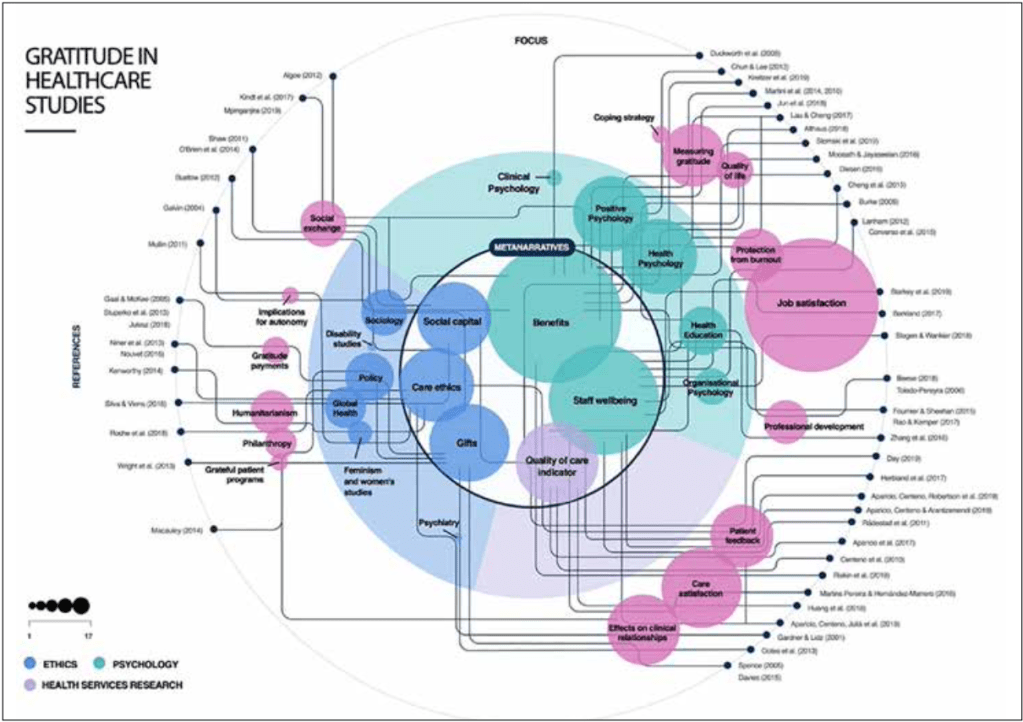
It seems fitting to consider what we have to be thankful for, and gratitude in healthcare is a very active field of study at present. A meta-review in Qualitative Health Research by Day et al reviewed recent works and referenced pioneering works on gratitude research dating to the early twentieth century and organized this vast body of work into six “meta- narratives: gratitude as social capital, gifts, care ethics, benefits of gratitude, gratitude and staff well-being, and gratitude as an indicator of quality of care.”2

Given the ubiquitous articles reporting on healthcare worker
burnout and the mental and physical consequences of COVID-19 on our workforce, Day et al suggested in their conclusion that more research is needed on “gratitude as a component of civility in care settings” and that further study might help researchers to understand the intersection of gratitude “with issues of esteem, community cohesion, and the languages of valorization that often accompany expressions of gratitude.”2

Individually, we might all take a moment to self-assess using a simple exercise such as the Gratitude Questionnaire – Six Item Form (GQ-6), or we might dig more deeply into the bibliography of “Gratitude in Health Care: A Meta-narrative Review” to study our own complicated relationship with gratitude more closely.2,3 Those in healthcare have been under great strain since COVID-19 first appeared on the scene, and perhaps a gratitude practice is just what the doctor ordered to help us to reboot and revive the sense of wonderment with which we began our careers.

References
1. Texas Department of State Health Services COVID -19 Dashboard.
2. Giskin Day, Glenn Robert, Anne Marie Rafferty. 2020 Gratitude in Health Care: A Meta-narrative Review. Qualitative Health Research. 2020 Dec; 30(14): 2303-2315
3. Gratitude Questionnaire – Six Item Form (GQ-6), taken from Nurturing Wellness by Dr. Kathy Anderson.

COVID-19 Vaccine Clinics for the Week of January 21

January 19, 2023 – (Tarrant County) – Tarrant County Public Health hosts numerous pop-up COVID-19 clinics across Tarrant County each week in partnership with public and private organizations listed below. Each site has the Moderna, Pfizer, and Novavax vaccines. Infants six months and older are eligible for the vaccination. Parents need to bring proof of the child’s age and their own ID for the vaccination. Booster vaccinations are available at all of the vaccination locations. 

  
TCPH would like to bring a COVID-19 vaccination clinic to businesses, churches, and organizations in the community thatare interested in hosting a pop-up clinic. It’s easy and free to host a clinic.
 
In addition to the vaccination opportunities below, the cities of Arlington, Fort Worth, Mansfield, North Richland Hills, Hurst, and Tarrant County College have also added opportunities for vaccinations. To find a local vaccine site, the County created a vaccine finder page: VaxUpTC website.

Pop-Up COVID-19 locations:

Stonegate Nursing and Rehabilitation  
Wednesday, Jan. 25: 10 a.m. to 2 p.m.
4201 Stonegate Blvd.  
Fort Worth, TX 76109

VaxMobile-City of Forest Hill  
Thursday, Jan. 26: 9 a.m. to 4 p.m.
6800 Forest Hill Dr.   
Forest Hill, TX 76140

Tarrant County Public Health CIinics: 

Northwest Public Health Center
Monday to Friday: 8 a.m. to 12 p.m. and 1 to 5 p.m.
3800 Adam Grubb Road
Lake Worth, TX 76135

Bagsby-Williams Health Center
Monday to Friday: 8 a.m. to 12 p.m. and 1 to 5 p.m.
3212 Miller Ave.
Fort Worth, TX 76119

Southeast Public Health Center
Monday to Friday: 9 a.m. to 12 p.m. and 1 to 5 p.m.
536 W Randol Mill
Arlington TX, 76011

Main Public Health Center
Monday to Friday: 8 a.m. to 12 p.m. and 1 to 5 p.m.
1101 S. Main Street
Fort Worth, TX 76104

Southwest Public Health Center
Monday to Friday: 8 a.m. to 12 p.m. and 1 to 5 p.m.
6551 Granbury Road
Fort Worth, TX 76133

Watauga Public Health Center
Monday to Friday: 8 a.m. to 12 p.m. and 1 to 5 p.m.
6601 Watauga Road
Watauga, TX 76148

For more information go to coronavirus.tarrantcounty.com or call the Tarrant County Public Health information line, 817-248-6299, Monday – Friday 8 a.m. to 6 p.m.

TCPH Announces COVID-19 Vaccine Clinics for the Week of October 8

Tarrant County Public Health hosts numerous pop-up COVID-19 clinics across Tarrant County each week in partnership with public and private organizations listed below. Each site has the Moderna and Pfizer vaccines and at times the Johnson & Johnson. Children five and older are eligible for the vaccination. Parents need to bring proof of the child’s age and their own ID for the vaccination. Booster vaccinations are available at all of the vaccination locations.

  
TCPH would like to bring a COVID-19 vaccination clinic to businesses, churches and organizations in the community who are interested in hosting a pop-up clinic. It’s easy and free to host a clinic.
 
In addition to the vaccination opportunities below, the cities of Arlington, Fort Worth, Mansfield, North Richland Hills, Hurst, and Tarrant County College have also added opportunities for vaccinations. To find a local vaccine site, the County created a vaccine finder page: VaxUpTC website.

Pop-Up COVID-19 locations:

Coral Rehabilitation of Arlington
Monday, Oct.10: 12 p.m. to 4 p.m.
1112  Gibbins Road
Arlington, TX 76011

Cityview Nursing and Rehabilitation 
Wednesday, Oct.12: 9 a.m. to 1 p.m.
5801 Bryant Irvin Rd.
Benbrook,  TX 76132

Grace Metroplex
Wednesday, Oct. 12: 10 a.m. to 1 p.m.
1310 South Collard St.  
Fort Worth, TX 76105

Haltom City Public Library
Friday, Oct. 14: 11 a.m. to 3 p.m.
4809 Haltom Road  
Haltom City, TX 76117

City of Arlington
Friday, Oct. 14: 10 a.m. to 4 p.m.
2800 S Center St.  
Arlington, TX 76014

Tarrant County Public Health CIinics:

Northwest Public Health Center
Monday to Friday: 8 a.m. to 12 p.m. and 1 to 5 p.m.
3800 Adam Grubb Road
Lake Worth, TX 76135

Bagsby-Williams Health Center
Monday to Friday: 8 a.m. to 12 p.m. and 1 to 5 p.m.
3212 Miller Ave.
Fort Worth, TX 76119

Southeast Public Health Center
Monday to Friday: 9 a.m. to 12 p.m. and 1 to 6 p.m.
536 W Randol Mill
Arlington TX, 76011

Main Public Health Center
Monday to Friday: 8 a.m. to 12 p.m. and 1 to 6 p.m.
1101 S. Main Street
Fort Worth, TX 76104

Southwest Public Health Center
Monday to Friday: 8 a.m. to 12 p.m. and 1 to 5 p.m.
6551 Granbury Road
Fort Worth, TX 76133

Watauga Public Health Center
Monday to Friday: 8 a.m. to 12 p.m. and 1 to 5 p.m.
6601 Watauga Road
Watauga, TX 76148

For more information go to coronavirus.tarrantcounty.com or call the Tarrant County Public Health information line, 817-248-6299, Monday – Friday 8 a.m. to 6 p.m.

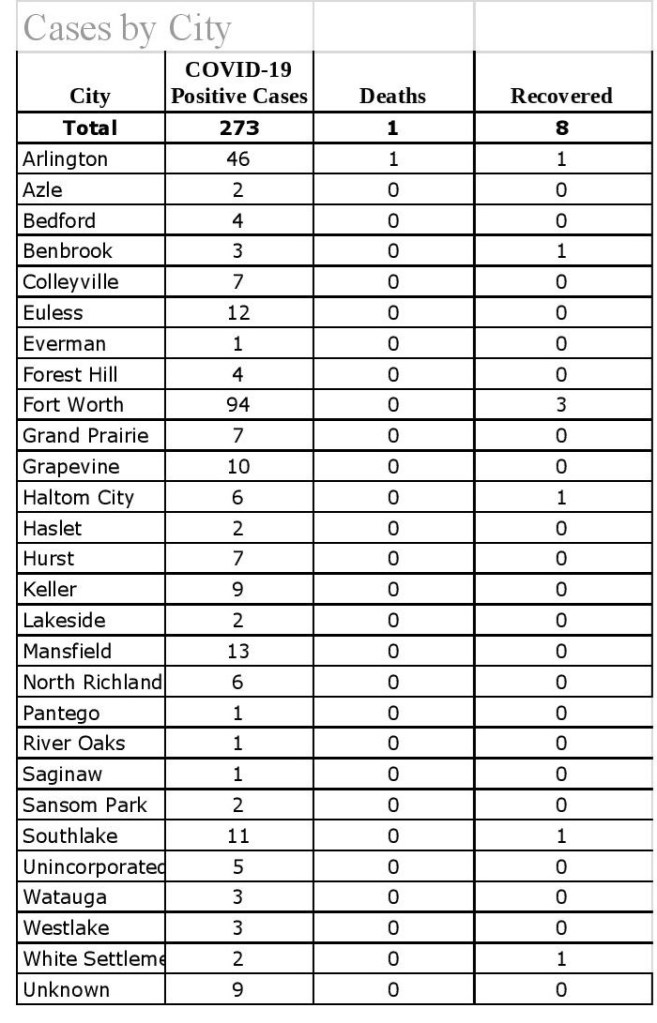
Tarrant County COVID-19 Activity – 3/31/20

COVID-19 Positive cases: 273*

COVID-19 related deaths: 1

Recovered COVID-19 cases: 8

Data from Tarrant County Public Heath’s (TCPH) report of COVID-19 activity in Tarrant County, updated Tuesday, March 31, 2020 at 1:15 p.m. Find more COVID-19 information from TCPH here.

* These data are provisional and are subject to change at any time.

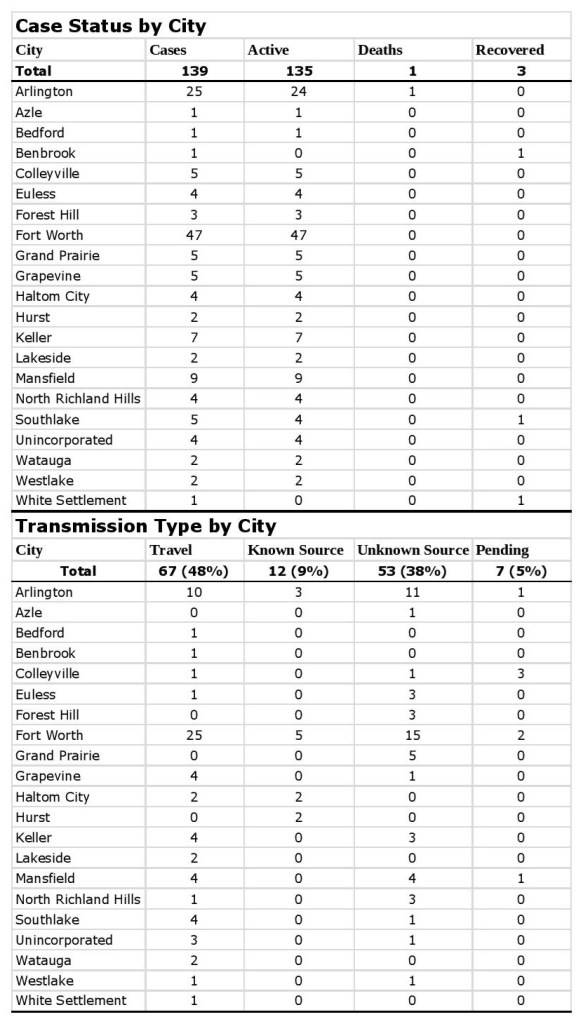
Tarrant County COVID-19 Activity 3/25/20

Data from Tarrant County Public Heath’s (TCPH) report of COVID-19 activity in Tarrant County, updated Wednesday, March 25, 2020 at 11:30 a.m. Find more COVID-19 information from TCPH here.

Source:http://www.tarrantcounty.com/en/public-health/disease-control—prevention/coronaviruas.html?linklocation=homecarousel&linkname=COVID-19

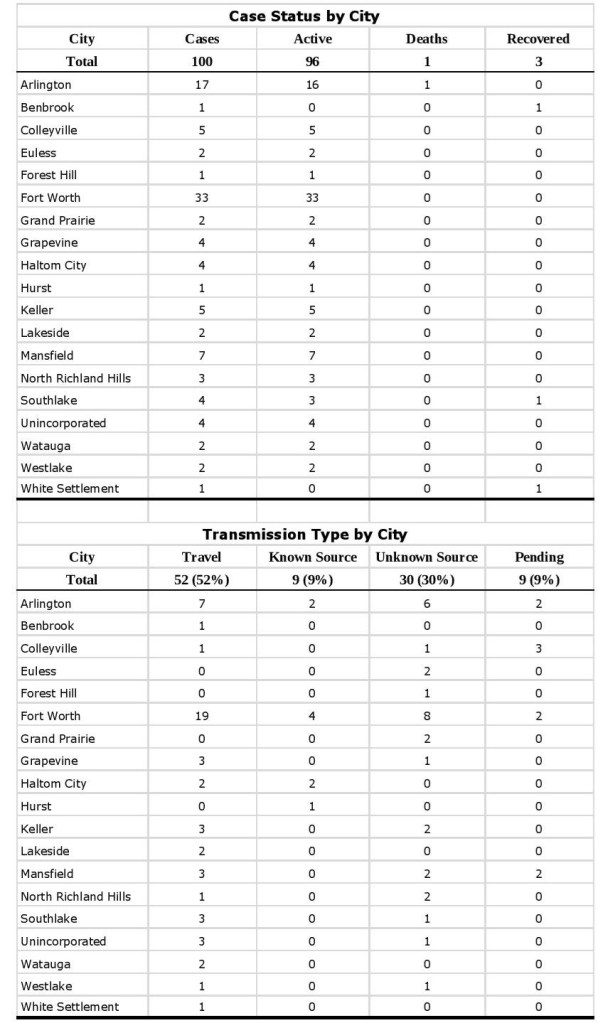
COVID-19 Activity in Tarrant County – 3/23/20

Tarrant County Public Heath’s (TCPH) report of COVID-19 activity in Tarrant County, updated Monday, March 23, 2020 at 11:15 a.m. Find more COVID-19 information from TCPH here.

Case Status by City

CITYCASESACTIVEDEATHSRECOVERED
Arlington131210
Benbrook1001
Colleyville3300
Euless2200
Fort Worth181800
Grand Prairie1100
Grapevine1100
Haltom City2200
Keller2200
Lakeside2200
Mansfield4400
N Richland Hills2200
Southlake4400
Watauga1100
White Settlement1001
TOTALS575412

Transmission Type by City

CITYTravelKnownSourceUnknownSourcePending
Arlington5242
Benbrook1000
Colleyville1002
Euless0020
Fort Worth11241
Grand Prairie0010
Grapevine1000
Haltom City2000
Keller1001
Lakeside2000
Mansfield2020
N Richland Hills1010
Southlake3001
Watauga1000
White Settlement1000
TOTALS324147

Design a site like this with WordPress.com
Get started