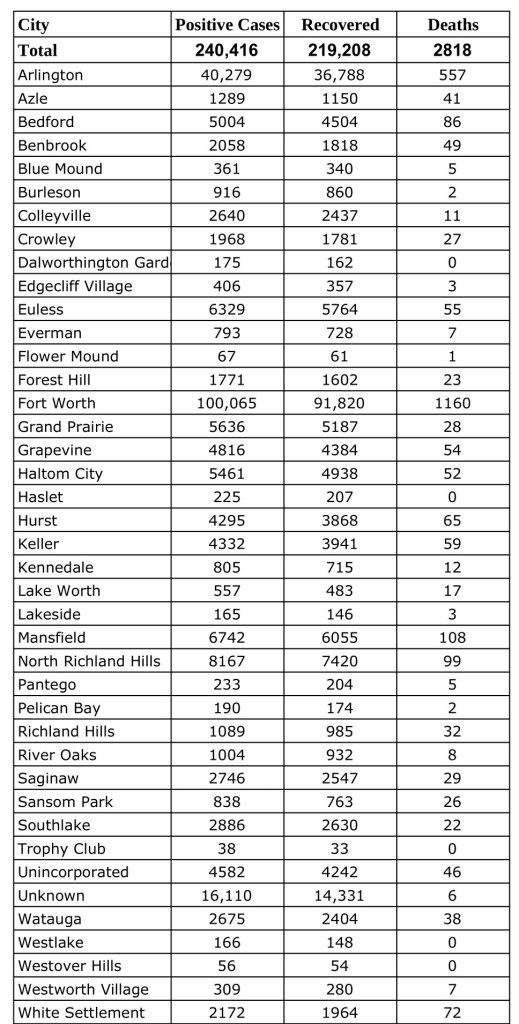
Data from Tarrant County Public Heath’s (TCPH) report of COVID-19 activity in Tarrant County, updated Saturday, February 27, 2021.Find more COVID-19 information from TCPH here.
*These data are provisional and are subject to change at any time.
Deaths and recovered cases are included in total COVID-19 positive cases.
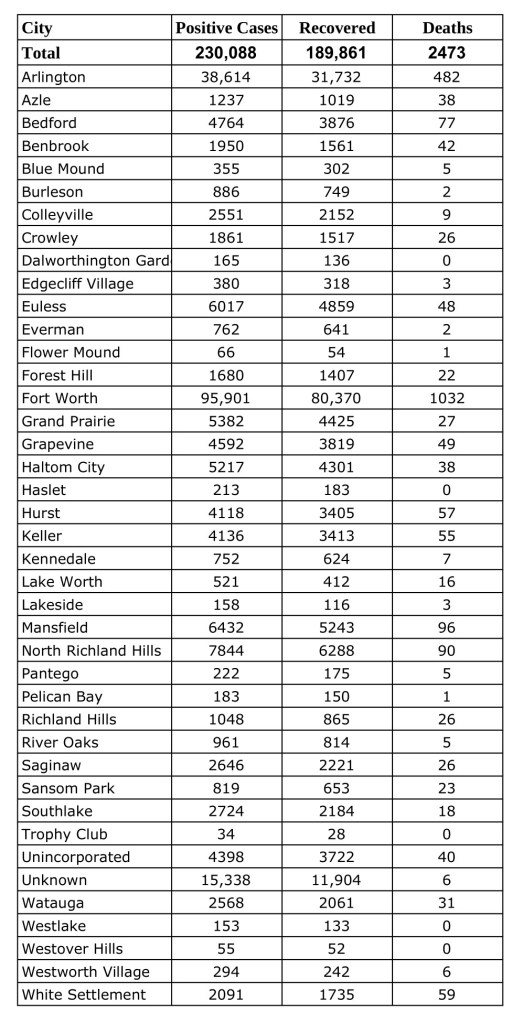
Data from Tarrant County Public Heath’s (TCPH) report of COVID-19 activity in Tarrant County, updated Thursday, February 25, 2021.Find more COVID-19 information from TCPH here.
*These data are provisional and are subject to change at any time.
Deaths and recovered cases are included in total COVID-19 positive cases.
Advanced practice registered nurses (APRNs) are asking legislators for full practice authority that would allow for essentially independent diagnosis and prescribing without any collaboration with a licensed physician
Rep. Stephanie Klick (R-Fort Worth) filed House Bill 2029, which if passed will allow APRNs to: independently prescribe dangerous drugs and controlled substances (up to Schedule III with some Schedule II privileges in inpatient facilities and hospice); order and interpret diagnostic testing; and prescribe DME and devices – all without any relationship with a physician. The bill is expected to be referred to the House Public Health Committee which is Chaired by Representative Klick. We need every Texas physician’s voice to help us.
Please contact your state lawmakers today. Let them know why it’s important to support physician-led, team-based care. Texas patients deserve the highest quality health care possible.
Tell them how much you learned in your years of medical school, residency, and beyond. Let them know you are calling on behalf of the patients of Texas, and how your education is much different from that of APRNs and other nonphysicians. Ask them to say “No” to the APRNs and HB 2029, and to help the Texas Medical Association advocate for what is best for patients: a physician-led, team-based care model.
You can use the new TMA Grassroots Action Center to share that message quickly and easily with your representatives.
This piece was originally published in the January/February issue of the Tarrant County Physician. You can read find the full magazine here.
The residency application process has changed significantly over the past several decades. I remember a grey-haired attending telling me that when he applied to residency, it consisted of hopping in a car, driving down the freeway, and requesting meetings at hospitals he encountered along the way. A strong handshake later, and the promise of training in the specialty of his choice was secured. Since then, the Match process has been transformed with the stratification of candidates by board examinations which dictate competitiveness for certain specialties. We are under pressure to shine starting on day one, with no assurance that our labors will be rewarded by placement into a residency program.
The class before mine underwent the pomp and circumstance of their Match days at home, sidelined by the COVID-19 pandemic. My class is interviewing for residencies through virtual platforms. We do our best to capture the vibe of a program through an online tour of a hospital recorded on a GoPro camera attached to a resident’s forehead. Our webcams are always on, and we exercise our zygomatic muscles to maintain a soft smile throughout the events of the day. We try our hardest to convey ourselves in the best light possible, both figuratively and literally (many of us have invested in elaborate lighting set-ups).
This is not an indictment of the residency programs whose attention we are vying for. These are unique times, and residencies face similar obstacles to those encountered by the applicants being interviewed. As we evaluate a place we may call home for the next three to six years, residency programs are navigating how to choose a class of interns without meeting them in person. Then there is the additional challenge of representing the program’s values and culture on a screen. Many have attempted to replicate pre-interview dinners with meal delivery gift cards or virtual resident speed-dating. One residency even sent a care package with personalized memorabilia from their city.
Although we have lost the ability to explore our future landing spots during the “golden year” of medical school, there are still many silver linings to consider. Instead of having to coordinate plane rides and lodging, applicants can interview from coast to coast in the comfort of a home setting. For students under financial strain, there are fewer restraints on our ability to consider programs that are farther away. Then there’s the benefit that few will admit—wearing shorts or yoga pants out of view of the camera frame during your interview.
While this certainly is not how I dreamed my fourth year would go, I nevertheless feel grateful. Leaders in graduate medical education are creatively finding ways to help us make informed decisions about the next step of our training. As we interview with leaders in our respective specialties, we reflect on the rollercoaster journey of medical school and the plethora of lessons learned. In the process of making our rank list, we ask ourselves hard questions about what our priorities are. How do we envision our professional identities and who are the people we want to be around during the formative years of residency training? I look forward to the day when I can be the grey-haired attending who wistfully shares stories of virtually interviewing in the midst of a global pandemic.
This piece was originally published in the January/February issue of the Tarrant County Physician. You can read find the full magazine here.
In the midst of the worst pandemic in over a hundred years, it’s easy to overlook vaccine-preventable seasonal influenza.
According to the Centers for Disease Control and Prevention, as of December 28, 2020, COVID-19 has already accounted for 336,761 deaths and 19,297,396 cases in the U.S. since its first appearance in early 2020. Tarrant County has reported more than 135,793 confirmed cases (TCPH data) and 1,425 deaths so far (https://covid.cdc.gov.covid-data-tracker). The current percent positivity (percent positive tests/all tests performed) for Tarrant County is a staggering 17 percent (also from CDC COVID Data Tracker).1
For reference, the 1918 influenza pandemic is reported to have killed 21,000,000 people including 549,000 Americans.2
Our most recent prior pandemic, the influenza experience between April 2009 and April 2010, H1N1pdm09, accounted for 60.8 million U.S. cases, 274,304 hospitalizations, and 12,469 U.S. deaths. H1N1 continues to circulate and is still included in the seasonal flu vaccine. A monovalent vaccination produced in response to the H1N1pdm09 pandemic after this strain emerged in 4/2009 wasn’t distributed widely until 11/2009.3
H1N1pdm09 was unique in causing more severe outcomes in younger persons. Approximately 30 percent of persons over 60 in 2009 were thought to have some immunity to H1N1pdm09 conferred by exposure in the past to another H1N1 strain.
As we make our way through the 2020-2021 flu season while in the throes of the highly politicized COVID-19 pandemic, how will we fare at vaccinating Americans against seasonal flu, and will flu vaccination rates provide some hint at public acceptance of, or enthusiasm for, COVID-19 vaccines?
According the CDC’s FluVaxView, during the 2019-2020 flu season, 80.6 percent of healthcare personnel received flu vaccines, with 94.4 percent vaccination in healthcare settings which required it and 69.6 percent in healthcare settings which did not make it mandatory.4
In the U.S., for the 2019-2020 flu season, CDC Influenza data are still preliminary but provide a range in numbers of influenza cases from 39,000,000 to 56,000,000, flu medical visits from 18,000,000 to 26,000,000, flu hospitalizations from 410,000 to 740,000, and flu deaths from 24,000 to 62,000. Even using the highest estimate for flu deaths from last season, COVID-19 deaths have already quadrupled the total number of flu deaths last season (https://www.cdc.gov/flu/about/burden/past-seasons.html).5
However, according to Flu Surv-NET (the Influenza Hospitalization Surveillance Network), the number of influenza-associated hospitalizations from 10/01/2020 to 12/05/2020 only totals 61 in the U.S. thus far (compared with prior seasons this is an unseasonably low number). There is not yet efficacy data for the 2020-2021 seasonal influenza vaccine because of low case counts so far, but most influenza experts expect a mild flu season due to COVID-19 practices of masking, social distancing, hand sanitization, and cough and sneeze hygiene.
As communities struggle to control the catastrophic consequences of COVID-19, getting our flu vaccines and encouraging all of our eligible patients to do the same demonstrates leadership and concern for the most vulnerable among those we serve. Discussing the flu vaccine with our patients also offers context for discussing the COVID-19 vaccines.
For residents in West Fort Worth are still affected by boil water notices, as well as others who might be experiencing water shutoffs because of water main breaks and repairs, here is some information about water resources in Tarrant County.
The below locations and times are for Monday. Be aware that water may run out before closing time.
All locations will have bottled water as well as water to fill containers.
They include four locations that will operate hand out water from 11 a.m. to 6 p.m.
Those locations include:
Beth Eden Baptist Church, 3208 Wilbarger St., 76119
RD Evans Community Center, 3242 Lackland Road, 76116.
Sycamore Community Center, 2525 E. Rosedale St., 76105.
Open from 8 a.m. to 6 p.m. is Birchman Baptist Church, 9100 N. Normandale St., 76116.
Disclaimer: Water is being provided to you by the City of Fort Worth in a disaster-recovery situation. It is the responsibility of the individual to ensure that containers being used for water collection are clean, free of contaminates and are a proper water storage container. The City of Fort Worth will not inspect the containers and will not accept responsibility for illness or other any damages that occurs from the service.
In addition to the city-operated sites, some breweries are offering water to residents. Please call to confirm hours.
CowTown Brewery, 1301 E Belknap St., (817) 489-5800
Panther Island Brewing, 501 N Main St., (817) 882-8121
Hop Fusion Ale Works, 200 E Broadway Ave., (682) 841-1721
Wild Acre Brewing, 1734 E El Paso St., (817) 882-9453
Resident need to bring their own containers for all breweries.
The Water Department realizes many affected customers have no water to boil and others have no power to boil the water. They are working to secure additional water for distribution as quickly as possible. Additional locations will be added. Continue to check the city’s website for updates. You can also call 817-392-1234 for additional water distribution locations; because supplies are limited, each household is limited to one case.
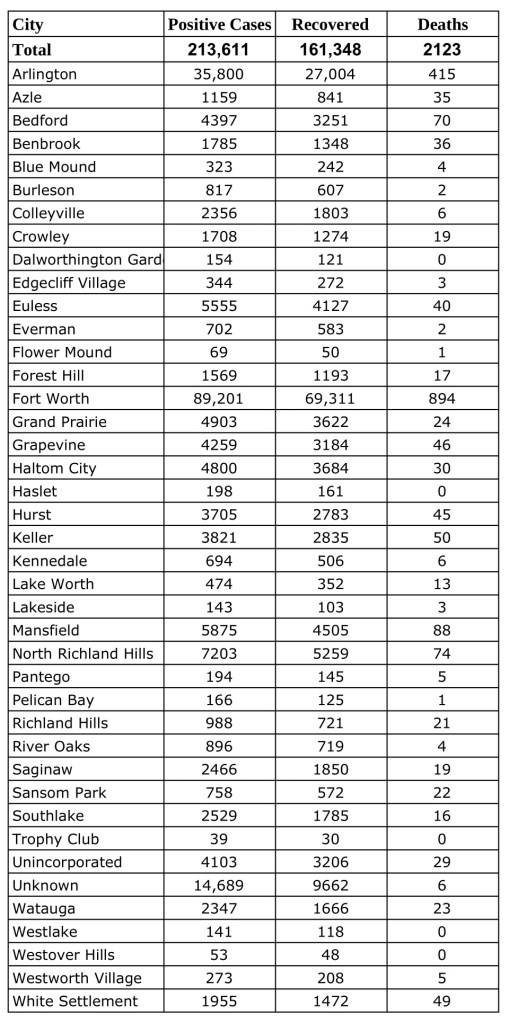
Data from Tarrant County Public Heath’s (TCPH) report of COVID-19 activity in Tarrant County, updated Monday, February 8, 2021.Find more COVID-19 information from TCPH here.
*These data are provisional and are subject to change at any time.
Deaths and recovered cases are included in total COVID-19 positive cases.
Data from Tarrant County Public Heath’s (TCPH) report of COVID-19 activity in Tarrant County, updated Thursday, January 28, 2021.Find more COVID-19 information from TCPH here.
*These data are provisional and are subject to change at any time.
Deaths and recovered cases are included in total COVID-19 positive cases.
This piece was originally published in the January/February issue of the Tarrant County Physician. You can read find the full magazine here.
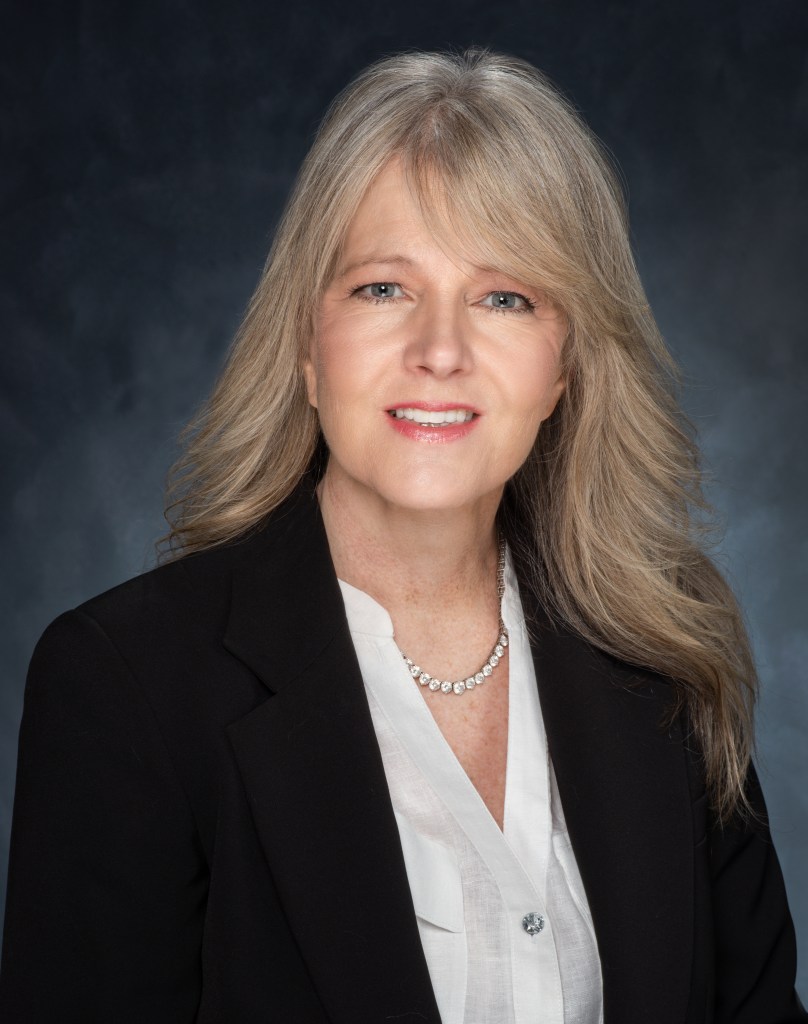
Dr. Angela Self always had an independent spirit. At age 17, fresh out of high school, she left her home in Las Vegas to make a life for herself in New York. As she was growing up, Dr. Self did not dream of becoming a doctor, but she never shied away from an adventure. Looking back, she thinks the decision to pursue Medicine shouldn’t have been such a surprise. When she was 14, Dr. Self volunteered as a candy striper at Southern Nevada Memorial Hospital (now University Hospital), and shortly after she moved to New York, she began working as a dental assistant. “Maybe it was a foreshadowing, but I had never even considered that I would go into Medicine,” says Dr. Self.
The idea to shift directions came suddenly. One day, after assisting with a procedure, Dr. Self began questioning her path. She was filled with a desire to care for patients directly in a capacity where she could serve as their advocate. Medical school came to her as the obvious answer, but she knew it would be a long, winding path. She did not yet have an undergraduate degree so she approached the decision thoughtfully. “Through a process of prayer, and seeking, and volunteering at my ambulance corps, I really felt a strong leading that I was to go to medical school. Once I knew I was going, there was no question in my mind from that moment.” When she felt confident that this was her future, she quickly began making changes to prepare for the long years of study that lay ahead.
Dr. Self realized that she would need a flexible job to support her education, one that would give her freedom to go to classes during the day. She was also hesitant to step away from the clinical interactions she had with patients as a dental assistant. “I thought, it’s going to be eight years before I can do anything,” remembers Dr. Self. “Here I had been working as an oral surgical assistant, a dental assistant. I had been in ORs with an oral surgeon and had been able to do hands-on things.” Because of this, as she began attending classes at a local community college and continued to work full time, Dr. Self also received training as an EMT and a paramedic.
She joined South Orangetown Ambulance Corps in 1987. It was an exciting but hectic time. Dr. Self had three different jobs at that point and picked up extra shifts on the ambulance whenever possible. She worked nights, clocking an average of 60 hours a week while still taking a full load of classes. Despite her long work hours, she was hesitant to slow down. She transferred to Pace University in 1990 and graduated with a BS in Biology in 1992.
At that point, Dr. Self ran into some barriers. She applied to medical school in New York but ended up being waitlisted. Because of her extreme work hours, she had not been able to maintain a 4.0 GPA. Dr. Self was concerned that this would stop her from going to medical school; it was the first time she began to doubt that she had made the right decision. She considered several alternatives, such as pursuing social work, becoming a pharmacist, or even getting an advanced nursing degree.
“Dr. Angela Self is an amazing colleague who I have the pleasure to work closely with on many projects. She is compassionate, honest, hardworking, and has everyone’s best interest at heart. I have the utmost confidence that she will represent Tarrant County Medical Society with dignity, compassion, and will be an overall amazing leader.” – Neerja Bhardwaj, MD
Then, a new opportunity arose. “A friend that went to St. George’s in Grenada suggested that I apply there,” says Dr. Self. She knew it would be a big change—Dr. Self hadn’t planned to leave New York for medical school, much less the U.S. Still, she was intrigued. “I had a couple of friends that I really admired that were going to St. George’s,” she shares. They were very positive about the school, so she decided to apply. She was accepted into the program and began classes in 1994.
Looking back, Dr. Self realizes that she could have applied to other U.S. medical schools, but she has no regrets. Living in Grenada gave her the opportunity to learn hands-on about diseases that are rarely seen in the States, due to Grenada being a developing country. She also gained some wonderful mentors at the school, including Dean of Students Dr. C.V. Rao. “He taught us, he mentored us, he watched out for us, and remains a friend, I think, to everyone who ever went there.”
While in medical school, she was on call for student emergencies. She also continued picking up shifts as a paramedic whenever she was on breaks. It was difficult to work so much while completing her education, but the benefit of financial security coupled with the valuable patient care experience made it worthwhile.
Dr. Self moved back to the U.S. in 1996 to complete her clinical rotations, working between New York and Baltimore. She graduated from medical school in 1998 and began an internship in anesthesiology at the Medical College of Virginia in Richmond. Though anesthesia was appealing, she had a passion to care for geriatric and terminal patients, so she believed her future was in oncology.
At this time, Dr. Self had a big life change—she gave birth to her daughter, Whitney. She took ten months off to care for her young child, until they moved to Texas. At that point, Dr. Self completed her internal medicine residency at St. Paul Hospital in Dallas. It was a difficult time to be going through the intensity of residency. “It was really hard to go every day because I felt I was robbing my daughter of having a mom,” says Dr. Self. She is grateful to her mother for taking care of Whitney, filling the gap when Dr. Self couldn’t be there.
As she completed her residency, Dr. Self fell in love with primary care. She was also ready to focus on her future. “I needed to commit to motherhood and Medicine, and I felt I could do that by doing internal medicine,” says Dr. Self. When she finished the program, she joined a private practice. Dr. Self worked as an internal medicine physician for 15 years. She was employed at three different clinics throughout that time; at one point, she worked for David Pillow, MD, a well-known pillar of the Tarrant County medical community. “Dr. Pillow taught me that patients will tell you what’s wrong if you just listen,” says Dr. Self. He helped her to avoid developing tunnel vision when treating her patients. “His physical exams were amazing. He taught me so many things that you never learn in medical school.”
Dr. Pillow’s guidance along with an extensive background in emergency care made Dr. Self a strong diagnostician. She was quickly able to discover the root of a problem, especially when critical treatment was required. Twice, she was able to get patients immediate care when they came to appointments mid-heart attack, even though their symptoms were irregular. Because she wanted to serve older patients, whenever she joined a new clinic, the Medicare patients were sent her way. “I got the ones with heart failure, liver disease, lung disease, and cancer, and then I got involved with hospice. That fulfilled that longing in me to work with end-stage patients. I did get to do what I wanted after all.”
Still, there was a downside to private practice; it was difficult to manage financially. “Medicare didn’t pay that much, and geriatric patients take a lot more resources, need a lot more time, so you see fewer in a day and reimbursement is lower, but it was what I was passionate about so I did it as long as I could.”
Eventually, Dr. Self made the move to working in administrative medicine. She has been on the other side of care for about five years now; currently, she is working for an accountable care organization. Though she misses taking care of patients, there are many advantages to her current role. “I can advocate for more people in an administrative role than in a primary care practice, where I might have one to two thousand charts, so I can affect one to two thousand lives in practice,” shares Dr. Self. “Now I can affect many more lives.” One of her focuses is improving the patient experience in post-acute settings.
While the change may seem dramatic, Dr. Self has been involved in organized medicine her whole career and has seen the impact of physicians advocating for their profession. She has been a longtime member of TCMS. In the early 2000s, she helped to review cases for the Public Grievance Committee. Dr. Self became more involved during the 2014 Ebola crisis. She was impressed by the way TCMS, TMA, and the AMA worked together to protect patients and physicians, and she knew that was something she wanted to be a part of. “Ever since then, I’ve made attending TCMS’s monthly board meetings part of my job negotiations!”
Dr. Self Is an active member of the TCMS Board of Advisors and the Women in Medicine Committee; she also attends TMA and TCMS meetings whenever possible. “(TCMS board member) Gary Floyd says, ‘Good doctors take care of their patients. Great doctors take care of their patients and their profession,’” says Dr. Self. “Being part of organized medicine is helping to take care of your profession. When doctors go down to Austin and speak with lawmakers in their white coats, it changes the way that we are viewed.”
Her fellow physicians look forward to seeing her in this new role as president. “Dr. Angela Self is an amazing colleague who I have the pleasure to work closely with on many projects. She is compassionate, honest, hardworking, and has everyone’s best interest at heart,” says Neerja Bhardwaj, MD, a palliative care physician practicing in Dallas. “I have the utmost confidence that she will represent Tarrant County Medical Society with dignity, compassion, and will be an overall amazing leader.”
In the next year, Dr. Self hopes to grow physician membership and participation in the Medical Society. She believes in the power of banding together to give doctors a voice for their profession and their patients. She also wants to serve as a resource, particularly for independent physicians who are struggling with the fallout from COVID-19. She thinks providing opportunities to connect with other physicians is an important part of this support. “Talking with other doctors who have experienced the same things helps,” shares Dr. Self. “I’ve been there.” All of this ultimately comes together for one purpose: to serve patients excellently and effectively.
When advising those who are considering going into Medicine, Dr. Self encourages getting as much exposure as possible before taking the leap. “Make sure you have fully answered the ‘why’ for medical school,” says Dr. Self. “Make sure it is something you are passionate about.” Shadow a physician, work as a scribe—whatever it takes to make sure you have found your calling in life. It isn’t an easy path, but it can be incredibly rewarding. “There is nothing else I would rather do.”
When Dr. Self is not working or attending meetings, you might find her volunteering at the Cornerstone Assistance Network. Even though she doesn’t currently practice in a clinic, Dr. Self still enjoys getting to treat patients, especially those who are struggling to access care. In her free time, Dr. Self loves traveling and going to live concerts. Last year she was able to attend the Eric Clapton Guitar Festival. “It was amazing and made me realize that I love the Blues. I didn’t know I loved the genre before that!” A highlight of her trips is always searching for the best lattes in hole-in-the-wall cafés. Dr. Self loves coffee—she even runs a blog to talk about her caffeinated discoveries (you can read some of her stories at coffeebyangela.com).
She enjoys going on these trips (when there isn’t a pandemic!) with friends and family. Dr. Self has the most fun when her daughter can come along, but Whitney is pretty busy these days. She is currently working on completing her undergraduate degree with the goal of applying to medical school in the near future.
We are excited to support Dr. Self as she prepares to lead us as we serve the citizens of Tarrant County and the community of Medicine.
This piece was originally published in the January/February issue of the Tarrant County Physician. You can read find the full magazine here.
Though I vowed not to touch the pandemic as a topic, it seems to be the one thing that’s on my mind. Still crazy after all these months.
I was in Florida when I saw President Trump come on television and announce that we were facing some big changes due to the coronavirus. What I remember most was that his face was white as a sheet and his voice, uncharacteristically, had no dramatic intonation. The serious look on his face and the coming lockdowns scared me much more than the thought of running out of toilet paper. I knew we were headed for a major disaster in this country and it hit me in the gut, hard. I cried easily and often for the next two weeks. I mourned the loss of my country. I knew that many would die, that we would be divided over the handling of the pandemic, and that the pandemic would be highly politicized. I kept changing the channel that March day in 2020. Forgetting Sarah Marshall was needed, and fast. It was an election year and we were already dealing with the polarity of being either a Democrat or a Republican, and now we would be divided over COVID-19 controversy. Let me just say that I have never, ever wanted to get sick from anyone in any public place who was coughing and spewing infectious particles. Masking is about the best idea I’ve ever heard of; I think it’s a great way to decrease disease spread during every cold and flu season, as well as in a pandemic. I once missed Thanksgiving with my family after my sister called and said, “We’re going, but John is sick and he’s running a fever.” I took the next exit off of I-35, turned around, and spent Thanksgiving home alone. It was worth it.
This past January I was speaking with a girlfriend who was getting over a pretty bad upper respiratory infection. She wasn’t sneezing or coughing, but as we talked a little spit droplet flew out of her mouth and into my eye. When that happens, and it does, I just say, “Whatever they’ve got, you’ve got it now.” I do not get that close, or face to face, to this friend anymore. Some people have to spray it when they say it, and COVID-19 is the last thing you want to have sprayed in your face. Looking back over this year I remember a few of my friends had severe upper respiratory infections. Was it COVID-19? Maybe. It seems like years ago that it was okay to cough or sneeze in public, but not now, and it’s just been a little over nine months. Now when a dust particle brings on an unexpected sneeze, the next thing you hear is, “It’s just allergies, I’m not sick!” I agree with stringent infection control measures in public places. I am saddened, however, by businesses closing, millions losing their jobs, nursing homes not allowing any visitors in a safe, distanced way (meaning little accountability and possibly increased neglect), and healthcare professionals using their credentials to further polarize an already confused society.
“Masking is about the best idea I’ve ever heard of; I think it’s a great way to decrease disease spread during every cold and flu season, as well as in a pandemic.”
So what do we do? How do we move forward? I have a friend who lost his wife to COVID-19 months ago (she was an ER nurse in New Jersey), and I have another good friend who just recovered from COVID-19 pneumonia. This virus is still a public threat. People are still dying. Treatments are helping many, but like the flu and other diseases, there is not a cure. A vaccine will not be 100 percent preventive. It’s the best we’ll be able to do, but it won’t be 100 percent. Do we allow our economy to collapse or do we get back to work in a safe and smart way? It’s easy for those of us who can go to work to say, “Stay home,” as we are able to provide for our families. During this pandemic, I went to a certain coffee shop every day and sat at a table outside with my cousin (it was the only contact that the both of us had with another person during the early days of the pandemic). We would see other coffee friends pull up and have their orders delivered to their car. We watched the mask requirement come in and we complied; we still do. The thing that we mostly did was sit there every morning and act normal while supporting a struggling local business. We were socializing over coffee in a safe manner. If I had to cough (allergies) I would get up and walk around the side of the building. In the spring, if the group ever grew to over the allowed number, someone would leave and let another sit and visit. Our coffee shop owners had to lay off twenty employees and close their shop in Southlake. One of the negative consequences, besides death from illness and job loss, is depression that has been made worse due to social isolation. Though many of us feel we can safely get our groceries, have our coffee, and take care of business, as long as the protective measures are being used, there are still many who are very afraid. That fear has likely served the most vulnerable well, as they’ve had limited exposure to COVID-19, but it has cost others their lives due to depression and suicide. It has cost some child abuse victims their lives, with school being a safe place where they could escape the abuse for at least a few hours. I am grateful that Texas has allowed businesses to reopen and let our citizens get back to work and their kids back to school. This pandemic is not over yet, but hopefully, much of the devastation is behind us as we learn more about this virus and how to best treat it.
The way I would like to see us move forward is with safety protocols and measures in place, while returning to our livelihoods with moms and dads able to pay the mortgage, keep the lights on, and feed their kids. Talk about “social determinants of health”; can we even measure the food insecurity that’s out there when we’ve taken a meal away from a kid who might not get any meals at home? Let’s move ahead with disease prevention. How many mammograms and colonoscopies were not done this year, leaving cancer undiagnosed and untreated? I’ve seen some “quality” scores and there are many “gaps” that weren’t closed in 2020. The thing about open gaps is that you just don’t know which gap closures would’ve caught a disease process in its early stages.
I wanted to start off the year with an article about avoidable hospitalizations from UTIs gone wild or how medical directors are people too, but instead, I have broken my own rule about avoiding controversy. If you’re a little confused on where I stand on COVID-19, here are my thoughts: 1) respect your fellow man by wearing a mask and keeping a safe distance; 2) consider if you might be putting a high risk person at increased risk (self-quarantine if you’ve been exposed); 3) be kind to each other as many are struggling with the loss of friends, family, personal health, or their job; 4) exercise your rights and freedoms in a safe manner; 5) the virus is very real and very deadly (to some even previously healthy people); and 6) take the vaccine if you get the opportunity—it’s the best we can do to turn the tide on this pandemic. Blessings, and I look forward to an America without COVID-19.




 Tarrant County Physician Online