“Patricia” has one main goal in life: to love and provide for her three young children. But when the single mother suffered from a painful umbilical hernia, it caused so much physical stress on her body that she was unable to work. And though she still trudged through family activities, the pain made her emotionally distant. Everything important to her was being compromised, and she worried about their future – especially that of her seven-year-old, who has special needs.
“The pain was bearable in the beginning, but as time went on it was getting worse, and my belly button was sticking out,” Patricia says. “I fortunately did not have to go to the ED, but I did resort to pain medication for relief.”
She knew continually taking pain medicine was not a good long-term option, so Patricia went to Mission Arlington for treatment, thinking she might have ovarian cysts. Instead, she found out about the hernia and that she would need surgery. In that moment, she was overwhelmed by fear.
“I did not have the money,” she says. “And who would take care of my kids? How would they be provided for? A lot of thoughts came racing through my mind.”
Then Patricia was connected to Project Access, and everything began to change. She realized she wouldn’t face the financial avalanche of paying for a surgery she couldn’t afford, and she was going to finally get help for the pain that was holding back every part of her life.
Now as Patricia heals from the hernia repair, she tries to put the impact into words.
“The surgery was done perfectly,” she says. “I don’t have any pain anymore, and when I have my menstrual cycle, it is normal. It is no longer heavy or overbearing. I can do anything now; I feel amazing!”
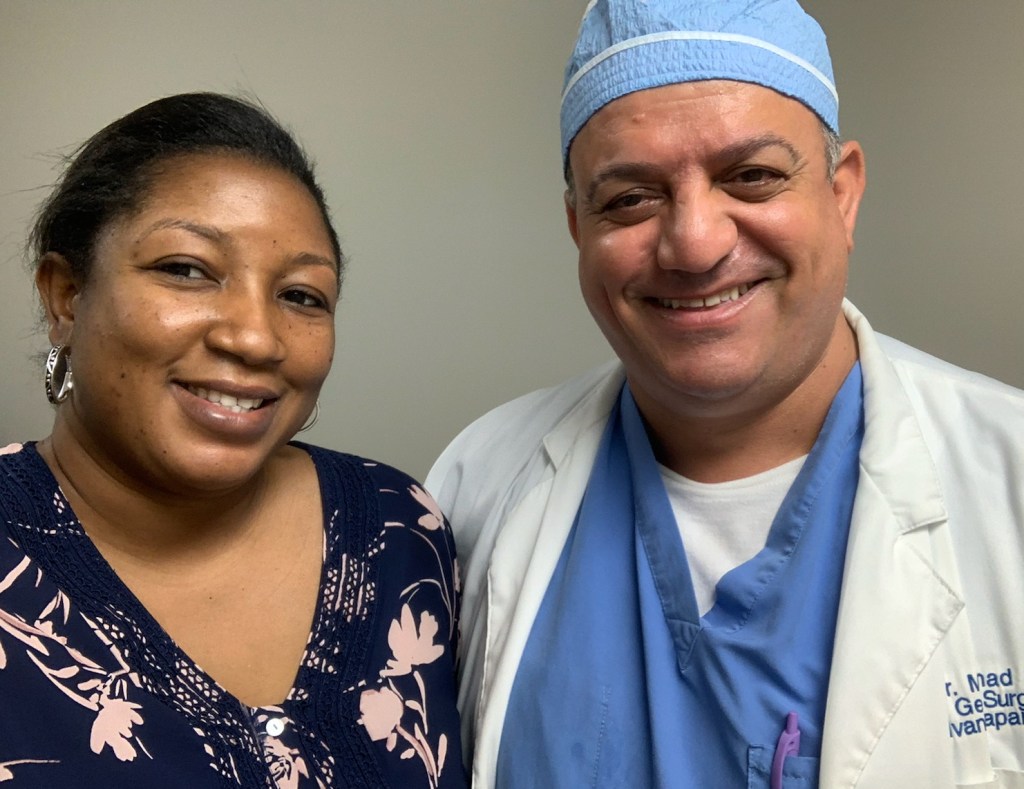
She thanks God for using the doctors and Project Access to provide much-needed care and prays that all who helped continue to be rewarded for their service. “I will always be grateful for everything Dr. Saad has done,” Patricia says. “I am so thankful for the support I received since day one and for guiding me through the process. I would not be where I am now without PATC.”
When Trey Moore, MD, started his career as a urologist in Fort Worth 26 years ago, he worked in a busy emergency department and his own private practice. In both settings, many of his patients weren’t covered by insurance and could only access stopgap care. At the same time, he was surprised by the dearth of opportunities for physicians like him to give back to their community by offering their services pro bono.
So, in 2011 he jumped at the chance to join Project Access Tarrant County, a then-nascent initiative of the Tarrant County Medical Society (CMS) that connects low-income, uninsured residents to specialty and surgical services provided by a network of volunteer physicians and facilities. Since its start, Project Access has served more than 1,700 patients and provided more than $14.5 million in donated health care.
Dr. Moore especially likes the program’s focus on surgical care, which is unique in the world of health care safety-net programs. Given his specialty, many of his neediest patients – such as those suffering from large kidney stones that cause recurring, and sometimes disabling, infections – require surgery to recover fully.
“Every [pro bono service] makes a difference, whatever we do, but [Project Access is] particularly helpful because so many of these patients – until they have a surgical resolution – are stuck in a vicious cycle of not being able to go back to work and cycling in and out of emergency rooms,” he said. “It’s a big stress on the patients and their families, and it’s a big stress on the system.”
But relieving that stress would not be possible without ongoing financial support.
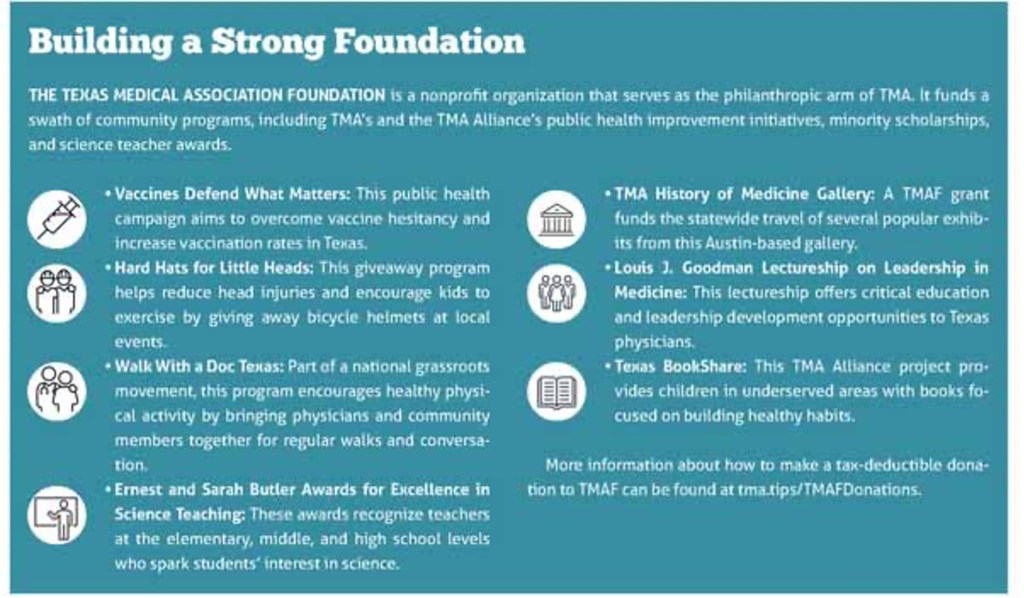
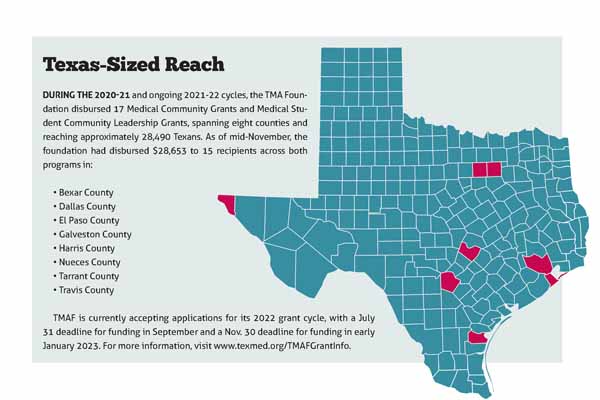
Project Access is one of several long-standing recipients of the Texas Medical Association Foundation’s Medical Community Grant program, which accepts applications from county medical societies and alliance chapters for up to $7,500 in matching funds to support unique community health improvement initiatives. The separate Medical Student Community Leadership Grants program accepts applications from TMA medical student chapters for up to $3,000 thanks to a fund established by Houston pathologist Roberto J. Bayardo, MD.
For more than two decades, TMAF’s grant programs have helped the Family of Medicine tackle the state’s most pressing health care concerns at the local level. Many grantees, including Project Access, have received funding over successive years, which allows for continuous programming. Physicians like Dr. Moore say this is especially important in Texas, which has the highest rate of uninsured residents in the nation.
Not only do the grant programs connect patients to life-changing care but also they honor TMA’s mission to stand up for Texas physicians by providing them with resources to create solutions to local health challenges and by reinforcing physicians’ trusted leadership in the community, says TMA Foundation Executive Director Lisa Stark Walsh.
“Our goal is to remove the obstacle of resources for members to do what they feel is necessary in their communities,” she said. “Medical Community Grants give physicians an opportunity to chip away at long-standing, intractable problems over the long term and to demonstrate their advocacy for the health of all Texans.”
Originally founded in 1966 as the Texas Medical Education and Research Foundation, TMAF is a separate, nonprofit entity that serves as the philanthropic arm of TMA. Since 1998, the Medical Community Grant and Medical Student Community Leadership Grants programs have disbursed $891,931 across more than 200 such grants to support myriad community health improvement programs all over Texas, ranging from vaccine clinics and border health services to breast cancer screenings and kids’ bicycle helmet giveaway events.
Houston neonatologist and TMAF Board President Michael E. Speer, MD, is passionate about growing the foundation’s endowment so it can offer even more grants that support Texas physicians and their patients. “If you look at the most successful colleges and charities, the best ones spend very little on themselves and most of their endowment on supporting the organization,” he said.
This growth mindset has paid off. In recent years, TMAF has fielded increased demand for the grant programs from county medical societies, alliance chapters, and medical student chapters. As a result, the upcoming application cycle will include a new focus area of physician health and wellness. This expansion stems from the success of a recent TMAF initiative, Caring for Physician Healers: Mental Health and Wellness Resources During COVID-19 Fund, which helped seven county medical societies launch or extend physician health and wellness initiatives during the ongoing pandemic. (See “Self-Investment: Physician Wellness Programs Bolster a Beleaguered Workforce,” November 2021 Texas Medicine, pages 22-25, http://www.texmed.org/Self-Investment.)
By harnessing the expertise of medicine to help address a community health problem, the TMAF grant programs complement the work of the association and represent the best of organized medicine, says TMA President-Elect and TMAF board member Gary Floyd, MD.
“Anyone in practice will find things that need to be changed,” he said. “When you’re alone or in a small group, you’re just a small voice yelling into the wind with very little result. When you join into organized medicine, particularly with TMA, you have [more than] 55,000 voices, and people tend to start listening.”
Physician-driven results Tarrant County Medical Society received its eighth TMAF Medical Community Grant in support of Project Access in 2021. The program’s organizers say it is a prime example of what physicians can accomplish working together to solve an entrenched community health problem. Tarrant CMS was inspired by the Dallas County Medical Society’s now defunct Project Access initiative, which focused on primary care. Given Tarrant County’s robust network of free and income-based primary care clinics, Tarrant CMS decided to gear its own Project Access initiative toward specialty and surgical care since that’s where the need was most acute.
Tarrant CMS Executive Vice President and CEO Brian Swift says Project Access runs on a shoestring budget that belies its impact. Patients are largely members of the working poor, and many are undocumented immigrants. They don’t qualify for Medicaid but typically don’t earn enough to afford private insurance, leaving them without coverage and beholden to emergency departments for symptom management. Without care that addresses the root cause of their medical problems, however, they are often robbed of their livelihoods – and sometimes their lives.
By providing specialty and surgical care to eligible Tarrant County residents, the initiative not only helps patients resume healthy lives but also saves area hospitals tens of thousands of dollars in emergency department costs. “These patients don’t have access anywhere else,” said Stuart Pickell, MD, Project Access’ medical director and an internist-pediatrician in Fort Worth.
Although physician volunteers provide specialty and surgical care, Project Access still requires funding to fulfill its mission. “Free isn’t free,” Mr. Swift said.
As with previous awards, the county medical society used the TMAF funds to offset the costs of its annual patient database subscription. “Data management does not come cheaply, so we really depend on that [funding] to be able to manage our Project Access database,” Mr. Swift said.
The grant-funded database – which Dr. Pickell describes as “essential” – allows staff to determine patients’ eligibility, which helps ensure Project Access is distributing its limited resources as judiciously as possible, and to track their care, including the donated value of medical services and administrative costs. In this way, the grant helps Project Access obtain more funding by quantifying its positive impact and cost savings.
Armed with the database, staff can focus on serving patients – and the broader community. Typical cases include a woman with cervical cancer who would have died without surgery, leaving her young children orphans; a construction worker with a hernia that kept him out of work; and a patient with osteoarthritis that had nearly disabled her until surgery allowed her to resume a productive life.
The Project Access model not only unburdens its patients and their loved ones from medical crises but also often allows them to return to work. This can be transformative, Dr. Pickell says, because a job offers the possibility of long-term health care access through employer health insurance.
After a decade of success, staff are now working on growing the program. With more than 500 volunteer physicians across numerous specialties, including ancillary care, their attention is focused on the limiting factor of operating room space and other facility needs. By renting such space, rather than relying on the whims of donors, Project Access can increase its patient volume.
Physicians would welcome such a change. “It’s such a gracious group of people,” Dr. Moore said. “They’re so grateful to get help. In a selfish way, it’s a great group to treat.”
Project Access also is keen to expand, both to meet the community need and to highlight the work physicians do every day to serve their patients. It’s supported in this endeavor by TMAF’s Medical Community Grant program, which allows physicians to spearhead solutions to the problems they’re facing on the ground.
“That’s why it’s so important for the foundation to continue doing what it does,” Mr. Swift said.
An engine for innovation Another repeat recipient, in this case of the TMAF Medical Student Community Leadership Grants program, the annual HOPE Health Fair in Galveston tackles a community health challenge while also providing medical students with the opportunity to fine-tune solutions over the long term.
The University of Texas Medical Branch (UTMB) TMA Medical Student Section chapter hosted its fifth annual event in November thanks, in part, to its fourth annual TMAF grant award. The fair connects approximately 250 uninsured Galveston residents – around a quarter of whom are homeless – to vaccinations, health care screenings, meals, and educational resources through the St. Vincent’s Student Clinic at UTMB. It also serves as a critical outreach opportunity in Galveston County, where 17.4 percent of residents under age 65 lack health insurance, according to the U.S. Census Bureau.
“We’re just catching ships in the night, people who frequently never have access to health care,” said John W. Davis, one of the event’s organizers and a third-year medical student at UTMB who also is pursuing a PhD.
The HOPE Health Fair received a $3,000 Medical Student Community Leadership Grant from TMAF in 2021, which covered about 40 percent of the overall cost. Without it, organizers would not have been able to host the event. “It’s very helpful for us to get this grant each year,” said Jenna Reisler, a third-year medical student at UTMB and an event organizer.
In addition to providing critical funding, the grant also has spurred innovation. Because the organizers are repeat recipients of the grant program, they take pains to improve the event each year. In 2021 they used the award to offer rapid COVID-19 testing and screenings for sexually transmitted infections, including HIV and hepatitis C.
By offering screenings, the organizers not only help attendees detect any debilitating illnesses they might have contracted but also prompt them to return to the student clinic to get their results and receive treatment. Once attendees have made the jump from the health fair to the student clinic, they can receive treatment for underlying health problems, such as diabetes and hypertension, and start to build patient-physician relationships.
In this way, the health fair functions as a kind of benevolent Trojan horse, linking Galveston’s most vulnerable residents to health care for years to come. “It’s a way to show people that we care about them,” Mr. Davis said.
Global reach Located in a top U.S. county for refugee resettlement, the Baylor College of Medicine (BCM) TMA Medical Student Section chapter and the Houston nonprofit Alliance for Multicultural Community Services have used the TMAF Medical Student Community Leadership Grants program to host the BCM-Alliance Refugee Health Fair. The annual event helps refugees navigate the local health care system – and provides medical students a glimpse at global health in action.
Like the HOPE Health Fair, the BCM-Alliance Refugee Health Fair aims to serve as a conduit for attendees to long-term health care access. At an upcoming event scheduled for this spring, student volunteers will distribute hygiene kits – including soap, hand sanitizer, masks, and health care resources in multiple languages – via a COVID-19-safe drive-thru. Attendees also will receive basic preventive health screenings and flu vaccines from local free and income-based clinics.
Although refugees can access Medicaid for up to eight months upon their arrival in the U.S., they are expected to secure private insurance afterward. This is a complicated process that can quickly fall to the bottom of a refugee’s to-do list, overtaken by tasks such as learning a foreign language, securing a job, and familiarizing oneself with the local public transit system. But the BCM-Alliance Refugee Health Fair aims to smooth attendees’ search for health care by introducing them to the Alliance and area clinics.
“Ultimately, even if these patients don’t stay on with these clinics, they at least have a starting-off point to return to if they develop a medical issue in the future,” said Avery Haugen, a fourth-year medical student at Baylor and one of the event’s organizers. “It really alleviates a lot of the stress of those first steps.”
The Baylor TMA student chapter will use its latest TMAF grant – its fifth – to print promotional flyers, purchase hygiene kit supplies, and furnish volunteers with personal protective equipment. The grant, which accounts for nearly all of the event’s budget, is critical to its success.
“This event is really not possible without the help from the TMA Foundation,” said Chris Wong, a fourth-year medical student at BCM and another event organizer.
In addition to educating refugee attendees about the local health care system, the event also serves as a critical learning experience for the medical students involved. Both Ms. Haugen and Mr. Wong are interested in global health, which is partly what prompted them to get involved with the fair.
“The event was really my first exposure to the idea of refugee health [and] the very specific health disparities that immigrants face, especially in our very complicated health system,” Mr. Wong said.
Similarly, Ms. Haugen sees the event as a unique opportunity to learn more about global health while studying medicine in Houston – and largely prohibited from international travel by the ongoing pandemic.
“For us, the refugee health fair is a really unique example of a way to promote global health on a local scale,” she said.
Concerned about those in Tarrant County who go without healthcare or who are forced to get emergency care because they cannot afford necessary medical treatments? Consider joining Project Access Tarrant County’s Lunch and Learn on April 20 from 11:45 to 1pm. At this event, you will have the opportunity to:
Learn how we are making a difference for Tarrant County’s low-income uninsured residents
Hear from our staff, physician volunteers, and patients
See how we provide healthcare services for those in greatest need and how our new initiative will expand services
You can register for this free event here. It is targeted toward those who work in healthcare and everyone who is passionate about helping the underserved of our community.
Project Access Tarrant County, which was founded in 2010, is a non-profit organization dedicated to expanding health care access and improving health outcomes for low-income, uninsured residents of Tarrant County, utilizing the charitable gifts of a network of existing voluntary providers and collaborative partnerships.
To date, Project Access has:
Scheduled 10,500 medical appointments
Enrolled over 2,100 patients
Provided over $18 million value in donated medical care
Performed 810 surgeries and hospital procedures
Their vision is for all Tarrant County residents to have access to a continuum of care, which includes specialty, pharmacy, laboratory, ancillary, and hospital care. Come on April 20 and see how you can partner with Project Access to bring healing and hope to those who most need it.
“It was stressful knowing I was not going to make ends meet.”
When “Roberto,” a 49-year-old husband and father of two, began experiencing a burning pain in his torso from an inguinal hernia, he knew he needed to do something about it. Throughout the day it would grow in intensity, making it difficult for him to work. Roberto’s hours were cut, and he eventually had to take an entire month off of work.
“I could not do anything,” he says. “I was falling into a hole of depression.”
The family was experiencing tension from the economic burden, and it was impossible to consider surgery with the financial struggles they were facing day to day. Then, he went to Cornerstone Clinic, where he was referred to Project Access.
“I am very thankful for Dr. Siadati, who was very attentive, respectful, and patient,” says Roberto. “I especially appreciated the patience Dr. Siadati showed when it came to the language barrier we had.” He thanks everyone who made his treatment possible, from those working the front desk to his doctor.
Since the surgery, Roberto has been improving steadily, and he was just cleared to return to work. He is optimistic about the future – he doesn’t feel stuck anymore in the cycle of pain and frustration. “It was a blessing, the entire process.”
“‘Angela’ was stuck. Osteoarthritis in her left hip was holding her hostage.”
Join us as we pick up on Project Access patient Angela’s story in Angela – Part II. You can readAngela – Part I here to learn how Project Access partnered with NTACHC to connect her to a medical home and access to critical presurgical clearance.
After years of debilitating osteoarthritis in Angela’s hip, after overcoming the roadblocks of stress tests and lack of basic medical care through Heart Center of North Texas and NTACHC, it was time for the pain to go away. Project Access volunteer Dr. Mark Woolf of Arlington Orthopedic Associates agreed to perform the hip replacement, believing it was absolutely necessary to Angela’s recovery.
Project Access coordinated the surgery at Baylor Orthopedic and Spine Hospital at Arlington, where U.S. Anesthesia Partners – Arlington Division would provide anesthesia. It was on the docket.
No matter how anticipated a surgery may be, though, there is always a level of anxiety that rises as it draws closer. We wonder if it will help our pain, if our doctor cares about us as individuals. We wonder if this is truly the answer we’ve been searching for.
As soon as the surgery was complete, any fears Angela carried with her were wiped away. She remembers the process being seamless and was overwhelmed by Dr. Woolf’s attentiveness.
“He visited me often; he came on my last day at the hospital to check on me and ask how I was doing,” Angela says. “He had already volunteered so much of his time for the surgery, and he continued doing so!”
After she healed from the hip replacement, everything changed. Angela now has a new job and is able to go to family gatherings and care for her house – things that arthritis had once taken from her. She says she is motivated by the prospect of a future that is not dominated by pain and that everyone who helped her get the surgery is like “God’s healing hands on earth.”
“Being able to have had this surgery has been a blessing for me and my family and is the most wonderful gift anyone could have received,” Angela says. “I will always be thankful for Project Access because they guided me through this whole process and helped so much.”
How can you access specialty care when your most basic medical needs are going unmet?
“Angela” was stuck. Osteoarthritis in her left hip was holding her hostage. The 52-year-old mother of three had to stop attending family gathering and doing performance-based tasks because the pain was too extreme.
“I felt overwhelmed and frustrated because I would wake up with intentions of getting things done but then as I started moving the pain in my hip was so severe that I had to completely stop what I was doing,” she says. “I could not even sit comfortably without having pain.”
The burden was even greater than that, though – she was no longer able to help her husband of 26 years support the family. Working was impossible when even household chores caused too much pain.
She sought treatment with rheumatologists as self-pay when she could afford it, but there was only so much they could do. She needed surgery.
Angela was frustrated; she felt like she was stuck in a never-ending cycle. Her family was suffering both financially and emotionally because of her hip problem, yet she could not rectify the situation because the cost of medical care was just too high.
And though Angela did need the hip replacement, her arthritis was only one piece of her medical puzzle. While she had been able to access some rheumatology care, she did not have a primary care physician to manage her routine care, or the comorbidities associated with her arthritis.
Project Access had a bigger part to play than solely connecting her to a volunteer. Angela needed more services, and we were determined to find them for her.
Since Angela did not have a primary care physician, it was important establish her with one so they could address her numerous secondary issues. NTACHC seemed to be a good fit, and Project Access was able to connect her to their care. NTACHC provided routine checkups and preoperative testing, and Project Access worked with them to guide Angela through the hoops of surgical clearance.
Finally, it was time for the pain to go away.
Tune in tomorrow to hear the rest of this patient’s story in Angela – Part II.
This piece was originally published in the January/February 2022 issue of the Tarrant County Physician. You can read find the full magazine here.
Isn’t it great when a business has more clients than they know what to do with? Of course! It’s a problem most business owners would beg for unless they are providing critical medical services to those in need.
At Project Access Tarrant County, we are honored to have the opportunity to provide surgical treatments to our client base. While PATC can always use more volunteer general surgeons, gynecologists, and orthopedists, lack of volunteers is not the main issue. Many of you have eagerly and graciously given of your time and expertise to these patients. We are all grateful for your time and efforts.
Unfortunately, the number of patients far exceeds the volume that Tarrant County hospital partners can provide on a charity basis. For us, having clients on long wait lists or undergoing emergency surgery because PATC is unable to coordinate their surgeries is heartbreaking. We don’t want these outcomes to become normalized or acceptable.
In 2020, we began working toward reducing our wait times. While progress has been slow, we have made significant strides in this direction. After considerable research into alternative services offered by peer organizations across the country, we have identified an opportunity to strengthen the number of patients we can serve through an additional lane to our current panel of services. To be clear, Project Access Tarrant County as it currently exists is not going away.
Introducing – Access Surgery Partnership. Based on Surgery on Sunday, a medical nonprofit organization in Lexington, Kentucky (www.surgeryonsunday.org), Access Surgery Partnership will host surgery days in a separately leased surgery center on a periodic basis on a day when the facility would traditionally be closed. The surgery center partner(s) will receive compensation for use of the facility. The surgery center staff will be comprised of teams of volunteer surgeons, nurses, and ancillary staff, both medical and non-medical. The united surgery center staff will perform multiple outpatient surgeries and procedures in one day, effectively eliminating long surgery wait times.
The traditional PATC model will still exist as we realize that not all procedures are appropriate for an outpatient setting, and not all physician volunteers will participate in the new model. We will still need our current hospital partners in order to serve our client base.
We are not doing this alone. We are building a strong foundation for this new service line by collaborating with Brittain-Kalish Group and Dynamic Development Strategies to complete a proforma, business plan, timeline of milestones, and a long-term development plan. Several funders have shown interest in backing this initiative, and we are continuing to cultivate and update those parties as we progress. In fact, the Sid Richardson Foundation has singlehandedly funded the “discovery phase” of this project as we research and plan.
A lot of work remains to be done with various challenges to overcome. Our primary and most imperative challenge is finding a surgery center partner. Additional challenges include recruiting volunteer medical non-physician staff and obtaining our own surgery center license.
This is where you come in. We need your help!
1. CONNECTIONS to Leaders!
o Do you know leadership at a Tarrant County surgery center?
Please make an introduction to PATC!
2. Staff VOLUNTEERS! Talk to your medical staff about volunteering.
3. STEP UP YOURSELF! If you have not been able to volunteer previously due to conflicts, this new model may be more conducive to your schedule.
o Contact me and we can discuss options!
As other opportunities to help arise, we will let you know about them. We will also keep you apprised of our progress towards making Access Surgery Partnership a reality. With the Tarrant County Medical Society membership, we know we are well on our way.
Melanie was the one suffering with a hernia, but it was hurting her entire family
by Allison Howard
All too often, struggles with our health bleed into other areas of our lives. “Melanie’s” hernia did not just cause her stomach pain and inflammation – it stopped the mother of three from playing soccer with her children. It made her struggle with depression and lack of motivation. It made her worry about the future.
Melanie had to go to the ED several times because the pain became severe, and she worried that her condition would become worse. Her children were anxious about their mother’s health, and she was concerned about them – her youngest is only one year old.
She sought care at Cornerstone Health Network, and it was there that Melanie was referred to Project Access. At that point she was relived – there was hope for the future. Melanie knew she would receive the care she needed, the care that she could not otherwise access due to lack of resources.
Melanie was referred to Project Access volunteer Dr. Mohamad Saad, who agreed that she needed surgery to repair the hernia. Dr. Saad performed her surgery at Harris Southwest Hospital, and anesthesia was provided by US Anesthesia Partners – Southwest Division.
Now, Melanie is again playing with and taking care of her children without pain. She is grateful to everyone who made this possible – from Project Access to Dr. Saad and his staff – because it has given her the opportunity to live a better life.
One of the things that makes Melanie happiest is knowing that it doesn’t stop with her – that many other people have also received critical care through these services. She shares her thanks for the help and genuine care that is extended to Project Access patients.
More than anything, “Katie” wanted to see her children clearly again.
“My eyes were always irritated and red and would burn,” she said. “I would think to myself, ‘What are my children going to do if I cannot see?’”
Without medical insurance or the financial means to seek help for her condition, Katie was at a loss. And to make matters worse, her condition worsened during the COVID-19 pandemic, making it even more difficult for her to find assistance.
“We were going through a hard time,” she said. “I did not think receiving the care was going to be possible. I knew I was going to have to stay like that because we could not afford it.”
Kate was also worried about her children. During remote learning, she wasn’t able to see the computer monitor well enough to help her four young children with their schooling.
“My 13-year-old daughter was very scared about getting my condition in the future,” she said. “She would ask me, ‘Am I going to get what you have?’ I would reassure her that she would be okay and not get it, but I did not want her to worry.”
Katie sought care at Community Eye Clinic. The optometrists there diagnosed Katie with bilateral pterygia that had encroached on her eye so severely that a cornea specialist was required to save Katie’s sight. They referred Katie to Project Access and she was connected to Patricia Ple-Plakon, MD, of Cornea Consultants of Texas. Dr. Ple-Plakon agreed that Katie required surgery.
“Dr. Ple-Plakon gave me her full attention,” Katie remembered. “She was so nice and helpful. I tell all of my friends and family that they need a doctor like her. She told me she was going to do everything possible so that I would be okay.”
Dr. Ple-Plakon performed the surgery at Arlington Day Surgery Center, and the impact on Katie quickly became evident.
“I was very nervous, but the nurses made me feel safe and secure,” she said. “I was not in as much pain as I thought it was going to be. I noticed the difference in my eyesight a couple days after my surgery. I feel so much better now. I feel comfortable driving now. I do not have any more problems.”
Post surgery, Katie has been able to do many of the things she missed because of her blurry vision – such as reading to her kids. “My case worker, Diana, was so kind in helping me through the process,” Katie said. “I would like Dr. Ple-Plakon to know that I really appreciate all her help. She is my angel. I would also like to thank Project Access. I hope they continue helping people who truly need help. They can really change a person’s world.”
This article was originally published in the September/October issue of the Tarrant County Physician. You can read find the full magazine here.
I will remember Project Access forever because not only did it save me, but it also helped my family.
I am twenty-eight years old. I have been married for seven years and I have a son and a daughter. Five years ago, I was diagnosed with rheumatoid arthritis. Doctors were shocked. They had never seen a patient my age with such severe rheumatoid arthritis.
My condition has affected everything. It has been the cause of my depression. I felt like giving up on life. I could not be a mom or a wife. My husband would always see me sick and in pain. I could not take my kids to the park. My son would ask me to kick a ball with him, but I could not do simple things.
It has been a major setback in my life. Since being diagnosed, I have had to quit three jobs because of my arthritis, especially in my knees.
This year has been hard because my pain has increased so much. It has been hard on me physically, emotionally, and mentally. One day, the pain was so unbearable that I went to the emergency room. After many tests, I was told that I needed an orthopedic surgeon. I knew that it was going to cost so much money. My husband told me that he did not care if he had to give up his whole paycheck for me to go to the doctor but that I was going to get the care I needed. That was when I started seeing Dr. David Brigati at Texas Bone and Joint. He immediately saw how bad my condition was and he told me he did not care what he had to do, that he was going to help me. He contacted Kathryn and that is when Project Access started helping me.
Dr. Brigati performed my double knee replacement at Baylor Surgicare. My life has changed so much since the surgery. I am 70-80 percent better. I can walk and get around on my own now, which is a huge accomplishment for me. I can finally drive and get in my car. I have been able to take myself to the grocery store. This past Sunday, my family and I went to the zoo. It was a big milestone for us because I was able to walk and go up and down the stairs. My husband kept asking me if I was okay because he couldn’t believe how much I was able to walk at the zoo.
Project Access also connected me to Baylor Community Care Clinic, where I have been seeing a therapist, and that has helped my mental health so much. The fact that I am now able to move freely and be more independent has helped me mentally. I feel so much better knowing that my family is not so concerned about me because they know I am improving day by day.
I will remember Project Access forever because not only did it save me but it also helped my family.
I have been connected to a rheumatologist, and I plan on starting treatment soon. Eventually I hope to go back to work because I can finally walk.
I want Dr. Brigati to know that I am forever grateful for him. He listened to me, understood me, and validated me. He did not just help me. He helped my husband, my kids, and my whole family. He helped me come back to life. I just want to say “thank you.” I do not have words to describe my appreciation. We need more doctors like him.
For a long time, I dealt with so much pain that was contributed to my depression. It has been very hard for me to get healthcare. I just wanted to stop trying. I did not know there are resources out there that are willing to help. It’s amazing to me that there are organizations that want to help others. I have seen how much the surgery and physical therapy costs and I am so fortunate to not have to pay for these services. I am so grateful that PATC was able to help me. Diana and Kathryn were so helpful, and I am grateful for their patience. They have been a huge blessing in my life. I will remember this forever because not only did it save me, but it helped my family.