SELF-CARE FOR HEALTH CARE WORKERS DURING A PANDEMIC

Public Health Notes

by Catherine Colquitt, MD – Tarrant County Public Health Medical Director

This piece was originally published in the January/February 2022 issue of the Tarrant County Physician. You can read find the full magazine here.


Almost two years into the COVID-19 pandemic, healthcare workers (HCWs) and those who study them are cataloging HCW burnout and compassion fatigue at epic levels. But experts who study HCWs have been describing and attempting to address these phenomena long before anyone could have imagined the impact of COVID-19 on our world and the healthcare systems we inhabit.

Very early in the course of the world’s experience with COVID-19, investigators began to sound alarms about the secondary trauma HCWs may sustain by caring for those infected with the virus. There was concern about HCWs being forced to make decisions about allocation of scarce resources, placing themselves and those they love at risk for infection through their work-related COVID-19 exposure, and having to deliver bad news to patients in person and to their families remotely.  There was also concern about the moral injury caused by the deaths of so many in their care from a disease for which treatments remain somewhat limited. 

Lai et al in JAMA Network was one of the first authors to publish on mental health outcomes of pandemic HCWs in China.1 The paper evaluated 1,257 HCWs in Chinese hospitals with Fever Clinics or COVID-19 wards and found that a large proportion of survey respondents expressed symptoms of depression, anxiety, insomnia, and emotional distress. Their findings supported the need for a range of responses including various psychological support services. 

Later in 2020, researchers in Italy examined “professional quality of life” in the context of the COVID-19 pandemic and sorted 627 subjects into two groups: those caring for COVID-19 patients and those not working with COVID-19 infected patients.2 They found statistically significant differences between HCWs caring for those with COVID-19 and those who were not, and those differences centered around perception of stress, anxiety, and depression as assessed by various scales akin to the PHQ9, a questionnaire designed to identify subjects at high risk for depression. These investigators found higher levels of “stress, burnout, secondary trauma, anxiety, and depression” among HCWs caring for COVID-19 patients, but they found no difference in their survey aimed at assessing “compassion satisfaction” between the two groups.  Compassion satisfaction for these researchers “encompasses positive aspects of working in healthcare” and the embodiment of “empathy and a strong desire to care for those who are suffering.” 

Perhaps most encouraging in the Italian study was the finding that compassion satisfaction among HCWs treating COVID-19 patients allowed these HCWs to use their capacity for empathy and the emotional support they received from coworkers, family, and friends to function effectively during the pandemic without losing hope or a sense of purpose. The Italian study concluded that “the mental health of frontline workers demands more study” to devise preventive and intervention strategies. 

What can such prevention and intervention strategies look like? Mental Health America (MHA) surveyed HCWs with a web-based tool from June to September 2020, and the majority of respondents reported stress, anxiety, and feeling overwhelmed.  They also reported concern about exposing loved ones to COVID-19, as well as emotional and physical exhaustion, inadequate emotional support, and inadequate time and energy to parent effectively.3 The MHA survey respondents included 52 percent with potential COVID-19 exposure at work, 20 percent with no COVID-19 exposure at work, and 28 percent with definite COVID-19 exposure at work.  The majority of MHA survey respondents reported compassion fatigue and only 31 percent reported feelings of gratitude, 28 percent of hope, and 20 percent of pride. In addition, 38 percent of those surveyed reported increased tendencies to smoke, drink alcohol, and/or use drugs. 

MHA has a 24-hour Crisis Line for frontline COVID-19 workers, who can call 1-800-273-TALK (8255) or text “MHA” to 741741 to speak to a trained crisis counselor. 

Now psychologists and other researchers are analyzing the results of these studies and similar data to develop strategies for protecting the mental health and well-being of HCWs and other frontline workers during this pandemic and in future disaster scenarios.  Greenberg et al, writing for BMJ in March of 2020, suggested several strategies, such as adequate staffing and resources.4 This would include providing personal protective equipment and access to mental health services on demand, establishing forums in which staff members at all levels can discuss “the emotional and social challenges” of caring for COVID-19 patients, establishing other channels for peer support, and actively monitoring of the mental health and well-being of all staff.

We have all experienced COVID-19 through individual lenses as HCWs in different settings, but few of us have ever lived through a pandemic of this magnitude. We must work to remain resilient, hopeful, and grateful with help from our peers and friends. 

References

1. Lai, Jianbo et al. “Factors Associated with Mental Health Outcomes Among Health Care Workers Exposed to Coronavirus Disease 19.” JAMA Network. March 2020. https://jamanetwork.com/journals/jamanetworkopen/fullarticle/2763229

2. Trumello, Carmen et al. “Psychological Adjustment of Healthcare Workers in Italy during the COVID-19 Pandemic: Differences in Stress, Anxiety, Depression, Burnout, Secondary Trauma, and Compassion Satisfaction between Frontline and Non-Frontline Professionals.” International Journal of Environmental Research and Public Health. November 12, 2020. Doi: 10.3390/ijerph17228358

3. https://mhanational.org/mental-health-healthcare-workers-covid-19

4. Greenberg, Neil at el. “Managing Mental Health Challenges Faced by Healthcare Workers During COVID-10.” The BMJ. 2020. doi: https://doi.org/10.1136/bmj.m1211

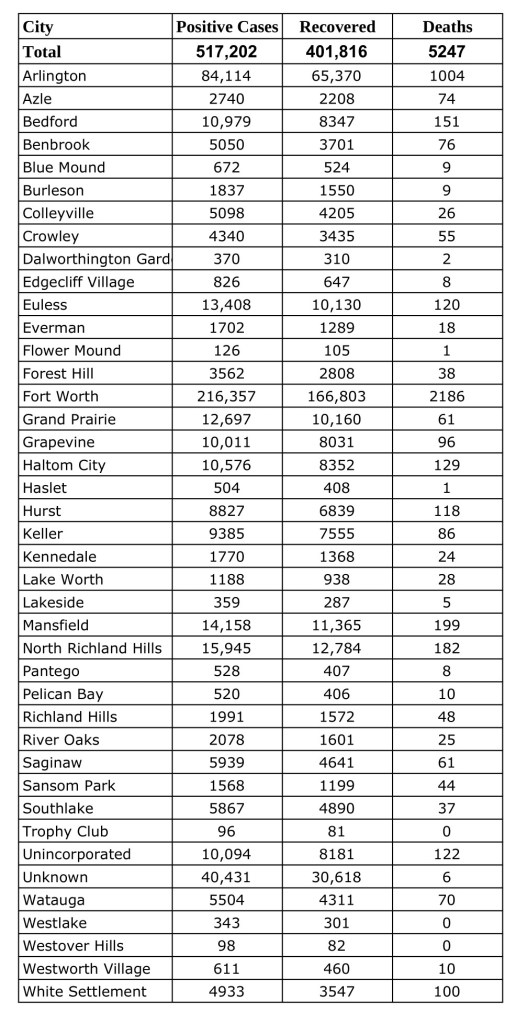
Tarrant County COVID-19 Activity – 01/28/22


COVID-19 Positive cases: 517,202

COVID-19 related deaths: 5247

Recovered COVID-19 cases: 401,816

Data from Tarrant County Public Heath’s (TCPH) report of COVID-19 activity in Tarrant County updated Friday, January 28, 2o22. Find more COVID-19 information from TCPH here.

*These data are provisional and are subject to change at any time.

Deaths and recovered cases are included in total COVID-19 positive cases.

Help State Fight Antimicrobial Resistance: Apply to Regional Committees

multidrug_resistant_bacteria_2

Physicians all over Texas can apply for the chance to help stop the spread of multidrug-resistant organisms as part of an Antimicrobial Stewardship Regional Advisory Committee (ASRAC) for one of Texas’ public health regions.

The Texas Department of State Health Services (DSHS) is now accepting applications for new members of the regional advisory committees, established by the passage of a Texas Medical Association-supported law in 2019, House Bill 1848 by Rep. Stephanie Klick (R-Fort Worth). The committees will attempt “to address antimicrobial stewardship in long-term care facilities and to improve antimicrobial stewardship through collaborative action.”

TMA considers the establishment of the committees a valuable opportunity for members with relevant expertise to take a leadership role on the topic in their communities.

Each committee will consist of physicians, directors of nursing or an “equivalent consultant with long-term care facilities,” public health officials knowledgeable about antibiotic stewardship, and “other interested parties.” Members must attend regular committee meetings (virtual or in-person), which will be held at least once every 12 months, as well as subcommittee activities, if required. Members also may need to travel to designated locations within the public health region for those meetings and activities.

The deadline for applying is Feb. 15 at 5 pm CT. Applicants will need to list contact information of a reference who can speak to your interest in and/or involvement with collaborative action designed to improve antimicrobial stewardship. Submission of a letter of recommendation also is required.

For more information, visit the DSHS Antimicrobial Stewardship page or email the agency.

Travel expenses arising from attending ASRAC meetings or other activities will not be reimbursed.

How Not to Use Rapid COVID Tests

By Julie Appleby and Phil Galewitz

Published by KHN on January 13, 2022. Read the original version here.

Julie Ann Justo, an infectious disease clinical pharmacist for a South Carolina hospital system, hoped Christmas week would finally be the time her family could safely gather for a reunion.

Before the celebration, family members who were eligible were vaccinated and boosted. They quarantined and used masks in the days leading up to the event. And many took solace in negative results from rapid covid-19 tests taken a few days before the 35-person indoor gathering in South Florida to make sure no one was infectious.

But within a week, Justo and at least 13 members of her extended family tested positive for covid, with many feeling typical symptoms of an upper respiratory virus, such as a sore throat and a runny nose.

Like many other Americans, Justo’s family learned the hard way that a single negative result from an at-home rapid test, which takes about 15 minutes, is no guarantee that a person is not ill or carrying the virus.

There are just so many variables. Testing may come either too soon, before enough virus is present to detect, or too late, after a person has already spread the virus to others.

And most rapid tests, even according to their instructions, are meant to be used in pairs — generally a day or two apart — for increased accuracy. Despite that, a few brands are sold one to a box and, with the tests sometimes expensive and in short supply, families are often relying on a single screening.

While home antigen testing remains a useful — and underutilized — tool to curb the pandemic, experts say, it is often misused and may provide false confidence.

Some people mistakenly look at the home tests “like a get-out-of-jail-free card,” said Dr. William Schaffner, a specialist in infectious diseases at the Vanderbilt University School of Medicine in Nashville, Tennessee. “‘I’m negative, so I don’t have to worry anymore.’”

That is even more true now that the new more transmissible variant dominates the country.

“Omicron is so transmissible that it is challenging to use any kind of testing strategy in terms of get-togethers and be successful,” said Dr. Patrick Mathias, vice chair of clinical operations for the Department of Laboratory Medicine & Pathology at the University of Washington School of Medicine.

Rapid tests are pretty good at correctly detecting infection in people with symptoms, Mathias said, with a 70% to nearly 90% range of accuracy estimated in several studies. Other studies, some that predate current variants or were performed under more controlled settings, have shown higher rates, but, even then, the tests can still miss some infected people. That raises the risk of spread, with the chance rising dramatically as the number of people attending an event grows.

Results of antigen tests are less accurate for people without symptoms.

For the asymptomatic, the rapid tests, “on average, [correctly] detect infection roughly 50% of the time,” said Shama Cash-Goldwasser, an adviser for Prevent Epidemics at Resolve to Save Lives, a nonprofit group run by Dr. Tom Frieden, a former director of the Centers for Disease Control and Prevention.

Looking back, Justo said her family took precautions, but she acknowledges missteps that put them at increased risk: Not all family members were tested before getting together because of a shortage of test kits. Some members of her family who could find rapid tests tested just once because of the need to ration tests. And in attendance were several children under age 5 who are not yet eligible for a covid vaccine. They were later among the first to show symptoms.

“We probably were relying too heavily on negative rapid tests in order to gather indoors with others without other layers of protections,” she said.

Even if everyone tested properly before the party, health experts said, it wouldn’t mean all attendees are “safe” from getting covid. Testing merely reduces the risk of exposure; it doesn’t eliminate it.

Other factors in assessing risk at a gathering: Is everyone vaccinated and boosted, which can help reduce the likelihood of infection? Did attendees properly follow all the steps outlined in the test kits’ instructions, which can differ by brand? Did anyone test too early after exposure or, conversely, not close enough to the event?

One critical detail “is the timing of the test,” said Schaffner at Vanderbilt. Another, he said, is how well the tests can spot true positives and true negatives.

Test too early, such as within a day or two of exposure, and results won’t be accurate. Similarly, testing several days before an event won’t tell you much about who might be infectious on the day of the gathering.

Schaffner and others recommend that self-testing start three days after a known exposure or, if one feels ill, a few days after the onset of symptoms. Because the timeline for detecting an infection is uncertain, it’s always a good idea to use both tests in the kit, as instructed — the second one 24 to 36 hours after the first. For an event, make sure one of the tests is performed on the day of the gathering.

Antigen tests work by looking for proteins from the surface of the virus, which must be present in adequate amounts for a test to spot. (Lab-based PCR tests, or polymerase chain reaction tests, are more accurate because they can detect smaller amounts of the virus, but they take longer to get results, possibly even days, depending on the backlog at the labs.)

Covid markers may linger as remnants long after live virus is gone, so some scientists question the use of tests — whether antigen or PCR — as a metric for when patients can end their isolation, particularly if they are looking to shorten the recommended period. The CDC recommends five days of isolation, which can end if their symptoms are gone or resolving, with no fever.

Some patients will test positive 10 days or more after their first symptoms, although it is unlikely they remain infectious by then.

Still, that means many people are using the rapid tests inappropriately — not only over-relying on them as a safeguard against covid, but also as a gauge for when an infection is over.

Rapid home tests need to be used over multiple days to increase the chance of an accurate result.

“Each individual test does not have much value as serial testing,” said Dr. Zishan Siddiqui, chief medical officer at the Baltimore Convention Center Field Hospital and an assistant professor of medicine at Johns Hopkins University. And, because the tests are less reliable in those without symptoms, he said, asymptomatic people should not be relying on a single rapid test to gather with friends or family without taking other mitigation measures.

Worse still, a recent study looking at the omicron variant found that rapid tests could not detect the virus in the first two days of infection, even though lab-based PCR tests did find evidence of covid.

The study examined 30 vaccinated adults in December 2021. “Most omicron cases were infectious for several days before being detectable by rapid antigen tests,” according to the study, which has not been peer-reviewed.

False negatives are also more likely when the extent of the disease in a certain area, called community spread, is rampant, which is true for most of the United States today.

“If there’s a lot of community spread, that increases the likelihood that you have covid” at a gathering, explained Cash-Goldwasser, since one or more attendees who tested negative may have received a false result. Positivity rates are running over 25% now in some U.S. cities, indicating a lot of virus is circulating.

So, right now, “if you get a negative result, it’s important to be more suspicious,” she said.

Vaccinations, boosters, masking, physical distancing, ventilation and testing separately are all imperfect strategies to prevent infection. But layered together, they can serve as a more effective barrier, Schaffner said.

“The rapid test is useful” — his own family used them before gathering for Thanksgiving and Christmas — “but it’s a barrier with holes in it,” he added.

The virus moved through those gaps to crash the party and infect the Justo family. While most of the attendees largely had mild symptoms, Justo said she was short of breath, fatigued and experienced headaches, muscle pain and nausea. It took about 10 days before she felt better.

“I certainly spent a lot of time going back to what we could have done differently,” Justo said. “Thankfully no one needed to go to the hospital, and I attribute that to the vaccinations — and for that I am grateful.”

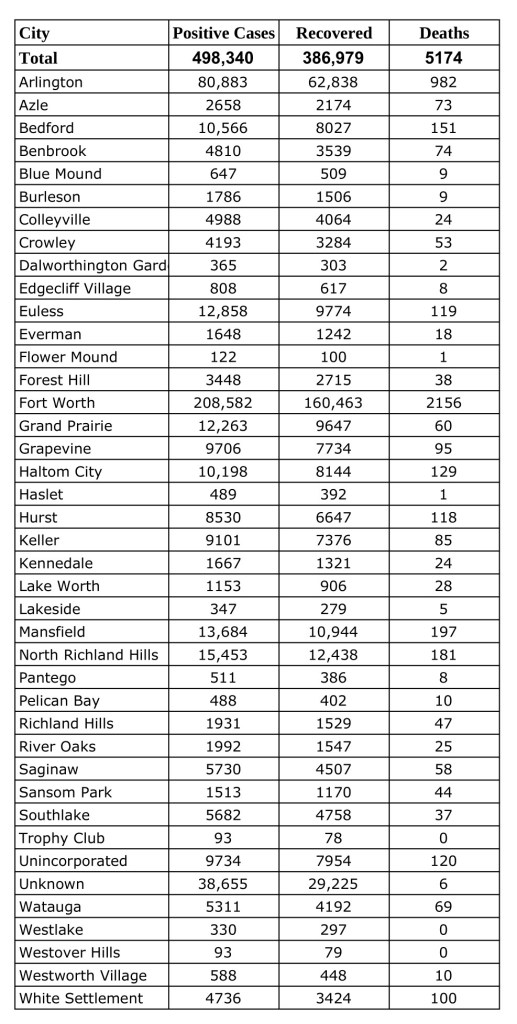
Tarrant County COVID-19 Activity – 01/25/22

COVID-19 Positive cases: 498,340

COVID-19 related deaths: 5174

Recovered COVID-19 cases: 386,979

Data from Tarrant County Public Heath’s (TCPH) report of COVID-19 activity in Tarrant County updated Tuesday, January 25, 2o22. Find more COVID-19 information from TCPH here.

*These data are provisional and are subject to change at any time.

Deaths and recovered cases are included in total COVID-19 positive cases.

The Dimming of the Shining City

By Jason Terk, MD

Published by KevinMD.com on October 20, 2021. You can read the original article here.

In March 1630, John Winthrop delivered the treatise “A Model of Christian Charity” at Holyrood Church in Southampton, England, prior to leading the first settlers of the Massachusetts Bay colony on their to journey to the New World. In his address, he referred to the new community they would found as a city upon a hill with the eyes of all people upon them. This reference to a portion of Jesus’ Sermon on the Mount underscored the importance of committing the colonists to brotherly love and unity, setting the needs of others and the community above one’s own needs.

I first heard this reference to a shining city on a hill at the moment of my political awakening and at the close of Ronald Reagan’s presidency in his farewell address in January 1989:

I’ve spoken of the shining city all my political life, but I don’t know if I ever quite communicated what I saw when I said it. But in my mind, it was a tall, proud city built on rocks stronger than oceans, wind-swept, God-blessed, and teeming with people of all kinds living in harmony and peace; a city with free ports that hummed with commerce and creativity. And if there had to be city walls, the walls had doors, and the doors were open to anyone with the will and the heart to get here. That’s how I saw it and see it still.

I was never much a fan of Reagan but did recognize his desire to lead all of us as a nation of different people who had unique talents to share and whose commonality of purpose exceeded partisan divisions. I also recognized that this vision was as aspirational as the source that inspired it. North stars have their role if only we faithfully chart our course by them.

As Reagan’s farewell words washed over me, I looked ahead at my immediate future and recalled my recent past. I would graduate from college a few months later and start medical school. I had just completed an idyllic nine months of study in Hamilton, New Zealand, an experience that still influences me today. I witnessed a nation of diverse people that cared about each other meaningfully. The Kiwi culture is exemplified in their national sport, rugby, emphasizing the team over the individual.

That promise of the shining city seemed more tangible as we witnessed the close of the 1980s and experienced the bliss of the 1990s. I and my contemporaries moved through those years, getting married, starting families, starting jobs, and acquiring mortgages. The demons of our nation still seemed to be suppressed by our angels for the most part. We could not know that the seeds of the cataclysm that was 9/11 and the divisions that would follow were germinating beneath us.

The number of years since that horrible day has verily seen the transformation of who we are and how we are. No longer do we have a presumption of goodwill toward those who are politically, religiously, or philosophically different from us. Yes, we have always borne the demons of racism and intolerance through our nation’s shared history, but there was almost always the patina of unity among us save for the years of the Civil War. Rather, we are now in a season of distrust and tribalism where each partisan seeks to win leverage for the sake of power alone only for those of like mind and mission.

The most insidious part of this darkening of our nation is the democratization of truth and the obfuscation of our understanding of reality. A lie told a million times on social media becomes fact. No longer can we count upon rationality, logic, and evidence to be the measures we employ to discern truth. Truth has been abducted to serve the mission of elevating influence, gaining advantage, and exercising power. It is a rot that is destroying us and creating many victims. The internet, formerly and quaintly referred to as the information superhighway, has become our road to perdition and the chief means of the purveyance of agenda-driven disinformation coming from both extremes of the political spectrum. The algorithms move us into our demagogic poles and obliterate the common ground where consensus suffocates from lack of oxygen.

This organized perpetration of deception has taken on more meaning as we have faced the last century’s most critical public health threat. Freedom which was once defined as something that required a personal sacrifice of individual concerns in deference to the needs of others and the community has now become rebranded as solely within the province of individual liberty. The simple acts of individuals wearing masks or getting vaccinated to protect all of us and ending the pandemic for our towns, cities, states, nations is too much for many among us who have distilled their catalyzed grievances into refusals to sacrifice their “personal freedom.”

Indeed, as I write these words, state legislatures, including our own in my state, are codifying this movement into law with bans on companies including hospitals, nursing homes, and medical facilities from requiring COVID-19 vaccination for their employees. And, those legislators are doing it not because of some sincerely held principles, but because they know which way the wind blows and cynicism Trumps all other considerations in getting reelected.

The victims of this now distorted concept of liberty are ones that we physicians encounter every day. The one that inspired this essay for me is an 11-year-old boy that I saw three weeks ago. He is a patient of mine in my pediatric practice who came to see me with typical respiratory symptoms that led to a diagnosis of COVID-19. While he recovered uneventfully, his father got sick the next day and died from the same illness five days later. Like the vast majority of people who die from COVID-19 now, he was unvaccinated, believing that getting vaccinated was unnecessary and part of a greater effort to undermine his personal liberty. His son is now dealing with the unimaginable grief of losing a parent at such a tender age and asking his mother if he killed his father by getting sick and causing his death. This happens every day now in our communities across our nation. These are wounds that will never heal for this generation of kids.

We have no hope of exiting this pathway to darkness unless we can collectively rise above our manufactured grievances and reductive individualism to truly witness and love each other. We must recognize and reconcile the real harms done to each other in the evil pursuit of purely selfish interests. Only then can we renew and rekindle the true light of a successful community and our city on the hill.

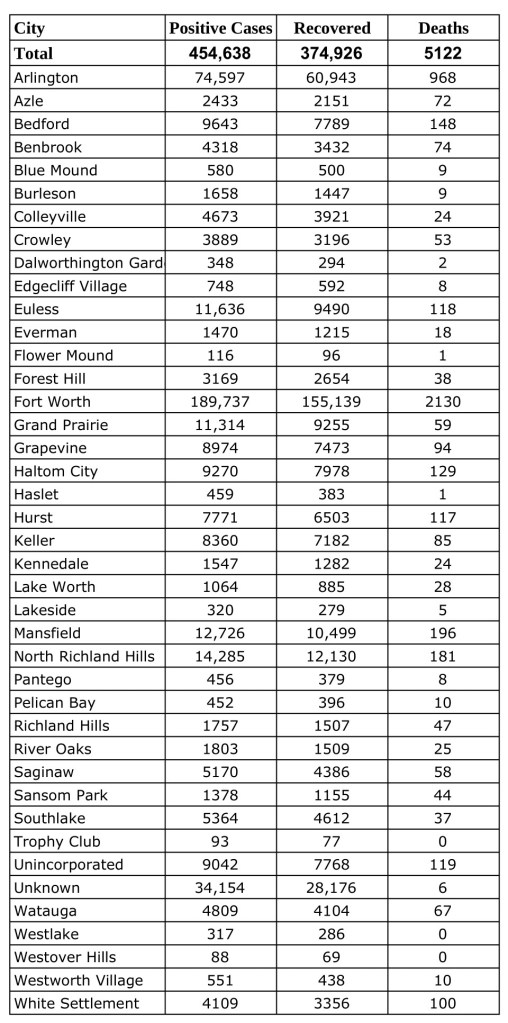
Tarrant County COVID-19 Activity – 01/18/22

COVID-19 Positive cases: 454,638

COVID-19 related deaths: 5122

Recovered COVID-19 cases: 374,926

Data from Tarrant County Public Heath’s (TCPH) report of COVID-19 activity in Tarrant County updated Tuesday, January 18, 2o22. Find more COVID-19 information from TCPH here.

*These data are provisional and are subject to change at any time.

Deaths and recovered cases are included in total COVID-19 positive cases.

Volunteers Needed for Arlington COVID-19 Testing Site

Tarrant County will be activating a COVID-19 surge testing site in Arlington. The Tarrant County Office of Emergency Management requests volunteers to assist with line management and other miscellaneous duties.

Volunteers will work 3.5-hour shifts with three volunteers per shift. This work will be outside and require standing for long periods. Volunteers will not be involved with the testing procedure. Water will be provided. Face coverings are recommended.

Dates:  January 20, 2022 – February 10, 2022

Time:     9:00 a.m. to 7:00 p.m.

Location: Globe Life Field, Parking Lot M 1205 Pennant Dr, Arlington, TX 76011

Volunteer Sign-up:

  1. Link: https://www.signupgenius.com/go/4090E4FA4A728A1F58-tarrant.
  2. Select one or more shifts and then click the Submit and Sign Up button at the bottom of the screen.
  3. Fill in your information. Please include your phone or email address. We will use this information to keep you informed of updates.
  4. Click the Sign Up Now button.
  5. You will receive a confirmation email with more information.

If you have any questions, please contact:

So-Called “Mild” Omicron Still a Serious Threat, Physicians Warn

By Brent Annear

Published by the Texas Medical Association on January 14, 2022. Read the original article here.

As the massive spike of COVID-19 cases continues, the degree of infectiousness and lack of the best and most available treatment worries Texas Medical Association leaders about what the next few weeks will bring. They say important medical advice bears repeating with patients

The omicron variant’s illness has been described by some people as “less severe,” but physicians urge their colleagues to help patients keep their guard up. In addition to making people sick enough to miss several days of work and school, the virus remains a serious threat to people at high risk for severe illness. Some physician practices have had to close due to COVID-19-related staff shortages or have gone to 100% telehealth visits.

“This illness may seem mild to some, but right now we don’t have enough effective treatment if too many high-risk patients get sick all at the same time,” said John Carlo, MD, a TMA COVID-19 Task Force member.

So far, only a single monoclonal antibody treatment (sotrovimab) is effective against the omicron variant. Supplies are extremely limited.

“On top of this, the omicron variant is incredibly infectious, even more so than previous variants,” Dr. Carlo added.

The Texas Department of State Health Services has reported more than half a million cases since Jan. 1.

“The good news is we know how to protect ourselves,” Dr. Carlo said. “Vaccination with a booster, diligent and effective mask-wearing, and avoiding poorly ventilated indoor settings are effective.”

Physicians also worry about Texas hospital beds filling up too quickly, as area hospitals already face staffing shortages due to sick workers. “We want to make sure we have the space for every patient who needs care,” Dr. Carlo said.

TMA’s COVID-19 Task Force recommends reiterating to patients the following protective measures:

  • Get vaccinated against COVID-19: Get the booster shot as soon as eligible, too.
  • If you must leave your home: Physically distance yourself, wash your hands frequently, and wear your mask anytime you need to be near someone when outside your home. Wear the best mask you can get: N95 masks are best, followed by KN95 masks, then surgical masks, then multi-ply cloth masks that fit snugly around your face. Wear masks if you can’t socially distance, even if outside, and even if everyone attending is vaccinated and boosted.
  • If you must gather with others from outside your home: Choose an outdoor or well-ventilated space.
  • If exposed to someone who has tested positive for COVID-19 (you were within 6 feet of him or her for at least 15 minutes in 24 hours): Quarantine away from others for at least five days and get tested after five days even if you do not develop symptoms. 
    • Watch for symptoms. If you have no symptoms after five days, wear a well-fitted mask for the next five days anytime you’re near anyone and avoid being around people who are at high risk.
    • If fully vaccinated or you have had a confirmed case of COVID-19 within the past 90 days, it is not necessary to quarantine, but you still should wear a well-fitted mask when around others for 10 days and get tested after five days even if symptoms do not develop. 
  • If you test positive for COVID-19 or have mild symptoms, regardless of vaccination status: Isolate for at least five days and until you are fever-free and your symptoms improve (stay away from other people, including people in your own household). (This applies to mild-symptom or zero-symptom cases.) After five days’ isolation, wear a well-fitted mask for five more days whenever you’re around others, avoid travel, and avoid being around those who are at high risk.
  • If you have severe symptoms: Isolate for at least 10 days and consult your doctor before ending your isolation. If you develop any serious symptoms, such as trouble breathing, seek emergency medical care immediately. 

“This current wave is spreading faster than ever before, and the only way to slow this down is for everyone – not just some people, but everyone – to be vigilant,” said Dr. Carlo.

Tarrant County COVID-19 Activity – 01/13/22

COVID-19 Positive cases: 441,134

COVID-19 related deaths: 5111

Recovered COVID-19 cases: 373,903

Data from Tarrant County Public Heath’s (TCPH) report of COVID-19 activity in Tarrant County updated Thursday, January 13, 2o22. Find more COVID-19 information from TCPH here.

*These data are provisional and are subject to change at any time.

Deaths and recovered cases are included in total COVID-19 positive cases.

Design a site like this with WordPress.com
Get started