Questions About Treating Obstetric Patients During COVID-19? Ask the Experts

Managing pregnant and postpartum patients during the COVID-19 pandemic has changed the way obstetrician-gynecologists provide screenings and treatment, in both hospitals and clinical practices.

Pick up your phone at 7 pm (CT) Monday, May 18, for the Texas Medical Association’s next Tele-Town Hall meeting on COVID-19, specifically for Texas OB/Gyns. Hear from Texas physicians who will share COVID-19-related epidemiological trends, clinical best practices, and tips for improving your practice’s financial viability, including how to effectively use telemedicine and patient outreach.

Our tentative list of speakers includes:

  1. Catherine Eppes, MD, Baylor College of Medicine
  2. Valerie Smith, MD, member of TMA’s COVID-19 Task Force
  3. John Thoppil, MD, president of the Texas Association of Obstetricians and Gynecologists
  4. Joseph Valenti, MD, chair of TMA’s Practice Viability Workgroup 

There’s no need to RSVP or register for this event. TMA will call the home telephone number on file in your membership records. If you prefer we call a different number – or don’t call at all – please email that information to the TMA Knowledge Center by 5 pm (CT), Thursday, May 14.

TMA designates this townhall for a maximum of 1 AMA PRA Category 1 Credit™.  

During this interactive, hour-long event, you can ask questions of our panel. TMA President Diana Fite, MD, will host, and Eugene Toy, MD, chair of the American College of Obstetricians and Gynecologists District XI (Texas) will moderate the call.

Get the latest information about the coronavirus on the TMA COVID-19 Resource Center.

Share This Poster with Patients Before They Arrive at Your Practice

Created by the Texas Medical Association. Read their article about it here.

By now, you have most likely made several practice changes to keep you, your staff, and your patients safe during the COVID-19 pandemic, including requiring face masks, keeping sick and well patients separated, and using telemedicine wherever possible.

But patients coming to your practice – for COVID-19 care or other health issues – might not be aware of all you’ve done.

The Texas Medical Association is here to help.

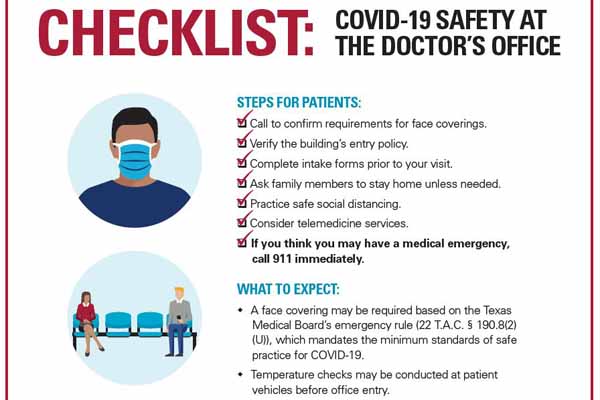
TMA has created a digital poster you can share with patients before they arrive that outlines your COVID-19 safety precautions. The poster includes steps for patients, such as calling ahead to learn your practice’s facemask policy, completing intake forms before arriving, and asking family members to stay home. You can send it to patients before their appointments, post it on your website, and share it on your social media accounts.

The “COVID-19 Safety at the Doctor’s Office Checklist” also outlines some of the steps you might’ve taken, including checking patients’ temperature in their vehicle, and social distancing in the waiting room. Also, TMA soon will publish a version for you to download, print, and post in your office.

If you’re looking for more tips and resources to increase patient visits safely, TMA’s practice viability experts have organized the information you in need in one document: Road to Practice Recovery: A Guide for Reopening Your Practice Post-COVID-19.

In addition, TMA’s COVID-19 Resource page includes posters and tools to inform your patients and staff about staying safe, including a COVID-19 social media toolkit, and a minimum standards of safe practice notification required by the Texas Medical Board.

The resource page is updated frequently with new information and resources so check back often.

Check out TMA’s Guide to Reopening Your Practice Post COVID-19

The COVID-19 pandemic led to a public health emergency the damaged medical practice viability. Physicians are in the difficult position of having to navigate operational, financial, and clinical challenges while still staying up-to-date with compliance, payment, and coverage issues. These changes have had a significantly negative impact. According to TMA’s COVID-19 telephone town hall meeting in mid-April, 36 percent of poll respondents indicated that they have lost between half and three quarters of their revenue since the start of the pandemic. Another 24 percent have lost three-quarters to all of their
revenue.


As the COVID-19 curve flattens and trends downward, you can take decisive actions to restore your practice operations. TMA’s practice viability experts have organized the information you may need to successfully reopen
your practice in one resource: Road to Practice Recovery: A Guide for Reopening Your Practice Post-COVID-19. From evaluating staffing levels and managing patient appointments, to ensuring patient safety and communicating regularly with patients and staff, this guide will provide the information practices need to more confidently head in the right direction.

Refer to TMA’s COVID-19 Practice Viability web page for additional tools, resources, and frequently asked questions regarding operational challenges that affect your practice’s viability.

Payers Extend Prior Authorization Windows During COVID-19

By Ellen Terry

Originally published on Texas Medical Association’s website.

Commercial payers have temporarily modified prior authorization timelines to help physicians care for patients during the COVID-19 emergency.

Below is an overview of some payers’ COVID-19 prior authorization policies:

Blue Cross and Blue Shield of Texas is temporarily extending approvals on services with existing prior authorizations until Dec. 31. This applies to services originally approved or scheduled between Jan. 1 and June 30. It applies to most nonemergent elective surgeries, procedures, therapies, and home visits for all group, fully insured, retail, self-funded, and Medicare Advantage members.. 

Aetna is approving prior authorization requests for commercial members for nine months instead of the standard six months. Physicians who already have received an approval for six months and plan to go over that time need to call Aetna to extend it for an additional three months. Aetna also will review precertification requests for elective procedures because the approvals are effective for a predetermined length of time.

CignaFor prior authorization requests received March 25 until at least May 31, Cigna is temporarily increasing the authorization window for all elective outpatient services from three months to six months. This applies to all prior authorization requests received for all Cigna lines of business. Elective outpatient prior authorization decisions made between Jan. 1 and March 24 will be assessed when the claim is received and will be payable as long as it is within six months of the original authorization. 

Humana is extending previously approved authorizations to a 90-day approval timeframe, except for home health authorizations, which are being extended for 60 days.

UnitedHealthcare has instituted a 90-day extension of open and approved prior authorizations, including those for many physician-administered drugs, with an original end date or date of service between March 24 and May 31 for services at any setting. This applies to all individual and group health plans, and Medicaid and Medicare Advantage plans, and to in-network and out-of-network existing prior authorizations. Approvals issued on or after April 10 will not be subject to extension. If a prior authorization approves the number of visits or services, the physician must obtain a new prior authorization for additional units, visits, or services beyond what was approved in the original authorization.

PPE Distributed to Fort Worth-Area Physicians

By David Doolittle

Originally published on the Texas Medical Association website.

Some North Texas physicians are about to receive desperately needed personal protective equipment (PPE) thanks to a partnership between the Texas Medical Association, the Tarrant County Medical Society, and the North Texas Regional Advisory Council (RAC).

The county medical society received a shipment of PPE from the RAC on Saturday that will be distributed to area physicians based on their practices’ needs, CEO Brian Swift said.

“This has been a team effort – everyone from the TMA, the RACs, and the doctors’ offices – to get these supplies where they need to go,” Mr. Swift said. “In North Texas, it’s been tough sledding for weeks, but it’s finally getting worked out.”

The collaboration, which began last week, is part of an effort to distribute PPE to the state’s community physicians, who have grown increasingly desperate for the protective equipment they need to care safely for patients.

Under the program, physicians indicate their PPE needs through an online portal created by TMA, which will forward that data regularly through eight designated Hospital Preparedness Programs (HPPs) and RACs. The RACS and HPPs will make the supplies available for county medical societies and other organizations to distribute.

That’s what happened Saturday, when Mr. Swift received word that the North Texas RAC in Arlington had PPE available for physicians in Tarrant County, as well as nearby Parker and Johnson counties.

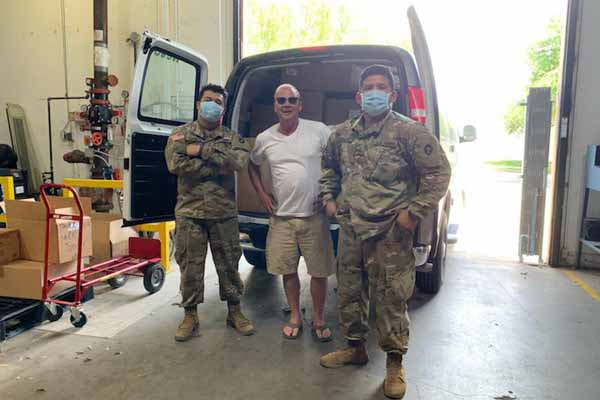
“I rented a U-Haul van, drove to Arlington and pulled up to the RAC,” Mr. Swift said. “There were two National Guard guys there who helped me load the PPE. I drove it back to our headquarters and returned the truck. It took about three hours total.”

The supplies include K95 masks, surgical masks, and face shields, which will be added to several thousand N95 and surgical masks that MedStar Ambulance service donated to the society a few weeks ago, Mr. Swift said.

Society officials have been contacting area physicians with instructions on when and how to pick up the PPE, he said.

“They’re just grateful, the staffs, the nurses, they’re excited to have it,” he said. “It’s great because we get to meet a bunch of new people.”

The portal is not a PPE order form. The amount and type of PPE in state warehouses varies each week. Submitting a form does not guarantee practices will receive supplies. Physicians whose data indicates a need for PPE will be placed on a distribution list to receive supplies as they become available.

To ensure each practice submits only one set of data to the PPE Portal, not all Texas physicians have received personalized login credentials. If you did not receive the credentials via email, check with your practice manager or the lead physician in your practice. Practices with multiple locations are considered a single practice. If it appears that no physician at your practice received the credentials, please contact the TMA Knowledge Center at (800) 880-7955 or by email.

For more details, see the TMA PPE Distribution Q&A document.

Remember, you can find the latest news, resources, and government guidance on the coronavirus outbreak by visiting TMA’s COVID-19 Resource Center regularly.

Help TMA Get PPE to Your Practice

As the Texas Medical Association told you Monday, personal protective equipment (PPE) will begin to move more quickly from state-managed warehouses to Texas county medical societies and on to private practice, community care physicians.

The movement of PPE, including N95 masks, is possible through an extensive collaboration among TMA, county medical societies, and a host of other associations and state agencies.

But we need your help.

Check your email today for a personalized link to the new TMA PPE Portal, which will include a needs assessment form for your practice. The form asks you to report your daily use of N95 masks, surgical masks, gloves, gowns, face shields, booties, and sanitizer. Only one email was sent to each practice.

Find more information, including who can request PPE through the portal, how much it will cost (spoiler alert: it’s free), quality control, and how to identify your Regional Advisory Council (RAC), in TMA’s latest PPE frequently asked questions (FAQ) document.

Remember that the portal is not a PPE order form. The Hospital Preparedness Programs (HPPs) and RACs will use the data to allocate a share of available PPE to county medical societies. The county societies will use the data and guidelines developed by a TMA work group to distribute PPE to community physicians.

“The RACs and HPPs are all independent organizations, and all operate differently. Thanks to the strong support of Chief Nim Kidd of the Texas Division of Emergency Management, everyone is working much better to meet the PPE needs of community physicians,” TMA President David C. Fleeger, MD, said. “We very much appreciate the assistance of Chief Kidd and the RACs.”

You can also find the latest news, resources, and government guidance on the coronavirus outbreak by visiting TMA’s COVID-19 Resource Center regularly.
TMA Supports Governor’s Science-Based Plan to Reopen Texas

Statement by Texas Medical Association (TMA) President David C. Fleeger, MD, about Texas Gov. Greg Abbott’s announcement on reopening Texas.


“Texas physicians are pleased that Governor Abbott is taking a gradual, science-based approach to reopen the Texas economy safely. We applaud the governor for placing four outstanding physicians on his recovery strike force and for stating in such a straight-forward manner, ‘We must be guided by the data and the doctors. We must put health and safety first.’

“We obviously look forward to the safe reopening of those portions of our health care system that have been shuttered as we took the steps necessary to slow the spread of this virus. The health of patients not affected by COVID-19 is an overwhelming concern. Telemedicine has been an important tool, but it does not substitute for hands-on examinations of growing children or diagnosing complex health problems. Many of our patients have put off desperately needed surgeries or procedures that can no longer be delayed.

“We cannot throw the switch overnight, however, or we risk a rapid return of a terribly contagious disease that has not yet reached its peak and is still killing dozens of Texans every day. Moving forward on safely reopening our state will require:

  1. Ongoing and consistent compliance with the social distancing practices that have worked so well, so far, at containing the virus in Texas;
  2. Reliable, affordable and widely available testing for our patients, physicians and other health care personnel, and those who have come in contact with COVID-19-positive patients, so we can identify and contain new cases as quickly as possible;
  3. Appropriate personal protective equipment (PPE) for non-hospital based/community physicians, nearly two-thirds of whom say they have less than one week’s supply of the most critical supplies, according to a TMA survey conducted late last week;
  4. A huge immediate expansion in our state and local public health infrastructure and workforce so we can track down, isolate, and monitor Texans newly infected with this virus – and anyone who may have contracted it from them; and
  5. A way to cover the health care costs of the millions of Texans who don’t have or recently lost health insurance.

“We appreciate that Governor Abbott has solicited the experts and listened to their advice. We must follow the science. We need to have adequate PPE, and we’re not there yet. We need to have adequate testing, and that’s not available yet in physician offices or in the wider community. And we need to have the ability to track down positive cases based on those tests, something our overextended public health system won’t be able to do in the immediate future.

“Patience has been a critical factor behind our successes so far. We must remain patient, calm, and vigilant. Until we have a vaccine, social distancing remains the best way to reduce the spread of COVID-19. As the governor said, we must make sure we don’t reopen only to have to shut down again.”

House of Delegates Meeting and Contested Elections Postponed

Due to the evolving COVID-19 pandemic and its effect on the ability of the TMA House of Delegates to discharge its duties, the TMA Board of Trustees called itself into session on March 29, 2020, to function as a Disaster Board.

TMA Bylaws 4.202

Function as disaster board. In the event a catastrophe of national proportions such as war prevents the House of Delegates from acting, the Board of Trustees shall have the authority to receive and act on the reports of officers, boards, councils, and committees; to legislate; to elect and install officers; and to approve the president-elect’s nominees for council positions in accordance with regulations applying to the House of Delegates. In case of national catastrophe, the Board of Trustees shall be considered a disaster board and shall be called into session.

To keep our members’ focus on the escalating health crisis and predicted surge, the Disaster Board voted on April 5, 2020, to suspend the 2020 TMA House of Delegates meeting, either virtual or in-person, until an appropriate time in the future when the crisis has subsided.

The Disaster Board still feels it is essential to transition TMA leadership to allow our organization to move forward appropriately and deliberately. The board will soon proceed with transitioning President David C. Fleeger, MD, to immediate past president, and President-elect Diana L. Fite, MD, to president.

For the uncontested positions, the Disaster Board polled the caucus chairs, who provided no further nominations. The Disaster Board will move forward with electing these uncontested candidates by acclamation.

The uncontested positions are:

  1. E. Linda Villarreal, MD, for president-elect
  2. Arlo F. Weltge, MD, for speaker
  3. Bradford W. Holland, MD, for vice speaker
  4. Michelle A. Berger, MD, for secretary/treasurer
  5. All uncontested Texas Delegation to the AMA positions

All contested elections are postponed until the Disaster Board determines the health crisis has concluded and the House of Delegates is able to function.

To keep a steady hand at the helm of TMA during this uncertain time, the board members whose terms were set to expire after TexMed 2020 will continue to serve on the board until such time as voting through direct ballot by the full House of Delegates can occur.

This extension applies to the following board members:

  1. G. Ray Callas, MD, at-large trustee
  2. Gary W. Floyd, MD, at-large trustee
  3. Lindsay K. Botsford, MD, young physician trustee
  4. Douglas W. Curran, MD, immediate past president, will fill the vacancy created by Dr. Villarreal’s transition from at-large trustee to president-elect

Once the Disaster Board returns authority to the House of Delegates at the end of the crisis, Dr. Curran will transition off the board and elections will be held for the three at-large positions and the young physician trustee position, as well as contested elections for alternate delegate to the Texas Delegation to the AMA.

Your Disaster Board is very much aware of the many serious problems you now face, including maintaining the viability of your practice and obtaining personal protective equipment. The entire TMA family is working hard each and every day to address those issues.

Practice Viability Toolkit

The COVID-19 pandemic has critically impacted medical practices. To help you make important decisions for your practice, TMA released a Practice Viability Toolkit that provides the most up-to-date information and resources available. The toolkit addresses a number of issues:

  1. Telemedicine, with information about technology, HIPAA relaxations, prescribing, coding and billing, and policies and procedures;
  2. Cash flow, including Small Business Administration loan assistance, lines of credit, payment deferrals, loan refinancing, and loans from private banks;
  3. Payers, coding, and documentation information, including Medicare, Medicaid, and the Children’s Health Insurance Program (CHIP), commercial plans, workers’ comp, and claims submissions;
  4. Human resources, including wages and hours, the Families First Coronavirus Response Act, and termination and unemployment benefits; and
  5. Advocacy, such as mass critical care guidelines, non-urgent, elective surgeries and procedures, the Coronavirus Aid, Relief, and Economic Security Act (CARES Act), payment parity for telemedicine services, liability protection, and stay-at-home guidance.

This Can Help Your Practice’s Revenue During COVID-19

This was published by Texas Medical Association. You can read the original version here.

This is not business as usual. The COVID-19 pandemic has affected physician practices both clinically and economically. 

You may already have made changes in how you care for patients, such as utilizing telemedicine in place of in-person visits. 

For a big picture perspective, Catalyst Health Network, a clinically integrated primary care network, has created a financial workbook you can download that calculates the effect a decrease in patient encounters and revenue has on your practice. 

You also can make adjustments in operating expenses that can keep your practice’s finances healthy. 

According to the Medical Group Management Association (MGMA) benchmark data, staff salaries and building occupancy are the two largest expenses in a physician practice. Staffing alone typically accounts for 25% of total operating expenses, and leases account for another 6% to 10%. 

However, these can be difficult sums to change: We want to support our staff, and we need to maintain an office space. 

There are other fixed expenses, like insurance payments, that may be deferred but not necessarily adjusted. However, there are some things you can do: 

Lease: Contact your landlord to discuss a deferment of monthly payments. If you are in your renewal period, negotiate a deal that includes a lower payment and/or deferment for the first few months of the new lease. 

Staffing: There are a few options like layoffs or furloughs, but be sure to consider your future funding needs as your decision could have an impact on loan forgiveness. If you furlough, you still need to pay for benefits. Furloughed staff are eligible to apply for unemployment as well. You also can consider rotating staff if you have patient care or billing needs to fulfill. 

Supplies: Stop automatic orders so you can have more control over which medical and office supplies you pay for. Consider joining a group purchasing organization (GPO) for pricing considerations if you are not already a member. 

Equipment leasing: Contact your vendors for any assistance they could provide during the current crisis. Your vendors might be able to defer or lower payments for a period of time. Evaluate use of equipment to determine if it is truly necessary to your practice. If not, return it and eliminate a payment. 

Subscriptions: Suspend any magazine or other unnecessary subscriptions. 

Shredding/Biohazard/Laundry Services: Suspend services you are currently not using. 

On the income side, Catalyst Health Network also has created a tool that compares the Small Business Association’s (SBA) lending options: Express Loan, the Paycheck Protection Program, and Economic Injury Disaster Loans. The tool has information on when and where to apply, the qualification requirements, and other pertinent details. 

The Texas Medical Association Practice Viability webpage includes more information and resources to help keep your practice afloat, including frequently asked questions (FAQs) on practice viability and human resources issues. 

Remember, you can find the latest news, resources, and government guidance on the coronavirus outbreak by visiting TMA’s COVID-19 Resource Center regularly.
Design a site like this with WordPress.com
Get started